Sunday, August 11, 2024

Re-evaluating everything about our lives.


This may be one of the most brutal National Day holidays I ever had to live through as I attended two wakes - one for a secondary school classmate who fought cancer and another for an ex-colleague who suddenly passed away. I thought perhaps for my own mental health, I highlighted some of my thoughts on this blog, just to get this out of my system.

a) Signal that middle age is coming

One of the surest signals of middle age is when you get fewer wedding invitations and begin showing up for more wakes. This should be a sign to change your approach to life. Some would go through a midlife crisis, and others must think much deeper about their relationship to work. 

b) The purpose of wakes

While it might sound morbid, I suddenly have some insight about funeral wakes. 

What is a wake for? Wakes cannot be for the dead as they don't even know you are there. While it might be for the loved ones to grieve, your presence can't improve the situation.

The wake is ultimately for the attendees to find closure, determine what happened, and whether the family can move on. In both wakes I attended, it was a way for folks who had long lost contact to get together again to catch up on what had transpired. In many wakes I attended, my friends made a promise to meet up under much happier circumstances. 

c) Shifting from achievements to joy

The hardest part about both wakes I attended was that both deceased were 49—the same age as me. Did my friends find any joy in life? Or were they still in the throes of seeking achievement in life? I highly doubt that Singaporeans my age have started to smell the roses. 

Everyone knows there will come a point in life when you take your foot off the pedal and start seeking more pleasure and improving relationships at home. But no one knows when the right time is to do that because we don't know how many good years we have left to live. 

I've been off conventional employment for a decade. I sometimes question my decision to drop a decade of earning power to build a portfolio career that paid a fraction of what I used to earn. 

After this week, I don't think I have any regrets anymore. 

d) What gives you happiness

Only three things cause happiness - oxytocin, serotonin and dopamine. Secretion of these chemicals is not fully under our control. 

Before middle age, we try to sacrifice short-term happiness to bring long-term satisfaction. In the process, we give up some health and mess up our lives a little. If we are lucky, we get some money in the process. In the middle, we are not too ready to take our foot off the pedal, but the search for long-term achievement and satisfaction reaches a state of diminishing returns. 

Some of my pals can't quit their jobs, but some practical fixes suit middle-aged people.

If we can't pick up more positives, we can aggressively eliminate the negatives. It's a concept in IT Security; we can reduce the surface area of attacks. 

I advised a friend recently who had an old friend who had recently grown bitter and made every social encounter quite unpleasant. This friend liked questioning her spouse's achievements or showing off what some rich people were doing, and it's been happening for years.

In Singapore, we have normalised this behaviour (because of Chinese New Year ) until we have grown to accept it as part of our social lives.

But Gen Z knows better. I've always wondered why we don't turn to a younger generation for their wisdom?

I explained that her friend feels insecure and has chosen nasty, defensive behaviour to amplify my friend's insecurities. This is a red flag in Gen Z relationships, and she needs to re-evaluate it for her own mental health. I then told her to consider "grey-rocking" the relationship—another innovation from Gen Z where you behave like a boring grey rock to disinvite further attacks from narcissists. 

The problem with us Gen Xers is that we do not have the psychological vocabulary to recognise people's attempts to inflict trauma on us. Gen Z has all sorts of wonderful lingo like gaslighting, cookie-jarring or what a situationship is. 

At this time, we're still in the middle of the seventh month Ghost Festival. 

We can get back into regular programming soon on this blog. 


Sunday, August 04, 2024

Thinking about the state of humanities and social sciences education ( ex-economics )


Not too long ago, NUS revealed that their enrollment in the Arts and Social Sciences enrollment has dropped by about a third. You can read the finer details here. This has caused some consternation online, which is no dissimilar to the shenanigans when it was said on mainstream media that the arts were non-essential during the pandemic. 

The question is how serious this is. Are Singaporeans abandoning the arts and humanities en masse, being more attracted to qualifications that can land better paying jobs?

It isn't simple, as the intake of humanities majors in NTU and SMU was not hit so badly. The main reason is that NUS decided to merge the Arts and Science faculties, so students of the combined school had more flexibility to choose their majors. Naturally, the folks with study loans obviously want something that can get them higher-paying jobs, so there will be a bias towards more quantitative subjects. 

So, is this a good thing or a bad thing?

This is a good thing that will elevate the status of the humanities or social science major. 

At the broader level, I think modern societies need to understand what happens if they overproduce Arts graduates and the industry fails to absorb them and provide them with good jobs. Arts and Law graduates are articulate enough to form a counter-elite. This is the subject of Peter Turchin's book End Times. It talks about how counter-elites are the seeds of political disintegration in societies in the past, like the Roman Empire. I suspect LKY was quite cognisant of this when he started limiting the number of Law graduates decades ago. 

As it has become harder to get into the College of the Humanities and Sciences, the arts graduate, regardless of major, would have at least ABB for A levels, so they would have some general intelligence to make them good hires. At least during my time, I know that FASS top students get selected into government departments like ISD, which is supposed to provide wonderful sinecures and pay their officers well.


I was fortunate to know many intelligent humanities graduates when I was at NUS and subsequently in SMU law school. I learnt a lot more from them than my peers in Engineering school because they employ different mental models to attack some of the common problems we face as young adults.

But I feel sorry for them as they must transcend the stereotype of the "Arts slacker" in the 2000s, the folks who barely made it into NUS, so they had to settle for any faculty that would accept them. The stereotype is that many end up selling insurance or squeezing into NIE to land secondary school teaching jobs after getting knocked up early in life. 

So, with a minimum grade of ABB, the Arts slacker is now an endangered species, if not extinct already. 

In fact, it would be fascinating if you met an individual who did well in the A levels and volunteered for a so-called "useless" subject like English Literature or Philosophy. In the past, this may have signalled laziness or incompetence, but now it can be a mark of higher social and economic status or very high personal agency—this guy does not care about what you think about his degree major! And that's cool!


Formal education may not be the best answer for many mere mortals like us who need a practical professional degree to attain FIRE. But there's nothing stopping you from giving yourself some humanities training after office hours. 
  • Will and Ariel Durant have a great book called The Lessons of History that helps laypeople appreciate history and how to appreciate change in societies. 
  • For literature, you can try How to Read Literature Like a Professor by Thomas Foster.  
  • For philosophy, you can try The Philosopher's Toolkit by Peter Fosl and Julian Baggini. Do not go for that book for poseurs called Sophie's World. 
In tandem with the shrinkage of the Arts faculty at NUS, they should apply less pressure on the professor to publish but instead create micro-credentials in the humanities and social sciences so that older mid-career dudes like me can explore and appreciate the humanities at a later stage in life. 

I need technical skills at an earlier stage in my career, but as I reach mid-career, I may want to discover some knowledge of what makes us human as well to round up my professional credentials. I visited Istanbul last year, and my trip would have been richer if I had understood the history behind the Fall of Constantinople. Some of the harder war games I play exist in a historical period involving states like Pomerania, and I may have to wage war against the Burgundians. 


Sunday, July 28, 2024

Personal Update


It's time for another personal update, as my blog frequency has been down lately.

a) Was down with stomach flu this week. 

Last Sunday, after some retail therapy at second book stores, I ate some scissors curry rice in Bugis at around 5.30pm. Everything was fine until Monday morning when I realised that I was feeling queasy and I had lost my appetite; then I emptied all the contents of my stomach, and I spent the rest of the day vomiting and getting diarrhoea.

I was so concerned about not being able to see the doctor without a diarrhoea attack I decided to install an app called Doctors Anywhere and used telemedicine to get my medical fix. The experience was really positive - I paid about $80, including medication (delivered in 3 hours), which included some non-essentials like electrolytes and probiotics. Still, even those came in handy for my recovery. The only downside I noticed is that the system does not recognise that I'm a CHAS orange card holder, which would have been much cheaper if I visited the neighbourhood doctor in person.

I imagine telemedicine to be handy for gout sufferers who struggle to walk 500m to the nearest clinic. 

b) Enjoyed a night of Japanese karaoke in a micro lounge. 

Another thing I did was to join some friends in a Japanese lounge in Shenton Way to understand why folks would spend $50-$100 a week on alcohol and some talking company. This act is way off my character, but I should also let my hair down occasionally. 

For those who are unaccustomed to nightlife, this experience was quite educational. Folks who run nightlife establishments are expert small-talkers, and it's an excellent way to keep company over a weekend. Conversations are nowhere as intense as when I hike with other bloggers like RetireBy50 when I often regret not taking notes because of so many lifehacks I can pick up from them. 

I will share the most family-friendly conversation snippet I can produce on this blog; for the rest, you need to ask me for a coffee or a long hike. We were talking about weird travel buddies, and someone was talking about heading towards a far-out location in Bangkok just so his weird friend could buy some watermelon juice. Apparently, this FOMO guy wanted watermelon juice because the seller had massive breasts. It was funny because I asked how a juicer with big breasts could produce better-tasting watermelon juice. I was also pretty sure that massive breasts can be found in other areas in Bangkok. 

The funny thing is that I missed most of the conversation because I was singing almost nonstop for three hours on the Japanese Karaoke system, as we were the only customers there. The equivalent fee to do this in Cash Studio may be much higher for a dedicated device that serves Japanese songs.

Anyway, I wonder if this lounge can survive if all their clients are like me, I only drank Soda Water and ate snacks, and with a cover charge, I spent $44. $44 might be a little on the high side if you benchmark against buying beer from your nearest supermarket. 

But I think if done properly, it should be compared with therapy. In such a case $44 is cheap. 

c) My single focus: Generative AI for investment analysis

My illness earlier this week derailed a lot of momentum as I'm on a crusade to being ChatGPT into my Early Retirement Masterclass. The work has been extensive, and it involves taking Udemy courses at x1.5 speed, reading research papers, and then reading O'Reilly books like the ones above to create a set of prompts to assess the future performance of local stocks.

While it does give me little latitude to raise fees, the investment in picking up prompt engineering skills will allow me to create similar materials for the legal sector when I run Legal Technology classes next semester.  

I hope to present some interesting results on this blog for investors to follow in the upcoming few days. 

d) What's happening in geeks, games and comics?

More distracting than a bout of stomach flu is the impending launch of the 2024 Dungeons and Dragons ruleset, and plenty of new reveals are going on. As the new rules are revealed, the usual theory is being crafted, and the following ruleset is being complained about. People are already unhappy with the new Ranger without knowing how the new rules work. However, there will be a lot of excitement on the 1st of August as the NDA gets lifted, and game influencers will start discussing in detail how the new game will be played. 

Of course, I can only update you by talking about how much the new movie Deadpool & Wolverine will rekindle the fortunes of the Marvel Cinematic Universe. There's even bigger news that Robert Downey Jr. will be the next big bad, Dr. Doom. 

It may not bode well for fanboys over the long term. There's a woke faction creating shitty stories like the Acolyte that may kill Star Wars eventually, and there's another faction that will never be happy unless you develop a lot of nostalgic fanboy service like Avengers End Game or Deadpool and Wolverine.  

Can Disney create new storylines and characters to entertain the next generation of geeks and otakus?

I don't know. But at least I can watch The Boys on Amazon Prime. 


Sunday, July 21, 2024

Do horny people find it harder to FIRE?


As younger Millenials and Gen Z begin their journeys towards financial independence, it becomes very useful and instructive to examine their own personal approaches to early retirement. And recently, one can't actually ignore the new rising star among our ranks as Ashish Kumar drove even the thought leaders here to refer to their dictionaries with a new word, "aroace".

Aroace stands for someone who is aromantic and asexual. If you are aroace, you experience very little romantic or sexual attraction towards other people. This is a novel concept because we know that most FIRE thought leaders here are single, with me being a rare exception with my wife and kids. So, it's not really arguable that being single makes it easier to make extreme financial decisions and engage in personal austerity programs, but being aroace takes singlehood to a whole new level because it may have to act at a fundamental biological level - you leverage your lack of horniness to attain earlier financial independence. 

The question for me is - Is it even ok for the FIRE movement to have its own sexual orientation?

I'm old-fashioned - for me, financial independence is a tool for family formation. I will earn passive income to better support my family in the future, and I expect my own kids to carry this forward. FI is a means to an end. It's not an end in itself. But I can accept that younger generations that have grown more individualistic would not consider family formation a life goal - I don't think any amount of cost-benefit analysis would justify getting hitched, and it's worse for young women. 

In previous articles, I've stated that family formation in Singapore can be lucrative if you scale the BTO/EC ladder and take advantage of economies of scale. Still, in essence, this works well only for assortatively mated couples, such as folks in the top universities who date and ultimately marry each other. 

If you run out of arguments, you have to hit the books, which is why I leveraged the book Red Flags, Green Flags by Dr Ali Fenwick, which has a fairly nice section on dating. 

The book does not discuss money much, but it highlights some issues with his decision to stay single. Singlehood works as a short-term strategy because you have the freedom to work on yourself, but studies on loneliness make it a bad idea over the long term. From my vantage point, I observe that singles are quite happy tight up to their 50s, then bitterness sets in, and they stop making new friends or lose the ones they already have. Many single folks don't have a real strategy for loneliness as they can't account for their personality changes over time. 

I was clear why I was single until my early thirties—I wanted enough passive income to live on and support my family. You need to know what you are working on. Maybe you are prioritizing your career, on a healing journey, or just trying to figure out your preferences.

The decision to stay single can also be a serious red flag. 

If you have stayed single for too long, becoming too stuck in your ways is straightforward. You also need to gain the skills and the willingness to handle relationship conflicts, such as my wife not liking my three straight days playing Baldur's Gate 3.  

The book offers a straightforward solution: When you run out of excuses (but being aroace is a valid reason to skip the marriage market) for being single, you should start dating casually to learn some social skills and about yourself. 

The consequence can be found in a recent CNA documentary. 

One fine day, your neighbours will complain about the smell coming from your flat, and folks will be called in to clean up your dead body.


Sunday, July 14, 2024

Thoughts about my latest Cohort Reunion and 50th birthday celebration


As opposed to how awful my last weekend was (which will be a topic for a future blog article), this week has been pleasant as I attended a gathering of Swiss Cottage Secondary School's 1990 graduating batch's 50th birthday celebration. As I belonged to the "study" clique in school many years ago, I did not expect to be at the centre of social interactions. Still, I deeply enjoyed observing the proceedings yesterday, and I have enough readers in that event to be able to pen my thoughts on reunions.

We're still basking in the glow from last night's celebration, with some folks in the financial sphere claiming to know my cohort mates. My mum commented that the ladies looked dynamic and young even though we were half a century old. But the wisest thing a classmate told me last night was that class reunions can be a tense affair for some people and that those who decide to show up are the most satisfied with their lives. So, at least 30 happy people from the cohort. 

That being said, some topics of conversation are interesting enough to make it on this blog. 

Investing in Malaysia

So, the background is a classmate who is a Malaysian working in Singapore kicked me up and drove me to the event. He was discussing investing in Malaysia with another classmate, and that other guy was quoting from this blog about my anti-Malaysian investing thesis. You know the rest, I don't agree with the 1M65 mobs at all, and I believe that political and forex risk will damn Singapore investors in the future if the incumbent loses power. And I speak this as someone who owns an income-generating shophouse in the JB suburbs. 

But it's unfair for a buddy to be contradicted because of what I write on my blog. Malaysian Chinese have a significant advantage in earning SGD and becoming landlords in Malaysia. This is because they can shift their expenses to SGD or MYR and are slightly less affected by forex changes. My current JB shophouse yields about 6%, so I don't see an issue of a Malaysian Chinese earning SGD to play JB Monopoly to systematically buy shophouses and then swap them for a motel later in life. 

But good luck if you are a Singaporean facing information asymmetries and a ringgit that may plunge further.


Wednesday, July 03, 2024

Should you prioritise Financial Independence over starting a family?


I want to answer a reader's question that was posed to me lately. This person found someone very attractive, but she wants to prioritise early marriage and children. However, because this reader is close to FIRE, he is conflicted about choosing FIRE or jumping into the relationship. 

It is time to share my updated thoughts on this blog because I suspect my earlier articles may have had an undue influence on him. I am OK with changing my mind on this blog as I age. 

First, there are solid arguments for a single guy to choose FIRE over starting a family. This would be my choice in my 20s, having only started dating when I could live on investment income (because I can pay for every date with dividend payouts). For a guy, his bargaining power grows exponentially as his portfolio grows, and you be fixated on a kind of woman, but not a specific one, so go for someone only when your bargaining power goes up. Truth is, for most guys, the dating scene can be very cruel, with dates on Tinder trying to sell ILPs to you and most women going after that "6-foot-five investment banker with blue eyes." 

But as I got older, my mind started to change on this matter. 

Suppose you are a guy, and you've already been shopping around. You are already in your mid-30s with a solid career and educational qualifications. You find someone more attractive than your previous set of dates, and she is similar in professional credentials. 

I fail to see why her desire to start a family should stop you guys from going ahead; you're adamant about attaining FIRE. 

Some points of consideration :

a) Suppose there is a fear of divorce. The national statistics should not apply to readers of my blog. Suppose the rate of divorce is 30% in Singapore. Your probability of divorce should be much lower if both of you are not married at too young and have degree qualifications. Adjust your probabilities as you know more about your date. 

b) The idea that marriage and kids can slow down FIRE does not account for the government policies that are specifically designed to maintain a heteronormative society via the BTO/EC systems. While a single guy can probably FIRE much earlier, he will lose out on the capital gains from a leveraged residential property that only married couples can buy. So far, the increases in my EC valuation exceed how much I spend on my two kids. 

c) Folks don't understand that marriage and kids can build one of society's most potent economic units as you reap economies of scale. Statistics show a retired couple spends less than two singles living separately. 

The final point I want to make is that many readers may be fixated on the remaining single FIRE thought leaders, but I don't believe that they will have the last laugh.

Just because a person is wise with money does not make them wise regarding relationships. If someone has money and is unattached, it may even say something about their personality!

I don't believe that any of my happily single friends have a plan to counter loneliness, which can kill at a rate faster than heart disease, and it actually gets more complicated to form friendships as a guy after your 50s. I don't see Gen Z running up to me to get me to play D&D with them. 

At the end of the day, we can learn from the tragedies we read about in the press, the cases of Yang Yin  
and Mitchell Omg / Audrey Fang may be lurking in the corner, waiting to pounce on the elderly who are financially independent.

Who will spend your money in the end?


Saturday, June 29, 2024

Some advanced thoughts on Malaysia and KL


After returning from my trip to KL, it might be time to talk a bit deeper. I hope that these random thoughts can moderate some of the feelings of folks who are caught up in the fervour started on some Telegram groups about buying homes in JB or KL.

a) Conscious currency conversion between SGD and MYR

While in KL, I often divided the cost of any item I wished to buy by 3.5 to calculate the equivalent cost in SGD, and I would always conclude that the price was low. Malaysians in Singapore do the opposite. They apply a multiplier of 3.5 and always conclude that everything in Singapore is costly. 

I had an attitude adjustment from a Malaysian friend who works as a PMET in Singapore. He has to travel to and from every week to give his family a better life. He is the only person who provides a unique perspective on all this. He says that Singaporean food is very cheap compared to Singaporeans' salaries. 

Imagine what it's like to pay MYR $15 for economic rice as someone who works in Malaysia. 

b) By the numbers, KL would make an excellent retirement destination for Singaporeans

If you look at the situation from a pure numbers perspective, my ERM students researched and showed that an expat in KL can live on $20,000 SGD a year, including rent in a one-room apartment. This means that a 4% withdrawal rate and a $500,000 portfolio can provide a working retirement plan for a single person. 

Beyond the numbers, issues like political stability, changes to the MM2H scheme, and safety will still be a big impediment for many Singaporeans. Having close relatives nearby and being a good driver can greatly help your retirement journey. 

c) Buying Malaysian real estate is still a terrible idea

After my trip, despite all the news about more collaboration between our two governments, buying property is still a bad idea. Singapore's land scarcity is unique to us, and we can't transplant our ideas about owning land to Malaysia. 

KL has old towns like Cheras. KL also has townships which are has-beens like Subang Jaya and upcoming yuppie enclaves like Putrajaya. The fates of house valuation will be based on these shifting tides.

It's nowhere close compared to the millions of dollars of equity you made buying your EC during the PM Lee era. 

That being said, there is nothing wrong with renting a unit in Malaysia using dividend payouts or HDB rents from Singapore. 

d) Education and being stuck in the lower parts of the value chain is an issue

Bank Negara has been trying to hype the Ringgit for the rest of 2024. They might be right in the short term, but I can't see how the Ringgit can maintain its current value against the SGD over the next 10 years. The locals need to improve their English proficiency, and I can't even speak English to someone in an up-market European-themed eatery. Also, the convenience store clerk of a Japanese outlet would turn your business away, claiming no loose change.

PM Anwar surprisingly knows about this problem but has chosen to anger his nationalists by asking us for help with English teachers. After I visit KL, I can understand how urgent this request is. Of course, how we respond will be equally entertaining. 

I encourage intrepid Gen Z types to consider trying out some kind of digital nomad lifestyle centred around KL. Earing in SGD and spending in MYR is da bomb! 

It's still relatively easy to fit in culturally, and for the more enterprising guys, you'll never know whether you can find a spouse while you are there. 


Wednesday, June 26, 2024

My latest trip to KL.


Last week, I took a trip to KL to enjoy the last few days of the school holidays. The trip was funded by rental payouts from JB property, which I could not unload at a reasonable price, so the feeling of the powerful SGD was diminished as I was spending primarily the rental income earned in MYR. Nevertheless, we put ourselves up at a better place at Ampang for $150 SGD a night - a far cry from previous trips where I preferred low-cost accommodation at Petaling Street. 

In many ways, KL has not changed. The "software" that Singaporeans take for granted was simply not there, with staff in convenience stores refusing to provide change and waitstaff at high-end eateries like Paul's being unable to converse in basic English. However, you get what you pay for, and the experience is still cheap and pleasant as you no longer feel the budgetary restraints that fetter your spending powers in Singapore. But there are certainly many areas where KL wins hands down - the Grab Taxis are fast and cheap, and we are better off just meeting our relatives at many foodie destinations instead of expecting them to drive us there. 

KL will always be the place to go for me because it now has three fantastic bookstore branches. The Kinokunitya bookstore at KLCC boasts a better RPG collection than the Singapore branch. There is also a well-designed Tsutaya bookstore at Pavilion Bukit Jalil and a fantastic Taiwanese bookstore, Eslite, at Bukit Bintang. Singaporeans will likely have to fly to KL one day to visit the bookstore as our national libraries crowd out the local bookstores here. 

Other than books, the only thing I can really talk about is food. I'm fortunate to have spent two days with a secondary school pal who drove me to distant eateries and two days with relatives who brought me to a different set of restaurants.  

Before discussing my pleasant food experiences, I want to express my disappointment at the much lower standards of my usual Prawn Noodles at Bukit Bintang Lot 10 food court. The lady boss remained the same, but the prawns were overcooked with the "black veins" still intact. We paid a ridiculous sum of MYR 280 for the meal, and I can get cheaper and better Prawn noodles next to my home in Woodlands. That is my last visit to the outlet. 

That aside, here are three of the better places I ate in.

a) Village Park Nasi Lemak


Village Park Nasi Lemak was the best nasi lemak I had ever tasted, but it was priced at a ridiculous $12.50. Comparisons with Coconut Club in Singapore are pointless, as I heard that Coconut Club's Nasi Lemak was based on this original brand. Like Coconut Club, the best part was the succulent chicken, which was crispy on the outside and soft-and-juicy inside. 

b) Siu Siu Restaurant


The second epic place where I had a meal was a local institution called Siu Siu Restaurant, where the local zhi char was excellent. We were disappointed that they ran out of crabs, but we still enjoyed many meat dishes and fish. Clearly, it is advantageous to go where the locals eat, and the food was not only cheap but excellent.

c) Porto Romano Restaurant 


The last choice was purely accidental. As we lived in an old but relatively upmarket mall called the Intermark, we found a classy-looking Italian eatery that served reasonably priced food. We had a decent pasta meal, and on the last day we were in KL, I tried to blow the remaining budget on a Surf and Turf item, and the price/quality exceeded our expectations. 

All in all, it was a good trip. I originally intended this trip to be for book browsing, but having friends and relatives drive us to far-out places really enhanced the foodie experience for me. If I go to KL again, maybe at year-end, I want to refocus on museum visits and their handicraft centre, which I cannot do on this trip.


Wednesday, June 19, 2024

Insights into Acquisitional Wealth, Italian Espresso bars and Chuan Chuan.


I will fly off to KL tomorrow for a few days of cafe hopping and wandering at bookstores. The KL scene has become much more vibrant for bookstores as Singapore has been losing them to our well-run libraries. I foresee a future trip to Bangkok to visit game stores and KL to bookshops.

Today's article is about chain combo-ing some books to derive insights. I was fortunate to read these books in a row, and they enriched my personal experiences during my short break after conducting my 34th installation of the Early Retirement Masterclass.

Let's begin with Josh Tolley's Acquisitional Wealth, a novel personal finance book that folks should read. Initially, it reads a little like Robert Kiyosaki, but then it takes a detour into the world of small business M&As. Tolley believes that instead of the usual work, saving and investing in mutual funds, folks might be better off buying businesses from small business owners. There are many non-cyclical businesses like a car wash or a laundromat with owners seeking to retire, and you can buy them just like a value investor should. One major issue is that you often have to borrow money to purchase such businesses, and the acquisition process requires months and the services of a good accountant and lawyer.

I enjoyed this book so much that I started googling for business brokers in Singapore. After a while, I realized that our markets are so severely beaten down that we can find illiquid companies trading at 3-5 PE, so there might not be a need to buy a business. The book's biggest glaring weakness is that it does not say much about valuation, which can be remedied by reading textbooks by Aswath Damodaran. If you are considering expanding your mind beyond the usual investments, consider taking this book out for a spin.


I give my brain a break after a finance read because I'm getting mellower and becoming more interested in human matters. Books should trigger pleasant memories, stimulate ideas for travel, and teach you a thing or two about life. 

Chinese Espresso by Grazia Ting ticks all the boxes. It is an ethnographic study of Chinese immigrants from Wenzhou who are now owners of espresso bars in Italy. This book made me want to travel to Bologna, Italy, with my posse next, given that I had a fun trip to Istanbul after reading the history of the Byzantine Empire. The idea is to meet ethnic Chinese who speak fluent Italian and Mandarin and are forced by circumstances to buy coffee bars to survive in Italy.

For a book like this, it's good to be exposed to the racism faced by Chinese immigrants, but it is also a fascinating read about coffee. The author worked as free labour for these espresso bars and discussed how difficult it was to generate the foam with evenly sized bubbles for a cappuccino.

But what's really valuable for the finance-obsessed is how ethnic Chinese think about business operations. The Wenzhounese can dominate the coffee bar trade because they see their kids as free labour. The profit from an espresso bar operation does not account for labour costs as it is family-run, and profits are for the whole family, with the patriarch using his funds to buy up other espresso bars for their married children. The Wenzhounese, the most entrepreneurial of all the Chinese dialect groups, already operate on acquisitional wealth the way Josh Tolley would have wanted. 

This completes the circle of books I read these few weeks, one book on theoretical ideas on small business M&A and another, an intimate description of small businesses in Italy.


I relate what I learn to my ordinary life. After conducting my course, I have two days when my wife and kids are with their in-laws in Malaysia, so I decided to hang out with a friend over the long weekend. He used to hang out in a Japanese pub that had closed down, so he wanted to just drink with the ex-staff, but all I wanna do is to sing.

So I followed him to a weird corner in Jurong East called Vision Exchange, an ethnic enclave of PRC immigrant workers with an entire row of Chinese eateries. 

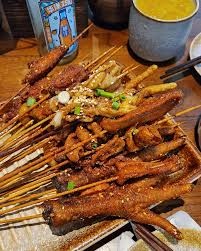
We picked a quiet eating place, and prices were super competitive; 15 sticks of Chuan Chuan were sold for just $10. Compare that with our local equivalent of 10 satay sticks for $13 at Pasar Malam.

[ On a separate note, I spent $13.50 on Chuan Chuan, then I sang for 3 hours in a karaoke lounge with one drink for $6. My total damage that evening was less than $20. ]

With such a price point, it is no accident that Mala eateries have also begun to dominate the local F&B scene the same way the Wenzhounese have acquired the espresso bars in Italy. 

Immigrants are willing to struggle as locals cannot chiku (eat bitter); they are willing to exploit themselves to sell cheaper food to us. With a Mandarin-speaking majority, Singapore is much more attractive to the PRC than Italy. 

But, of course, there are plenty of parallels between local Singaporeans and Italians. When Italians see the PRC, they think that the Chinese are part of a mafia group. We tend to see them as money launderers.

If there is any lesson to learn from my reading adventures, personal finance readers owe a lot to sociologists, and we should read their books more. One classic is The Millionaire Next Door by Thomas Stanley, who inspired me to go all the way to hunt for cheap chuan chuan in the first place. 


Saturday, June 15, 2024

Letter to Batch 34 of the Early Retirement Masterclass


Dear Students of Batch 34,

It's been a great honour and privilege to conduct a 5-Day Early Retirement Workshop for you.

 As I cover this latest batch of students, interest rates are still high, and 2024 is expected to have just one interest cut around the year-end period after the US elections. The pessimists might say that the portfolio we build still faces some downside risks as REITs continue to underperform. Still, optimists would see this as a bargain opportunity with a longer stretch. After all, the projected yield of the portfolio built by this batch is high at 7.42%.

 Community observers who follow the construction of ERM portfolios should note that this class would have selected a large variety of local stocks, as dividends are pretty high across the board. However, I removed a few counters to make the portfolio more manageable and accommodate folks with a smaller amount of capital, so please refer to the rejected list of stocks for details.

 I am a realist. Students should see some capital losses if inflation remains high in the US, which is why I hedged with one banking counter. Otherwise, the portfolio will outperform if we get lucky and interest rates come down early in 2024.

Returning to the class, I wish to thank this batch of students for keeping me entertained and curious. The conversations in the classroom make the class come alive, and I’m grateful to be able to tap into your broad life experience today. I particularly enjoyed the conversations about Chinese society, what working in China feels like, and how the nature of involution has shaped Chinese society today. They gave me hope that the situation in Hong Kong has bottomed out.

Lastly, I hope Batch 34 will participate actively in the FB group. I look forward to seeing you at the following community seminar, which is slated for Q3 2024. 

All my focus is now on bringing LLMs into this program

Hope to see you then!

Christopher Ng Wai Chung


Thursday, June 13, 2024

About some Telegram finance groups I am in


Today, I will discuss the few personal finance-related chat groups I am in on Telegram. I thought it would be interesting to share a little bit about the groups I participate in so readers of this blog can join them. 

Before I begin, I want to talk about the elephant in the room in the 1M65 chat group I do not participate in. From what I gather from folks who visit that group, the culture of 1M65 is similar to the EDMW forums of yesteryear. There is a lot of posturing, and occasional fights can break out, getting trolls banned. Nevertheless, I greatly respect Mr. Loo Cheng Chuan, who made the group what it is today, even though I have no desire to participate.

We must thank Mr. Loo, as he keeps many weirdos and folks jonesing for stock tips at bay so they don't infect the other smaller communities.  

a) Dividend Investment (https://t.me/+SCUdfE_LPMydufBw)

The first group I want to talk about is the Dividend Investment group, which has over 3000+ members and is the place to go for news on Singapore dividend stocks. On the first observation, it is the average group you go to to get news on dividend stocks. 

The admin is very conscientious about dividends coming out from SGX and HKSE counters, and one of the pleasant things I like about it is that it showcases a down-to-earth lifestyle. Dividend investors love sharing food pics, not from expensive restaurants but cheap hawker centres. My guess is this group may have more Gen X and Boomers in it.   

The group is quite friendly and down-to-earth, but it goes into battle mode until someone comes into the group to criticise dividend investing. Then, they can be pretty fierce. I don't blame them; at the moment, dividend strategies are going through a bear moment, and most retail investors just want to talk about NVIDIA and buy based on momentum. So dividends investors are the LGBT+ folks of the investing world - folks getting their lifestyle and investment choices questioned all the time. Still, they are fundamentally very comfortable with who they are, why judge them on their investment picks? 

Dividend investors just want to be left alone to collect their passive income. They might be older and have a lower concentration of professionals, but they do not aim to be the most brilliant guy or the best investment manager in the room. A common trope when someone collects dividends is jokes claiming they live a "dangerous" lifestyle. This is the result of 1M65, which made the claim that dividend investing is dangerous.  

A few guys I like include Huatist, the resident bear who gets excited when stocks turn red. Paul is always free to dispense the occasional wisdom and what he has for breakfast. 

b) Singapore Financial Independence Community or SGFI (https://t.me/sgfinindependence)

I spend a lot more time in the SGFI group. It was started by Supreme Leader Investment Moats to discuss the more esoteric aspects of FIRE, such as the safe withdrawal rate, but it has evolved well beyond his control. 

If you want me to describe SgFI culture, it has become a safe space for high-IQ professionals with INTJ personalities. Occasionally, some folks show up to ask everyone whether their retirement plan is sustainable, but they stay to talk about travel, FI philosophy and lifestyle. The female participation is easily the best I've seen in any group, so be prepared for some weighty female issues to be discussed now and then. I think getting women to open up about their lives and finances is hard enough, and SgFI goes further to attract highly accomplished female professionals to join our discussions. I hang around because the otaku and geek discussions are cool, and INTJ folks are very knowledgeable about anime and RPGs. 

All this being said, SGFI is not an inclusive culture. 

Ideas have to be robustly defended. If you want to brag about trades in a non-contextual manner, you will be cut down to size quickly. The Dividends group clearly understands that SgFI is more PMET-bent, and newbies complain that some members are pedantic. (It might be a GEP thing.)

 I cherish the discussion of the trio of ladies XX, KitCat and Ash. I'm afraid that some incel might chase them away. 

One guy, Leon, is working on summarising the complicated discussions using AI. 

Supreme leader Kyith may occasionally show up if something displeases or annoys him. 

There are many other groups, but due to information overload, I only follow two. However, I don't do this for investment reasons. I'm more interested in lifestyle choices and philosophies. 


Sunday, June 09, 2024

How to think like SM Lee Hsien Loong


Whether you like him or not, PM Lee Hsien Loong presided over a successful reign that generated a massive amount of wealth for the country. After 2011, when the PAP lost Aljunied, he managed a quantifiable rebound in life satisfaction and happiness for all Singaporeans based on Gallup polls. As he settles into becoming Senior Minister, I can imagine journalists jockeying for positions to publish his memoirs or approach to leadership, which academics will study for decades to come.

But what if I told you that a book already exists about how SM Lee thinks?

Apparently, SM Lee was trained by a famous academic named Richard Zeckhauser from the Harvard Kennedy School. This nifty book by Dan Levy summarises Zeckhauser's thinking approach into a number of simple maxims that are practical and useful for lay readers. I think internalising these maxims would make it easier to discern SM Lee's leadership style once the book arrives in a few years. 

Here are a few points I have attempted to internalise to my work. 

a) When faced with a complicated problem, consider the extreme or simple cases.

Before attempting to figure out how to motivate people to pursue FIRE, we can look at the extreme case of how a successful situation can look like. Twenty years ago, my approach was to live on dividend income and then farm my entire take-home pay to super-size the portfolio to become a millionaire. I did not know what retirement looked like, but I definitely understood the prestige and status accorded to millionaires. 

These days, when I am crafting a solution for students, I need to come up with a more universal or simpler approach to FIRE. So, my idea is to try to generate $100 of passive income on average a month. $24,000 into a dividend portfolio yielding 5% can get the job done, and saving $2,000 monthly for a year will let someone try the idea on for size. 

Both approaches help explain financial independence, and folks can only discuss more complicated topics like safe rate of withdrawal or Monte Carlo simulations from other sources when they think that this can be sustained longer for themselves.

b) Think in terms of quantifiable probabilities.

This idea is to learn how to think about probabilities and revise them as we get news from the markets. 

Right from the start of 2024, I was betting that bringing down inflation in the US would be problematic, so my affairs are structured to consider cuts starting in 2025. The wonks are betting a 50-50 chance that a revision will start in November. 

Until September, this 50-50 will be revised when inflation results are reported. It is a superior way to invest, as if the probability drops, I can delay pivoting from, for example, DBS to FCT for my portfolio. 
 
c) Thinking at the margins

The biggest weakness of lifestyle design around FIRE is the idea that one can resign abruptly after reaching financial independence. We are still determining what happiness levels we will feel when we trade all our working hours wholesale for leisure time. 

So, this idea of thinking at the margin is the solution to the problem of Early Retirement. Your question should instead be: If you reduce an hour of working time to add one hour of leisure, will this result in greater life satisfaction? And then you keep making this trade-off until adding an hour of leisure no longer adds satisfaction to your life. 

There isn't a lot of corporate flexibility to allow you to progressively reduce your hours at work in practice, so a person can quit his day job after financial independence, get a short holiday, and then gradually increase his freelancing time to see whether it can increase his happiness. 

My issue has always been doing bullshit jobs in a toxic work environment. In a better environment where I can feel that I am contributing, increasing my exposure to work may make me happier. 

Anyway, this is a pretty nice book that teaches policymakers how to think, but I think that anyone can benefit from reading it. If it can sharpen the mind of one of the top mathematicians in the world and assist him in running our country, maybe more people in society should be taught this.

Saturday, June 01, 2024

Investment lessons from Shogun


The first TV Series based on James Clavell's Shogun was made in 1980, and I vividly remember watching it when I was about 7-8 years old. The plot was too complicated for a kid, but I recalled the shocking scene of seeing someone boiled alive in the show. Shogun was rebooted in 2024 and is available for Disney+ subscribers; this version is not to be missed. Fans are saying that it is Game of Thrones that is done right.

On the Telegram finance discussion groups, some folks drew financial inspiration from popular characters in the series, like Kashigi Yabushige. Still, the discussion was short-lived because Yabushige committed seppuku at the end of Season 1. 

I would have wanted to have a deeper conversation about whether assessing an investment strategy based on the outcome instead of the process is correct. Still, we might be better inspired to consider what the main character, Yoshii Toranaga, can teach us about investing.

I summarise this briefly into three parts :

a) Toranaga knew when to let go of his pawns to serve his greater ambitions

One gripping aspect of the series was how often people are willing to give their lives for their lord. Toranaga understood that to create the impression that he had conceded defeat, key household staff members had to commit seppuku.

For investors, it means having proper conditions to exit positions when it is no longer to hold onto them. In such a case, dividend investors are not particularly good at letting go of a counter; we often only throw in the towel when dividends are stopped completely. In this sense, technical analysts and quantitative investors are better placed to cycle their positions. 

I probably got out of AEM a little late when the troubles started this year, but my algorithmic positions are always dynamic, and I cycled out of Indian Small caps for the NASDAQ when the momentum shifted.

b) Toranaga does not control the wind. He only studies it.

When Toranaga is about to execute his disloyal vassal Yabushige, Yabishige asks him how it feels to control the winds. Toranaga answers that he merely studies the wind and does not control it. Even in a moment of triumph, Toranaga is humble and understands his limitations.

In investing, Warren Buffett can control the wind. Anyone who can buy enough shares to install his own directors in a company can unlock value in an undervalued company. However, most of us are not at Warren Buffett's level. We can only read financial statements and analyst reports, deploy our capital intelligently, and hope the stock will eventually reach its intrinsic value.

But there are many ways to read the winds. People spend years learning how to read financial statements, and I write code to unveil momentum indicators that work. Toranaga probably has a network of spies and is already aware of who his disloyal servants are pretty early in the series. Increasing how we read the wind would matter. Suppose the methods of reading the markets are conventional. In that case, getting unconventional results will get harder, so I resort to code to search for investment insights. 

c) Toranaga is actually very frugal with the deployment of his resources.

Throughout the series, the audience is led to believe that Operation Crimson Sky is Toranaga's planned frontal assault on Osaka Castle, with maybe a slight twist involving cannons being fired from the sea. But as it turns out, the entire operation to free hostages within the castle was executed with just one highborn woman, Toda Mariko. With one life, Toranaga could break the alliance of the Regents arrayed against him and even cause his rival lord to lose the favour of the young heir. 

Investors may have a different way of framing what Mariko means in their portfolio. For a value investor, Mariko can be a 100-bagger stock. She can also be a longshot bet on an altcoin going viral online. 

For most retail investors, stacking all their resources on a longshot gamble is a mistake. Most retail investors want Mariko to be a lottery ticket that will change their lives. 

That idea is wrong. Toranaga's military forces are primarily concentrated in Edo and can engage in massive battles independently. A small 1% percentage into a 100-bagger or an altcoin can improve your returns without raising too much risk for your portfolio. This insight can only be understood if we study the concept of the economic utility of our investment portfolios. 

There's no need to put all your eggs into a counter that has high returns and a high standard deviation. You can backtest how a 1% investment in a Bitcoin ETF can influence a 60/40 portfolio over the past 10 years. You don't need a flashy, one-sided bet to outperform your peers. 

Anyway, I hope I've not spoiled the series for readers. I'm eagerly awaiting the second season of the story that would have to depart from the original book, but plenty of inspiration can be gained from actual Japanese history. 


Sunday, May 26, 2024

What a beneficiary can do with inherited sums from a departed loved one


Recently, a friend has lost a loved one and has questions about what to do with sums of money left by that loved one. I wanted to write an article explaining my thoughts on what to do if you have a windfall from a departing loved one. 

Before I begin, I want to share that, as human beings, we would usually not treat inherited wealth as earned wealth, so I think the insights from behavioural finance experts on mental accounting may not be helpful when we are still grieving the departure of our loved ones. Even after more than five years after my dad was gone, I still segregate his sums in a separate account and would only use the capital for medical reasons. The dividends are also reinvested most of the time. 

The most important thing I would not do is pass the sums to a banker or financial advisor. As this involves AUM or commissioned sales, it would be tantamount to allowing the FA to inherit the wealth, so all my solutions I will discuss involve the DIY handling of sums of money.

Here are some of my considerations :

a) Singapore Savings Bonds (SSBs)

The most basic answer right now would be SSBs. This is the closest thing to a riskless investment and guarantees that capital can be preserved. SSBs yield 3.28% for the first 3 years, which is slightly higher than the inflation rate of 2.7%. However, it is still being determined whether it can continually beat inflation as the years go by. Finally, you can only have a maximum of $200,000 SSBs in your CDP account. Payouts occur every April and October when stocks generally do not pay dividends. 

b) Globally diversified ETFs with a discount broker

A more savvy solution is to do what most savvy retail investors do: put it with a discount broker and then buy a diversified pool of ETFs from different asset classes. The expense ratio can be meager, at below 0.3% per year (unless it's commodities). You can optimise on taxes by buying accumulating funds and UCITS ETFs on the London Stock Exchange.

I backtested a portfolio that invests 25% in stocks, REITs, bonds, and ETFs. Average returns exceed 7%, with a low standard deviation of around 12-14%. However, this asset allocation must be rebalanced annually, so there's an administrative overhead.

The biggest issue with this approach is that it is emotionally less satisfying as you need to liquidate to spend the sums. There may be a sense of unease with inherited sums, but spending about 2.5% of the prevailing amounts yearly should adequately preserve wealth and even allow payouts to grow over time. 

c) Local dividend stocks

Performing some factor selection of local dividend stocks may only slightly underperform the ETF suggestion and even result in a higher standard deviation. Still, Singapore markets have already gone through some terribly wrong days and are cheaper than foreign markets. Picking 20 blue chips with the highest yields and then cheery picking 10 with the lowest volatility can generate returns of over 8% for the past 10 years with single-digit standard deviations.

While the historical data looks good, this strategy's real strength is its emotional appeal. The more diversified your dividend portfolio is, the higher the frequency of payouts. If you are willing to pay a fee for higher trading costs, stocks in the CDP system can even be paid directly to your bank account at 5.30pm on a payout day.

This is particularly good for grieving individuals as it feels like your loved one is always looking after you and sending you money to buy a meal at the restaurant. I suspect this is one of the reasons for 1M65's hilarious outburst that SGX is all about Kiasu and Kiasi investors who will not take a risk on innovative tech counters. As such, I actually think Mr Loo Night would be right, but we dividend investors would like things to stay this way!

The downside I noticed about this strategy is that it is, after all, focused on high-yielding stocks of a single country, so the strategy can have its bad days. You can occasionally have drawdowns that are very large compared to the ETF strategy. 

As for me, I did not have to convert my father's holdings into dividend counters because I had been doing it with his blessing for decades while he was still alive. He transitioned from asset to cash-rich, while I did the opposite as I took on a mortgage loan for my executive condominium. These days, even closer relatives remarked how much I now looked like my dad as I reached my 50s.

Right now, I can share some of my thoughts because I collect rentals from a shophouse my father bought when I was a JC student in JB every few months. This shophouse supported me when I was getting my first degree. The ringgit has weakened immensely, so after all my diabetic meds and my mum's blood pressure meds, there's only so much left to buy relatives a treat in KSL

I always tell my uncles and aunties not to thank me as the money came from my dad's savvy moves when he was younger. 

My dad would have been 82 years old next Friday.

I hope he would approve of my actions as a steward.


Sunday, May 19, 2024

Better alternatives to Early Retirement


I had much to think about this weekend because we just had a secondary school reunion. I did not intend to attend the event initially because I didn't know how to pitch my "lifestyle choice" within such a short timeframe. I need to use mathematics to explain how I could foot off the pedal 10 years ago, and it might get as awkward as the last family gathering I had. But because my cohort over-ordered table tickets and folks talked about sharing the cost of unsold seats, I threw my hat into the ring because I was free that evening. I should catch up with my secondary school classmates entering their 50s this year. 

As it turns out, quite a few folks follow me on this blog, CNA's Money Mind, and my material on YouTube, so there's no need to explain it to them. Still, folks in their 50s are now contemplating whether they can just stop work, so I had to tell them not to do anything rash unless their investments exceed 300 multiplied by their monthly expenses. Even so, I told them about the awkwardness and the loss of personal identity I faced when I gave up on regular employment, and even turning myself into a lawyer did not fully solve that issue. 

But I did not prescribe too many specifics. My classmates are successful in the corporate world but stuck with the skillsets they have honed over the years. If they need to get out, I suggest they find something passionate about first. 

This brings me full circle to what I am currently doing with my life.

I'm actually doing some kind of reverse FIRE. 

In the past, I struggled hard to get my passive income to exceed my expenses with some legroom so that I could do something else with my life instead of just accepting what my workplace offered me. But I stayed on for 7 years after financial independence because I enjoyed my work. It took a stint out of the public sector work to make me throw in the towel, and by then, my dividends had exceeded my take-home pay. 

As business is terrible, I'm struggling to do the opposite.

I'm seeking part-time gig opportunities to supplement my business income and live on my earned income. This number is below my family expenses, including mortgage payments, so I must use up a small part of my passive income to keep everything sustainable.

Of course, I have set some ground rules for my work. 
  • It has to work where, psychologically, the positives of work outweigh the negatives. 
  • It should also not touch weekday office hours because I consider my daily afternoon nap and swim one of the biggest positives in my life. 
As it stands, this is a challenging goal. 

If I succeed, I can pay all my expenses with passive or active income. My active income will only be earned at night or over weekends, and my engagement with clients and stakeholders must be positive and make me look forward to doing the work.

So, I think I might be able to make this arrangement work if interest rates start going down before the end of the year and I add another gig to my current list of engagements. 

If rates stay higher and longer, I might have to bite the bullet and start selling my weekday time to meet my objective.

But I will miss the afternoon naps if I do that.