Growing your Tree of Prosperity is an introductory investment guide written specifically for Singaporeans who wish to take their first step towards financial independence.
Saturday, June 29, 2024
Some advanced thoughts on Malaysia and KL
Wednesday, June 26, 2024
My latest trip to KL.
c) Porto Romano Restaurant
Wednesday, June 19, 2024
Insights into Acquisitional Wealth, Italian Espresso bars and Chuan Chuan.
I will fly off to KL tomorrow for a few days of cafe hopping and wandering at bookstores. The KL scene has become much more vibrant for bookstores as Singapore has been losing them to our well-run libraries. I foresee a future trip to Bangkok to visit game stores and KL to bookshops.
Today's article is about chain combo-ing some books to derive insights. I was fortunate to read these books in a row, and they enriched my personal experiences during my short break after conducting my 34th installation of the Early Retirement Masterclass.
Let's begin with Josh Tolley's Acquisitional Wealth, a novel personal finance book that folks should read. Initially, it reads a little like Robert Kiyosaki, but then it takes a detour into the world of small business M&As. Tolley believes that instead of the usual work, saving and investing in mutual funds, folks might be better off buying businesses from small business owners. There are many non-cyclical businesses like a car wash or a laundromat with owners seeking to retire, and you can buy them just like a value investor should. One major issue is that you often have to borrow money to purchase such businesses, and the acquisition process requires months and the services of a good accountant and lawyer.
I enjoyed this book so much that I started googling for business brokers in Singapore. After a while, I realized that our markets are so severely beaten down that we can find illiquid companies trading at 3-5 PE, so there might not be a need to buy a business. The book's biggest glaring weakness is that it does not say much about valuation, which can be remedied by reading textbooks by Aswath Damodaran. If you are considering expanding your mind beyond the usual investments, consider taking this book out for a spin.
I give my brain a break after a finance read because I'm getting mellower and becoming more interested in human matters. Books should trigger pleasant memories, stimulate ideas for travel, and teach you a thing or two about life.
Chinese Espresso by Grazia Ting ticks all the boxes. It is an ethnographic study of Chinese immigrants from Wenzhou who are now owners of espresso bars in Italy. This book made me want to travel to Bologna, Italy, with my posse next, given that I had a fun trip to Istanbul after reading the history of the Byzantine Empire. The idea is to meet ethnic Chinese who speak fluent Italian and Mandarin and are forced by circumstances to buy coffee bars to survive in Italy.
For a book like this, it's good to be exposed to the racism faced by Chinese immigrants, but it is also a fascinating read about coffee. The author worked as free labour for these espresso bars and discussed how difficult it was to generate the foam with evenly sized bubbles for a cappuccino.
But what's really valuable for the finance-obsessed is how ethnic Chinese think about business operations. The Wenzhounese can dominate the coffee bar trade because they see their kids as free labour. The profit from an espresso bar operation does not account for labour costs as it is family-run, and profits are for the whole family, with the patriarch using his funds to buy up other espresso bars for their married children. The Wenzhounese, the most entrepreneurial of all the Chinese dialect groups, already operate on acquisitional wealth the way Josh Tolley would have wanted.
This completes the circle of books I read these few weeks, one book on theoretical ideas on small business M&A and another, an intimate description of small businesses in Italy.
I relate what I learn to my ordinary life. After conducting my course, I have two days when my wife and kids are with their in-laws in Malaysia, so I decided to hang out with a friend over the long weekend. He used to hang out in a Japanese pub that had closed down, so he wanted to just drink with the ex-staff, but all I wanna do is to sing.
So I followed him to a weird corner in Jurong East called Vision Exchange, an ethnic enclave of PRC immigrant workers with an entire row of Chinese eateries.
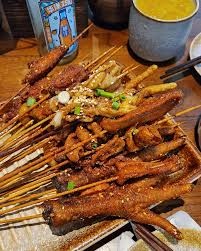
We picked a quiet eating place, and prices were super competitive; 15 sticks of Chuan Chuan were sold for just $10. Compare that with our local equivalent of 10 satay sticks for $13 at Pasar Malam.
[ On a separate note, I spent $13.50 on Chuan Chuan, then I sang for 3 hours in a karaoke lounge with one drink for $6. My total damage that evening was less than $20. ]
With such a price point, it is no accident that Mala eateries have also begun to dominate the local F&B scene the same way the Wenzhounese have acquired the espresso bars in Italy.
Immigrants are willing to struggle as locals cannot chiku (eat bitter); they are willing to exploit themselves to sell cheaper food to us. With a Mandarin-speaking majority, Singapore is much more attractive to the PRC than Italy.
But, of course, there are plenty of parallels between local Singaporeans and Italians. When Italians see the PRC, they think that the Chinese are part of a mafia group. We tend to see them as money launderers.
If there is any lesson to learn from my reading adventures, personal finance readers owe a lot to sociologists, and we should read their books more. One classic is The Millionaire Next Door by Thomas Stanley, who inspired me to go all the way to hunt for cheap chuan chuan in the first place.
Saturday, June 15, 2024
Letter to Batch 34 of the Early Retirement Masterclass
Dear Students of Batch 34,
It's been a great honour and privilege to conduct a 5-Day Early Retirement Workshop for you.
Returning to the class, I wish to thank this batch of students for keeping me entertained and curious. The conversations in the classroom make the class come alive, and I’m grateful to be able to tap into your broad life experience today. I particularly enjoyed the conversations about Chinese society, what working in China feels like, and how the nature of involution has shaped Chinese society today. They gave me hope that the situation in Hong Kong has bottomed out.
Lastly, I hope Batch 34 will participate actively in the FB group. I look forward to seeing you at the following community seminar, which is slated for Q3 2024.
All my focus is now on bringing LLMs into this program
Hope to see you then!
Christopher Ng Wai Chung
Thursday, June 13, 2024
About some Telegram finance groups I am in
Sunday, June 09, 2024
How to think like SM Lee Hsien Loong
Saturday, June 01, 2024
Investment lessons from Shogun
Sunday, May 26, 2024
What a beneficiary can do with inherited sums from a departed loved one
A more savvy solution is to do what most savvy retail investors do: put it with a discount broker and then buy a diversified pool of ETFs from different asset classes. The expense ratio can be meager, at below 0.3% per year (unless it's commodities). You can optimise on taxes by buying accumulating funds and UCITS ETFs on the London Stock Exchange.
I backtested a portfolio that invests 25% in stocks, REITs, bonds, and ETFs. Average returns exceed 7%, with a low standard deviation of around 12-14%. However, this asset allocation must be rebalanced annually, so there's an administrative overhead.
The biggest issue with this approach is that it is emotionally less satisfying as you need to liquidate to spend the sums. There may be a sense of unease with inherited sums, but spending about 2.5% of the prevailing amounts yearly should adequately preserve wealth and even allow payouts to grow over time.
c) Local dividend stocks
Performing some factor selection of local dividend stocks may only slightly underperform the ETF suggestion and even result in a higher standard deviation. Still, Singapore markets have already gone through some terribly wrong days and are cheaper than foreign markets. Picking 20 blue chips with the highest yields and then cheery picking 10 with the lowest volatility can generate returns of over 8% for the past 10 years with single-digit standard deviations.
While the historical data looks good, this strategy's real strength is its emotional appeal. The more diversified your dividend portfolio is, the higher the frequency of payouts. If you are willing to pay a fee for higher trading costs, stocks in the CDP system can even be paid directly to your bank account at 5.30pm on a payout day.
This is particularly good for grieving individuals as it feels like your loved one is always looking after you and sending you money to buy a meal at the restaurant. I suspect this is one of the reasons for 1M65's hilarious outburst that SGX is all about Kiasu and Kiasi investors who will not take a risk on innovative tech counters. As such, I actually think Mr Loo Night would be right, but we dividend investors would like things to stay this way!
The downside I noticed about this strategy is that it is, after all, focused on high-yielding stocks of a single country, so the strategy can have its bad days. You can occasionally have drawdowns that are very large compared to the ETF strategy.
As for me, I did not have to convert my father's holdings into dividend counters because I had been doing it with his blessing for decades while he was still alive. He transitioned from asset to cash-rich, while I did the opposite as I took on a mortgage loan for my executive condominium. These days, even closer relatives remarked how much I now looked like my dad as I reached my 50s.
Right now, I can share some of my thoughts because I collect rentals from a shophouse my father bought when I was a JC student in JB every few months. This shophouse supported me when I was getting my first degree. The ringgit has weakened immensely, so after all my diabetic meds and my mum's blood pressure meds, there's only so much left to buy relatives a treat in KSL
I always tell my uncles and aunties not to thank me as the money came from my dad's savvy moves when he was younger.
My dad would have been 82 years old next Friday.
I hope he would approve of my actions as a steward.
Sunday, May 19, 2024
Better alternatives to Early Retirement
- It has to work where, psychologically, the positives of work outweigh the negatives.
- It should also not touch weekday office hours because I consider my daily afternoon nap and swim one of the biggest positives in my life.
Wednesday, May 08, 2024
Deeper thoughts about FIRE
I had the same questions when I first read about Barista and Coast FIRE - both movements do not eschew the working world altogether, so they are short-cuts at best and half-baked ideas at worst. But I'm convinced that very few folks will complete the journey over time. FIRE influencers are overwhelmingly Tech or Finance professionals, and the MBTI personality type that dominates the movement is a rare INTJ type that is less than 5% of the human population.
So, some kind of moderation to create a form of FIRE for ordinary humans is inevitable. Even my challenge to ask my students to set aside $24,000 to generate an average of $100 a month in dividend income is quite challenging to some.
b) Does FIRE threaten the financial industry?
If FIRE does not threaten the livelihoods of commissioned FAs, we are not doing FIRE correctly because we can save 2-3% in fees when we invest directly using a low-cost broker. I think the financial industry understands this point, and I'm detecting many "dog whistles" to that effect.
An increasingly common strategy is to ask whether people make personal sacrifices regarding FIRE. Talking about some folks' relationships or appearance is also a low blow. Another approach is to "forgive" and "give permission" to others to start saving later in life. More complicated strategies will pick on a person's inheritance.
It's all an attempt to convince folks not to start, but it ignores how much freedom a person can achieve with even $100 in passive income a month.
c) Does FIRE threaten policymakers?
If done correctly, policymakers should actually promote FIRE. A severe practitioner will have to work really hard and maybe hold multiple jobs to get a credible portfolio running before they reach the age of retrenchment.
There are certainly worse movements that are gaining more traction, such as the idea of lying flat.
d) What can policymakers do to make FIRE less attractive?
Actually, policymakers threatened by this movement can take welcome steps to make FIRE less attractive in Singapore society.
I can imagine myself continuing working on a statutory board today if some really toxic managers did not exist because I liked IT work, and I have no issues going to work even with a passive income of $20k+ a month. I'd like to hang out with friends in the office, too.
If you want to blunt the impact of FIRE, we need to take further steps to make Barista FIRE a reality. More work from home, flexible work arrangements and a four-day workweek are a good start. I don't think you can remove the assholes from the government offices or any corporate HQ overnight, but creating a means to minimise contact with these people and creating outcome-based work objectives will help immensely. For me, the potential for AI is to require less middle managers so assholes will be stuck in individual contributor roles.
Suppose a double-first from Cambridge prefers a life as debating coach rather than a path to say, the Admin Service, I'm not really interested in his choice of FIRE - I want to know specifically what kind of Ministry culture will drive him to freelance instead of becoming an Elite.
e) Are there viable alternatives to FIRE?
Every successive generation of folks will reach adulthood and get their shit together at a much older age. They will also become more individualistic. This is a common trend from Boomers all the way to Gen Alpha.
I'm seeing younger Millenials and Gen Z taking up a gap year after years of work to travel or do whatever they want. This is a viable alternative as they effectively separate their retirements into multiple parts and enjoy small bits of it when they are young.
My generation will not do this because it can taint our resumes.
But HR will be unable to do anything if every young Singaporean aspires to this lifestyle. Just like the CCP will note able to do much if every young person in China starts to lie flat.
I actually love what young people are doing here when it comes to lifestyle design, I welcome credible alternatives to FIRE and love hearing about them. If done collective as a population, the working world can become a much better place even for older folks like me.
Thursday, May 02, 2024
Strengthening the case for dividends investing
Friday, April 26, 2024
Wisdom from "Useless" books
Folks who wish to read up on my financial insights will need to wait a while as I'm having multiple headaches trying to maintain my business, so I'm thinking about my finances a lot. It's just not something I can arrange neatly into a blog article at the moment, I might actually be in crisis mode.
At the moment, I'm gradually tilting my reading into less practical territory. As I spend hours on a bus to teach evening classes in faraway lands, my reading speed has increased quite a bit, and I have to moderate the pace at which I read the helpful programming, finance, and law stuff I tend to be more obsessed with. Of late, I think that I'm getting some applicable "wisdom dividends" from the stuff I'm reading, so I'm sharing them here.
a) The Way Home by Ben Katt
Saturday, April 20, 2024
Friendly Career Update
- The doctrine that says adults are more motivated learners is BS in a world where taking diplomas can earn a meaningful allowance. It falls to the instructor to motivate them to pay attention.
- ERM instinctively got it right five years ago with diagnostic assessments, online pop quizzes and real-time feedback via apps.
- Coming up with a hook and a narrative is essential, although I need to improve myself at this. I only use previews in private-sector work where I have to sell.
- My peers don't like smart alecks in class, but I'm happy to trade away my boomers with smart alecks anytime because they often can detect poorly made lecture materials and sharpen your wits as a practitioner.
- If a class polls heavy introversion, they will often be very grateful if you give them online means to interact with the class materials rather than call them out to embarrass them.
- At a personal level, I find it hilarious that I can now discuss high-falutin ideas like Bloom's Taxonomy and Gagne's 9 events with actual MOE trained philosopher kings.
Wednesday, April 10, 2024
Will FIRE's enemies grow stronger?
- First is a Rice Media report on 31-year-old Ashish Kumar, a top scholar who quit Ministry work to run his debate coaching business.
- Next is gold medallist Joseph Schooling retiring from the competitive swimming arena.
- Finally, my favourite comedian actor, Henry Thia, talked about reducing the number of acting projects and entering retirement mode.
Friday, April 05, 2024
A question of Two Apples
I am writing articles now that I should have written weeks ago.
If you can catch this movie YOLO, I suggest you do so because it's one of the rare gems coming out of China that is neither patriotic nor involves loads of CGI. In fact, it is one of the more motivational movies out there that successfully captures the angst of modern China.
One fairly sweet moment in the movie concerns the philosophical question that was directed at the protagonist :
If you have two apples, one large and one small, and your friend wants an apple from you, do you give up the big or the small apple?
If you are most folks, you might give up the small apple and keep it for yourself. This preserves the Big Apple for enjoyment, but some folks are inclined to give up the bigger fruit because they see themselves as caregivers.
The movie reveals that the protagonist sees herself as the kind of person who would give up both apples, to which her dad replies that this would mean that she would have friends. The scenes following that revelation were quite heartbreaking to the audience.
I don't want to spoil the movie, but from my point of view, anyone who gives up both her apples sees herself as a martyr—someone who actively sacrifices her own personal interests for others. This is an inherently unsustainable position, very antithetical to Ayn Rand's ideas.
Interestingly, scenarios where no apples will be given to the friend are missing from this philosophical discussion.
In what situation does this friend deserve a single person anyway? That may turn on whether this person is a giver or taker of apples in the first place.
For me, my default position is that no apples will be given.
Apples should be earned.
But folks like me who refuse to give up a single apple will naturally be the villains or bad guys in every movie.
But I don't care because I might be very good at utilizing my apples. I can bake an apple pie for my family and preserve some apples for rainy days. More importantly, I plan to plant the apple seeds, and a generation later, my descendants can have their own apple farm.
Whether my descendants will give up, and apple for their friends will be moot because they will have enough apples to feed the whole town.
All because I started out by refusing to give my apples away.
The Mainland Chinese would obviously want to celebrate the sacrifice of their women and immortalize it in a movie.
Still, it does boil eventually to what you plan to do with your apples.
Socialism with Chinese characteristics may not align itself with Capitalism with Singaporean characteristics.
Monday, April 01, 2024
This is where I talk a little bit about my hobbies
- Pathfinder was a fork of 3rd Edition many years ago, and now it has resurged with a remastered version that has created its own IP.
- Kobold Press is about to complete its version of the 5th Edition called Tales of the Valient.
- Matt Colville, a super charismatic DM, is now launching his own RPG that is very similar to D&D.
- Matt Mercer, who is a super successful voice actor who promoted D&D, is now showing off Daggerheart, a more descriptive and narrative system, to mixed reviews.
- Cubicle 7 just launched Broken Weave, a heavily altered version of 5th Ed that is focused on exploration and narrative play.