Saturday, July 30, 2022

Letter to Batch 26 of the Early Retirement Masterclass


Dear Students of Batch 26,

It’s been a great honour and privilege to conduct a 5-Day Early Retirement Workshop for you.

Batch 26 is one of the luckiest batches to graduate from the ERM programme, just a tad less lucky compared to Batch 12, which managed to buy right at the market bottom of the pandemic crisis. Batch 12 bought the stocks in March 2020 and constructed a dividend portfolio that generated 7% per year. At the time of writing, they still managed an XIRR of 16% when the rest of ERM was plugging along with an XIRR of just 4%.

This can be considered the wrong time to invest for many people. The US had just completed two consecutive quarters of negative GDP growth. China is bogged down by the demon of its own design, otherwise known as the Zero COVID policy. Russia is still trying to invade Ukraine. The Fed has declared a crusade against inflation, leading to rising interest rates worldwide. And now, the Hungry Ghost month has just started.

But it is always the darkest before the dawn. ERM remains resolute that there is no better time to invest than now. The equity risk premium we track has been going up three batches in a row. A downturn worldwide has always been suitable for low beta, high dividend portfolios that our programme has been known for.

This is also the batch where a lot of calculated risk-taking took place, with Dasin Retail Trust being chosen after Group 3 did a detailed investigation on the odds of being able to enjoy the 16% current yield that it offers. The team was cognisant that the business could fail but was persuaded when they saw some recent purchases by Aqua Wealth holdings from the SGX announcements. Alumni should feel free to omit the purchase of this counter if they are uncomfortable with the risks involved.

Lastly, I hope that Batch 26 will participate actively in the FB group. Sometime in Q3 2022, we should be meeting up for an online community webinar.

Hope to see you then!


Christopher Ng Wai Chung

Friday, July 29, 2022

Why you will fail at Value Investing - part 1


Over the next few weeks, I will be reviewing the latest literature on Value Investing. I've decided to do a three-part series on this blog before I summarise it into something more useful on the Dr Wealth blog. The first book I will be reviewing is Where the Money Is by Adam Seesel and I see this as a valiant attempt to update the principles of value investing in the digital era. 

The biggest conclusion I get from reading this book is that most of us would likely fail at value investing. 

If you look at the training provided by my peers in the training industry, a lot of younger trainers claim to be some kind of acolyte of Waren Buffett, but even Warren Buffett has evolved over the years. He started as a disciple of Benjamin Graham and adopted a deep value philosophy based on liquidation value, combining it with board control. Then Buffett pivoted under the influence of Charlie Munger and began to buy companies with powerful mindshare on TV. The latest incarnation of value investing subjectively imputes earning yields of digital companies by peer review. 

If I adopt this alleged form of value investing,  then value investing is effectively meaningless.  It becomes ambulatory with the times - it can be anything you want it to be. So long as investment performance is good. 

Nevertheless, I think there is great value in doing a thorough literature review and seeing what scraps can actually be used in Singapore. 

There are three parts to doing value investing for the digital age, I will discuss business quality. 

In the author's view, business quality is high if (1) the company has a low market share in a market that is very large and growing rapidly. (2) The company has a sustainable competitive advantage.

The moment we look at this definition of business quality, we will see logistical difficulties in finding such businesses. It is tough to generate a screen for low market share in a growing market. A retail investor would literally have to read the newspaper and find a company by pure luck. And weekly periodicals in Singapore put a very neutral spin on articles featuring local companies. No journalist would deliberately put in the article numbers on market share and the rate of growth of the industry at large - you need to find the exact article by chance.

Also, what are the odds of a Singapore company being able to compete globally? In many of these cases, authors of value investing companies will invoke Peter Lynch - buy what you know or follow your wife around when she goes shopping. 

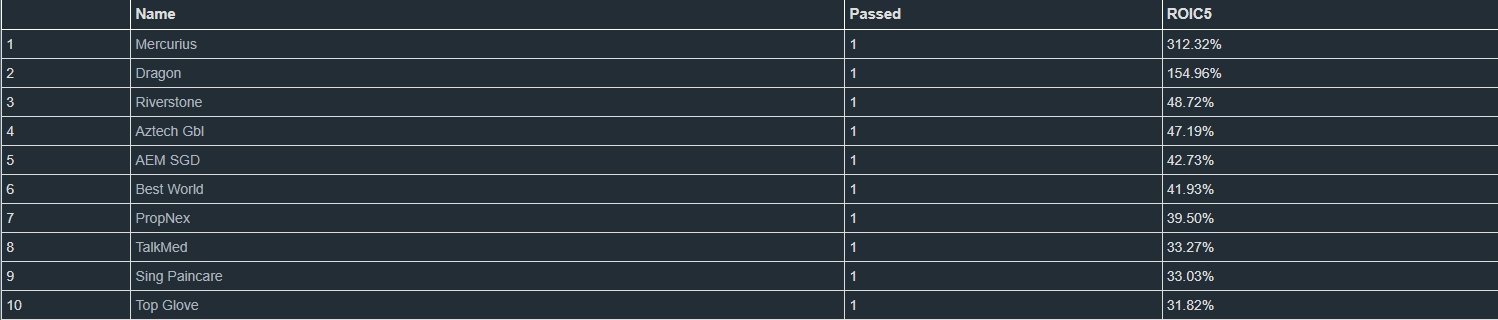
The idea of sustainable competitive advantage is slightly more useful because we can isolate a factor in screening. Companies with a high ROIC are generally seen to have large moats. Now let's see the highest 5-year average ROIC companies in SGX.

[ Note that most value investing acolytes prefer to subjectively evaluate the moat of a company. I hated that ever since someone else in an investment panel argues that Old Chang Kee had great investment moats when any Mak Cik from Batam can come over and start selling sardine epok at MRT exits. If you still prefer this form of subjective evaluation then you should revise Porter's 5 forces model and steer clear of eating too many curry puffs. ]


So as a budding value investor, you will start with this list of 10 companies, and you want to go through each of them one by one to see (1) what is their size relative to their target market (2) whether their market is in fact growing. 

As in all cases, it helps if you are a full-time investor. You may also want a Bloomberg terminal.

This is just round (1) Business quality.


Sunday, July 24, 2022

Why buy the whole cow when you only need the milk ?


The idea of why a person would want to buy a whole cow when he only needs to drink some milk is quite an ancient one. My dad always had a bunch of friends, which I did not respect very much, they said this very often to my dad and me when we hung out over weekends. The idea is mostly applied to their views on marriage. And my dad’s single pals were asking why bother getting married when they could visit prostitutes. Now I want to point out that I had a fairly liberal upbringing, my parents would visit lounges over weekends and I take along as a secondary school and JC kid, so I was familiar with the smoke, alcohol and prostitution way before NS.

I thought it would be fun to revisit this idea in the financial realm. If you adopt the mindset of my dad’s single pals, then the same argument can be made for making a living in Singapore.

It does not take a lot to survive as a bachelor in Singapore. The ballpark is not too far from LKYSPP’s 55-year old imaginary single who needs $1,768 a month. While this is not high living, it enables a basic standard of living with some amounts of entertainment thrown into the mix. 

Now, it does not take a lot to earn $1,800 a month. You can earn his amount doing food delivery. Recently, you can even earn $3,500 washing dishes. You might be able to wash dishes part time to earn that bare minimum of $1,800 to sustain your lifestyle. You can play Diablo Immortal the rest of the time and still have some money leftover to visit prostitutes.

Now my father’s single friends are probably the very kind of people who will scoff at the FIRE movement. If you want to FIRE, then you need to aim well above the median income of $4,500 and save more than 50% of your take home pay. You will need about $530,400 at the safe rate of return of 4% to credible generate about $1,768 a month. They would then find the idea of earning $530,400 within a decade even more ridiculous, with folks paying me good money to raise the probability of success of doing that. 

So the same mental model applies in finance. Why buy the whole cow ( raise $530,400 ) when you only need some milk ( $1,768 a month ).

If you follow this train of thought, you’d come back to that story of the MBA who tried to advise a fishermen. The idea was go through one full circle of levelling up, starting a business, scaling, so that the fisherman can relax like what he used to do in his youth. 

Whats hidden in the story is that the fisherman can probably fish for a living over the short term, but he has to contend with illness and old age over the long term, so saving up and scaling up a business is just another way to sustain his lifestyle, and possibly grow a family in the meantime. It’s also ridiculous if the fisherman is single and contend with other fishermen for mates, so he has to struggle to signal his economic resourcefulness to women as well. 

But I think there’s no better no way to understand the consequences of choosing this philosophy of life. 

And I should explain why my philosophy is the opposite - to own as many cows as legally possible. If things work out, folks will be paying good money to buy my milk. 

My dad’s friend, did remain single his whole life, he partied hard with prostitutes and drank lots of beer. At an older age, he got lonely, and eventually settled down with an old prostitute in a HDB. The old prostitute had some kids from an earlier dalliance, but he provided some financial assistance for them as they grew up. 

He did buy an old cow in the end, the calves were not even his but he had to raise them too.   


Friday, July 22, 2022

Is Singapore too "tense" for our own good ?


For reasons which can only be explained if you know me well enough, I seldom have a meal with my secondary school classmates. It's just the way it is if you are a banana and your school is very Chinese helicopter. But when I do, I always learn something.

Prior to the latest event, my classmates asked me why his dad could support a family on one income but he can't and whether it is feasible to emigrate to Australia. 

This time around, my classmate, who is a very senior Malaysian R&D engineer, said that Singapore is very tense and he'd rather live in JB and commute to Singapore than living here in Woodlands. Initially, I thought this was an economic argument because SGD goes a long way in JB. 

But it is not, the main draw is that he can be with his family in JB over weekends.

So I was puzzled because what's the difference if you spent a weekend with family in JB versus SG beyond the obvious economic advantages?

I did not unpack the argument. His reasoning was that Singapore is just a "tense" place.

Just today I found out the hard way what my classmate meant.

I was bringing my son back from school and this bastard rode a bicycle at warp speed towards a crowd of K2 children. I did the best thing I could and interposed myself between my son and him, forcing him to slow down, then he cussed me in Hokkien, and rode away. Upon reflection, there was nothing I can do because my son rode a tiny scooter and I would hypocritical to tell a bicyclist off in front of my kid, so I just kept silent.

In my head, there were two scenarios, if my son was hit and I go berserk on him, I will die. He's got a hard luck Kranji Turf Club face and looked fit in his forties and I'm a diabetic sedentary worker who might have sarcopenia. If somehow I survive and hit him with a lawsuit, I'll probably be able to do better than engaging in melee combat, but I probably can't recoup my costs, so I won't win either way. 

But the outcome is optimal, I keep quiet and go about my own way, and bicyclists will continue to plague the pavements around the primary school.

You can interpret the meaning of the word 'tense' from the rudeness of the encounter. That's one way of seeing it. 

In KL, the infrastructure is so bad, bicyclists will have to contend with potholes rather than schoolchildren. Traffic infrastructure is so bad that courtesy actually helps a lot if you need to cross the road. Same in some US states - if everyone can carry a gun, being extra polite is a survival skill. 

I think the deeper problem is the internal calculus I am so used to going through as I go by the day-to-day business in Singapore. I can :
  • Physically fight, but that never achieves any objective and getting caught on camera will ruin me.
  • Call the police, if there's clearly a Penal Code violation, but my experience is that police may reject the case. 
  • Go to court where you can find recourse in Civil Litigation. But you need to be rich and the amounts at stake substantial. 
  • Complain to MP. A favourite manoeuvre. 
  • Somehow pay the problem to go away, but the other party wins.
I apply the same mental model in many tense situations. If a fight breaks out, should it be done with words, a video, my fists or a writ?

A society can be thought of as "tense" if everyone is constantly evaluating their options this way. 

Apparently, things can be as ferocious in one local social media platform for traders and investors. I heard of this story/myth/ rumour from friends. All unsubstantiated, so I will keep the parties anonymous.

Apparently, some seasoned investor takes it very personally if he plugs a buy call for particular company stock and someone actively brags about trying to short it. One altercation got so bad, the police got involved because someone's profile even got uploaded to a gay dating website. 

For me, whoever shorts a stock I really like is a True Friend, at least others can buy it at a cheaper price.

No, I will not name that platform with salty traders. 

I will also never go there.


Friday, July 15, 2022

Why you need to have your own Marshmallow Test


When the Stanford Marshmallow Test was conducted in the 1970s, psychologists concluded that kids who can exert enough self-control to resist eating a marshmallow move on to have greater life satisfaction and success. This rocked the world of self-help when the ability to delay gratification was then touted as a powerful predictor of personal success.

But in 2020, psychologists attempted to replicate the experiment with a more diverse and larger sample size, they found that the effects were very much more muted, with children with a higher SES background being able to resist the marshmallow much better. 

Heck even when my son was sent to NUS to measure his ability to resist temptation, he coped well beyond what other kids could handle because I would buy him an ice-cream quite often when I brought him home from school so a Mars bars is not very much to him. Perhaps the modern test should be 10 mins on an iPad, with an extra 30 mins if the kids can do nothing for an hour. I think my kids will fail the test if it's designed this way.

Validity of the test aside, business and executives should design their own version of the Marshmallow test to see whether the folks they work with have the capability to delay gratification. Not everyone is designed to be able to commit to long term projects to make money. 

I noticed a particular pattern among the younger people I get exposed to. 

The folks who condone quick-fix marketing messages that hijack the emotions of other people also have a heightened fascination with get rick quick schemes. They might be useful to other business people, but these are not the kind of folks who can support a product or project that builds wealth steadily. When I work with folks like this, my brand almost always takes a hit.

So how do we design a Marshmallow test for our personal use? 

The first cut is always educational qualifications. Sadly, Singapore is so hierarchical and obsessed with paper qualifications, a degree from a local university requires a lot of careful planning and execution. This will be followed by the field of study - the harder the field is, the more conscientious and intelligence the candidate will be.

But what if you're just stuck with candidates with the same qualifications? 

Then you need to design something from your own industry. Maybe in software engineering, you might wish to see the developer's comments in their software code to see whether they are intelligible, whether Programming Patterns are adhered to and variables don't get recycled.

For me, I will just show or write about the latest REIT current dividends. 

If you are an investor for a while, REIT dividends are fairly high right now and some of the heavily beaten down REITs like EC WORLD can be bought at bargain prices.     


More of the folks who get excited about the table above tend to become my better clients. As yields are at a historical high around 8%, it's still mathematically impossible to get rich quickly by waiting for REIT dividends to arrive. Folks who are interested in this are generally willing to pay the price and delay gratification for financial independence. 

Now to complete the test, we need the opposite of REITs dividend yields. 


The above table shows the real-time yields of Apollo Vaults, a platform to do liquidity pool mining on the collapsed Terra Classic blockchain. The yields fluctuate by the day and are largely boosted by exploiting mathematical differences between APR and APY.  More importantly, vaults compound in USTC, which is a stablecoin that has already collapsed in May 2022. So while you can compound your USTC at 1,600%, USTC can collapsed by 60-70% over a day's trade.  

( I love channeling part of my REIT dividends into the Terra Classic Blockchain. )

Invariably, Apollo Vaults will attract a different kind of investor. These are the same folks who can really comfortable discuss options, drop-shipping, building a business empire with information products, direct selling and SEO. They may not be the students that I'd like to have but are grist for the mill for the dudes that show up in a Youtube ad. 

( Yup, even my crypto course is too serious for them ) 

This is what I've discovered over time, as I flash the different mathematical properties of the two asset classes I teach, I excite a different demographic. The same goes for different blog articles. 

The really sad thing was that I had an even more powerful Marshmallow Test when I was growing up :


I stared playing D&D at the age of 10. What's a fricking plate of marshmallows compared to a handbook that introduces the bell curve to primary school students using 3 six-sided dice? 

The 1st Edition AD&D was so dense and difficult as a ruleset, it's impossible to play without at least processing 100+ pages of text. Worse, in the 1980s, no one plays D&D in a consistent manner.  

Too bad the latest edition of D&D has become so simplified that it's now a staple of mainstream entertainment and playing D&D has lost it exclusivity.  

Pfft, you can even catch Vecna on Netflix. 


Monday, July 11, 2022

Million dollar idea : How to Develop Conscientiousness


The question of how to develop and increase conscientiousness is a million-dollar question that parents and various arms of the government want to be answered. It is no surprise that this is one of those questions that I've kept at the back of my head because one way to summarise my life is all about witnessing folks who are less talented and intelligent than I move on to thrash me in all areas of my life.

How big is such a question?
  • Ritalin, a drug that deals with ADHD, rakes in millions every year. Some folks without ADHD take the drug to help them concentrate in class and do coding. 
  • Angela Duckworth earned millions in defence contracts to teach grit and resilience to US Air Force.
  • Teen camps that can turn students around probably generate many times more revenue than investment training courses.  
I don't think the question of developing conscientiousness can be fully answered because a lot of interventions may not result in permanent change. I am only 10 percentiles above the median in conscientiousness, and only became more conscientious after I got older.

If there are few ways to make someone more conscientiousness, borderline conscientious folks like me have to rely on changing the way I work to be more effective. So while I can never be as punctilious as some of my ISTJ colleagues at work, I can develop a system to be as effective as these very OCD people.

These systems to virtually raise conscientiousness comes in many forms :
  • Getting things done or GTD is a popular productivity system. ( Which I just can't follow, sadly )
  • Marie Kondo's KonMari system is an organizational principle for physical objects.
  • Lawyers use a simple system called IRAC to improve their legal writing. 
  • Even entering all your stock picks in Stocks Cafe is a system. ( Vital one, in fact! )
The beauty of Building a Second Brain is that it jazzes up note-taking. Knowledge workers often have to capture notes from different media from images to paragraphs of text to .wav files. The author teaches a simple system called PARA to organise your notes :
  • Projects - Ongoing projects. For me the courses I conduct are projects.
  • Areas - Areas of interest. For me, it is Investments, Health, Parenting, Lifestyle Design and Comedy.
  • Resources - Material related to specific Subjects. I split mine into areas like Engineering, Finance, Psychology, Philosophy, and Law
  • Archives - Completed Projects that are no longer being run.
I think I can sense an improvement in my quality of life after I've installed Microsoft OneNote on all my devices and I can now capture interesting snippets of information without really caring what format they come in. Not only do I have something to relate to my training material, but it's also easier to help my body of knowledge evolve. When organizing my notes, I can suddenly recall that one area of study can solve a problem in another.

Of course, my low conscientiousness does affect how much I can integrate this into my life. I can install note-taking software and build a taxonomy of notes. I still can't build an over-arching productivity system out of this note-taking tool because it feels as uncompromising as GTD. 

But hey, it's managed to change my life in a small way. 

I think the final lesson about developing conscientiousness is that baseline conscientiousness is often required before life can flourish. Blog readers will forward my posts if I regale them with stories of that guy who promised to make out 100 prostitutes in a year, but productivity posts like this will see a much more lukewarm response.  

Worse, nothing much can be done for folks who don't read blogs at all. 


Sunday, July 10, 2022

What great questions are you working on?


Financial independence and running a freelancing business has narrowed the field that I read. In those days when I worked for other people, I read books on running businesses and office politics, it feels quite good that I can free up some of the mindshare to read more deeply into quantitative finance and technology. 

Building a Second Brain  by Tiago Forte is a fairly nice read with interesting ramifications for knowledge workers. I enjoyed this book and will be putting in several articles to blog on it. 

I think one surprising point of personal improvement is to simple ask ourselves, what are the big questions we are grappling right now ? In this world where folks are narcissistically trying to increase personal pleasure and reduce personal pain, refocusing on the big questions about life can bring more focus into what the modern knowledge worker is trying to do. I think this is particularly relevant in an era where younger Millenials / Gen Z are trying to focus on mental health / doing fuck'all / lying flat, when older Millenials / Gen X are too busy sipping champagne, spending their money on expensive holidays, and accusing some other generation of being lazy and self-entitled. 

Seems like in all cases, Millenials seems to be root of their own problems.

In this book, the author recommends that all knowledge workers prepare about a dozen questions that they'd like answered. This is almost like the GP papers that A level students will have to do except the answers may take a lifetime to answer. A dozen questions is too much,  but I think having 2-3 questions is more reasonable. While the author does not have a system to qualify these questions, I think it's worth applying the ikigai framework as a test to see whether it is worth solving - we should be asking ourselves whether answering the questions is profitable, desirable, something you enjoy working on, and something you can credibly solve one day. 

Once you have these great questions embedded in year head, you will automatically employ a cross-disciplinary approach looking at it. Solving good questions often require mental models and skills from multiple disciplines. 

It's fairly obvious what question I was fixated with in my 20s and 30s. 

My question was simply what does it take to become financially independent such that I can decouple my survival from my need to work the corporate world. When I asked myself this in my mid-20s, the IT industry was reeling from the first dot-com crash and the beginning of the outsourcing revolution which eventually took the life of an European colleague of mine.

Everything I did, from earning multiple degrees, building a dividend portfolio, downgrading from economic rice to vegetarian beehoon, dabbling in Stoic philosophy, reading 2-3 books a week, was channeled to answer this one question. And even after solving it for myself, even as I can systematize my solution to teach other PMET, I can't seem to show low income Singaporeans how to solve this problem. 

I think a good question or problem will probably not be solvable over a lifetime, so I'm not beating myself up over this, I just keep improving my knowledge over time. 

There are other questions that animate me and would motivate make me expend sufficient effort to solve it if the opportunity arises :
  • What will it take for Singapore society to do  away with commissioned salespersons in the financial advisory industry?
  • How can we increase the conscientiousness of ourselves and our children?
In my second part of the review of this book, I will talk about the multi-million dollar question of how to infuse conscientiousness into someone. 

In the meantime, feel free to share the big questions you are currently looking at. 


Tuesday, July 05, 2022

On Stand-Up Comedy


Last week, just before July this month, when I'll be conducting not one class but two, I decided to do a bit of exploration beyond just finance and gaming. So I paid $50 to attend a stand-up comedy event by Rachman Blake who is still performing at Blue Jaz at the moment.

It's good to get out every now and then to do things out of the blue. Anthony Robbins called this a 'breaking the pattern' and it was money well spent. I had a good laugh but I also managed to get exposure to what a world-class performance is like.  

What I particularly like about the performance is that the comedian took great pains to understand what living in Singapore is like and shared some really sharp observations about us.

I won't spoil all his jokes which centre on his sex life and dating in general but one of my favourite anecdotes is about Singaporeans who love talking about interest rates while on a date. And this was a great observation because if I were in the dating scene, I'd definitely talk about Fed action this coming end-July and its possible impact on interest rates and home loans. I think talking about interest rates exceeding 4% for fixed-rate loans is probably more exciting (and painful) than talking about anal. Worse if your loan is tied to SIBOR/SORA.

While I doubt ENTJs make great comedians, I'm beginning to see that exposure to comedy is not just relaxing and fun, but also good for my business, because the injection of some comedic elements can make my material more engaging. Some clients go for my programmes because of my competence, but I think I can increase my reach if I can improve my warmth. 

I'm not coming from unfamiliar territory as I did try some improv in the past but I did not follow up after one session. Feedback from classmates was that my jokes are too 'atas' and require some knowledge of current affairs. Also almost 4 decades of TRPGs should help. 

So I'm going to do this the slow steady way, I'm going to sign up for comedy courses in Udemy which should set me back less than $200, then I will slowly attend a couple of stand-up comedy acts. This July, I will attend my first Powerpoint karaoke session.  

If I find some avenue where I try my luck with an open mic setting, I'll go to unleash a few quips about FAs and hope I don't get beaten up by insurance salesmen. 

If you have a cruel anecdote or gag about FAs and don't mind me stealing and repurposing your material, feel free to write to me with your contribution. 


Sunday, July 03, 2022

Feedback on Education and Lifelong Learning


If I do get to participate in the Forward Singapore feedback sessions, I'm going to talk about two issues:

a) Changing the grading system in local universities

There's been a big change jumping from NUS Engineering school in 1995 to SMU Law School in 2014.

The most immediate change is the increase in levels of anxiety which I was not really prepared for even though I'm kinda used to the academic environment. I don't come from a generation that really gives a damn about mental health but I witnessed a nervous breakdown in class and an exam score hacking from another classmate. The system is really unhealthy and students don't get to work on their personalities and interests because final grades are so consequential. ( eg. Baker and McKenzie will only interview anyone with SMU GPA > 3.7 )

It's extra grating because SMU likes to put happy faces on the walls while you are getting to the lecture theatres. The fucking dancers on campus don't help because they are actually not from SMU. 

One problem is that universities see themselves as being in the service of industries and GPAs function as some kind of shortcut that HR managers love. 

I propose a simpler three-grade system for local degrees.  For every subject, either you pass, fail or get a distinction. A distinction means you score in the top 5% of your cohort. Scoring and weights for the final degree classification should be confidential and students should also just get three grades Fail, Pass and Distinction. 

The system still celebrates excellence and some top employers can still use the distinction grade as selection criteria, but students still get a chance to shape their resumes with more internships, CCAs or hobbies. 

Let's not spoil the HR managers and let them try to learn more about an interviewee rather than to fixate on just one aggregate score. 

Graduates are not wagyu beef.

b) Claw-back of Skillfutures payouts

During the pandemic, it is possible to sign up for courses that pay $1,200-$1,500 per month for six months. This is a lifesaver during the pandemic but we're not getting numbers on re-employment after training is over. I do know that folks who do not get a job after 6 months exist in Singapore, some are highly educated, which makes this convenient money grab at the expense of taxpayers.

When I learnt about this loophole, I was so angry I actually took steps to actively rebel against the taxman last year.  ( But it's totally legal, I used my dividends and fees to generate $50k+ of tax deductibles by maxing out my SRS, CPF and Medisave contributions. ) I ended up cutting my nose to spite my face and lowered my standard of living so that I don't have to pay a single cent of income tax this year.

I'm probably going to do this again this year even though we are out of lockdowns. The price I pay is that I don't get fancy travel, but at least I get the satisfaction that my money is not used to subsidise these deadbeats. ( Having more money in CPF-SA is not too bad as well. )

I want future schemes to include a claw-back provision. If a job is not found six months after training, then maybe a clawback amount of $2,000 should be imposed to provide an incentive for the bum to at least try to get employed. I am aware that the government is now more careful in selecting candidates for these incentives but I think clawbacks should plainly be outcome-driven. 

As I do invest in my student portfolios, the government may even want to claw back money from training firms as well, but this can be smaller at maybe 5% of revenue for each student who does not get a job within 6 months. This way the schools have an incentive to actively filter potential students.

I'm sure other citizens will have different peeves and I respect them for it. 

But do let me know whether you agree with my approach.


Thursday, June 30, 2022

Adventures in the Terra Classic Blockchain.


This week, both my mum and various pals on FB have been buying a lot of Toto tickets. I just took a short visit to the website and noted that the next draw is worth $8,000,000. When this happens, heartlands normally go berzerk and you see long queues in every betting outlet in Singapore. 

The crypto space has its Toto equivalent and a few days ago, I authored a paper on the Terra Classic Blockchain on the Dr Wealth Blog ( link ). The central idea is that we can treat some long-shot cryptocurrency bets like a visit to the amusement park. Everything is harmless so long as you do not entertain the idea that real money can be made. 

It seems that the world has changed over the next 5 days. A hacker group known as Anonymous has decided to throw their hat into the ring and pledged to bring Do Kwon, architect of Terra, to justice. As a result of that both the LUNA Classic and USTC mooned.

  • In my article, I got into USTC at around 0.63 cts. It is now 7.35 cts. A 10x increase.
  • LUNC was 0.000054. Now it is about 0.00013. More than an x2 increase. 
I'm sitting on decent profits now, but I've yet to cover all my crypto losses if I count my losses that are stuck in Finblox right now. 

So as I've suspected, the Terra Classic blockchain has become the new Toto, if USTC restores the peg, then folks like me will be sitting on 200x gains. I can't even imagine what will happen to me if LUNC gets to $1. While these are all highly improbable events, so is winning Toto. As a consequence, there is a lot more capital locked into the legacy Terra Classic blockchain than the new Terra 2 Block Chain. 

From a mathematical perspective, high-risk high-return asset classes do have a role to play in your asset mix provided you have will power to keep it within 1% of your total net worth. If you lose the 1% to a de-pegging event like LUNA, it will not affect your overall portfolio, but in the event, it goes up 10x, it would significantly boost your annual performance. 

USTC and LUNC has gone up too quickly over the past few days, it will retrace, but traders will be waiting for the next catalyst to make their move. 

The next catalyst can be anything, a new platform that accepts USTC and LUNC can lead to another rally. But my bet is that any incriminating evidence found on Do Kwon and Terraform Labs will lead to minor rallies. I see a major upside coming if, somehow, Do Kwon's influence on Terra Classic can be totally excised from the chain by regulators.  

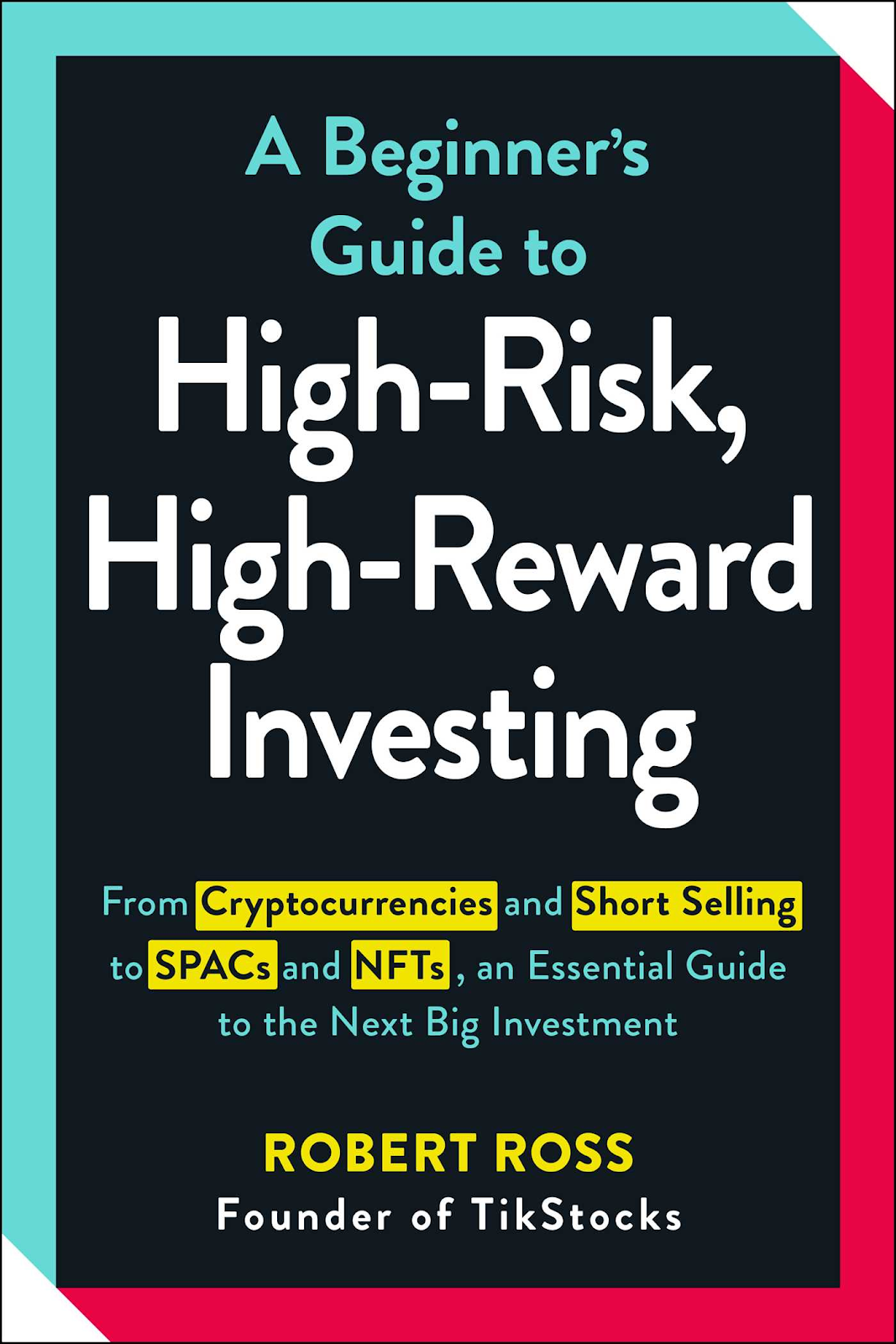
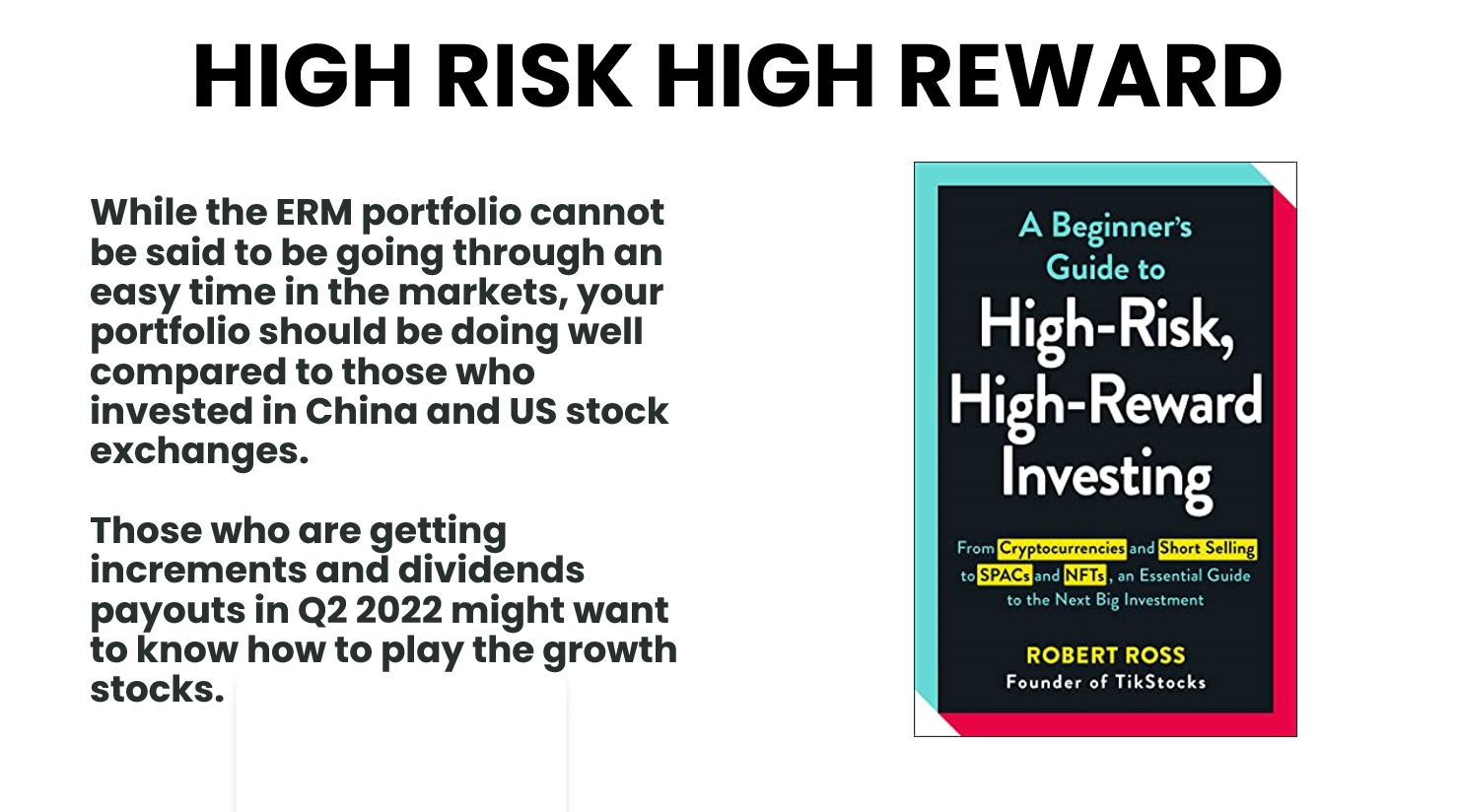
The central ideas are explained in Robert Ross' High Risk, High Reward Investing and I will be talking about this tonight.

If you're free, why not log in for this short session where I address my Alumni who might be thinking of pivoting into high-risk growth instruments.

https://us02web.zoom.us/webinar/register/3816560529405/WN_zj1qD-w4TGaP36I51sM2jg 


Tuesday, June 28, 2022

Fighting Insurance Balloon Snatchers with Dividends Investing


There's been quite a outrage lately against the latest stunt financial advisors are pulling against parents of little children. Mothership has an article that contains the details here : 

https://mothership.sg/2022/06/aia-roadshow-balloon/

The company has since apologized and then word was circulated over the web that a particular group in trying to deny that they are behind the balloon stunt in Tampines had inadvertently admitted that they pioneered the maneuver.

The follow-up actually even reflected even more badly on FAs as some seem to be more sympathetic towards the balloon snatching maneuver. This was reported on CNA as FAs cite rents as some kind of justification to bully a small child over a balloon : 

https://mothership.sg/2022/06/aia-roadshow-balloon/ 

My friend suggested that I talk about how to generate dividends to pay for balloons so that parents will never be subject to the marketing tactics of insurance agents. I think we can take a step further to use the dividends coming from retail landlords to pay for these balloons. 

Because... natural justice.

If I am an FA, I'd really hate S-REITs and will find a way to paint REITs negatively in any way I can. This is because older Singaporeans often will not switch investments once they have a way of getting >5% every year. The benefits illustration of longer tenured endowment plans cannot exceed 4.25%.  

So in this mental exercise, we will begin with a quad of retail REITs and their current yields taken from Stocks Cafe:

  • Capital Integrated Commercial Trust - C38U - 4.75% 
  • Frasers Centrepoint Trust - J69U - 5.34%
  • Starhill REIT - P40U - 6.58%
  • Suntec REIT - T82U - 5.56%
If you build a Balloon Portfolio by blending these four REITs in equal shares, you should expect a portfolio that yields 5.56%. By buying shares of retail retail malls, you can be assured that part of the rents from these insurance booths would get into pockets over every calendar year.

( Disclaimer: A well-diversified portfolio should contain much more than four stocks. This is just a way to show how you can pocket the rents paid by insurance agents to buy balloons for your own kids. ) 

So imagine you open a brokerage account and invest $1,000 into each of the four REIT, you should expect $4,000 x 5.56% or $222 a year. 

The next step is to figure out how much it costs to get a balloon. I found a link to buy a penguin balloon filled with helium at $9.90. (link)

$222 would pay for 22 balloons a year or almost 2 every month.

And the beauty of this is that you get $222 to deal with any of the antics insurance agents will attempt on you or your family. Maybe it's just balloons targeting kids today, but it may also be cosmetics for the wife in the future or health center massages in Geylang for the husband. Financial advisors will never stop bothering you the moment you step into a mall since atrium sales are now allowed again. 

More importantly, you gain agency over your own lives (pun intended). 

The insurance agencies has been fighting a war of brand positioning over concepts like early retirement and nothing infuriates them more than a person who can buy equities on their own to make investment income a reality. 


Saturday, June 25, 2022

Pivoting to Growth Investing - ERM-CCI Community Event for Q2 2022


Our next community event will be on 30th June 2022 730pm.

Like all community events I conduct, members of the public are invited to attend, but the materials assume that attendees have already completed at least one course I conduct. Alumni can also gain access to the recording.

The YTD performance of the STI cannot be said to be particularly stellar, but it has outperformed US and China markets. So while dividend investors may be reeling from slight losses, investors who focused on growth would have suffered very much more. And students from my ERM programme should have collected quite a decent amount of dividends in May and June 2022.

In this episode, we will discuss the points to note for a small pivot into growth investing. While I am all for dividends investors continuing to farm their dividends into dividends stocks, some students in my community may wish to consider channelling some income into growth stocks so that they can benefit from bull markets after Fed stops raising interest rates. 

Investing in growth stocks is fundamentally different if you are dividend/value investor. You are coming from a position of strength and likely using a combination of salary and dividend payouts to take positions in growth stocks that will give you the highest probability of profits over the next 6 months to 1 year. You also can exit and move the funds back to dividends after taking profits.

In this next presentation, we will :

  • demonstrate how to use the tools you already know to screen stocks.
  • introduce the simplest frameworks on how to time the markets and minimise your regret.
  • define a comprehensive exit strategy for your growth positions.
  • rinse and repeat our frameworks on how to apply it to cryptocurrencies.
  • update ERM portfolio results and discuss details on how you can sign up for a refresher class. 
This will be a short 1-hour gathering over zoom and I look forward to catching up with students during Q&A. 

Register for the talk here : 

https://us02web.zoom.us/webinar/register/3816560529405/WN_zj1qD-w4TGaP36I51sM2jg 

Sunday, June 19, 2022

Which husband would you choose?


The last thread had plenty of great engagement from female readers so I thought I'd do a thought experiment for the ladies today.

Suppose you have to choose between two men:
  • Bert works for his money and earns about $5,000 a month but does not know how to invest. 
  • Ernie gets $5,000 from a trust fund every month but does not work for a living.
Who would you choose and why?

If you apply some logic, Ernie would be a better choice because he can get $5,000 every month without doing anything, so he can theoretically give you financial support and still be helpful around the house. The choice of Ernie may also be supported by economists like Thomas Piketty who posits that over time, the growth in investment returns from capital trumps the return on the value of labor over time.  ( r > g )

In reality however, Ernie is more likely to be discriminated against in modern society, because he's laid back and his personal time has no value to the real world. Bob can be introverted hermit without suffering any consequences, while Bert can be seen as a potential leader in corporate world. 

This thought experiment exposes the differences between rationality and evolution. 

Ernie comes with $5,000 and time that can be deployed around the household, but Bert would still be the pick of a majority of women because he's got potential, leadership qualities so may be considered a better candidate to father more children.

But I'm getting ahead of myself. 

Lady readers can share whether they prefer Bert or Ernie.

Of course, I think the modern woman would prefer not to make the choice given that they have pretty good careers on their own. If they are PMETs most of them already have built onto themselves an Bert. 

The promise of investing better allows women to have their cake and eat it too. Ideally, they can have both Bert and Ernie while retaining their autonomy as well. 

This makes it really stressful for single men who have to up their game and generate the same kind of income as multiple Bert's and Ernie's. 

The alternative is to lie flat and just give up on starting families. I'm seeing a lot of this too.

I find some new-age Gen Z guys amusing. They dress themselves up to look like a harmless chipmunk even though they are of the age where they can date women, but the only women who might date them are those who are into Spongebob Squarepants.  


Thursday, June 16, 2022

Robowars and the Gender Gap in investing


Of late, aggressive marketing teams from robo-advisors have been trying to promote superior returns by comparing performances against their competitors. But finance is a very subjective field and when making comparisons, it is possible for one party to make it seem that they are better for investors by adjusting their timeline of comparison. The result of these aggressive forms of marketing is war, where roboadvisors try to one up each other to steal market share.

For a more detailed treatment of the Robowars, you can visit Seedly here to read about one salvo being fired by Stashaway.

Personally, I'm not really for roboadvisors taking pot shots at each other because marketing professionals need to be hired to do this, and this inflates the expenses of a roboadvisor and its ultimately the consumer that pays for the entertainment. 

I am also sensitive that investment trainers do not do the same. Singapore dividends investing is riding high at the moment after perhaps a decade of trailing behind US Tech investors and Crypto bros. In another economic regime, we would not be doing that well, trends come and go. If trainers start tracking their portfolios and trigger a wave a comparisons, it would invite reprisal when the economic fortunes begin to shift. I think it's a lot easier to focus on personal charisma and refining a philosophy to pick students who are more aligned with your style. That being said, because two decades ago, I got challenged by an insurance agent to compare investment returns, so I have have my performance tracked on Stocks Cafe, just in case some investment pugilist wants to come knock on my door. 

In the end, I did throw my hat in the ring. I suggested a simple duel. The warring robo-advisors should always be ready to publish returns net of fees, standard deviation, and Sharpe ratios for three years ending say, 1 June 2022. A higher Sharpe or Sortino ratio should adequately divide the boys from the men. Interestingly, once these marketing guys see a genuine attempt at resolving the issue of whose dick is longer, they disappear from the forums. 

Comparing dicks is of course, what some companies might want to get out of business of doing.

Yesterday, I was also invited by Stashaway to attend to discussion the gender gap when it comes to investing and went out of sheer curiosity because I cannot imagine why someone would be crazy enough to invite me, a BBFA spokesman and Senator of Singapore Incels, to discuss why women are not investing sufficiently in the equity markets. So I had to go to at least find out how I got selected. 

I was pleasantly surprised and flattered to hear that I'm one of the OGs of financial blogging. For a blog that earns just $150 every 4 months, that was very flattering.

The research presented was not novel, as Stashaway is heavily regulated by MAS. I expect them to present the results on the web soon, I added some points which probably cannot be shared by on their platform, instead I just want to put on this blog what I think about gender differences in investing :

a) Males invest more aggressively because, unlike women, we males are ranked and yanked based on economic resourcefulness. So long as women prefer more successful and wealthier men, men will not only be aggressive with investing, they will take more risk than it is mathematically rational to do so. This is why men buy more crypto, and women buy more cosmetics. It's evolutionary psychology.

b) Simply showing what women are leaving on the table when they lower their asset allocation to equities is not enough to get more women into investing. I bluntly told Stashaway to invite a lady divorce lawyer to share her experience on the latest case law. She can speak credibly about division of matrimonial assets and in which cases wives actually end up giving husbands maintenance. Fear is a much more powerful motivator. 

c) My favorite narrative is that, in modern societies, guys are not reliable anymore. Males not just lose important earning years doing NS, we are slowly losing out academically to women. While guys dominate the STEM disciplines, there are guys who can't operate a spreadsheet. Even if the strongest case where a women finds a local male grad in the tech field, it'll be heroic for him to take on 70% of the economic workload. Women can look into societies like Afro Americans in the US where black males face large unusually high incarceration rates and see how much these Black women are studying hard and empowering themselves. 

 d) In my possibly archaic view, men will never be an "Ally" of women. I'm a provider to the women of my family, and I am concerned about the welfare of my daughter when odds are my son in law will suck and unable to support her 100% (won't even be his fault). When you say Ally of women, I imagine some effete BTS team member who wears makeup and support equality so long as they sell more music records. Gen X men are grudgingly partners, but only because we're not good at making money anymore to feed the whole family. I think a lot of old school guys want to provide for the whole family but they can't.

e) Ideally, guys needs to be kicked out of the discussion room for now. Upon reflection, it does not come as surprise or irony that most of the folks discussing the research finding in room are the dudes and I contributed quite a fair of that yesterday. I feel genuinely bad about the whole encounter now. There were two journalists in the room, and they were so quiet I though I was in a speed dating situation organized by the SDU in the 2000s. Initially, I'm not a big fan of women's only events because of my firm belief that stocks don't check your gender before they send dividends in your bank account, but giving up some space so that women feel more comfortable about speaking up is really important for now.  

Anyway, this is just a glimpse of my personal encounters yesterday, I think we should give Stashaway a chance present their findings and pivot to an important demographic. And do give their fund performance some slack - sometimes you win, sometimes you lose. Over the super long term, the gap will not be too different for portfolios with the same asset allocation. 


Sunday, June 12, 2022

For Air-level students, straight B's may be a mark of mediocrity


It may a virtue or a fault with the Singaporean system that we can be so lenient with some of our kids but so brutal to others. 

This week we are treated to an article that talks about the shifting fortunes of the A-level intake for different local university faculties ( link ). While Law and Medicine kept the minimum straight-A requirement, the newest top faculties include not just Computer Science, but also Data Analytics and Food Technology. 

As some faculties got elevated, others fell. Accounting is a particularly prominent victim of this shifting of fortunes with the cut-off being straight-Bs. 

What erks me is not the change of fortunes, as I've witnessed Engineering move from star faculty to the proverbial garbage dump, but the reaction of the faculty when they start getting more ordinary students. 

If you read closely the comments of the Accounting professor, I came off with the impression that admitting straight B students is an unmitigated disaster for the accounting faculty, it is as if straight B accountants are unlikely to think critically or bring innovation to the industry. Of course, the professor did not position it that way, he was questioning whether the course material needs to be reformed, but if you think more deeply, why do reforms only need to be triggered when you start getting straight B students? 

( If the Faculty of Engineering watered down the syllabus when they got students who get a C in Physics and Maths, people can die! The solution is to prevent them from graduating or give them a Third Class so they can make millions selling real estate or insurance! )

What entertains me more is that the Computer Science faculty in NUS does not even hide its exclusiveness anymore with prominent figures calling the older Straight-C generation of computer scientists "garbage in garbage out". I think it says more about the professor than my CS peers in the IT industry. 

This is one of those rare moments when you experience the true feelings of elites in Singapore. I actually think that only Air-level types get exposed to this before the working world. It's real-world training and at the very least it mirrors the public sector and the scholar-farmer divide - the largest employer in Singapore. 

While I think there's absolutely nothing wrong with straight B A-level grades, I always preferred the A-level system because this is where personal growth comes from trauma.

The world of local degrees is going to continue to be like this. At the micro-level, people are constantly going to be benchmarked and subject to a lot of microaggressions. At the macro level, NUS and NTU grads, even straight-B accountants,  can now get fast-tracked roles in London which should see increases in starting salaries in a few years' time.

While I might come off being unhappy with this, I think exposing my kids to elitism, prejudice and unfairness is a good way to build their character, which is why my stand on bribing them to go JC instead of Poly is still something I am considering. 

You would not really want to do the opposite as well. A friend sent me a link from the Mothership where a bunch of parents defended their decisions to send their kids to a private university.  

This was so badly done, I thought whoever orchestrated this should be fired. 

At the end of the day, if elitism and injustice is something that upsets my kids, then I suggest that they try financial markets for change. 

A REIT will give you the same dividend regardless of your A levels grades. 

In similar vein, the Terra USD lying in a wallet of a Dean's Lister will depeg no matter how many Phds you have.


Tuesday, June 07, 2022

Should a fresh Polytechnic Graduate get a Private Degree or Wash Dishes for a living?


Once again, I can't express how disappointed I am at Millenial advice columns and HR career experts who miss out on this latest issue that once again I will have to blog about this.

Suppose you are a fresh graduate from a Polytechnic and contemplating a private university degree. 

A quick survey on the latest private degree salaries would expect a salary of $2,900 based on April 2021 data (link). The private degree is not cheap because it lacks subsidies and will cost you a couple of years of your life.

Now, if you look at the current trends in the industry right now, dishwashers can earn about $4,000 a month. (link

The gap of  $1,100 is not trivial, suppose you become a dishwasher for three years and save the $1,100 difference compounded at 6% p.a., you will have an additional $42,000 compared to your peer who would have just graduated from the private university and accumulated around $56,000 in student loans (I used JCU Business Degree costs in my model).

If you can save more than $1,100 a month, the decision to become a dishwasher instead of attending a private degree can come up to over $100,000 if you factor in additional earnings and the fees you would pay!

Of course, there might be some concerns about dishwashing work in Singapore. 

The first concern is whether the dishwashing work at $4,000 is sustainable. That will be a valid concern if we take on more foreign workers to do this work, salaries will dip again. But I think it's high time the government start to rethink its labour policies to allow foreign workers only in tandem with more local hiring. Also, nothing stops the poly grad from attending a private degree after the gig is no longer available.

The second concern is that an office worker may have a career ladder but the dishwasher doesn't. To be realistic, we may need more data on salary increments of private degree holders, but suppose we go with an annual 5% increment of a $2,900 salary, it would take more than 6 years for the office worker to reach the level of the dishwasher. That's assuming the dishwasher does not invest his savings. Adding the length of the degree we could be looking at a 9-year salary advantage! 

The third question is that dishwasher work is backbreakingly hard and may attract social stigma. This, I agree. But a $4,000 salary is the right step to change our attitude toward blue-collar workers and these salaries may also push business owners towards better automation which may result in easier work.

The issue of Private Education Institutions has always attracted a lot of controversies and I seem to be the only blogger happy to talk about this. So much so that folks actually goad me into commenting whenever a salary survey comes up.

There are of course the politically correct words spoken by folks who run these institutions who keep accusing the industry of discrimination, but no rational business owner can ignore the cost savings they can get when they hire a PEI student as compared to hiring a local grad. The situation may even be the opposite - some policymakers have in their books subtly hinted that the salary uplift of a PEI grad compared to a polytechnic graduate worth about $500 pm may not be justified.

There is a lot of food for thought, but I will end with a thought experiment. 

Suppose a diploma programme director was to be able to convince his entire cohort to take up dishwashing roles, the salary survey for the following year will show results that even exceed some local degree programs! 

That is at least a powerful story in the hands of a local journalist.


Thursday, June 02, 2022

Dirty Secrets of Wei Foo


If I do not have something interesting to write about, I'd normally explore the content generated by others to see whether I can build on top of it. Once again, the Woke Salaryman did an excellent comic strip on FIRE and I think I can add value by doing an article on this. 

Please visit this link if you have not done so earlier because my article assumes that you have read the comic.

I've been following the response to this comic, and I must say that I'm quite disappointed. 

A common response is that we should try to become Wei Foo. 

In my opinion, that's not mature because it's hard to attain FIRE. 

A mature response is to figure out who you really are in that strip. 

My cousin, who works for an asset management firm, lost money in LUNA (like me) and admitted that she's a lot more like Curtis. As for myself, even as I FIREd almost a decade ago, I find that I have a much stronger affinity with Amelia, because my ENTJ personality makes it hard to do nothing post-FIRE. 

I also don't agree with the life philosophy of many folks who area ahead of me in the FIRE movement in spite of my deep respect for them. Do I want to aspire towards a life playing MMORPGS until I die? Or spend the rest of my life splitting hairs to get the 4th decimal place of the safe rate of withdrawal?

As I'm part of this FIRE movement, I think we're to lax with Wei Foo and I want to deconstruct Wei Foo properly and explain why he may not deserve the admiration that has been depicted in this comic series.

a) Wei Foos may be born rather than made

Wei Fee is an imaginary construct of the Woke Salaryman who did an admirable job trying to depict a person who can achieve FIRE. Kudos to them for not Mary Suing themselves into their strip. 

My first issue is that Wei Foo is likely to be born with some specific personality traits, which Woke Salaryman was unable to explore due to their medium.

Every ERM class I conducted would fall into just one or two MBTI personality trait. As it turns out INTJs dominate the FIRE discussion groups on Reddit and also my biggest paying customers, so much so that I no longer see myself as an educator of finance, but as an enabler of a specific group of people who self-select into the ranks of the Financially independent. 

I have very close INTJ pals. 

You don't really turn kids into INTJs, its largely natural occuring, so this defeats that round of folks trying to "become Wei Foo for the winz". A stereotype INTJ-Wei Foo-compliant-avatar is a software architect who listens to World Music, watches obscure anime, and reads books about the Occult. I love hanging out with them, but even I can't even get remotely close in terms of broad interests.  

If you accept my assertion that Wei Foo are probably INTJs, then all hell breaks loose.

b)  Wei Foo may be in a very elite industry that is very hard to get in.

INTJs are fundamentally not a high-earning personality ( but they are above average ). Amelia who seems more ENTJ can say that she can do sales or take on a leadership role to earn her $12k a month. If you expect an Introvert to so the same, then you will be left with just maybe software development that will respect introversion and a broad conceptual approach to work. Accountants and Engineers have an ISTJ inclination.

Modern software engineering is a very modern niche skill. 

(Otherwise the private management degree holders who have a starting play $1,200 less than dish washers today will apply en masse to become full stack engineers.)

Even if you do get into the industry, there's a big difference between the 100x developer who can architect a blockchain smart contracts platform, and a tech peon who specializes in shaping JDBC connections. Its an intuitive open mindedness that can adapt a technical solution to business needs.

Worse, the Wei Foo of the future will be conversant in Quantum Computing. I took a couple of introductory courses and it's no joke. Basically you need to manipulate linear programming matrices that contain complex numbers. Right now, you needs Physics degree with a specialization to get a foot in the door, an elite CS degree may not be enough.  

So it's not easy to qualify as a Wei Foo, you might need to be top 5% in STEM subjects.

c) Wei Foo may be emotionally stunted and will have trouble finding a mate 

The introversion that allows Wei Foo to master finance and investing and develop the "Kiam siap" to FIRE will be an impediment to developing an emotional bond with someone. There are some folks who FIRE and have a family, but there are also quite a number who FIRE and stay single. 

I'm saying this because I feel it too even when I'm not an introvert ! We ENTJs are also emotionally stunted, but we're kinda proud of it.

If you combine introversion, kiam siapness, super mild Asperger's, deep interest in hard core fields like investing and finance, it's a straight road to BBFA life. I encourage female readers to date them to really understand what I mean.

This is why I disagree that Wei Foo can even get married on shoestring budget. Most Wei Foos won't even come close. 

I think if we adopt this framework to deconstruct Wei Foo, then we will understand that sometimes, it's not the price we pay to attain FIRE, but it can be our genetic makeup, and the price to pay is understated. 

Fortunately, the world requires all sorts of folks to function, you need the Amelia and Curtis to run the economy, and if some of them never attain FIRE, it is possible fine.

The movement has evolved milder forms of FIRE like Coast or Barista for other personality types, go read up on them further to explore which idea suits you.

Saturday, May 28, 2022

Terra USD - LUNA is like your penis, difficult to cut it off.


For those looking for a great article on Terra 2.0 which just dropped, you can refer to Dr Wealth's blog here. 

If you want to read something less wholesome, please continue.

My new LUNA token has finally arrived. At the moment, I have no idea how much they are worth, but some folks are estimating a ballpark value of about $5 each. When exchanges start seeing some transactions, it may sink very quickly because there doesn't seem to be any motivation to hold onto it.

I'm not selling mine. If the new LUNA crashes again, I might buy even more. 

With the new blockchain, the old LUNA classic blockchain is really starting to erode. I have a morbid fascination with the UST and LUNC tokens which really lost a lot of value, but I love playing them like monopoly money, I've got liquidity pools worth a couple of hundred bucks ( but millions of LUNC) spinning off $10 USD a day, but the websites no longer seem interested to interact with my wallet when it's on classic mode, so I can't even claim my tokens. 

It's always sad for a trainer to see a blockchain de a slow death erode this way, because even if the tokens have no value, the idea of using tokens to connect to a website and being able to get into a liquidity pool at a low fee can be a powerful educational tool. With $100, someone can get millions of LUNC and then get into a pool that gives 1000% p.a. 

My personal wish is that somehow the classic blockchain survives and attracts a kooky bunch of computer scientists who then proceeds to crafty really weird projects on it. 

For the new blockchain, I understand its sole purpose is to preserve some kind of developer ecosystem, but experts are saying without a stablecoin and 20% returns, there is little motivation for it to grow. 

So I will make a weird prediction here.

Some kind of stablecoin with high returns will come back to Terra 2. It might be disguised in a another form like a derivative or even a liquidity pool, it may be convoluted to execute, but the truth of the matter is that young men need the fantasy of a high yielding stablecoin to feel in control of their lives. 

Terra USD-LUNA dyad is really like your penis. 

You can't live without your penis. 

If you cut it off in the new blockchain, someone else will find a way for it to grow back. 

Would it be legal? Well, whoever reinvents it will not care. 

If you observe crypto bros when LUNA was in it's peak, it's like a penis member fully erect. Guys become a lot more confident when they date women and engage in a more edgier and risk-taking behavior. The reason is that women really do take economic resourcefulness as a primary consideration when selecting men. I may even venture to guess that UST-LUNA has a direct impact on levels of testosterone of significant male population when it is rising. 

Terra grew because it is an enabler. Why else do Ponzi schemes keep coming back in a different form?

The saddest thing about Terra is that the UST event is a massive castration event for thousands of young single men. It came at a time when other erect asset classes are witnessing their own castration like US Tech Stocks and China Tech stocks. 

These are, indeed, flaccid times.

Hopefully, some of the more clear-headed investors have taken note that those who invest locally in REITs, bluechips and business trusts are still doing ok at times like these. While dividends investors are not flashing their 12-inch erections at others, we've always been modest in most economic climates. 

After all, anything larger than a mouthful is a waste.


Wednesday, May 25, 2022

Previews cancelled this week due to nasty sore throat


I've been really unlucky. After a 3-hour wait in TTSH awaiting my specialist appointment, I developed a sore throat over the weekend. I've since been conducting ART tests every other day, but I have been negative so far.

While I'm feeling fine, I was unable to go ahead with my previews this week because I've developed a really nasty cough. This is disappointing as I've got a spotless absentee record so far for the past 3+ years and dividends investing has been gaining some interest probably at the expense of growth, tech and crypto investing as of late.

I'll probably get back to shooting videos next week, with at least two coming up. 

For now, I've got a new article out on retail bonds.

I'm going to take a rest and I hope to come up with something on this blog in about two-days time. 

It's probably good for me to lay off my work for a while and just focus on reading investment books for a change. 

Monday, May 23, 2022

Soul vs Structure - Singapore's Faustian bargain


One of the small tiny superstitions I subscribe to is that shit awaits someone once he or she says that "Singapore has no Soul". It's almost as if LKY is now some kind of Guardian Angel that will exact vengeance against anyone who says we have no soul.

Sharon Au said that when she moved to Paris years ago and recently her apartment in France got robbed and the robbers took everything except her pussy. Days later, she complained that French authorities were too busy to help her retrieve her property.

Even during my KL trip, my aunt complained that Singaporeans have no soul. Then, in the latest SEA Games, Malaysia's medal tally was so bad they ranked behind us - a country that has an insignificant population that does not even have an emphasis on sports. 

I'm going to now try to unpack and develop this idea further with a few mental models.

The first thing we're going to do, is to figure out what having a Soul trades off against. We have to give up our Soul for something right? 

Off the bat, I'm going to suggest that Soul trades off against Structure. 

So if you go by my logic, Singaporeans have no soul, but our traffic system works because of an oppressive ERP system and traffic rules that do get enforced. In KL, you can wait 3-5 minutes for the pedestrian lights to turn green only for 15 seconds. As a consequence of that, no one obeys traffic rules. My mum almost got knocked down over a zebra crossing that has faded stripes in KL Sentral.

The larger intellectual challenge is to show that Soul and Structure tradeoff against each other like inflation and unemployment. It is possible that they are not mutually exclusive. 

To deal with this, we will apply another mental model and examine who likes to complain that Singaporeans have no soul. 

I'm going to just guess that on the MBTI these folks belong to the FP or Feeling-Perception spectrum with a low score in Conscientiousness. It's largely their inability to deal with folks on the TJ or Thinking-Judgement spectrum who have high conscientiousness so the most convenient way to avoid cognitive dissonance is to just claim that they are soulless. 

At this juncture, do note that when TJ guys make a mistake, it's often buying the wrong stock and misjudging probabilities on investments going up. However, when FP folks make a mistake, it often involves venereal disease or large doses of heroin. Almost all Legends talked about by alumni group involve someone who is an FP. FPs lead a dramatic life full of ups and downs, but more downs as they get older and TJs start climbing the ladder.

Another reason to support the trade-off is that those places that emphasize soul would normally have serious issue arising from a dysfunctional structure. Parisian police are too overworked to deal with folks getting robbed. Malaysia cut their sports budget and headcount by half and still acted surprised when the SEA games results were so bad. 

So there you go. There is definitely a case that Singapore lacks a soul, surveys have shown that we exhibit the least amount of emotions in the world. 

But is that such a bad thing? 

We get a decent structure in return.

Our system works, we get decent healthcare, low taxes, and a great REIT regime that supports retirement planning. When the FP artistic types were hit by COVID-19, our structure provided them a $1,200 - $1,500 stipend so they can continue to complain that we have no soul instead of doing food delivery worker or a prostitute. 

Now let's see whether the structure we built up can deal with banned chicken imports from the North. 

I got pals celebrating because it means more decoupling in the future, but I'm looking forward to more vegetarian meals in June.