Monday, March 30, 2020

Brave new world of Webinar training

Dua Lipa: Critics rate Future Nostalgia as the best album of 2020 ...

After the government announced that gathering of more 10 persons banned, we've been trying to pivot into Webinars, so I have spent the greater part of the weekend trying to translate my training program into a webinar. 

The work to pivot was much harder than I thought and other trainers may want to read this before going ahead.

(Why do I want to share my training intelligence with other trainers? Simple, I believe one-day investment trainers will be asking me to train them! BWAHAHAHA !)

a) Webinars are labour intensive

My biggest fear was that webinars are so easy to run, there will be thousands of competing training programs in the near future. As it turns out, this is farther from the truth. While I proceed with my training at a much slower pace, my colleagues spent the entire time troubleshooting connection issues.

Their work is worse than IT operations because even if a server fails we have an hour to get it back up. My trainees miss one hour, it is as good as not attending the course.

Make sure there is a team working when a webinar is happening.

b) Better for the team to be located together during the webinar

As a webinar is a performance to a large remote crowd, don't make of the mistake that you can do the webinar remotely vis a vis your teammates. A lot of coordination takes place real-time.

In my case, there is a time delay between my narration and the time my students receives the message. Without another teammate logging in as a virtual student, I can't estimate what that time is.

I also received an urgent call from health authorities halfway while conducting a quiz ( SHIT! ). My teammate took over. Turns out they just want to arrange to delivery of medication.

Anyway, this may be unavoidable as we lock down further. I now have all the infrastructure to conduct the next session from home. I need to cordon my kids off if I have to do that.

c) Attention span is different in a webinar

We took the decision not to risk the quality of the training by stretching the training from 2 days to 4 days. This gives more time for Q&A, which comes in a greater volume in a webinar format and prevent students from losing focus. I can definitely rush through investment training, but I am unique in that I invest in my student's portfolio. This forces us to put a premium on quality.

d) IP issues take centre stage

It is much harder to defend your IP when you go webinar. We rushed into this without much forethought (unforgivable, as I am legally trained). You need a web of NDAs and physical measures to protect your IP. My material changes each lecture but trainers need to spend more time on this.

In can introduce my professor to anyone who is interested in such matters.

Just contact me privately, even if you are a market rival.

e) Never go full 100% webinar no matter how bad the situation is

It never ceases to disturb me when I see an ad slashing a $1,800 course into a $19 webinar. The decision to go online will kill most legitimate businesses, including my own. So right now I am willing to add one day of face time to all my students when lockdowns are over.

It will be one full day of practice sessions I intend to model after this Software Development school called 42.

While I am not Dua Lipa, I am pretty sure my physical presence nets my business partners more than simply just downloading my disembodied voice.

This blog continues to post with lower frequency as I put renewed focus on my ERM FB community.

I will see you guys probably one more time this week where I post a personal update.

More next week when my class is over.


Thursday, March 26, 2020

Riding the COVID-19 roller coaster ride

Image result for roller coaster hell

The past few days were horrendous. I thought once I squared off my margins, I would have a few days of peace but the COVID-19 situation grew so bad, I was no longer allowed to conduct my class this weekend, ruining months of marketing and sales of tickets.

While these restrictions are very much needed in Singapore, I just can't let my planning all go to waste. So I had been working on turning the class into a Webinar and had to learn the use of webinar software from scratch.

The harsh truth about training programmes is that if it can be made into a webinar so easily, then it will be too easy to take the instructor's lunch because all it takes is a series of Youtube videos with the same content to get the job done. This parallels the work from home effort going on in Singapore - if you can totally work from home without missing a beat, your work can be outsourced and your employer will remember that when the economy recovers.

I will be converting my course into a two-weekend webinar, but once this is all over, students will be invited for a full-day meet-up to run through the practice sessions again with a new data-set. Hopefully, they can appreciate that they will get more than any previous batch of students.

Of course, my anxiety is not over yet. We're still not in full lockdown mode, so I can still conduct the webinar from an office location. If there is a fullscale lockdown, I may need to retreat further to conduct the webinar from home.

We are basically operating from instinct, trying to stitch different web-tools together to make learning a superior experience. As in all things IT, a little bit of lag and all hell can break loose on the day of the performance. The upside is that I can now conduct web seminars so I will expand my reach and community engagement over the next few months while COVID-19 rages in Singapore.

And just as things are about to get worse, investors received a significant amount of dividends today and this will go on until 31st March. At least the rents have not stopped arriving for this month.

Another pleasant surprise is that I may even be classified as a freelancer under the Budget announced today, so I am actually entitled to $1,000 for nine months!

I will not invest it away because the economy needs me to put it into circulation as soon as I receive it so it goes to my wife to buy groceries for my family. I have plenty of ways to pick up more investment securities.

Make no mistake. The response to the COVID-19 will hurt my training business. But whatever I experience, it will be nothing compared to the rest of the gig economy who suffer tremendously over the next few months. I'm glad for them that we've announced the Mother of all Budgets to help them for the next few months or so.

This blog will not receive a lot of updates in the meantime as I struggle with the fluid situation.


Saturday, March 21, 2020

Invitation to Gloat and a Personal Update

Image result for rakdos

I miss this blog.

I don't know 99.99% of you guys but I am sure folks read what I put up.

The reason why I took a short break was that market changes forced a rethink of my course slides and I was suddenly asked to submit the slides for printing by this weekend. Couple that with adjusting my portfolio to avoid margin calls, it was a shitstorm for the past few days.

a) Death of the Leveraged REITs strategy

Risking sounding too dramatic,  the Leveraged REIT Strategy died a horrible death last week. I have been selling for weeks and informed all my students of my change in investment approach but my selling was still too slow to mitigate the damage to my leveraged portfolio. I think a series of articles on Dr Wealth would be more appropriate and I expect readers to look forward to it.

You guys should know I don't do the "I knew it all along"  kind of articles, I prefer to think about what went wrong for me and I promise to showcase the stupidity that got me to this stage. My advice to critics is to gloat now and be as public about it as possible. I mistimed the market even though I documented everything on how my own strategy could fail in my older slides.

On the brighter side, I no longer owe my brokers money and, unless a miracle V-shaped recovery occurs, I can make my kids millionaires with the bargains we are getting in the markets.

The wealth exchange between one generation and the next generation has begun.

b) COVID-19 and lifestyle adjustment

Removing margin also has a strong psychological dimension. I am now free to think about things that matter.

As an extrovert, I have been too focused on life outside my home. Now it is time to look at the large volume of books and games and finally, find a way to play them. I will see whether I can teach my kids to play The Fantasy Trip, an old retro game only the oldest fogeys will know about. Each character sheet is the size of a credit card.

c) Impact on training business

Make no mistake - COVID-19 will hurt the investment training business. Attendance is down as a proportion of registrations and registrations is also down. As a response, I am adding a lot of COVID-19 related investment analytics into my presentation to spur demand.

My fear is that classes cannot continue. We have changed venues once yesterday to ensure the 1-metre safety distance and I will be experimenting with webinars once my course prep is complete.

The upside to all this is that I get to interact with my 370+ community.

d) Sharpening the Saw

At least two areas in my life is not a total shitstorm. My Python programming is moving along fine and I managed to get some leeway building websites with flask.

The best progress is my exercise. As gym sessions continue, my body has stopped aching after an aggressive workout. I also have developed an unholy breakfast concoction using yoghurt, blueberries and granola that does not taste like shit so I can sustain it. Today I even managed to make avocado edible by adding lemon juice, salt and yoghurt.

Yoghurt is very key because the acidophilus bacteria helps with controlling my blood sugar. Problem is that this class of yoghurts are very sour and needs some bit of hacking.

e) Reading

I am torturing myself by reading Playing at the World by Jon Peterson. It is more boring than legal cases I used to read but it is a painstaking description of my D&D hobby. I learnt about the kind of wargames Prussian generals played 300 years ago and mythical roots of elves and dwarves.

Anything to get me out of overthinking about the markets.

f) Hobbies and entertainment

So far I have held back from taking the easy way out buy playing computer games or binge-watching anime. This is probably not sustainable. Right now, anything can happen as I try to stay indoors. Maybe I'll watch Star Trek Picard. Maybe I'll buy a PS4 or Nintendo Switch.

I've also reduced my workload to focus on leisure this weekend.

Anyway, without the weight of a margin account, I am actually much happier than before COVID-19. Bargains galore in the markets for those who can hold indefinitely and I am forced to think about my hobbies and leisure.


Sunday, March 15, 2020

MBTI - Astrology for HR Professionals !

Image result for I'm not crazy MBTI

A big market downturn is also a time for personal reflection. After the Friday 13th panic where I unloaded stocks to shore up my margin account ratio, I had to distract myself. This time around, I chose to read a book on the Myer-Briggs Type Indicator, a personality profiling system largely dismissed by the academic community but generally quite successful in the business world.

In my view, when a system does not have the firm backing of the scientific community, it belongs to the same class of belief systems as Astrology. My opinion is that technical analysis, the capital assets pricing model and the efficient markets hypothesis, all fall under this category. Consequently, I do not like to dismiss Astrology, being a huge fan of good and somewhat random advice in many Astrology columns. Up till today, I have yet to see an astrologer advise Capricorns that this week would be a good week to murder an insurance agent or commit money laundering. In a similar vein, technical analysts do have a respectable approach to risk position sizing and emotional management.

I will not really explain what the MBTI is. I think readers should try to find some online test and figure it out yourselves - there are plenty of tools on the Internet for this purpose. I was aware of the weaknesses of this system - I tested ESTJ in JC but recent online assessment have tested ENTJ. The context of an engineering career makes a person highly practical and data-driven., a luxury a lawyer might not be able to enjoy. Legal training tends to teach us to be more strategic and think about the big picture. I probably am neither ESTJ or ENTJ, I am likely E*TJ.

This book by Pearman and Albritton takes the MBTI further and delves deeper into the model by considering alternative modes of behaviour and personal weaknesses. You may not believe in MBTI yourself, but you will come off feeling that the authors really drink their own kool-aid.

The first insight is that beyond our primary processes, we have auxiliary functions. My primary mode of behaviour is Extraversion-Thinking and this shows across both my engineer, a law student and trainer personas. So I take in information best when interacting with team-mates and crowds.

A person's auxiliary function balances the Extraversion with the Introversion axis. As such to make a decision, I often have to reflect internally upon the information I get from conducting classes. At this stage, it's get confusing because I can't tell whether my auxiliary function is IS or IN. An IS prefers to reflect upon hard facts and have a bias for the practical. An IN prefers to intellectualise and loves dealing with broad concepts and theories.

I am neither a sensing or intuitive person. I generally find myself dealing with back-testing data and trying very hard to reconcile them with theories about market outperformance. There is no escape from tying the hard facts to the broad concepts to determine the action an investor has to take. I think it is this full-stack approach to investing that makes it so hard for me to pin down my current MBTI profile. Sometimes the most practical way to take on huge amounts of data is to start with great first principles.

Of course, the hardest part of the MBTI is to know your weakness. In my case, my biggest problem is coded IF. Getting in touch with my internal feelings. Even the remediation steps are really hard to contemplate given my current work situation.

In situations when I deal with people I should focus more on their emotional state and the personal values they bring to the table. This is a horrendous idea to me given that, logically, people come with so many contradictions that dealing with it means arriving at sub-optimal results. Also, I think culturally, this can be viewed as a weakness.

The hobbies I should adopt is less vomit-inducing. I was advised to spend more time making art. In this case, I am grateful for my RPG background which is amateur theatre with lots of dice and mass murder. With my financial independence, I have attempted musical composition and improv classes. I think they all ended in unpleasant disasters.

This should not stop me from trying shit that I don't understand - I need to set an example to my kids.

Even with the lack of scientific rigour, readers should make it a point to know your MBTI. This will at least prevent you from being stuck doing work you hate. Imagine an INFP studying data science. That would be suicide-inducing.

Knowing your MBTI also helps in understanding a lot of business books that seem to be hell-bent on adopting MBTI over the better frameworks used by academics. I once had an economics professor who asked a group of zombie public servants whether they like more entrepreneurs DNA in their organization which was, predictably,  met with a resounding yes. Then he pulled the rug under us, saying that entrepreneurs tend to be ENTPs, one of the flakiest and least conscientious types who are likely to the worst fit for my organization.

That moment of one of the most pleasant ones I had when I was in government. Broccoli had more personality than some of my colleagues.


Friday, March 13, 2020

Beyond Anger and Frustration...

Image result for atrocitus

This morning Dr Wealth CEO Alvin Chow asked me to pen my thoughts on the context of the Great Recession of 2008 against our current economic back-drop. I decided not to do so yet because I am in the middle of aggressive back-testing on this new bear market, what I want to know is to get a real-time understanding of investment factors that fail when the market is in free-fall. The results will probably be available next week before my next preview.

But Alvin said that this is a good time to demonstrate some pathos to the investing public. I don't think the Dr. Wealth blog is ready for any pathos from me yet, like many investors I am shellshocked by recent market moves, but this blog can accommodate my more random musings.

The truth is that I'm really angry today.

This is nothing like the Great Financial Recession. During the GFC, I had one simple unleveraged portfolio and a ridiculously low expense rate. Now, while I have a substantial unleveraged portfolio supporting my family, I do have a leveraged portfolio that is almost facing a margin call this morning.

I have a personal rule to react when my margin account ratio reaches 150% - I sell away enough counters to get some breathing space regardless of my personal feelings of how the market might turn in my favour later.

Today my margin account ratio hit a low of 147%, so I took a significant number of my legacy investments (before I started using Bloomberg) and sold it off to push up the margin ratio to a more reasonable number. The result is that I took some losses and only gave myself breathing room to take in a further 18-20% drop. Doing this lifted the psychological burden on me, but not the possibility of further drops when Western governments were found to be unable to cope with COVID-19.

My personality is that I hate selling my investments. The broker takes a cut, and the guy buying from me is certain to make a huge profit if he can hold onto it for 2 years. But selling now is better than selling everything when a margin call occurs.

Naturally, when an investor sells shares, magically, the markets will rebound. As of this moment, the DJIA futures are trending up. Selling stocks is almost like making a sacrifice to some Pagan God by killing your firstborn child.

Once the margin accounts are secure and I am not going insane and thinking whether the broker will margin call me, the next thing to do is to distract me from compulsively looking at the markets. At least for today, teaching myself Python paid off as I was able to write a nice webpage using the flask library and even picked skills on Python project skeletons. After that, I even forced myself through a fairly technical book on the MBTI personality framework.

If this market event is a repeat of history, then those with strong holding power who can farm their salary into the financial markets without breaking a sweat will be almost assured a straight path to becoming a millionaire when all this is over.

As to how much leverage to take and which strategies to follow, this is something I have to explore over the next few days. There is a delicate balance, make a portfolio too defensive and it can protect you against further downturns, but defensive portfolios will not do that well in recovery.


Wednesday, March 11, 2020

MBA in a Nutshell #28 - Accounting and Finance : Investment Appraisal

Today we will look at various ways to internally appraise projects in a company. These frameworks are more appropriate for business administrators but they can be modified for use by some investors.

Let us begin with common metrics :

a) Net Present Value (NPV)

NPV =  Cash Outflow - Present value of incoming cashflow

This is the most basic of all investment appraisal techniques. Where the NPV is a positive number ( such as +$10,000 ), the project is viable. Where it is negative, you are likely to be throwing good money after bad projects. This can be manipulated by projecting a different future incoming cashflow and lowering the discount rate in the calculations.

b) Internal Rate of Return (IRR)

This measure calculates the proper discount rate that would set the NPV measurement of zero. On a spreadsheet, the IRR() and XIRR() functions can perform this calculation separately. When you use IRR you no longer have the ability to manipulate the discount rate. Companies often set a hurdle rate when assessing projects using this framework. Many years ago in P&G we were told that IT projects that do not have an IRR of 15% should not be carried as P&G is better off farming the money to branding campaigns.

c) Payback period

The final measure is based on the number of years a project needs to break-even. This simply takes the investment outlay and divides it by the yield of the investment project in absolute dollars. A $100,000 project that returns $20,000 every year will reak even in 5 years. If you use this approach, projects are chosen based on how quickly they can pay you back your original investment.

The text-book goes beyond these standard measures with a scathing critique of measures created by the consulting industry. Measures like EVA and MVA are designed to distinguish consulting offerings from each other and introduces biases in measurement. For example, EVA tends to be biased towards managers who milk their companies and focuses less on growth.

The author suggests that, instead of following the latest management fad, simply using operating income divided assets into an ROI measure works best.


Saturday, March 07, 2020

How to think about Skills Future, educational courses and future proofing your lives

Image result for iron man

I was thinking about this question when someone on BIGSCRIBE decided to ask around on how to future proof ourselves and determine which Skill Future course to take.

This is a question I have been grappling with myself for decades. I entered the workforce when some people still believed in loyalty to the firm you work for. When I joined P&G, there was this rare moment in my life where I actually aspired to have a lifestyle like my managers and bosses, so I upskilled based on what I thought were tech skills a manager should have to look after an IT infrastructure properly.

As IT managers tend to look after an entire IT platform, I took every certification exam I could on Windows, UNIX, AS/400, Novell, Cisco, IT Security.

I wanted to rise, and I needed to rise really fast.

Taking two to three times the number of exams compared to an undergraduate did not accelerate my career progression, but it did accelerate my ability to take a lot of exams. This may seem sort of worthless at first, but I found that I could take the CFA, CAIA, and FRM almost simultaneously when I realized that my company is not that loyal to me as compared to my stock investments. So, inadvertently, I unlocked the most important future-proofing skill in my 20s - the ability to pick up deep technical skills almost real-time on my own, with negligible costs, without the need for instruction. 

I think doing what I did would be a waste of time for younger people today. Instead, I will provide a framework on how to think about investing in personal skills.

Here is what I think you should approach your education :

a) Being job-ready does not make you future proof

Being job-ready means you have something an employer wants. It can rapidly put food on the table. If you do not have a job right now, you better find a way to be job-ready. The constellation of courses on specific skills like how to be a security guard or a private investigator falls into this category. If you are jobless, you better rush towards one of these certifications.

Future-proofing courses are generally not as practical as job-ready courses. A course on statistics and linear programming will not land you a job immediately but it will pave the way for a deep learning programming course that will in turn land you a better job placement in the future. The goal of future-proofing is to download as many mental models into your head as possible, but you can only afford to do this when you are not hungry because developing mental models need patience.

The consequence of understanding this will change the way you look at education. As the government drives for more adoption of polytechnic diplomas, that's just trying to get Singaporeans to be job-ready. If you really want to future proof yourself, only a series of advanced degrees will give you the myriad of mental models to do that. But advanced degrees may not directly land you a job unless it also teaches job-ready skills.

b) There are some skills that make you job-ready and can future proof you.

In fact, these can be categorized into four categories.

  • Interpersonal skills involve public speaking and selling.
  • Creative skills involve writing and design. 
  • Technical skills like programming, investment management, and marketing funnel design.
  • Physical skills like personal hygiene, yoga, and organization consulting (Marie Kondo ?)
To monetize these skills, my experience is that focusing on one is not enough. I know folks in the Toastmasters for decades who hardly make money from their public speaking skills which win them trophies every year. My current job involves at least three skills: Selling, public speaking and investment management. 

I just need to hone each skill to the top 30% of the cohort and I should do ok.

c) You need a learning 'exoskeleton'

I'm still developing this new idea which I think has merit. As investors, we have no idea how much alpha has already been extracted from financial markets before the profits come trickling down to us. 

As a trainer, I can't simply present myself as a person people would pay money for, I see myself now as a combination of tools with my personality to do my job - sort of an Iron Man character. The exoskeleton places me quickly up the rankings in an interpersonal, creative or technical skill for a small investment on my part. Also, unlike the good old days of corporate loyalty, my tools ow travel with me from project to project. 

My exoskeleton looks like this :
  • High-end laptop and presentation clicker. 
  • Bloomberg terminal to backtest investment ideas and empirically make investment decisions.
  • Mentimeter presentation tools to crowdsource insights in real-time from students.
  • Pre-built graphics for slide and infographic creation.
  • Grammarly subscription to proof-read all articles and generate a better style. 
  • Books summary subscription sites to keep me at the edge of business fads in the corporate world.
  • Online cloud storage to bring my lecture materials wherever I go.
  • I'm not even done. I hope my Python programming skills will lead to a few customized modules to answer some hard questions investors cannot answer even with current skills.
To keep above the crowd, I pay a fee every month to maintain my tools so that my tools will always be slightly more sophisticated than someone who gets the tools for free. My dividends and fees make paying for these tools a piece of cake ( except the Bloomberg terminal, that I wish I can afford one day ). 

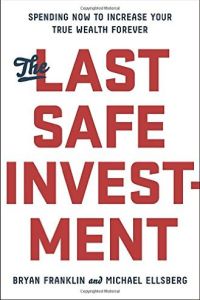
For a complete treatment to answer this question go read The Last Safe Investment by Michael Ellsberg and Bryan Franklin. I will be integrating the concepts of the book to the local context and likely presenting part of it in the Seedly festival in June. 


Wednesday, March 04, 2020

Why are young people so jelly about my Financial Independence ?

Image result for michael ellsberg

If you read financial blogs but have just started out, you would probably be shocked that it is possible not to work in Singapore and have everything paid for by dividend payouts. A decent number of these readers will then hunker down to figure out how the capitalist system in Singapore works.

It is of no surprise to me that many readers will feel jelly or salty about financially independent folks - to these guys, we must somehow be crooks!

I think my own success is actually quite conventional.

The basic framework even has a name - Financial Advice Commonly Delivered or FACD based on the excellent book shown above by Michael Ellsberg.

Here is how FACD works :

a) Earn money from a job.
b) Save a large chunk of it, delaying gratification for the next 2 decades.
c) Invest (and reinvest) in various instruments with an emphasis on stock equity.
d) Retire when dividend income/capital gains begin to exceed basic expenses. ( 4% withdrawal rate )
e) Be happy because you've won the game. ( Maybe at the expense of family and relationships )

Almost every FIRE initiates to grandmasters employs some kind of variant of FACD to meet their financial goals.

If financial success can be so cookie-cutter, then how do we explain that young readers, upon reading about my six-figure dividend income becomes so traumatized that they need other financial bloggers like Budget Babe to console them and make themselves feel better? (link)

Actually, there are many structural weaknesses of this FACD model that renders it useless to many Singaporean.

Take earning money for instance. Not all degrees are recognized the same way by the industry. A better local degree qualification can mean more than $1,000 per month in earnings. This means that FACD has a bias towards above-average academic ability.

On the other extreme, savings require a lot of willpower. Most American books on personal finance talk about saving 10% of your pay every month. To get comfortably retired, I needed to save about 60-70% of my take-home pay in my late 20s.

There is clearly a bias in FACD and it does not account for recent developments like the gig economy and the disruptive effects of AI on the ability of an average person to hold a day job. Even as this book addresses the issue by advising readers to develop the right skills, I think it does not have a full solution to the problem.

Because of the inadequacies of FACD, the industry has spawned multiple advisors and trainers in an attempt to fill this gap. As finance is a wicked problem, you will notice a significant variation in things that are taught and advice that is given.

Like the martial arts schools in Wu Xia novels, contradictions and conflict can arise.

As a content provider myself, I believe that the problem of financial independence can be tractable if you believe that a partial solution can make a positive difference in your life. In other words, if you cannot attain $10,000/month of dividend payouts, what about just aiming for $100 a month.

At $100 a month, at least your data plan is free.


Monday, March 02, 2020

MBA in a Nutshell #27 - Accounting and Finance : Improving Cash Flow

This section, while common sense for street-wise entrepreneurs, may not be too obvious for folks with no business experience.

Incoming money deals mainly with accounts receivable. Here are some tricks of every trade :

a) Have payments wired into your bank account - This earns interest and avoids delays from cheque processing.

b) Use a central bank account - This applies only if your organization is so big and decentralized, it has multiple bank accounts. One account can reduce bank charges and even earn more interest.

c) Give cash discounts for early payments - 2% if payment made within 10 days. Note that this can be a lot of money when annualized.

d) Bill customers on a timely basis - Odds of collecting a delinquent payment after 90 days is 75%, for 180 days is around 60%. Bill on a cyclical basis.

e) Make an active collection effort - Use a lawyer for a nice letter of demand if necessary.

f) Deposit receipts on a daily basis - Don't want to lose cash or cheques.

g) Use a factor - You can sell your accounts receivable at a slight loss, but the factor then will become responsible for collection.

Managing outgoing cash has a few bastard moves, all designed to maximize float within the company :

a) Centralize accounts payable and pay at the last moment - I would hate this if it is done to me.

b) Draw cheques from out of town banks to take advantage of float and take longer for cheques to clear - This sounds like a super bastard move that may not work here as we don't have out of town banks. Can someone share how this is done in practice?


Saturday, February 29, 2020

Why it never pays to carry balls in the office


I got away with a hell of a presentation today, and this is one of the slides I shared with folks who attended my class preview today.

Throughout my career, I've always found it strange why people are so eager to Angkat Bola / Carry Balls / Brown Nose their way up a workplace. I think employees should be generally agreeable and get their work done promptly, but there is not need to go overboard when it comes to making your bosses feel good.

One particular case I know involved a colleague of mine who had an exasperating habit of inviting her managers to her home for a barbecue while not inviting her immediate peers. She was not mean to her peers - she just wanted to "manage her superiors" beyond what was socially acceptable in a Singaporean workplace (Obviously, she's not Singaporean). As a consequence of that, she rose  up the ranks of the company very quickly. I remember the day my company failed to win a major government tender, and since this colleague played a major role in the bid, I recall her peers were quietly celebrating the loss.

If you look at MOM data, an average worker can expect a 5% every year from age 25 to 45. After that, staying employed becomes a problem, and salary trends tend to flat-line after age 45. A lot of senior managers lose their jobs in a retrenchment exercise and political savvy is not that useful given that their patrons may also be out of a job as well. The reality of the situation is that, once retrenched, a 50-something worker will never be able to get a five-digit a month job again, so why shore up this amount of political capital when companies will discard you like an empty printer cartridge in the future ?

The idea behind this slide came from Thomas Piketty's controversial idea that for the most part, the inequality (r>g) holds in a capitalistic society unless there is a plague or a war going on. The growth in the value of your investment assets will always outstrip the growth of income derived from labor (proxied by GDP growth ).

Let's put this down using a practical example.

Scenario A) Be a balls-carrying sycophant and lose the respect of your peers

Suppose you decide to carry your bosses balls. In the normal case you get a 5% increment. If your boss is particularly impressed with your brown-nosing, you can raise your average increment by 60% or get a nice 8% increment.

Let's just say that you are this good at balls carrying.

Scenario B) Be an uncontroversial worker but save 50% of your income.

If you can save 50% of your income and can get 8% investment returns last year, you would be able to get a 5% raise on your salary and the equivalent of a 4% raise arising from your investment savings made last year. At 9%, you can actually beat the sycophant by 1%.

Of course, the two options I selected are not mutually exclusive. The best solution is to combine (A) and (B) and become a sycophant who also invests in the markets. In practice, that requires a lot of effort.

If the (r>g) inequality holds in Singapore society, you are always better off just being a solid corporate citizen but also be an avid long term investor. My personal experience is that manager types, upon knowing that I'm pretty good at investing, are often eager to befriend me instead. It has made my time in SGX a lot more pleasant when your key customer is also a retail investor. When an engineer accidentally brings down a server, maybe I can start the conversation with a friendly tip to ease into the ugly discussion about the IT incident.

When you hit your fifties, your bosses' balls have become so sagged that you may need more than two hands to carry it. On the other hand, if you plan your finances well, after 20 years of work, your investment income may have already exceeded your take home pay.

Just don't invite hubris by crushing the balls that fall unceremoniously onto your hands.


Wednesday, February 26, 2020

Maybe we men should NOT give Singaporean Women what they want...

Image result for skiing

The biggest incident I experience last week shows the multi-stage nature of the COVID-19 virus outbreak.

First the markets reacted when people started falling sick in Asia. Now markets are reacting when everyone around the world started falling sick. I think the next wave is when the economic fallout starts to hit the main street in Singapore. This can take place even when the outbreak is under control.

Last week, a friend was let go and I spent the day panicking about his future. I visited a head-hunter's home for a social event hoping that I find a way out for my friend only to find the headhunter out of a job himself.

A week's deeper reflection confirmed that I was deeply wrong about who needs help.

My friend is intimately familiar with my investing methods. I pointedly asked him how long his money would last to which the reply was easily 3 years. He is also very gritty and has even lined up for himself a job that pays an hourly rate. He has no expectations to get a better job amidst the virus outbreak. My friend is young and can take quite a decent amount of punishment.

On the other hand, the headhunter seemed "confident" that he can last another 6 months without employment, after which all he had to do is to "sell his home". Like me, the headhunter is not a spring chicken anymore and has to contend with a tougher job market. How he can get employed amidst the virus outbreak is a mystery to me because I'm pretty sure he has more headhunter friends to seek help from !

So it is highly likely that my young friend will survive. My headhunter friend may be in serious trouble and I have no idea what he will do to get out of this mess.

There may also be a fundamental difference with the way my friends see life :

  • My young friend is tough and willing (even eager) to eat shit. Like me, he does not have much a sense of style. He spends a lot of time gaming. His was a life of instability and struggle.
  • My headhunter friend is the opposite and was my go-to source of great food recommendations. He's cool and have a great sense for music his era - A product of decades of job security and career success.  
So here's the thing. If we build a male avatar out of my friend and the headhunter, I think Singapore women will probably dump my friend and go after the headhunter equivalent in his 20s. 

When Singaporean women were asked what is the biggest turn-off in their dating profiles, they roundly condemned men who have an affinity for gaming and anime. If I were dating in my 20s today, I would have settled for becoming a BBFA. In the world of gaming and anime, Dungeons and Dragons and Magic players are even more alienated from the main stream.  

Singaporean women are subtly telling everyone that they despise introverted men.

In fact, Singaporean Women also betrayed their preferences when they said that they loved men who ski. I am familiar with this because one of the reasons I did not like lunching with colleagues in my mid-20s because Gen X women love to hijack the conversation to talk about scuba diving - the "skiing" of my Generation.   

As we need to get out of Singapore to ski, perhaps women want men who are sporty, extroverted and outgoing. They may also prefer men with openness to new experiences. But to enjoy skiing, men would first need to be willing to spend money - I googled a 7 day trip to Hokkaido and it costs about $3000+ per person. If someone skis as a hobby, I expect several such trips a year to the Swiss Alps or even Aspen Colorado.

Here's the thing, while hypergamy is normal for women, a willingness to spend does not imply actual wealth. Millenial women should be smart to observe what happened to the men of my generation : some of the dashing, debonair and cool dudes end up being betrayed by their corporate masters and end up bitterly complaining about the unfairness of the capitalist system. 

Younger guys need to wake up to the idea that just giving what these women on online portals is a recipe for a lifetime of pain. 

Just ask yourselves, what happened to the "fly" dudes of Generation X. 

Some dudes in my generation had to be cool in their 20s, playing guitars and riding a motorcycle - where are they now? Are they living lives of "perpetual job search" like the Kims in the movie Parasite ?
  • Save 50% of your salary. Own the means of production.
  • Ignore women who hate anime fans. You can even get fitness tips from One Punch Man. 
  • Don't pick up skiing. Each trip is worth at least a decent position in a good REIT of your choosing.


Monday, February 24, 2020

MBA in a Nutshell #26 - Accounting and Finance : Other People's Money

Other People's Money (OPM) or float basically means that savvy business people arrange to receive cash owe to them at the earliest opportunity and send money that they are obligated to pay others at the last possible moment. When managed well, this results in a cache of money called float.

You can earn interest on your float. The master of float is Warren Buffett because he gets to invest his float consisting of insurance premiums prior to them being paid out to cover insurance claims.

The book mentions variants of OPM such as :

a) Gift certificates - All that amount of Kino vouchers you are hoarding is earning them interest.
b) Traveler's checks - I never used these but folks prefer to keep them rather than redeem them after a trip.
c) Commemorative stamps - No sane collector will use the stamps in the First Day Cover to send actual mail.
d) Celebrity Checks - Imagine if Billy Eilish or Blackpink's Lisa wrote you a $100 check. The check with her signature is probably worth more on eBay than the value of the check itself.

What is evidently missing in the book and relevant in modern times are the amount of cash value stored in super-apps like Grab and some of the new-fangled multi-currency credit cards like Revolut. Most of us would put a little bit of money in these wallets and then use it at a much later time. I can imagine the amount of float Grab has right now because there is a lot of spare change in our Grab super-app.

If float is used properly, it can be many times more effective than having a margin account.

I guess one way of making your business better is to design it around the idea of getting more float so that you can invest in higher yields and then use the dividends to run your company.

Theoretically speaking, a company can "FIRE" if investment income can cover the costs of running the business.

Saturday, February 22, 2020

Personal Update

No photo description available.

It is time again for a personal update.

a) Impact of COVID-19 

The impact of COVID-19 has been very small in many retail investor portfolios. The STI ETF was down 1.21% so far in 2020. The ERM portfolio is actually positive territory at 1.62%. Defensive investors have avoided the worst so far.

Sadly the same cannot be said about the real economy. I was trying to help a friend move on with his career by consulting a headhunter yesterday only to find the headhunter out of a job ! The combination of bad news flying around this virus season totally ruined my Friday. I suspect us full-time investors are living in a bubble protected by dividend payouts. We don't see the reality of how bad things are.

Is it something we can foresee ? Thomas Piketty spoke about inequality being represented by an equation (r>g). The rate of return of capital always exceeds growth of labor income. Investors seem unaffected by the corona virus so far, but we will see a lot of workers laid low over the next few months. SME, companies relying on the goodwill of private investors will be affected first.

b) Budget 2020

Budget 2020 gave a nice boost to the stock markets this week. I was initially disappointed with the lack of tax rebate for individuals but I soon realized that the investment community won big with a 25% corporate tax rebate and property tax rebates. 

This is a very generous budget and should offset the downturn which is likely to be much worse than SARS.

c) Training business and COVID-19.

Some other trainers have been asking whether my business was hit by the corona virus. I have not and my results have been largely the same even though I was asking myself whether I should stop and take a break.

So far attendance and sales of my program has held up and we have enough to run a class in March 2020. We are very paranoid about infection in our sessions so in the last round our attendees were screened for temperature twice - once by the building and once by Dr Wealth staff. It does not cover asymptomatic cases but we do what we can to ensure the safety of the customers.

As the possibility of a slowdown is still there, I have started planning for an advanced course for current alumni of my program in case revenue needs to catch up in 2020. I am pretty excited by this new course idea but we're still trying to find the data sources to make this kind of investing feasible for retail investor. If I succeed, we might be able to launch mid-2020.

d) Working out

I am midway through my physical training regime to improve my blood sugar numbers. Training is short but intense and I face body aches two days after training. In between weekly sessions, I make sure that I swim enough to keep my fats burning.

But the improvement was felt within a few weeks. I don't have willpower to do everything well. A lot of my mental exertion is spent on the financial markets so I benefit from paying someone to keep me motivated to work out.

I may run with the idea of getting external help by attending a Python class even though I can easily learn Python on my own with a book. I can follow at a reasonable pace and can even make a couple of new friends.

e) What I am reading

The most important thing is what I am not reading - my Economist subscription has lapsed and I am not renewing it as I have 50-60 books in my KIV list. I just finished Margin of Trust by Lawrence Cunningham and Stephanie Cuba that talks about how Buffett runs his business empire. I also wasted a lot of my time on a Gary Vaynerchuck book that I shall not name. Without reading the Economist, I can now attack entire volumes of finance textbooks because they are actually easier to read !

f) Getting more jaded with my working gear

The corona virus has reduced my overall expenses but I am scaling up in other ways.

When it comes to work, I have been getting really upmarket gear that would be dissonant with my engineering roots. My presentation laptop is a high-end Microsoft Surface Book 2 that costs >$3,800. Recently, my old clicker that got me through law school died and I got a ridiculously expensive replacement at >$160. It allows me me to spotlight a tiny area when making a presentation and even vibrates when I am out of time.

This does not even consider the software licenses I pay to enhance to my training materials or the paid tiers I use for the cloud. I am likely to teach myself Canva to enhance my materials further this quarter.

Maybe one day it would be tax advantageous to be able to expense all this.

But that day is not here yet.


Thursday, February 20, 2020

Which type of Charlatan are you ?

Image result for ben carlson scam book

I strongly recommend Ben Carlson's Don't Fall For It for any reader who is trying to become more streetwise. More importantly, as someone who aspires to disrupt the training industry, it is important for me to be armed with a better way to distinguish between a crook and the real deal in my own industry and, as it turns out, one of the chapters from the book makes the price of of the book worth paying for.

Basically, there are two kinds of Charlatans, each corresponding to one form of statistical error.

a) Type 1 Charlatan

A type I error in statistics is a false positive. If you are shopping and get a fire alarm but there is no fire, you get a false positive. Correspondingly a type I charlatan is someone who is sincere about what he is doing, but following this charlatan ultimately destroys you. The example in the book is John Law, a Scottish economist who convinced the French government to develop the use of paper money and ultimately precipitated the Mississippi Bubble which led to massive losses for French citizens and led to his dismissal in 1720.

b) Type II Charlatan

A type II error in statistics is a false negative. It is the situation where there is indeed a fire but it was not detected by a fire alarm. Correspondingly, a type II charlatan is someone who knows that he is a fraud and goes ahead to cheat other people with the aim of becoming really rich. John Blunt, who was the founding director of the South Sea Company, did something similar to John law and was responsible for the South Sea Bubble that affected many hapless English investors, is an example of such a person.

If we contextualize the situation to Singapore, this framework may be useful in daily life :

I think the first application is on any financial adviser that you may have. There will be a class of FAs who are doing this work to churn commissions. Those that fall into Type II category may be the kind of folks who openly refuse to sell you term insurance or find all sorts of ways to churn the current policies that you have. My commissioned-based agent friend, before quitting, used to tell me stories of their agency bosses who spent a lot on a lavish lifestyle. An agent friend, prior to leaving the agency, told me his boss even flew into a rage when he publicly challenged his lavish spending ways in some company meeting.

( But I think he had fun asking why his soon-to-be ex boss why she was not setting a good example. )

In my opinion, the Type II FAs are actually the safer ones - once you know someone who just wants to earn commissions, you can do your own research and just buy what you need. As practice, I think there are enough groups in the Web that act as a zoo for Type II FAs - just observe how aggressively they defend the high-commission ILP products online.

The real danger are the Type I FAs - The sincere folks who are not really numerically savvy who really believe that some products are great until they explode in your face. Type I FAs can sell a lot of products and ruin a lot of lives. There is very little defense against someone who is genuine about helping you. The only way I can think is to flip the table and educate the FA on how insurance products are structured on the back-end. One possible approach is to get them to befriend an actuary and say that you'll buy something if the actuary buys it for himself.

I would avoid eating sausages that the sausage maker would, himself, refuse to eat.

Of course for any discussion to be fair, the framework has to apply to investment trainers as well. Generally speaking, a trainer is more likely to be Type II if :

  • Employs fake credentials. Without mentioning actual names, there is case law on such trainers in Singapore.
  • Cherry picks investment results. For results to be credible a consolidated snap-shot of the entire portfolio should be made available. If you just share your 10x baggers, what about the bad investment calls you have made ?
  • Demonstrates best effort to employ empirical findings to back all assertions. 

This leaves folks in a conundrum. What about the Type I investment trainer ? Someone who is earnest about his training program but we have no idea whether his approach can lead to ruin.

Because finance is a wicked problem, it is entirely possible for someone sincere to product horrible investment results. Heck, even someone with the right methodology can lead to horrible results.

In this matter even my suggestions are somehow incomplete and need further refinement :

  • The trainer should be open-minded to accept that there are plenty of alternatives to make money. 
  • There is an adherence to the doctrine of falsifiability - Every model can potentially be disproved by investment results. This can lead to new, improved model over time.
  • The trainer must be intellectually humble enough to flag out all bad judgment calls and find ways to turn them into teachable moments.

The Type I or Type II Charlatan is a great framework for assessing any scheme you encounter. The first thing you do is to assess whether you might be subject to a con from someone who is out to get something from you. Next you need to accept the reality that even if the person is sincere, the scheme in question may still be unsafe for you to act.

Nevertheless, if you can, read this book.


Tuesday, February 18, 2020

MBA in a Nutshell #25 - Accounting and Finance : Internal Controls

To safeguard assets, every organization needs to establish internal controls.

Here is the list of widely-accepted forms of financial control:

a) Be clear about roles and responsibilities. One person to be made responsible for losses in the cash register as and when they occur. In IT we use a RACI chart to do this and its a nifty tool for this purpose.

b) Where there is a potential of interest, create two or more roles. The person who controls cash cannot double-hat as the book-keeper. In a previous job, my role as IT governance reported within the IT department. I actually got into some trouble suggesting that I report to internal audit instead.

c) There has to be a system of checks and balances like two signatures on checks or access to lock boxes.

d) Hire reliable personnel. A nice acid test was suggested by the book is to ask a previous employer whether they would rehire the worker if he were available.

e) Document control procedures wherever possible. A simple example is an incentive given to every customer to report incidents where a receipt was not given to them.

f) Create duty rotation. Banks do this a lot to see whether some problems stop when an employee goes on vacation.

g) Utilize independent checks like auditors and CPAs.

h) Supervise closely to monitor performance.

As you can see, this is a lot of work. If I ever set up a company to do all this, I won't be able to focus on providing training and research on financial markets. Imagine having to create these internal processes for marketing and finance at the same time.

This is why MBAs still matter. You need good administrators with book smarts to keep a business running.

Visionaries can't do much without able lieutenants.

Sunday, February 16, 2020

What can we learn from Oscar winning movie Parasite ?

Image result for parasite movie

English Literature in lower secondary school would be more interesting to me if my Literature teacher were to spend more time talking about how to make money and attract chicks.

There's actually plenty of financial inspiration from literary works - In Jane Austen's Pride and Prejudice, Mr. Darcy value as a mate was tied to his $2000 GBP income from Pembroke estate. If students are taught that $160,000 USD in passive income would make them as eligible as Mr. Darcy, the value of English Literature lessons in Singapore would be much higher today.

I'm not sure what deserves more scorn - English Literature classes in lower secondary school, or the Oscars ? In my entire life, the Oscars has never chosen a respectable Best Picture, skipping movie greats like Inception to classics like Empire Strikes Back or Superman v Batman.

But this year, things are different. The Oscars actually picked a decent movie for Best Picture. 

Parasite is a wonderful riff off Ursula Le Guin's The Ones who Walk Away from Omelas and brutally explores the differences between the rich and the poor in Korean society. To really appreciate this piece, you need to understand the idea from Ursula's work that in every Utopia every  household has a child locked in the home basement and kept miserable so that the household and society can remain prosperous. If somehow this child were to escape, calamity ensues.

Parasite takes it one step further, proposing the idea that there is a basement within a basement and the movie climaxes by showcasing what happens if someone from this deep basement actually escapes. The movie leads to a satisfying conclusion that does not attempt to molly-coddle the audience with a good ending.

As my own literary criticism skills are stuck in Secondary 2 because my teacher could not teach me about making money or hitting on chicks, I am unable to provide that analysis that most RGS-Literature-Goths chicks can give. Reading that may cost your a significant portion of your life-force, instead this is what watching Parasite means to me :

a) The Rich will always attract Parasites

I think the things that freaked me out the most watching the movie is how easily the Rich attract Parasites. In the movie, a parasitical family eventually replaces all the staff supporting the wealthy. This is the same in real life - the middle-class are constantly harassed by commissioned financial advisors and real estate agents. As you climb up the ladder, the parasites change - they get replaced with private bankers and personal shoppers. It also recurses downwards as personal bankers also attract parasites of their own.

( Note : The idea that investment trainers can be considered parasites if they keep finding ways to monetise their students community is not lost on me. I think the movie's greatest weakness is that it did not portray the rich family also as parasites of something even bigger than themselves ! )

b) Tragedy comes from misunderstanding

Another thing that makes me glad is the the rich family was not portrayed as being callous or cruel. This is much unliked the viral Prince Ea videos that always had to portray the evil system as an old, white guy.  The rich in the movie behaved in a human manner, but questioned the lifestyle of the poor and criticised their smell only when they believed that the poor are not listening. In essence, they were less blameworthy than the poor family who had to scheme to be able to leech off their resources.

The real evil was the misunderstanding that comes from class differences. This is the beauty of the movie as even the instant noodles eaten by the rich has to be infused with top class steaks. My own take is that a person's wealth does not have to come with isolation. A millionaire can take public transport and fly coach. I think  with more exposure to ordinary people, it is easier to avoid situations like that in the movie. Conserve the money to solve real emergencies.

c) Compassion is a weakness poor people cannot afford to have

This is the kind of answer that will make the English Literature teacher hate my guts and why one principle I follow is to always avoid being examined on humanities subjects.

An important moral people may refuse to acknowledge is that for the lower classes, they simply cannot afford to be compassionate to others. The tragedy in the movie can be avoided if the parasite family did not grant access to a previous parasite access to the home basement premises.

If you want to displace others in the hierarchy, you need to be totally cruel and block access to the people you have just displaced.

Compassion is something only the wealthy can afford.

Anyway, I hope that some of you would be willing to brave COVID-19 to watch this movie that is still showing in some cinemas.

I will be replicating the Ram-Don instant noodles tonight. Hope I don't end up with Lao Sai instead !


Friday, February 14, 2020

Happy Valentine's Day - On assortative mating and hypergamy

I try to write something every Valentine's Day to update my understanding of the dating world. By now I am a dinosaur and have been out of the dating game for over a decade and things have changed quite a bit from the last time I dated.

Recently someone asked FB what is the probability of a JC-Poly union blossoming into an actual marriage. The trolls immediately activated and said that the chances of dying from COVID-19 is higher than such a relationship succeeding. The good news arising from this thread is that I participated by asking for instances of RGS-ITE relationships and was told that a Govt scholar married her ITE sweet heart who works at the front desk in the same government ministry. It's a nice tale that deserves a Jack Neo movie adaptation but I rather not verify it because we are all entitled to our own fantasies of modern living.

Assortative mating is now in mainstream policy making. This was mentioned by Tharman Shanmugaratnam as a major source of inequality in modern society. People are now attracted to others who fall within the same social economic status likely arising from more more women getting into the workplace. Consequences for society are dire as rich couples then transmit a much larger social advantage to their children. I am glad that assortative mating is there to take the heat off rent-seekers like us dividends investors - when some woke person bitches about inequality, I get to ask them why they married a degree holder like themselves.

The other issue is that even though assortative mating takes place, female hypergamy is still rampant. Asian women still do not like marrying down socio-economically. Even CNA Luxury is featuring a new dating app that has an acceptance rate of only 14% that allows only elite men to participate.

Government has not started introducing hypergamy into mainstream discussion even though I think they should. I think it keeps too many women on the shelves. In a meet-up with financial bloggers, many female bloggers alluded to me that they are prepared to decouple salary metrics from a potential mate's masculinity but female bloggers are a small constituency in the female population. It is up to a new generation of Singaporeans to decide how to redefine masculinity. I think the situation is still quite bad - stay at home dads get micro-aggressions in daily life. I take my son to school sometimes and I feel it too - five-digit monthly dividends portfolios are invisible and people will look at you funny anyway.

The response from males in the face of both assortative mating and hypergamy is very straight-forward -They withdraw from mate competition.

In every major recession, males who drop out from the job market experience a boost to their life satisfaction. This is because there is a universe of computer games and streaming videos waiting to entertain them for $20 a month.

We've done this mental exercise before. A $100,000 portfolio can generate $500 a month at 6% yields. More if you are willing to employ leverage. $500 a month can support a BBFA that just streams and eat instant mee. If the portfolio fails due to some reason, just get a gig economy job to top up. This is slowly becoming a acceptable lifestyle for males.

If you take this BBFA route, you will not have a lot of hair left by the time you hit your 50s, but there is no woman to judge you on Valentine's Day.


Wednesday, February 12, 2020

What can Private degree holders learn from Money Launderers

Throughout my working life, I worked with private degree holders of all stripes, some good and some bad. There are bad local degree holders as much as there are bad private degree holders but the good ones I am exposed to are often unfairly tarred by their qualifications. This is largely because educational qualifications in Singapore are signalling instruments rather than skills certificates. Our HR departments want a to use a shortcut to reduce the number of applications to a reasonable number so a local degree provides a convenient tool to make life easier.

So, I probably do not need to need to remind everyone that if a local degree holder play the Game of Life at Normal mode, a private degree holder plays it at Hard or Inferno mode. The salary gap between the local degree holder is over $1,000 a month bench-marked against a private degree counterpart with a much higher employment rate six months after graduation.

When I suggested to a colleague to launder his private degree ( because I think he's a great worker ), he couldn't stop laughing.

This is probably a good reason to do more research towards a blog article.

As it turns out, money launderers can teach private degree holders quite a bit. In fact, if you have a  third class or second lower local degree, the same lesson applies to you here as well. It's not that your degree is crappy - grade inflation just makes things so bad that an Honors degree is just not what it used to be.

As it turns out, money laundering is divided into three phases, all of which can point to useful and practical steps a private degree can do to improve his station in life. This article does not cover the situation whereby a private degree holder gets into a sales role or starts a business because these are options that are least dependent on educational qualifications.

a) Placement

The first step is moving money from the source of its ill gotten gains. In this step, money launderers typically find a way to smuggle the money out of a country. Imagine someone crossing national boundaries with a sack of gold.

When analogizing this process for private degree holders, the national boundary is the boundary between school and the workplace. Needless to say a private degree holder can face a lot of discrimination in a job interview. Here are some suggestions in the placement stage :

  • Do a lot of internships so the employer can witness your actual work ethic. This makes the job interview unnecessary.
  • Pull strings to get a job. Use your family connections to get something. Be shameless at it because us local degree guys will not fight fair anyway.
  • Join the tech industry. Tech discriminates the least because the demand for IT support will always be there and skills matter more. Why so many private degree holders study shit subjects like business management baffles me when Tech is one industry that will hire anyone that can code or do system admin.
  • If all else fails, lower your starting pay to get anything that pays the bills.
During the placement stage, avoid joining the gig economy unless you can developing deep tech skills. You don't want to be stuck as a Grab driver for an extra $800 a month even though that may be tempting.

b) Layering


When layering, a money launderer makes it harder to detect and uncover money laundering activity. One way to do this is to buy a material asset with your cash and then sell it away to make the money more legitimate. In the 1990s, I heard that some folks are offering cash to buy up winning lottery tickets at a face value higher than the winning value.

Layering is critical to a private degree holder. Once you have a steady job to pay the bills, you need have a plan to make your private degree stick out much less in your resume. This phase is not easy, some ideas I have include the following :

  • Produce results that are so stellar that it overwhelms all your previous educational history. This is hard because a lot of job roles may not have clearly defined results.
  • Get a masters degree from NUS or NTU. This works but local universities may also discriminate against private degree holders. 
  • Get into a good MNC via a contract role and then work like a bitch to turn it into a permanent role.
  • Create a stellar record of community service outside the workplace. Joining grassroots or Toastmasters may create something to talk about to an employer beyond work. 
  • Earn a string of industrial qualifications that are recognized in your industry such as the CFA, CPA, CISA or even PMP qualifications.

Remember that you need to be a realist when you commit yourself to layering. I am fully cognizant that private degree holders actually pay more for their degrees and the temptation to emphasize it more will be there, but everything you need to do once you get a job is to take steps to overwhelm it with something better in your resume.

And for God's sake, do not use your hard-earn money to get another advanced qualification from a private university. If you do need skills, use a MOOC or get a graduate diploma from a local university.

c) Integration

The final stage of money laundering is integration where the money, once laundered get reintegrated into the legal economy. Launderers often employ shell money to buy properties where proceeds from these sales would then be 'legitimate'.

With a good resume and a job, it is now time for a private degree holder to improve his station in life. Getting to this stage probably means that this person may have done more career planning than the normal local degree holder so I expect this guy to be tough cookie. At this stage, the usual career advice matters but some common patterns exist :

  • Develop a niche in your company to make it hard to retrench you. When I was in HP, the first managers to be retrenched are non-degree holders. Pink slips came so fast, a work record could not even be established. Doing something no one else wants to do is vital. During my time knowing how to operate a mid-range or mainframe server leads to years of job security.
  • Build networks with other private degree holders to cover each other's backs. In my time in the legal industry, I know that the University of Tasmania lawyers cover each other's backs much better than local degree holders. They go back a long way when they were students in Temasek Polytechnic.
  • Of course it goes without saying that this is the time to start building an investment portfolio.
Also, don't fall for the big lie that soft skills matter. People get better people skills as they get older. To think of soft skills as a competitive advantage is balderdash. Where two executives are equal in tech skills, of course soft skills become a tie breaker. Deliberately building up soft skills beyond just OJT thinking that they will boost your salary is hogwash designed to keep humanities professors employed. I work with a lot of low-EQ troglodytes because they have a mysterious power to keep things going. May of these trogs come from the legal department.

I think while private degree holders in Singapore do find life much harder than local degree holders, developing a stoic and realistic attitude can make a big difference in balancing out life outcomes at a later stage in life. 

While it may be unpleasant for some readers to review the approach used by money launderers to wash money from ill gotten gains, it forms a reasonable analogy to show us how to develop an action plan forward.


Monday, February 10, 2020

MBA in a Nutshell #24 - Accounting and Finance : Creative Accounting

This article highlights various approaches to accounting that can possibly lead to civil and criminal penalties. Because financial statements allow a degree of flexibility and discretion, highly skilled accountants with the right lawyer can this game while avoiding more serious consequences.

It is therefore up to the investor to be wary of creative accounting techniques :

a) Growth in accounts receivables exceed growth in sales 

This happens if you sell a sell a lot of products but keep extending credit terms so you never collect on the debts owed to you. This technique can boost revenue but minimize actual incoming cash flow. The final outcome is that the company eventually runs out of cash while looking profitable throughout this period.

b) Growth of inventories exceed growth of sale

This suggests that the company's products are crap and they are losing market share.

c) Ordinary expenses are included in restructuring charges and restructuring happens frequently

This can overstate future profits. As I am not an accountant, I'm not even sure how to detect this. I am guessing that reading footnotes on the restructuring is required to see this. This gets worse if the company is serially writing off something. In the book, Kodak tried to restructure in 6 out of 7 years.

Having worked for HP and facing restructuring throughout my entire stay there, this should be more common than expected. In fact, I can argue that in old HP, restructuring charges ought to be ordinary expenses.

d) In-process R&D charges are written off by the purchaser at the time of acquisition

As I am not an accountant, I thought this was fine. How much of R&D even results in a product that can be monetized by a company ? Why not just write it off so that investors will not have false hopes about the future. But this idea is also wrong, most decent companies have intangible assets and this has to be R&D spending that will be amortized over time.

As an investor, it is very tempting to build a checklist from the above-mentioned points to qualitatively suss out the weaker counters. Unfortunately, they hardly matter in REITs because there is little by way of product sales and R&D.

The problem in investing is that even if you can build a detailed checklist of accounting watch-outs, you will merely be left with a few obvious stocks to buy that every retail investor is hoarding like toilet paper right now. The outcome of rigorous screening is often the same as intuition.

As such, you need to be be careful of investment experts who talk about screen filters and qualitative checks but end up with a list of strong-sponsor REITs that yield less than 5%. Any uncle with some investing experience can create this list for you without a model or a checklist. 

Saturday, February 08, 2020

Can you support a sugar baby using CPF payouts ?

In Financial Blogger's Cinematic Universe, the topic that always sparks a reader's interest is CPF.

Another topic that readers like to read about is sugar babies.

In times like the Corona virus infection, it may not be too feasible for some of my friends who are life-long investors in the Geylang region to continue to visit their regulars haunts because there may be a chance of infection. In fact, the 12th Corona victim is likely to be a freelance sex worker. The person who reminded me of this fact is strangely enough, my mum, who was so concerned about my friends, she asked me to remind them to stop visiting Geylang this new year season.

But I am a realist.

If I can't sell my investments in anticipation of the situation getting worse, I am pretty sure my pals would still need to have their needs met. With this realization, why not combine these two topics into one and let's see whether it is possible to support a sugar baby. Sugar babies probably see fewer clients so I expect them to be a safer choice in times like this.

Fortunately, we now have data on how much a sugar baby costs. It takes about $3,000 a month to support one. In fact, A friend gave me another data point of $2,500, but he gave the caveat that at this price point, the sugar babies are kind of plain and not really worth the trouble.

Armed with this data, let's go to the CPF Life estimator website to see whether someone born at the same time as me can support a Sugar Baby.

a) Current FRS sum of $181,000

The first simulation is for the sum of $181,000 for a males with around the same birthday as I do.

The output looks like this :


As you can observe, the standard plan is your best best as it has the highest proportion invested in annuities. The Escalating plan increases at 2% every year but you might be too old to enjoy your sugar baby by the time that reaches $3,000 a month.

Ok, so I estimate in most cases attaining FRS is insufficient to support a sugar baby.

b) ERS sum of $271,500

A CPF member can keep an enhanced retirement sum of up to $271,500. If you are really committed to getting a sugar baby at age 65, you can commit more money in your CPF. Based on the calculator you get the following payout :


You get better numbers at around $2,000 under the standard plan. At this stage, it should be pretty obvious that sustaining a sugar baby with CPF is going to be quite hard.

c) CPF Life supplemented with dividends 

I think by now, you should be convinced that CPF Life can, at best, supplement the sugar baby lifestyle and cannot stand on it's own. Suppose you already have FRS, you can expect a pay out of $2,000 a month, you will need a dividend portfolio to do so.

Suppose you blend a REIT portfolio with some blue chip equities, you should be able to attain a 5%.

To generate an extra $1,000 a month, you will need $12,000 / 0.05, you still need an extra $240,000 to cover your short-fall.

d) Share a sugar baby with friends

With a full FRS sum, you will still need $240,000 to life your sugar daddy lifestyle. This can be  insuperable.

Fortunately I know an old friend who was able support a sugar baby while working as a technician in his 40s with an income below $4,000 - He got a few colleagues to share one.

I don't really recommend that readers do this because it's almost tantamount to sleeping with your colleagues and you might be cultivating a super-infector.

Anyway, I hope that you have learnt something from this article and can experiment with the CPF life estimator.