Tuesday, October 29, 2019

MBA in a Nutshell #11 - Marketing : Marketing Mix - Product - Product Lifecycle

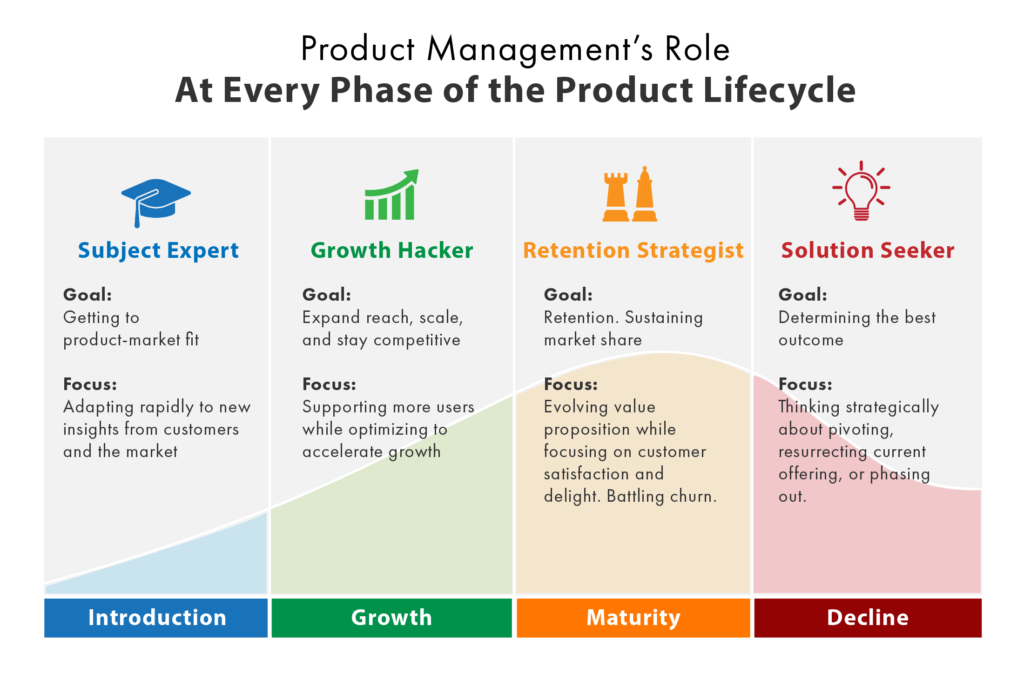
Image result for product lifecycle

Like many living things, a product has a life cycle and evolves through multiple stages.

i) Introduction

At this stage, there is a lot of research and development. Sales and profits are low. A product at this stage his highly vulnerable and funds are needed to grow properly.

ii) Growth

At this stage, sales and profits are growing. A substantial amount of promotional effort is required to sustain this stage.

iii) Maturity

Sales and profits peak at this stage. Profits may diminish because competition is getting into this game.

iv) Saturation

Decreased profitability occurs here. Competitors are starting to get into the game.

v) Decline

Market share is slowly being eroded and cost cutting will occur at this stage.

vi) Abandonment

Production ends at this stage.

When you understand that everything has a beginning and an end, you begin to have less of an attachment to your product and more to the process of grandfathering a product through the various life cycles. Right now, I believe that my program, having only graduated 300+ students, is at a growth stage with maturity not too far away.

Of late, I noticed that mainstream media is starting to develop a bigger fascination with FIRE and FB groups are trying to establish some materials on to attain some limited version of financial independence. As of now, I believe that any attention given to the possibility for early retirement will strengthen my hand so I expect to put in more effort to ride on this interest from the general public.

Over time, I do expect more groups to want to muscle into financial education territory, as I am sitting on some capital and profits over the past year, I should have a few tricks up my sleeve to further differentiate my product from the rest of the pack.


Sunday, October 27, 2019

Thinking at the margins.

Image result for burger and lobster roll

One reason I would like Economics to be introduced to O level students despite only starting to study it serious at my Masters is its immense usefulness in daily life (as compared to that abomination English Literature). 

One really nifty concept in economics is marginal value, which is contrasted with average value. Marginal value is the value we give to one extra unit of an item. i.e. I'm going to eat lobster rolls with a friend next week and I bet we're both looking forward to it. This is a special event because neither of us eat lobster rolls on a regular basis. If my friend has already eaten three lobster rolls that morning, he probably would not be too excited to each his fourth lobster roll  with me that afternoon. 

Ergo, the marginal value of the fourth lobster roll is very small compared to the first. 

The crucial problem in education is the ability to translate a theoretical idea into everyday living. 

How can we think at the margins the same way economists are trained to do ?

Not all dividend dollars are equal. 

As we starting to get payouts from our investments, the dividends would not be worth very much. You might see a $50 payout in your bank account once every three months, hardly enough to pay for anything else. This can cause a lot of Millenials to give up on the dividends chase. 

The marginal value of a dividend payout happens when one quarter of dividends payments start to exceed three months of particular bill. Then you can at least say to yourself that in that payment category, the item will be free henceforth. If you spend $40 (or $120 per quarter) on a sim-only plan, the marginal value of the $121 dividends dollar that quarter will be very high because your data will be free moving forward.

The success of a dividends strategy, thus, relies on chaining your dopamine rush by being aware of your regular expenses. It's great to know the size of your smallest bill every month so that you will know the point that expense becomes free. In my opinion, a data plan is always the best place to start. 

For rookies, you might want to ask yourself at which stage of your portfolio development does your data plan becomes fully subsidized by dividends payouts ? 

I'm rapidly reaching a stage in my life whereby an added dollar of dividends in a quarter is not particularly valuable to me. My biggest expense every month is my mortgage and I have a leveraged account producing close to about 120% of my quarterly mortgage payments every three months.

At this stage, the magic of Economics 101 can be further applied when you have a steady flow of dividends coming into your bank account.

Capitalism ensures that there are millions of products that are designed and engineered to have a high marginal value to you. I got the latest Kindle Paperwhite with 8Gb and free data after stacking a round of discounts on Shopback and Amazon.sg. 

I also tried to do more shopping at Cold Storage to try out a better brand of butter. The marginal value of better butter is a little overrated, sadly. 


Friday, October 25, 2019

Why engineers and tech professionals hate immigration and what can be done about this ?

Image result for richard posner radical markets

I will do a little bit of social-political blogging today.

A hot topic of the next elections is likely going to be about CECA because I suspect that Tan Cheng Bock will leverage on this issue as Heng Swee Keat is very possibly the architect of this agreement that grants free access to Indian tech professionals into our economy in return for granting Singapore banks full access to the Indian economy.

From the perspective of local engineer like myself, CECA is a game changer that kept my salary low and increased the competition and stress we have in local workplaces.  As I watched the movie Three Idiots lately, I was very impressed by India's almost divine reverence for their engineering talent. I asked myself how can our local  engineering degree holders who can get Bs or Cs for Physics / Maths A levels compete against a demigod-engineer from IIT?  The truth is they can't.

The quickest solution to the problem is to simply not be a plain engineer in Singapore.

The solution is to become an engineer-landlord.

Once I started investing, I can start to see how we can benefit directly from the flow of professionals into Singapore. As Singapore becomes more competitive, companies want to set up here, and Indian professionals also want to rent our spare homes and buy our goods. I daresay that my investment and rental gains, net-net, exceed my losses under the CECA arrangement. I even spent two happy years in Singapore Mercantile Exchange which was set up by an Indian billionaire.

But this leaves a serious problem in our society today.

Not everyone can become an engineer-landlord. There will be folks who are left behind and would want to punish whoever drafted the CECA with India.

So how can we solve the problem of allowing the man on the street to benefit directly from immigration so that we will not have a populist revolt ?

Radical Markets by Eric Posner is the first time I felt that there is some hope that a solution can be found. Here is how to adapt his ideas to Singapore :

First we have to identify a discriminated class in Singapore. To me, non-degree males are a discriminated class in Singapore. The GINI coefficient for males is much higher than females and non-degree males have a lower representation in Singapore Parliament than women or ethnic minorities.

( Only MP Charles Chong lack a degree )

I think the first solution is to align the needs of non-degree males with potential immigrants.

Suppose Beck Hock is a non-degree male working hard to raise a family in Yishun, very likely he will struggle to make his ends meet if Singapore goes full throttle into globalization.

What if we let Beng Hock sponsor Rancho, a Indian Engineer, to work for Google in Singapore ?

Beng Hock will have to interview Rancho to decide whether he will fit into Singapore society, buy insurance in case Rancho turns out to be unable to work, rent a room to him and vouch for him for a year so that Rancho can get a three year work permit.

Rancho has to pay Beng Hock a fee to work in Singapore and be his guide to local culture. From some economic surveys, Rancho will be willing to pay big money to Beng Hock for that privilege, sometimes as high as $9,000 to work here.  The process of setting a price can be an auction mechanism like COE.

A non-degree male can credibly sponsor one new immigrant every year boosting his salary by a decent $300-$500 a month, this can limit the effects of xenophobia drastically in our society. Also the vetting by heartlanders will account for things like cultural fit that cannot be reduced to a set of criteria by any government bureaucracy.

For sure, there will be problems if we implement this system in Singapore. But that's what our scholars are for.

If the government does not want immigration to smack them in next elections, finding way to allow ordinary Singaporeans to directly benefit from immigration is key to their political survival.


Monday, October 21, 2019

MBA in a Nutshell #10 - Marketing : Marketing Mix - Product - IP Protection

Beyond product design and differentiation IP protection is important to protect your product.

As I never really wanted to AVOID being stereotyped as an IP Lawyer (because a lot of engineers who become lawyers do end up in IP law), so I did not take the full complement of IP law modules so I can't really do a decent article on this topic.

The book distinguishes three forms of IP protection in its marketing chapter:

a) Trademark

Trademarks distinguishes your product and service from others. You can follow the steps to register a trademark here, otherwise you can seek a remedy under common law via the law of "passing off" to protect an unregistered trademark (The TM symbol).

Registering a trademark is useful to bar other players from using it and also allows you to gradually build better brand recognition. Our government also makes it a point to provide generous tax rebates to businesses trying to register their trademark.

Upon registration a trademark is valid for a decade.

b) Copyright

An author has automatic copyright over his work. For published works, the copyright lasts for 25 years in Singapore. If a third party infringes your work that puts you on a disadvantage, you can sue this third party but remember that ideas cannot be copyrighted, only expression of ideas in tangible form.

c) Patents

You can patent something if it is new, involves an inventive step, and it is capable of industrial application. Many different kinds of patents exist.

Generally speaking, a patent lasts 20 years and the process of getting one can be tedious and expensive. Worse, applying for a patent basically means sharing information on it to the world at large. However, during this 20 years, you can sue anyone who uses your invention without your permission.

Beyond the basic copyright that I am entitled too, I probably do not need better IP protection right now. Maybe in about a year's time, as I come up with newer product offerings, I will re-examine this matter.

Perhaps a graduate diploma in NUS on IP Law may be in the horizon.


Saturday, October 19, 2019

Real issues in retirement and how to deal with them.

Image result for the psychology of retirement

Most financial bloggers deal with only the financial aspects of retirement. Even my course, as it attempts to build a generation of early retirees to dot the commercial landscape in Singapore, requires a laser-like focus on personal finance so that a person can get out of the rat race which is going is still good in the workplace.

If you are an actual retiree, however, you will soon find that retirement is a game of multiple dimensions and you will to play all of these aspects of the life game well to enjoy a great life in your personal winter. The Psychology of Retirement by Rosenthal and Moore discusses all these issues in detail. 

Here's what missing from most articles on FIRE about Retirement :

a) You need to be healthy to retire well.

This can be so cliche but folks are surprised at how hard this is. Our Singaporean healthcare system has enabled citizens to live up to an average of 85 years but it has capped our Health Adjusted Life Expectancy to around 74 years. This means that 10 years of our lives are spent being ill before we pass away.

Making matters worse, when you read literature on nutrition and wellness, they are typically from the US and may be biased by commercial interests.  Even as I started on intermittent fasting, I am confused by so much conflicting advice - is coffee with butter cheating on your diet ? Governments do not have an incentive to cover this well so we're stuck with using our feelings to determine what keeps us healthy.

I've learnt that chiropractors can call themselves doctors in the US and spawn a new class of health advice that I prefer to verify with scientific evidence. Worse, in the US, scientific papers can also be sponsored by commercial interests.

Personally,  I think diabetics should avoid listening to anyone outside the formal medical fraternity unless it is endorsed by a specialist.

b) You need develop good social relationships to retire well

The scientific literature say that loneliness is a bigger killer than obesity for retirees so you need to find ways to improve social relationships post-work. The fact that many FIRE aspirants are introverts make things worse.

I am lucky that I have a family of my own. Imagine a large number of singles achieving FIRE and then realizing that they are mostly on their own during weekdays when their pals are at work. They can't even find others to holiday with them with all the money they have because so few succeed in FIRE in real life.

Even in the FIRE discussion I have on WhatsApp, the number of actual FIRERs are small and generally have yet to succeed in organizing an activity together.

I think we have to up our game because most of us are guys and guys generally only bond by taking part in common activities. As we get older, we lose touch because we become too old to participate in activities together.

c) You need to reinvent your personal identity to retire well

The worse way to retire is to do it involuntarily. Cold turkey does not buy time to figure out what role you need to play in society and this can be painful after the few weeks of honeymoon period.

A better way is to work part-time, maintain your connections and self-worth while figuring your life out. Once again, I am very lucky because I bought 4 years of time to retool myself as a lawyer before this amazing opportunity came to let me transform into an investment trainer.

Even today, I struggle to explain what I do to an layman audience.

  • How can a guy retire at 39? 
  • If he does, how is it even possible to teach it to others? 

An explanation is so complicated, sometimes I just say that I'm unemployed because it's easier to understand and salespeople avoid me upon hearing that.

If you get retrenched in your middle age, what you will experience will be even worse than what I had to go through because of the loss of self-esteem and the lack of time for you to retool how you see yourself. The lack of a middle-gear for careers that allow part-time work is strangely absent from our workplace,

Perhaps while many of you are actively trying to achieve FIRE, remember that you need a plan to maintain your health, relationships and personal identity while you are attaining your journey towards financial independence.


Thursday, October 17, 2019

MBA in a Nutshell #9 - Marketing : Marketing Mix - Product - Differentiation

We're heading into the marketing mix taught to most MBAs which is the 4Ps of  Product, Price, Place and Promotion. Interestingly the author claims that in HK and Singapore, "people selling" and "physical evidence" would extend the marketing model into the 6Ps.

We will only be taking a short while to talk about product differentiation.

A great example of product differentiation in the book is Haagen-Daaz  that added more butterfat and pumped less air to build a new category called premium ice-cream. I was shocked to discover that Haagen Daaz actually came from New York, hardly the kind of place conjured by it's classy Swiss-like brand name.

Unfortunately for me, I entered an industry that isn't exactly a Blue Ocean zone. It is not difficult to find videos on various value investing or get rick quick courses on the Internet. Complicating matters are the really well-run Telegram groups that I am already part of that can provide real-time advice on reaching financial independence or REITs investing.

So this is what I did to differentiate my product from the rest in the industry :

  • My course is driven by a life objective rather than an investing style. A retail investor is learning a framework on how to retire early and not a specific form of investing. So unlike other trainers, this gives me the freedom to pivot based on changes in the financial markets. Strategies do fall out of favor every now and then, so I am not locked down to any investing approach.
  • I adopted a quantamental approach and then made it feasible for a retail investor to execute the investment strategy without too much analysis which tends to paralyze them under a different course provider. I know because I was the last batch of NUS Applied Finance masters, I spent years being paralyzed by the Equity Analysis framework taught by the CFA program.  This combination is unique and based on a blend of different academic papers published in journals. 
  • My course covers leverage in greater detail and provides an option to boost returns if you are willing to take on a non-zero chance of margin call. Only a minority of students go on to apply leverage but many students are intellectually curious enough to want to learn more of how that works.
  • Beyond the course, I built a walled-garden on FB consisting only of alumni of the program. This way we have a safe space for serious investors who are sick of getting "PM me pls" messages in the more open forums. This group also provides lifetime updates and support on the portfolios built by the latest batch of students.
  • I am also building a coalition of partners who are willing to offer special rates for students of the program in exchange to getting access to them. So far students are pleased with the software tools and salary based FAs I can introduce to them. Naturally, I have a network of lawyers to help them with stickier issues they may face as part of their lives.
  • Lastly, I am part of the product too. Not only have I gone through the process of attaining financial independence, I have over a decade of public speaking experience was spent one semester being bashed-up by seniors in the SMU International Moots Program. Most of the best investors I know are mainly introverts, may be socially awkward, and may not like being interrogated by a paying member of the class. This is a space I can play in. 
Beyond what the students get, my course is the only one where I actively take a leveraged bet on my student's investment choices using a significant part of my trainer fees. This ensures that I will work hard to improve my material over time because I face investment losses if my students make bad bets on the market. This is probably the hardest component to replicate because it almost means that any trainer willing to do this will have to forego a salary for a year after each course.

In summary, product differentiation is a marathon. 

Over time, I fully expect competitors to come into this space and I am ready to meet them in this field of battle-  so much so that I am willing to publish my play-book on this blog for them to review.

But rest assured, I am already working to develop my next innovation in the financial education space.

Next week I will talk about IP protection.


Monday, October 14, 2019

Personal Update

Right now, I'm blogging from Festive Hotel in Sentosa.

We decided that we needed a short break so my wife got us a 3D2N stay in Sentosa so that my mum can head to the Casino, my kids can get to Universal Studios, and I can get more work done in my hotel room. For the past few weeks, I am resolving my father's matters and have been shuttling to and fro my family lawyer's offices. When it comes to such matters, it's ok to be slow and steady but the most important thing is to be accurate so that the paperwork will be quick and painless.

a) Financial markets

Singapore miraculously avoided a technical recession in Q3 2019 !

Every workshop preview, I would conduct a poll on what my audience thinks about Q32019 but the polls consistently  vote a that technical recession will occur albeit with V shaped recovery thereafter. The only time I noticed an upturn was the last preview when the folks voting for a L shaped recovery suddenly disappeared. But this narrow escape has been hinted by government officials for some time so we're not seeing a vigorous response in SGX at the time of writing.

I believe that the longer direction for the economy is still down, as I was informed by a friend that MAS will be reducing the rate of the appreciation of the Singapore dollar. A sure sign of pessimism in the markets.

b)  Personal investments

Because I have been investing course proceeds regardless of market timing, my portfolio is experiencing a decent upsurge of late. This might even be sustained as Trump makes peace with China and focuses on impeachment proceedings.

I recently revised the process on how to open a brokerage and CDP account, as me and my mum just completed creating a joint account and made two buys just to test the GIRO and dividend payout capabilities.

( If you are curious I bought Netlink Trust and Keppel DC Reit. No back-testing required for this decision )

For my mum, everything has to be uncontroversial and a wee bit boring.

My next project is to start CFD investing in OTC bonds, which will be a very interesting endeavour that will keep readers excited for the next few months.

c) Books I am reading

Image result for hard at work singaporeans book teo you yenn

NUS academics have published a really good read called "Hard at work - Life in Singapore". This is a politically neutral (generally speaking)  piece that gets 60 ordinary Singaporeans to just talk about their lives. I strongly recommend that investors spend time learning about our fellow Singaporeans - I've been stuck living in an EC for years, living on my dividends and I think it is humbling to read about other fellow citizens like the barista who makes $6 an hour and funeral director who shares some interesting observations on his industry.

I don't totally support what the authors have done, turning the MOE Scholar and Police Officer section into an LBGT advocacy piece, but for right-winged capitalists, this book is important to recognize that our society needs multiple perspectives in order not to fall into the trap that the Hong Kongers have fallen into.

If I have to redistribute my wealth to maintain social harmony in Singapore, I want the tissue paper seller, supermarket worker, and barista to get a decent part of it.

d) No, I did not get punished by Blizzard for my support of Hong Kong

By some twist of fate, I was informed that a professional e-sports gamer called Blitzchung is also called Ng Wai Chung. This made me a subject of teasing by many of my friends even though I actually see myself as being more sympathetic to China. (A side-effect of being more pro-Singapore than pro-Hong Kong)

I don't understand what HK Youths are trying to achieve when they do things that affect daily commerce of their city state. It is their parents who suffer when there is no money to be made.

They can learn to be more like us and vote with our feet. Hopefully this will bring a nice boost to property prices here.

e) Final lifestyle hack I picked up in Sentosa

On hindsight, it was really dumb of us to pay $1600 for a two night staycation.

I saw an old secondary school classmate and he told me that he could get a $200 per night stay from Carousell because hardcore gamblers are selling their free hotel stays online. Just now, I went to Carousell and there might even be opportunities to buy staycations at Marina Bay Sands.

Maybe one day, I'll be blogging next to the Infinity Pool.

Let me know if you have utilized this life hack.


Saturday, October 12, 2019

Lessons from my Dad #1 : Never let anyone count your abacus ( 打算盘 )

Right now my biggest priority in my life is to resolve my father's probate matters so that me and mother can move on in our lives. Naturally, it is going to take me a while to unpack all the lessons my father has imparted to me from an investment perspective so over the next few weeks or even months, I will share whatever I can about my father's very large influence on me as an investor.

One of the lessons I learnt maybe even as a primary school kid is that my father hated folks who "beat his abacus". He used to say in Cantonese that you should never let someone 打你的算盘.

I was doing some research just now and it seems to be related to the idiom "to beat a small abacus" or 打小算盘 which has a totally different meaning which is to be very petty-minded about money.

To understand the context of my family growing up, I was influenced by largely by two polarizing forces. My mom's family was very poor and never found a proper way to manage money. My maternal grandmother engaged in an old practice called tontine - even today we suspected that she was some kind of tool used by her neighbors. An uncle recently commented that my mother's family lived on a perpetual system of deficit and lived largely on loans and only did OK because of the high inflation in Malaysia that actually made this a feasible way of life for the past 30-40 years - maternal family was living like US citizens ! My father was the opposite, his finances were like a black hole singularity, once money is made, it never goes out - he can earn money, but good luck convincing him to spend any part of it.

Like all couples, my parents fought about money because they have different financial values but nothing makes my dad's blood boil when some impecunious relatives and friends suggest to him what he does with his finances. Sometimes I imagine myself in my father's shoes, fiscally ultra-responsible, with better educated in-laws telling him what to do when he towers ahead of everybody else in net worth. It must have been really irritating for him so this was one of my earliest influences when it came to my own financial awakening years later.

The imprint on me was undeniable. I was very indignant growing up in an era when insurance agents retooled themselves into financial advisers and suddenly an entire industry wanted to beat my abacus. Naturally I went on to take on drastic steps to in-source financial expertise within my own family.

I was determined to ensure that no one beats my abacus.

Ironically, once I started getting really serious finance credentials on my resume, my father started to give me a fairly big influence over his investments. I rewired his portfolio to provide him dividends while he maintained his ability to day trade with an old school broker. As he got older, I established more control, reducing his trade frequencies so he could enjoy seeing his money trickle into his bank account. My father just wants to see dividends trickle into his bank account. He has no real material goals in life other than to clown with his grand-kids.

I guess you can never be too dogmatic about your principles about finance. My dad let no one beat his abacus, but eventually I became his only abacus, working with him to address complicated rights issues and cycling his money into better investment opportunities.


Thursday, October 10, 2019

MBA in a Nutshell #8 - Marketing : Product Positioning

Image result for product positioning

Product position can potentially be an offensive blog post, so I will not go all out to share my real thinking behind where I stand vis-a-vis my competitors. This is something between me an my business partners and can be work in progress as the competitive landscape in investment training changes.

To create a product positioning map, we will first need to build a 2 x 2 matrix. The axes are arbitrary but one common way to differentiate between different training providers is price.

I would not say that my program is expensive, but for the past two previews, customers are starting to remind me that I have a very close competitor who charges a mere fraction of what I charge. I do respect my competitor quite a bit, so I don't wish to talk about my competition since I am not a student of their program. I normally respond to clients by just saying that, in spite of my pricing, my course is getting a fair share of students and doing objectively rather well and let them infer the rest. So at least I know that, in the grander scheme of things, the perception is that my course is priced on the higher side.

There is considerably more leeway to determine what is the second axes to differentiate training programs. One possible axis is the "growth-dividend" axis - some training focus on growth stocks and capital gains while my course has a distinctive focus on dividend yields. Personally, I don't like this distinction because my course focuses on Early Retirement which means that my strategies can pivot away from dividends if a better retirement strategy comes along,

So perhaps I need a better axes to position the products available in the markets

Right now I am thinking of the "narrative-quantitative" as an axis that differentiates training programs in Singapore.

From what I do know, the value investing school has a strong narrative component where investors create a narrative around why a stock is a good investment. This may come from an intimate understanding of the history of a stock, the capabilities of management, and some idea of how they have a competitive advantage in the market place. You will know that a course is narrative when trainers invoke Warren Buffett's name a lot.

My course is actually quite averse to narratives. The name I invoke a lot is Clifford Asness - I've been invoking him long before The Economist made it cool to do so this week ! So I am a finance hipster, I was into Clifford Asness long before it was mainstream to do so.

My students do employ some qualitative criteria when investing but we emphasize the quantitative properties of a portfolio first and dip into the narrative second. Ideally, my students will process the news and raise an alarm when they see SPH in a screen and argue that SPH will be rejected because they are trying too hard in an area that they lack competence in. Another case is the repeated rejection of BHG REIT for the reason that analysts reports are strangely absent on the web for a REIT and it's focus on Chinese Retail. Whether they succeed in making a good judgment call is less important because the quantitative back-test results do most of the heavy lifting in my class.

Choosing a second axes is not enough. The final 2 x 2 matrix must be able to inform me whether I can get customers when I focus on one quadrant.

From the way I view the competitive landscape, the "narrative-low price" quadrant has decent customer demand so my competitors have been around much longer than I have been so this is a segment that I think folks can operate on. I think I can open up my own "quantitative-high price" quadrant and do fine for the medium term.

Gathering data on the availability of paying customers for each quadrant is currently not something I can do yet with total objectivity. Fortunately, Dr Wealth has an article pipeline that allows us to mine for ideas on what the investment community is most interested in.


Monday, October 07, 2019

Letter to Batch 8 of the Early Retirement Masterclass.


Dear Students of Batch 8,

It’s been a great honour and privilege to be able to conduct a 2-Day Early Retirement Workshop for you.

We’re seeing some really interesting twists and turns for this particular batch of students ever since I decided to make the course more democratic and gave students the chance to select the strategy to perform the screening on. The hallmark of a good DIY investor is autonomy – the ability to make your own decisions to invest in something regardless of what was taught.

In this batch, you were presented with two possible strategies for REIT investing – a “high dividend strategy” and a “strong sponsor strategy”. Students initially voted to select a strategy with good sponsors after reviewing the quantitative metrics but proceeded to reject 50% of REIT counters after one session of qualitative analysis (largely due to the fact that yields are so low). You then requested to review the high dividend strategy which was done and resulted in fewer rejected counters.

The net effect is that this batch has two REIT portfolios by the end of class. Combined with the blue-chip portfolio earlier, this class has created three portfolios in total and, upon further review, I have decided to invest my trainer fees into the blue-chip portfolio and dividend REIT portfolio.

I have also learnt a lot of new facts that I have to confirm with my usual circle of experts and blog readers. Primarily is the issue raised by a student – that if you go to higher class ward in a hospital such as Class A, you will not be allowed to downgrade your ward if you get re-hospitalised. I find this policy hard to believe given that our financial fortunes may change between hospitalisations and downgrading may sometimes need to be done because we have no choice. Nevertheless, it is good to raise controversial issues for discussion because this can help some readers of my blog.

Another really useful thing I learnt from a student concerns Islamic Finance which I have no real expertise in. The question is whether REITs violate some aspects of Islamic law and, if not, why does only Sabana REIT claim to be Shariah compliant but not the rest? I will be trying to find the answer to this question over the next few days.

[ Blog readers do chip in if you can. ]

Otherwise, this batch of inquisitive students have raised possible areas of improvement for my course. One area that demands a new write-up is what happens after holding onto a portfolio for a year - do you sell the portfolio to buy the latest round of stocks selected by the latest batch of student, re-run the stock screen last year, or cherry pick stocks not found in your portfolio?

This issue will definitely be addressed by the end of this week in the form of article I will add to my course materials.

Christopher Ng Wai Chung

Tuesday, October 01, 2019

MBA in a Nutshell #7 - Marketing : Market Strategy

From the last article, I have only advanced one page of text. Marketing strategies are surprisingly simple consisting only of three basic strategies which I share below :

a) Concentrated strategy

When you apply a concentrated strategy, you have an intimate understanding of the customer and can produce a product that caters only to this target market.

As trainers, we can do more of this and yet not fall into the trap of competing for every soul out there in the market. Sadly we don't do this well enough in this industry yet.

One example outside my expertise is a financial program tailored to employees of a particular company. Succeeding in one sale made to HR translates to many students in a program. What is stopping me right now is what kind of sane company will pay to have someone teach their employees to retire before their 40s. It might make sense before a major retrenchment exercise though...

Another possibility is a course on couple finances that allows dating or married couple to participate in planning their finances together. Again, this unlocks the possibility of working with SDN and gaining a captive audience. 

Oh, how much I would love a captive audience from my stand-point at the moment !

b) Differentiated Strategy

A differentiated strategy breaks the customer down into multiple segments and then attempts to come up with a product to target each segment. This is more common in my field because my partner Dr Wealth has different programs catering to different kinds of investors.

This is a practical strategy because different product lines can target complementary segments that expand the revenue broadly.

Personally, I believe that a profitable line targetting Millenials and Gen Z exists in this space right now but I think no one has yet to figure out how to create a useful program that fits within the price point most Millenials are willing to pay for.

The conventional train of thought is that Millenials are too poor to pay for an investment program. My train of thought is that Millenials are too poor NOT to pay for  a good investment program. That is because they have the longest time to compound any investment that they can get into.

c) Undifferentiated Strategy

The undifferentiated strategy creates a product that is not targeted at any segment much like products like Coke or Tide detergent.

I think a lot of training programs fall into this category because of general ignorance of the program developer. These guys are typically finance and not marketing people.

While trainers know quite a bit about value investing, for example. I believe that it's a mistake to think that it works for all segments of society. If someone's investing methodology does not enable dividends, for example, then it is best not to target senior citizens who need dividends to pay their regular bills. In similar vein, a heavily quantitative program has no choice but to sacrifice poets and humanities majors who balk at the lack of a good story behind every investment move they make and a different program will cater to them much better.

You can actually assess an investment training program based on how careful the provider is at who the program is meant to target. An inexperienced provider will always claim that their investment know-how works for everyone who can live and breathe but someone with some experience will be able to safely tell you who is program best designed for.

I don't believe in a one-size-fits-all strategy. An investment methodology that works for everyone, in essence, works for no one.


Sunday, September 29, 2019

Building better Personal Finance online communities.

So here are some of the changes in the way I do my blog articles.

This blog, which has a small and dedicated readership will become more "meta", focusing on thoughts on my evolution as a trainer as well as snippets on my personal life. For the folks who want to read about my politically incorrect theories about dating, that's going to remain here.

For the more advanced investing articles, I will be posting on Dr Wealth.  The reason is that Dr Wealth has a much wider reach and have the SEO chops that brings more exposure for folks who wish to come for my workshop previews.

My free workshops are rapidly evolving into an actual free public lecture that anyone can attend without making a substantial financial commitment for my courses. I've reached a stage in financial independence where I can evolve to do more pro bono work and the feedback on my workshop content is actually fairly good at the moment. We've also had two successful runs without email blasting so I can safely say that I've stopped spamming your mailboxes for quite a while. While I can't write direct mailing off totally because it's still a good strategy for others, I'm doing everything commercially possible to avoid spamming members of the public.

Moving forward, I have a new challenge -  I'd like to think of ways to improve how finance communities are run.

All my students ( now close to 300 in size )  are placed in a closed FB group where they receive future course updates for no additional membership fee with the caveat that updates will last only up till the point I decide to stop being a trainer.

So I am now in the privileged position of administering a walled garden, much like the Apple iOS ecosystem compared to other personal finance forums which look more the like Android ecosystem. These are fairly serious investors and I got investing heavy-weights in the community. 

On my part, I'm using the community size to drive a hard bargain to see whether I can get better deals for my community. Right now, I got a better deal for Stocks Cafe and made some friends with non-commissioned FAs to help my students out. Recently, I just helped out a friend using my contacts who told me that he can't seem to convince an FA to sell him term life insurance. I have also cultivated a broker ally that can provide promotional rates for margin financing.

Right now I'm on the lookout for a trustworthy law firm (it has to be small and ferociously customer oriented) to direct my students if they need help with legal matters. In all these engagement, with the exception of Stocks Cafe where I do get paid, I do not seek a commission - I want to win the best deals for my community.

I just want my students to be winners in life.

Beyond developing superior bargaining power, I am also looking for a better way to run a finance community and the Philosophy of Science has something to say about that. It was Robert Merton who came up with the CUDOS framework that govern how scientific communities work.

I believe this can be translated into the management of an online Finance community :

a) Communal

This condition cannot be met in full but communal sharing of information can happen within a walled garden community and with paying customers, it does not make sense to share the best data with outsiders. Otherwise, I try to practice full transparency with portfolios created by all batches of students in private domain.

Some attempts to co-create material with some alumnis have materialised but died down in the past. I hope to do more of this in the future.

b) Universal

This is basically about non-discrimination. Beyond race and gender, I believe in the wisdom of crowds and it does not really matter what a person's education is.

If this person votes on asset allocation or market cycle, a class of 30 students and a trainer is light-years smarter than one trainer working it out on his own. To reinforce this aspect of community building, if I decide to sell a component of portfolio, i normally give the community a chance to vote for its replacement.

c) Disinterestedness

This is really hard to achieve in an online community and is the reason why public forums attract so much animosity when FAs provide a teaser to a person's query and then ask for a personal PM if the person wishes to carry on further. In this case, the FAs are not disinterested. They have potential money to make for every answer they give.

In a walled garden, it is a lot easier to be disinterested and give the best answer to benefit the entire community because folks already paid to get there.

d) Originality

We're slowly inching towards more originality, but we are not there yet. To achieve this milestone, my course has to win over and enroll the thought leaders in investing - that's a super difficult task.

I have a strategy to deal with this and it's inspired by Chan Brothers that my family is quite loyal to. Chan Brothers is not known as the cheapest travel agency. I think Chan Brother's longevity is that prices are high because they are not interested in the "fish market" crowd as told to me by my tour guide. They also provide better hotel rooms and want classier customers.

With higher prices, you are forced to create material to be worthy of the higher price point. The reward is not just more revenue but also higher quality of students that end up creating better portfolios for your trainer fees.

Ultimately if you want a better community, your course offering has to crack the barrier of serious investors who are confident of reading up on their own and making their decisions autonomously. The course has to seriously shorten the learning curve and bring auxiliary deals that justify the course fee.

In that I have an advantage, I was totally self taught using the CFA texts and never had a sifu in my life.

e) Skepticism

I think this is the most important trait that a Finance community need to cultivate. I'm glad the current membership has a few "grumpy" guys who will question every deal that is shared by a newbie. This is important that we don't make things personal and question everything that we read about.

Science advances by falsification of ideas and replacing it with a better hypothesis. A good community has to be like this. Ideally, a revelation has to have the power to make me want to make a U Turn and change my slides. For example, The latest Keppel DC and MINT rights issue raised their traded price ! I had to revise my lecture slides after that because I previously taught that rights issues are often punished by the financial markets.

So, over time, what is my wish a a trainer ?

Perversely, I want my offering to be less about my course and the knowledge that can be gained from it even though I am working on my materials everyday. I want my final product to be the student itself. People buy the course because it speaks to their personal values and they want a network of folks who think like themselves.

Signing up should say something about their own personal identities.

Because of commercial realities, I am a long way from this goal, but at least it's something I can work towards as some means of personal actualisation.



Friday, September 27, 2019

Dealing with Maid Problems...

One the same day we buried my dad at sea, my mum and myself went over to the police station to make a police report. This is first time in my life that I had to do so and it was an interesting experience.

We fired our maid after she racked up $800 in phone bills using my father's phone while he was on his deathbed. The following month Singtel sent us a bigger bombshell - a $2,000 bill for the calls made to Myanmar as well as paid apps installed on my father's phone !

My first objective was to see whether this can somehow be positioned as theft on my maid's part, my second objective is to create a paper trail to seek an exemption from these fees by appealing to Singtel.

I was not successful at the police station to convince them that our maid stole from us. The IO felt that I might have a better case if the phone was locked and the maid hacked the phone. This, I somewhat agree, but it's good to have a printed copy of the police report. The police sergeant said that I have recourse at the Magistrate's Court in a civil suit, but I don't think it makes sense trying to sue a Myanmar maid.

Next, I went to Singtel, gave them a copy of my dad's death certificate, police report and, in essence, begged them to waive the fees while transferring the home line to my bank account. My concern was that the deduction will be by GIRO and given that I'm fresh from burying my dad, there is nothing I can do if Singtel decides to deduct the phone bill anyway. In this attempt, Singtel was compassionate enough to agree to waive the $2,000. I suspect this happens fairly often in Singapore.

I have decided not to make my final move which is to lodge a complain to MOM about my maid agency. They knew that the maid used my phone and racked up $800 of bills for our family and yet they foisted my maid to another employer days later. I thought MOM should be warned of this kind of behavior even though there is some chance that no action will be taken.

As the $2000 has been waived, I have decided to devote my time and effort on my father's estate and move on with my life.

Feel free to share your opinion as to whether I did right and what you would have done in my place. I am willing to entertain any legal suggestion on how to get my maid out of Singapore for good - I don't think any employer deserves to have her on payroll.

I am writing this so that other folks who have domestic helpers looking after senior citizens will get at least one data point on what to do.

The largest damage done to us is that my mum is now so terrified of domestic helpers and we will have challenges when eventually she will need someone to look after her later in life.


Wednesday, September 25, 2019

How should FAs sell their insurance products ?

Image result for flip the script

First of all, calm the fuck down.

[ Note that this post was removed from the Seedly discussion group because of my use of the four lettered word. Moderators wrote to me to explain their stance. There is no hard feelings but this reflects how much FAs fear articles like this on the web. They rather censor me than debate earnestly on this topic. Do spread it around because the context behind my use of 'fuck' is not meant as a cuss word. ]

I'm not here to bash Financial Advisors today.

I am teaching myself how to sell better and thought the best way would be to get to the level that I can teach someone so that I can become an ace salesman myself. Also, Dr Wealth sales staff are fans of my blog and I want to give them a little bit of training of my own.

I think there is nothing better than to demonstrate to FAs how to sell better to level up my own skills as a sales person. As it turns out, the old formula of introducing the product, acting exceedingly fake and optimistic about it, trying to close and then working super hard to deal with objections, is a thing of the past. As consumers, we know that you will employ these Jedi mind tricks on us and this explains why the internet is full of negative press about financial advisors.

Instead int he book Flip the Script by Oren Klaff, a much better model is proposed.

I think if an FA were to follow this script, they can do much better.

[ Note that I am not qualified as an Financial Advisor and the dialogue serves to demonstrate a sample sale and should not be taken as investment or insurance advice * Wink * * Wink * ]

Oren calls this the Buyer's Formula :

a) Introduce the buyer's formula

The trick is not to sell any product, but to sell a buyer's formula. Unfortunately, this formula has to come from a position of sincerity and earnestness. I will demonstrate my Buyer's formula for term life : "Look, a lot of students I have overpay for insurance. The quickest way around this is to find a mix of products that produces the lowest commissions for insurance sales personnel. This means hunting for a range of products that they will NOT SELL to you."

Now I got your attention, I'm not a just another fly-by-night FA.

b) Outline obvious ways to fail.

" Look at ILPs being peddled by FAs. They are obvious commissions generators. I know someone who is aged 60 and he tells me that he pays so much for his mortality credits for his ILP, his investments no longer increase in value after he pays his premiums. Also his ISP's with a Class Ward A has just gone up in premiums again. And critical illness is just a lottery ticket that pays when you get cancer.  That's no fun if you are at the age where you can't work anymore ! "

This is not only believable. This can be true. More interestingly you are an FA who seems not to be interested in pushing expensive products to the buyer. Intriguing.

c) Highlight Counterintuitive ways to fail.

"I'm all for buy-term-and-invest-the-rest and I can process your term insurance purchase right now if you wish, but the problem with term life is that it may not cover the case where you have some accident or mental illness and can't perform your task. I have disability income insurance and I bet no other FA has ever tried to sell to you before."

You highlight the small flaws for strategies that investors employ like BTIR but support it along so that I can find a genuinely good product to complement it - Disability Income insurance.

d) List Obvious Actions

" The trick would be to buy insurance without an investing component but figure out how to invest for a better future. Investors need a different kind of insurance plan : a cheap accident policy, a minimalist hospitalisation and surgical plan of up to B1 ward, and this disability income insurance. You can do all this with your term life for less than $300 per month if you already have AVIVA Group Term Life. You can focus the rest of your income on dividends stocks."

e) Less Obvious Hacks.

" Oh yes, you're probably smart enough to create a REIT portfolio on your own. At 6% yields, this insurance is free if you have a $60,000 REIT portfolio. A good investor should never pay for insurance from his earned income ! "

Genius ! Who thinks of shit like that ?

f) Hand over Autonomy

" Look, you are already a dividends investor, I can't really tell you what you should buy but I've done this hundreds of times with other clients and they are really happy with this combination of insurance products. "

Modern buyers don't like to be told about how to run their financial lives by Financial Advisors. This pisses me off. If you hand over autonomy to me, I am actually more plaint to future requests.

g) Redirect to keep buyer in bound.

" Yes, the combination may not pay out too well if you get cancer because there is no Critical Illness insurance, but that's what your investment portfolio is designed to do. Your investment portfolio will cover contingencies not covered by insurance such as getting retrenched, kids going to university,  or that stupid cousin wants money to open a coffee stall. "

Just let the customer object and get their satisfaction. You don't have to deal with every objection aggressively.

I'd like FAs to seriously consider using this gentler sales approach to earn their money, it requires a more intimate understanding of the customer and an honest assessment of products you can sell to make the world a better place. Maybe over the long term, you may earn lower commissions per sale but you can make it up with stronger volume coming from better referrals.

Another way of looking at this is that competing FA reading this will try out my script and actually starts getting sales from it - can you risk ignoring this different approach used by your competition ?


Monday, September 23, 2019

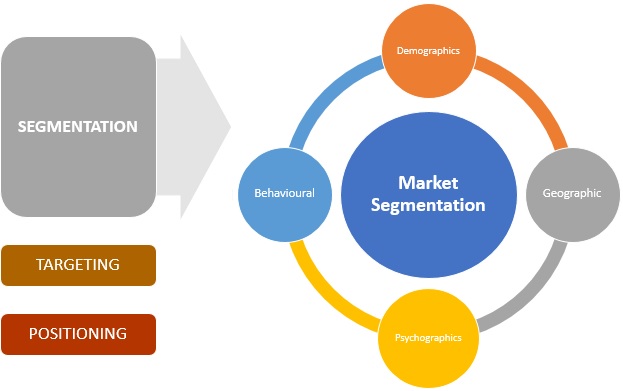
MBA in a Nutshell #6 - Marketing : Market Segmentation

[ Thank you for the well wishes. It is time for this blog and myself to move on. We will be slowly getting back to our regular programming. ]

Image result for market segmentation

Market segmentation used to be easy when I was reading about it for fun.

When I actually do it as part of running a business it becomes very hard. This is because when you have a business running, market segmentation is an empirical exercise. You need data to understand the customers paying for your service offering. Old school approaches to guessing the profile of your customers can lead to sub-optimal profits for this section must be taken seriously.

There are 4 dimensions to market segmentation :

a) Demographic

This is basic information on age, gender, marital status and education. When it comes to demographics, trainers generally attract their own kind. My course has a very strong male population in their 30s-40s - many sign up because are fans of my relationship articles on this blog.

How to expand beyond this middle aged males segment is an important question I need to answer. Millenials would have made great ERM customers not because of the amount of capital they have, but because of the amount of time they have to compound their investments and propensity to take on more leverage risk.

I really don't want to lose this crowd so I will be working with Millenials to see how I can appeal to them in a better way.

b) Geographic

This is based on location and I do not have any information on my customer. Perhaps it would be nice to map customers into Districts. I am confident that valuable insights can be gleaned if I can get some visibility on this.

c) Psychographic

Interestingly I had a conversation with Alvin Chow, CEO of Dr Wealth on this topic yesterday. He believes psychographics is even more important than other forms of segmentation. Fact is that my class attracts a lot of engineers. In fact, Dr. Wealth attracts a lot of engineer-trainers so the bias may be built into the whole company design ! Their latest Quantitative Investing class is totally run by engineer hedge-fund gurus.

Attracting engineers is great but it limits the scope of investment training. I increasingly believe that this is not through active design as the mathematics in my course is not that hard and social science majors can benefit more from my program.

It is likely that  I attract engineers because I status-align with them much better. While I am a dinosaur in IT these days, I still emphathize with project managers and can converse very comfortably about software development and IT infrastructure. I find it much harder to talk about feelings and relationships, that's unless someone wants a really cynical conversation about divorce law and it's effect on families.

I am seeing opportunity in stretching beyond the engineering sector. Recently, I am enrolling students who are athletes and designers and it is very satisfying to see them get some dividends rolling into their bank account, but I suspect I need a lot more to show them a lot more empathy to convince them that I can help them.

Still, I doubt I'll get enough lawyers to attend my class, though. Lawyers are supremely skeptical folks and may not have much respect for data that rely on historical precedence. Some may want a rational-deductive approach to show why an investment will work in the future, I doubt I can provide a definitive assurance for that. ( They should be careful when meeting gurus who claim that they do. )

d) Usage

This is the most exciting part about Market Segmentation I want to explore. A lot of folks buy baking soda for reasons other than baking. Baking soda can be used for cleaning as well.

I've known for a while that a lot of retirees attend my Early Retirement Masterclass and increasing I am getting students who can teach me a thing or two about early retirement themselves.

So I am building a new consumer profile - someone in their late 40s to early 50s who is very competent about making money, but coming from the business or property investing world. They may not trust their private bankers and want to educate themselves on how to deal intelligently with them and want someone to ruthlessly bust the myths spread by the financial advisory personnel.

For this to happen, I need to bring in some legal chops in the relationship to be able to understand the class of problems they face - some may need a trust-like structure to provide a legacy for their children.

The payoff for good market segmentation is high. If I can successfully define my customer segments, I would be able to craft a marketing message for each segment that adds value to them and we will not need to blast emails that trade-off on our goodwill in the future.

Some trainers ave already become public enemies for the FB marketing campaigns they have launched and I'd rather quit the business then fall into this category.


Wednesday, September 18, 2019

How I arranged for my father's wake.

A good friend reminded me that I have to undergo six stages of grief. Right now, I have no idea which stage I am - I still feel sad and would tear a little when I think of my dad, but the best way forward would be to keep writing and sharing. In fact, I will be back at working on my next preview tomorrow.

I am very grateful for the well wishers who were very supportive of this blog as well as social media presence.

Right now I would just like to explain some thoughts regarding how I organized my father's wake with the hope that this provides at least one data point for blog readers.

Me and my mum we recalled into the hospital at 3am in the morning. After some paperwork, we selected Direct Funeral Services to manage the wake because legendary undertaker Roland Tay is very distant relative of ours. To my surprise, Roland Tay was the first person to pick up my call at 4am in the morning and sent a director to our location to get everything settled.

The most crucial decision is that my father's wake will not involve any religious elements.

This is consistent with his and my lifelong beliefs.

When I was young, my dad always thought I should go a mission school and study the Christian Bible. But his philosophy towards religion was purely functional - I should become closer to Christians because I can cultivate valuable business relationships and networks in the future. As a twelve year old, I protested. I was bullied quite badly by ACS kids in my estate and told my dad that he would not appreciate the repeated calls for school donations. I also knew that without all the shiny toys I would not be able to fit along the mission schools in Bukit Timah road. There was also the witch hunt conducted by fundamentalist Christian teachers against D&D players in the 1980s.

I inherited my dad's attitude towards religion.

Even as my dad did not care about rites, most of the time I burned paper during the seventh month with my mum, for vague reasons like good health and 4D winnings. I burnt paper because I wanted to be close to my mum, and because I'm Chinese.

If you are a cynical relative, you might conclude that me and my dad worshiped money. But I think it is a lot more sophisticated than that. I followed this famous evangelist before he went to jail and devoured his sermons on postmodernism because it was so mesmerizing and relevant to me. To me, this guy is not a man of God - This guy is a hedge fund manager who figured out how arbitrage your very soul. For that same reason, I spent a lot of time watching him on God TV while outsourcing jobs in India - it felt good seeing another Singaporean while working in Bangalore.

So it's not negotiable that my dad will have a free thinker's wake. If I had an imaginary fundamentalist Christian brother who pressured my dad to convert on his death bed, I cannot understand who will take bigger offence - me or actual Christians who find my dad hanging outside their GCBs in Heaven, riding his Ducati Daytona motorbike and wielding his shotgun.

And what a good decision a "free thinker's" wake turned out to be.

Direct Funeral Services conducted an event that gave my dad dignity sans all the noise, incense and (to me) pointless hymns/sermons. Initially, I thought relatives would silently disapprove our godless decision but many uncles and aunties all said that they wanted something similar.

The actual framing of the event is a marvel. It is priced and packaged as a Christian package minus religious elements. During the wake, some vestige of Chinese culture were adhered to, like red strings were placed on the tables.

After the 3-day affair, my dad was cremated at Mandai and buried at sea the following day.

The entire proceedings cost about $10,500 including the sea burial. The newspaper article cost $2,500. Total collections of "white gold" offset around 2/3 of my expenses.

My father was a paragon of frugality. I hope he would have been proud of how consistent I was in containing the costs, all this while producing an event that sent him off in dignity.

For readers who do not profess to any religion, you might consider having $20,000 standing by to deal with funeral expenses. There should be plenty remaining to deal with matters after the wake such as probate matters.

I was extremely lucky because I am an only child - there was no fundamentalist Christian elder brother I had to fight to get my way for my father's wake, but if you do, please get this matter settled while your parent is still alive. Ask them what their wishes are.

Otherwise the guy who pays the most will get to dictate the terms - this is the Singapore way.


Monday, September 16, 2019

Eulogy to my father, Kenneth Ng Fook San (1942 - 2019)

No photo description available.

[ This eulogy was never delivered during my father's wake. I was too distraught and cried throughout both attempts to finish this write-up. Before my father was cremated, I wished my families well and told them that my speech would be completed on my blog. ] 

My father Ng Fook San passed away on 14th September 2019 3am. The doctors deemed that he died  due to an infection that got him onto the hospital bed for 3 months, but I believe that it was probably because he could no longer cope with an added dosage of antibiotics that was administered because he developed a new bacterial infection from medical equipment being used to assist doctors in the drawing blood samples.

My father was born in the middle of World War II. As a child he was probably quite bad in school, dropping out in Secondary 2. I remember as a primary school kid, I found his report card in the family storeroom and saw that he scored 11 / 100 in mathematics. I have never seen him so angry and embarrassed in my whole life. My mum told me that he was so ashamed that he threw his report book away and never wanted me to see it again.

His formative years were spent in Ritz Farm where he managed my grand-dad's farm. An uncle Joe Chng who showed up at the wake and related a story that my dad was quite a cool teenager. He owned a Daytona Ducati motorcycle and spent his youth skiving at Sarabat stalls in Tuas, returning only to his farm office when his dad was inspecting the farm premises. As a farm manager who had to hunt and protect his property from trespassers, my dad was also a legitimate bad-ass. He was proficient and was subsequently licensed by Malayan authorities in the use of a shot-gun. 

What my dad lacked in book smarts, he has plenty of hands-on practical intelligence, something which I was unable to inherit from him. When the fences in my old semi-D house was blown down after a very strong wind, my dad built his own wooden fence with no external help and it lasted until we sold the property.

As a lover and boyfriend, my dad was relentless when chasing my mum. Being a Singaporean "interloper" dating a Senai lass who tapped rubber, my dad attracted a lot of negative attention from village gossipers. My mum was a subject of a lot of negative comments after my father bought her a car. This was a really big deal in the 1960s and my mum told me that her dad, unhappy with villagr gossip, beat her up so bad that she almost left home and eloped with my dad in her twenties. Somehow, my dad was able to find for his wedding a Chevrolet - A car that was unheard of at that time and no one was able to top that after that.

My dad spent the greater part of his career years in retail being one of the founders of Pet Lovers Centre then moving on to start his own pet business in mid-1980s. My father did not get along with his siblings and they soon parted ways long before my cousins turned Pet Lovers into this powerhouse today. Because I grew up in a retail environment so I had greater access to my parents during my formative years.

My dad had a pragmatic attitude towards his career. After we wound down the pet business, he took up a job being a manufacturing worker in a packing plant, retiring only after I graduated with my first degree. This was a story I payed in my head every time my dividends hit a new high and I reminded myself that if my dad could go on being useful to society,  why not me.

As an investor, my dad was second to none, clinging onto his piece of landed property even as his friends sold theirs and mocked him for stinginess and frugality. Even as I took over the portfolio and rebuilt it around the concept of dividend payouts, my father's portfolio continued to outpace mine because he has a day trader's instinct and years of experience with Teletext always timing his buys with a slight advantage and always selling it before I did it in my own portfolio.

As my father, his influence on my life was, unsurprisingly, large. He has probably spanked me only one or twice in my life and his laissez faire approach to parenting allowed me to develop my own personal interest towards my academics. I studied whatever I liked ( mainly engineering, mathematics and IT programming), where i felt like ignoring my books, I did that with no negative consequences (failing CL2 repeatedly every year) I was never berated for producing bad results and my dad, never really pressured me to take on any particular vocation. Unlike other parents, both my dad and mum were very open to new experiences and I spent my 'O' level and JC days hanging out in lounges listening to country music with my parents.

What my dad did give me is an unrelentingly tight-fisted attitude towards money and an amazing ability to cling onto my investments no matter how much my peers mocked me for being a fool. This worked wonders for me as piled my paycheck into the markets during the Great Recession of 2008 when everyone was panicking and running away from the financial markets.

When I was a teenaged rebel I did many things I was not proud of and said many negative things to my parents, I thought I was totally different from my dad in every way, excelling in my studies when he had not. As I got older, I find myself becoming more and more like my father, and being very proud of of the legacy that he has left for me.

I am, after all, my father's son.

Rest in Peace, Dad.

I miss you.

One day, we will meet again.


Friday, September 13, 2019

A meaningful gift.


One of my students gave me a very meaningful gift last weekend along with a touching hand-written note.

Perhaps I share a little bit of background of this gift while keeping the student's identity secret.

My student is, objectively, a very successful man by local standards - richer and way more successful than me  to he point whereby I asked him whether he has a class that I can attend. He attained his wealth the hard way without family support and is much younger than me. You might want to ask why he would even bother attending my investment class. I will only say that his wealth was made through illiquid investments and he wants to pick up some DIY investing skills to avoid the hassle of dealing with them.

Privately, I told him that my course cannot address his biggest issue, which is transmitting the right values to his children and then, somehow, the conversation veered into our favorite brands.

I vaguely recall that we had a conversation about the Rolex Daytona and how much we don't really aspire to owning a Rolex but his eyes lit up when I told him how much I loved shopping at Decathlon.

The conversation about Decathlon is what sales people call the "Show Hand" moment. I was not making a sale, but I was just inadvertently signalling and demonstrating to someone that we hold a very similar philosophy in life. Sometimes a sale is not made on the merits of a product, a salesmen may have actually be a vintage car geek like the customer. I once told a potential customer how to buy a revision guide to study for a Project Management qualification and he ended up paying for my course. Salesman then complained to me that this guy was different to get around until I started talking about IT Project management with them.

I have a few $3.90 T-shirts from Decathlon although my wife and mum really hate it when I wear them in town. Until my mum got fed up and got me a pair of Skechers, I wore a pair of $15 sandals everywhere I went with my signature Mr Greedy Uniqlo T-shirt.

My student was telling me that he bought $9.90 bermudas in bulk. At first I did not believe him because I would have seen that deal when I visited. After class I conferred with another Decathlon fan about bermudas and he had to use Google to extract information on it.

Anyway, I really loved my gift. I'm the kind of guy that pumps my trainer fees into student's investment ideas - I can wear what my students give me. In fact, I wore it three days non-stop and even had a key meeting with a brokerage house where I met a team, including senior managers, to discuss future areas of cooperation.

So thanks to my student, I found my future corporate look !

Anyway, Decathlon is opening their first outlet on Orchard Road and I expect it to be in Centrepoint.

It's really poetic justice as Centre-Point kids of the 1980s are probably Decathlon biggest customers today.


Wednesday, September 11, 2019

MBA in a Nutshell #5 - Marketing : Miscellaneous considerations

Image result for marketing

When marketing to a customer, there are a series of extra considerations that has to be made.

a) Other participants in the buying process

Sometimes, it may seem that one party may be the key decision maker but another party exerts a very strong influence in the decision making process. When buying my EC, I let my wife be a primary decision maker, I just make sure that the final decision is within my financial budget. Fortunately, almost all my customers for the training program show up for my previews alone and there is only one key decision maker to take care of. A variant of this arrangement is when one person gets to make a choice subject to the veto power of another. This is common in toy sales.

The downside of simpler decision making is that I seldom meet couples in my training classes, advising them to split up and share notes on two different courses instead.

b) Buying as a rational and emotional process

 If buying is a rational process, all I have to do is to let everyone know my course syllabus and pitch my class at a reasonable price.

If I really did this, I would probably be a divorce lawyer today.

No matter how cold and calculating my students are ( a majority are indeed engineers ), buying an investment course has a emotional component that can only be dealt with with a preview. This preview must have enough pathos to elicit interest.

I have recently transitioned from a very powerful message of "The Death of the Singapore Dream" to my newest performance of "The Four Seasons of Life".

Luckily, I spent my childhood DMing RPGs and manage theatrics fairly well.

c) Cognitive Dissonance

Every buyer faces conflicting emotions when purchasing a product. A person who buys a cigarette is probably aware that smoking is harmful but conquers his internal logic anyway. This is why marketers like to tell a customer that they are "worth it" or they should reward themselves.

In this aspect, my training courses face an uphill task.

For the sake of portfolio that I will build as part of the program, I prefer calmer and rational students who are more likely to understand what I teach. I told my partners that it is better not to hijack the amygdala of workshop participants because a bunch of Warren Buffett worshipper-fanatics may not be able to build working investment portfolio to do justice to my invested trainer fees during class.

If it is one emotion that I do channel is everyone's anger about being powerless in a capitalistic economy and the student's desire to give themselves one shot at financial freedom. Hopefully the anger is replaced with determination once I show them that succeeding even partially will have a huge impact in their lives.

d) Post-purchase Dissonance

When you spend thousands of dollars on something, you get buyer's remorse. This happened to me many times when I buy gadgets like e-readers (something I am still obsessed about).

Coming up with a reasonable money back guarantee program and building a vibrant community of alumni is how I deal with this. I know I can't answer all the questions from my students which is why now I have a community of 270+ members to help each other out.


Monday, September 09, 2019

Letter to Batch 7 of Early Retirement Masterclass students


Dear Students of Batch 7,

It’s been a great honour and privilege to be able to conduct a 2-Day Early Retirement Workshop for you.

This particular class is distinguished by its active class participation. The Q&A for this session is so intense that we finished both days at around 6pm. What I really like about this batch is that some questions shared are quite novel and learned a lot from everyone.

I think the question that left the biggest impression on me is the concern that investment class participants being permanently tied to the trainer via an “umbilical cord”. 

Having a community that is becomes too heavily reliant on back-testing results from the trainer to cherry pick strategies is not the design intent of this program. Instead, I hope that over the next few months, you will be able to detect some common themes in the subsequent strategies published to gain enough courage to develop an opinion on what works on the SGX, and then screen and invest stocks of your own. Sharper students have noted that picking counters with low P/E ratios seem to consistently work in local markets.

As we’ve crossed the month of August, optimism is slowly returning into the Singapore markets and a smaller number of class participants believe that we are undergoing a market trough. This may be a sign of improving conditions in the markets.

For this batch of students, we have, once again, evolved the method that we use to pick our stocks. Students are now given a choice to vote between two strategies based on five-year and ten-year back-tested results to grant them more autonomy over what stocks to select for the Batch 7 portfolio. As such, your selections can be found in the two spreadsheets attached and I have also included the screens that were not chosen by the class for your future reference.

The passive income portfolio built by this class this time round is particular attractive having forward yields of 7.2%. You should prioritize this portfolio if you do not have sufficient capital to buy both portfolios. Using $20,000 of course proceeds, I intend to also buy the equities portfolio that has been built by this class but it the allocation will be equally-weighted between 17 counters short-listed by this class.

Finally, there are requests to accompany me to witness actual back-test strategies on a Bloomberg terminal. I doubt I can do this for such a large class of students every month so I will be putting up a video of how I perform a back-test soon.

Christopher Ng Wai Chung