Friday, June 29, 2018

Inequality explained as a game.


I read with great amusement a FB share by a person known as Mark Lin who wrote a brilliantly original take on inequality. You can find it here.

While I am of the opposite camp from Mark Lin, I must congratulate on his approach of describing the kind of inequality we have in Singapore. He describes it as basically playing a kind of Monopoly game where the winner of the previous game gets to start with two pieces of property that he can collect rental from.

The effect of reading this FB update immediately gave me a motivation to make sure that my kids get a piece of property each after I die, otherwise I don't think Monopoly best describes the game we play in Singapore society

The truth is anyone can use a game to analogise inequality. What if inequality means that the chess champion in the tournament last year gets to play the current tournament with two queens ?

Wouldn't that kind of inequality be even worse ?

Because I am such a huge fan of Dungeons and Dragons, I believe that inequality would be better modelled as a Fantasy RPG. Some player characters can and do start out as Nobles and can begin the campaign with more gold in their possession. So a particularly unequal society will allow the PC who pleased the DM most to start the game with a suit of plate-mail.

A plate-mail is really powerful in 5th Edition D&D but it is hardly a game-breaker in role-playing terms. The platemail is only really cool if you intend to play a Fighter or a Paladin. It also rapidly becomes obsolete at higher levels. If you belong to a different class, you may even have to liquidate the plate-mail to get some useful items for the next adventure. For most adventurers, the item lists do not break the game in any particular way even if you have a lot of gold.

What is particularly interesting when we use the D&D analogy is that one class in particular does not really care about the platemail at all. The Sorcerer is highly Charismatic arcane spellcaster who does not wear armor at all. Their armor is their self-confidence and persuasiveness. If you are a powerful salesman, nothing can stop you from making lots of money in Singapore society. The top real-estate agents can easily make more money than the most lawyers or medical specialists. The other class that does not need magical items to function well is the Monk.

But more importantly, D&D is a better analogy for life than Monopoly because you can't really win a D&D game. All you do is to try to stay alive so that you can keep playing. Nobody is really congratulated for getting the most gold or xp in a game. The closest thing to a winning player is one who created the most memorable story and gave other players the best laughs of the day.

Here are a few examples of some of exploits of the PCs in the groups I played with :

1) In a tournament to impress a king,  the party was supposed to defeat a manticore faster than a group of knights. By the time my monk could act in combat, the two other PCs have already destroyed one of the manticores which made the party a winner. Cursing under his breath, the monk rushed the second manticore who was meant to challenge the knights and tried to punch it with my fist. The attack did really low damage to the Manticore, but the Manticore was stunned in mid-air and fell 450 feet to the ground, killing it instantly.

2) My rogue was supposed to defend a high priestess from being kidnapped by a orcs. Suspecting that the party would be destroyed ( The DM was an asshole killer DM ), my rogue convinced the high priestess to exchange clothing with him.  The DM eventually sent some Orc Elites to take out the party but kidnapped me instead.  The high priestess was able to escape and we succeeded in our objective in spite of being completed defeated in combat.

3) What became a legend in my older group was a fighter who was so afraid of being burnt by dragonfire, he crawled into the dragon's anus and stayed there the entire fight. He was the only PC unhurt in that combat.

I think D&D imitates life a lot better than a silly game of Monopoly. We don't really know what determines success or makes one a winner but we often go through life's journey being part of narrative of someone else. 

We should make this narrative as cool as possible.


Tuesday, June 26, 2018

The Art of the Good Life #28 : Making a deal with the Devil.


I can certainly relate to this chapter.

Beyond harming oneself or one's immediate family, there's not a lot that people will refuse to do if the monetary incentive is high enough. It might not be a bad thing for society because,  sometimes,  even a serial child rapist-killer should have access to justice and should be a chance to hire a lawyer to defend himself even though his actions may be universally disgusting.

This closes the three sections on the Circle of Dignity.

The author proposes that in order to live a good life, we develop a set of principles that we will never compromise.

The first section says that we will stick to these principles even in the face of rational and persuasive argument. The second section says that to stick to these principles, we must be willing to suffer grave bodily harm. And now the third says that we must not sell out these principles no matter what the monetary incentive is.

Sadly, beyond the principles concerning the safety and well-being of my family, I'm not sure if there are any principles that I will go so far for.

After all, in a modern society, almost everything has a price.

Sunday, June 24, 2018

Tuition as an investment


I read the news with increasing consternation that our society has created a monstrosity such as the tuition industry. The situation is now so bad that I think personal finance gurus need to put their heads together to formulate a better framework to decide whether kids should have tuition because the consequence to  your wallet is so dire that in the BIGS FB group, professional tutor La Papillon estimates about $1,500 spent per month for four subjects.

And this is only for one child.

Tutors have a guaranteed rice-bowl due to the systemic mess the education system has created for itself.

Teachers are overworked. They have administrative work to do and have to actually teach kids how to think and do their own research. This takes time away to teach kids how to pass exams.

At the other end of the spectrum, exams have to be pitched at a level harder than the material taught because the education system also has to sift through to the population to decide who gets to qualify for the most financially rewarding jobs. If exams test at the level of what was taught in school, we would need some kind of university entrance exam to sort out the cohort further.

This gives tutors an effective playground to operate on. Tutors don't ever have to teach critical thinking or how to even behave like a human being ( Although some do out of the goodness of their hearts ). Tutors specialise in helping kids survive the Academic Hunger Games of Singapore because that's what parents pay for. This means mechanically attacking every possible question that can come out in exams.

This is why rich families have a distinct advantage. Their kids have time to pick up critical thinking and new economy skills. Learning how to pass exams is simply a monthly pay-check to a tuition agency.

Not every parent has unlimited means. I will simply suggest a controversial idea here : Tuition is an investment. Basically, it is far superior to see tuition as a means of transferring your financial capital into your child's human capital. However, you need to understand that you are in essence converting your equity, cash and bond assets into a call option on the human capital owned by your child.

Your child needs to internalise what is being taught by a tutor for this call option to come into the money. This is the part which I can't really help with because every child is unique and I do know of some kids who simply don't benefit from tuition at all.

There are some consequences of employing such an approach to tuition :

a) The better you are as investor, the less tuition you should be willing  pay for.

This always gets parent's goat when I show them my numbers.

Suppose I take the $1,500 and invest it in a portfolio yielding 10% per annum for 15 years instead of paying for my child's tuition. As a consequence of that, the child fails to make it into a local university but gets a polytechnic diploma instead. I can, as a form of compensation, give him the entire portfolio of $630,000 on the day he starts his diploma job at $2,400. If the portfolio continues to generate 10% every year, your kid would have an effective starting salary of $2,400 per month + $63,000 per year.

This is way higher than the salary of a lawyer, doctor or engineer.

b) Even if you do not buy (a), limiting tuition can be profitable.

A lot of parents protest with my idea (a). One argument is that a fresh poly grad is the last person who should be handling such large sums of money. I can accept that. After all, parents know their kids best.

( I'm sure some kids will even declare financial independence and FIRE on the first day of work ! )

Suppose (a) is too hard to accept, then perhaps reducing tuition to just one key weak subject would some sense. This basically creates an asset allocation for your child that consists of tuition and the usual asset classes subject to the Mean-Variance portfolio concepts in Finance.

Future parents may even employ a tutor and a robo-advisor to look after their kids's future.

c) Even if you ignore this idea, you have to accept that tuition has limits.

The beauty of this idea is that investing in tuition now has logical limits. You will not invest in your children's education if returns to their human capital is too low compared to your returns on financial capital.  Otherwise, you are just subsidising a a tutor's lifestyle.

The value of a degree can be low if your kids insist on studying subjects which do not lead to steady professional jobs. There are NUS degrees with a starting pay as low as  that of a high-end private degree (many SIT degrees are worse). Worst, in the future, even a professional qualification may force some kids in the future to join the gig economy.

This is also balanced by existing high-paying jobs that do not require degrees such as real estate sales and being commercial pilots.

We need a new framework to assess a child's tuition needs and I would like to launch the first salvo in this new frontier in personal finance :

"Minimise tuition, invest the rest."

It is now time that we take the "Buy term, invest the rest" war-cry and drive it against the tuition industry !

The larger tuition franchises are now starting to sound like MLM companies and insurance firms, playing along the insecurities of parents to make an extra buck.

Before I end, I want to suggest a solution for policy makers. I think teachers should be allowed to get extra allowance for staying back in school to teach the weakest students in each subject. These students will have to pay for tuition within the school system but at a rate lower than the private sector, so it should be a voluntary scheme.

If every school transforms into a tuition agency after 3pm every day, the private enterprises will find it harder to wage psychological warfare against kiasu parents.


Thursday, June 21, 2018

My World Cup 2018 shenanigans...


Dungeons and Dragons geeks, as a general rule, are not into soccer.

Nerds and jocks do not mix.

For the life of me, I never understood why folks would bother so much about 22 guys kicking a ball while hordes of fans use the event as an opportunity to get drunk in a pub. It also irks me that whenever the English loses, wife abuse in England goes up.

After becoming an investor, though. I learnt that World Cup season is also bargain hunting season. So I started to follow the World Cup results because I wanted to know whether the market might recover during the semi-finals.

But this year, I have decided that things will be different.

To get some of my skin in the game, I started betting on the World Cup results.

Right now, I know nuts about football, but I do know that Brazil is the favorite to win  from the analysts in Goldman Sachs. I also know that the Economist seems to have projected Germany to be winners.

Being a total idiot to football betting.

I told my mum to buy $50 to bet on both Germany and Brazil to win the world cup, thinking to myself that if either team wins, I will be able to Wifi my home with Google Mesh technology.

But that was not to be.

Even in the best case scnario, a $50 bet on either Brazil or Germany would only win at best $200. My best case scenario would not even net one Google Wifi Router. In fact, it would not even cover the fees you pay to your cable provider to watch the World Cup in Singapore.

The MIT Technology review article pegs a Brazilian victory at 16.6% and a German victory at 12.8%.  Through the Kelly criterion, I can confirm that both my bets are a fools errand ( if you do it legally via Singapore Pools that is. )

The Kelly Criterion for the Brazilian bet is (4(0.166) - 0.834) / 4(0.166)) or -0.7%. The German bet will be even more disastrous.

Whenever the Kelly Criterion returns a negative number, it means that the bet is a pure gamble and investors are better off putting their money elsewhere.

So I guess I just have to appreciate the fact that I just bought myself a reason to follow World Cup 2018.

Anyway last Sunday, I finally gave up the idea of a Google Mesh Wifi, I bought a high end repeater at $150 and now enjoy a full 5 bars for my Home wifi.

Looks like I better stick to income investing.

Tuesday, June 19, 2018

The Art of the Good Life #27 : If you break on the outside.


The second part of the Circle of Dignity series is about maintaining the upper hand no matter what happens.

The example given was a story of a Vietnam veteran who was supposed to be paraded through the streets to show the world how well-treated US POWs were treated. Moments before he was supposed to be paraded, he bashed his face so hard against a stool, his face became bloodied so much so that the Vietnamese were no longer able to use him to make a public statement.

Although I sort of get this advice, I would hesitate to attempt such heroics. I mean, if I die, I would not be able to see my kids anymore. What's personal dignity anyway if you lose your chance to see your family in the end ? Instead, I think it's better to bend even if you sacrifice your personal dignity in the process.

But still, in my own little way, I am able to put a smaller principle into practice.

What I hate are sore losers when playing board games.

There is always this breed of gamer who overcompensates for his lack of real world achievementso he treats a gaming session as a matter of life and death.

My principle is that a sore loser should never be allowed to win board game, even if this means that I lose badly.

There was this Settlers of Catan game I played where the sore loser was on board. I clearly had the lowest point so I was losing badly. But before sore loser was about to win, I turned to a friend who was one point behind and asked him what resources he needed to get his last victory point. I then traded the resources for a nominal resource.

At my successful attempts at Kingmaking, the sore loser flew into a rage.

That remains one of the most satisfying board game experiences I ever had.

Saturday, June 16, 2018

Radical ideas on parenting.


This came about after I became triggered after reading Teo You Yenn's book when she created a false dichotomy on the various approaches to parenting found in Singapore.

For the folks that she did a lot of ethnographic research on, she labelled their approach towards children as seeing them as a "blessing". Children are almost like a gift from the Almighty. You take the children as they are and then do your best in raising them. Children for these folks are happy accidents.

Prof Teo had no mercy for the folks on the other side of the rich-poor divide. The label she applied to parents like myself is that we view our children as "projects". This is because we take a lot of pains to plan our families and put our kids through the education system.

By using two carefully chosen labels, Prof Teo was able to realign everyone's perspective on Singaporean parents. The good has become evil, and evil has become good.

If you have a kid out of wedlock, fail to get them into the best educational institutions and create the next generation of possibly very needy welfare recipients, you are forgiven because children are a "blessing" and society should ideally love every Singaporean unconditionally. If, like me, you take pains to ensure that your kids have a fully topped up Child Development account, we're suddenly soulless cogs in the machine who raise children our kids the same way a Project Manager meets a series of milestones. This is even when we're working hard so that our kids might become responsible tax payers in the future.

Another words, we're the 70% Sinkies responsible for everything horrible about Singaporean society today.

There are a lot of parenting gurus these days on social media. But to me, the only way to vindicate your ideas is that your own kids turn out well. And the truth is, there are no guarantees when it comes to our own kids. Kids are very creative in finding all sorts of ways to become a disappointment and disgrace to their families, so it's best to be humble, do your best but be prepared for the worst.

For today, I'm just going to offer alternatives from what you read from parenting gurus. I'm not trying to burst their bubble, because their kids may well win the Academic Hunger Games of Singapore. I just think that perhaps we can inject a lot more skepticism when we read what most of consider "common sense" when it common sense.

A key idea I take issue with is the idea that we should not give our children too much because it would sap their willingness to put in the hard work for their future and become overly entitled as Singapore citizens.

On careful inspection, it really does seem like common sense. We need to let children come to their own when they find work in the workplace. But I believe that I have valid reasons to be skeptical about this advice. I think that the folks spreading this idea, are the folks, who themselves, have received very much from their parents, so they might not be aware aware about how a little capital can go a long way in life.

Here are some of points that are worthy of consideration :

a) Children from richer families are better at delaying gratification.

This is possibly the most important discovery in social science of late. The orthodoxy is that children who can delay gratification seem to do very well in their adult lives. Buts someone tried to replicate the Stanford Marshmellow test lately,  and they found out in a bigger experiment that the kids who passed the marshmellow test came from richer families that was able to give them the stability and predictabiilty in their daily lives in such a way that they can delay something good to achieve something better in life.

b) Successful entrepreneurs tend to be rich kids with safety nets.

Another harsh truth is that the successful entrepreneurs are rich kids with safety nets. This actually makes sense if you are in the FIRE movement. The biggest risks I took throwing my IT career away to study Law in SMU simply cannot be performed by a family man who needs a day job. I need financial independence to be my enabler.

It's the same principle when you ask a young IT professional to forego a banking IT job to get into a startup. He'll do it if it is safe, otherwise, he needs an assurance if he were to survive a collapse of his startup. Coming from a rich family can provide that insurance from startup failure.

c) Investing requires experience and tuition fees.

This third point I have to share is that investing requires time. You need to have the courage to open a trading account, get a few trades out, lose a little money, but eventually figure out how to get a diversified dividend stream into your bank account.

It took me 14 years and over 7 digit portfolio to gain the courage to play with leverage. I have yet to even figure how to short a CFD.

Similarly, young investors might not be able to learn about all these tricks the Mr Market can offer to teach without a larger starting capital. Getting them to earn their way there can potentially work, but a larger starting capital can get them more comfortable to the idea of risk at a much earlier stage in life.

d) We may overestimate the job prospects for our children's generation.

It's very easy to say that Millenial's just need to be as hardworking and vicious as Gen X, but they are not coming into a job market with plenty of MNC and comfortable public sector jobs. Millenials may spend years holding jobs in the gig economy and face years of lumpy salary payments.

It's easy for me to say that kids should just build their passive income the same way I did, but I relied on decades of MNC employment to make it happen. Will these MNCs even be around in 25 years ?

P&G and HP are ghosts of their former selves.

In fact, I think believe the opposite compared to those "parenting gurus". I admit that given that my own kids are a work in progress, I can be wrong about parenting. But I believe that as it stands, what I am proposing is not inferior to what other parents are touting.

Rather than to just leave our kids to slug it out, I believe the following alternatives may work but might be controvesial:

a) Tuition money can invested into a financial portfolio if the gains in human capital are low compared to gains in financial capital.

For this point, you need to understand your kid's character.

Not all kids are academically brilliant. $1,500 invested in a top flight tuition every month may send some kids to Raffles Institution or GEP, but other kids with the same investment can still end up in Changkat Changi Secondary School.

Not all kids respond well to expensive tuition and hot-housing.

However, the opportunity cost of paying for tuition is investing in the financial markets. A good backtested portfolio can reasonably return 9% every year. If your kid cannot graduate from a good local university, he might do better with a portfolio that generates passive income along with a polytechnic diploma instead.

b) Give your kids an early inheritance while you are still alive to supervise them.

There are too many stories of useless adults in their 30s waiting for their parents to die so that they can become financially independent. The common sense solution is not to give these useless bastards anything.

But I think the solution may the opposite of that approach

While a parent is alive, why not give your children small amounts of capital so that they can learn how to handle larger sums of money, which really requires a different mindset from wage slavery anyway.

Personally, I would give around $50,000 on graduation day and negotiate a cash award for every level of CFA my kids are able to conquer. This would get them to become more confident with handling a market portfolio and given them an incentive to take on one of the hardest exams the world has to offer.

Imagine other Millenials struggling with their study loans but your kids are figuring out how diversified portfolio of REITs can pay off some of their daily expenses so they know that alternatives to earned employment exists. That's a genuine competitive advantage.

Anyway, do share your feedback on these controversial ideas I'm pretty open to criticism because I have two decades to refine these ideas while my own children grow up.


Monday, June 11, 2018

The Art of the Good Life #26 : But If Not

This is a really tough chapter for me to grasp, so I will keep it short.

The author believes that everyone should develop a circle of dignity. One component of this circle of dignity is to have a set of principles that you absolutely commit to,  so much so that even rational argument would not be able to displace it.

I struggle with this principle largely because I do not have a religion, so beyond my immediate family, I don't have many principles which are not subject to negotiation or rationalisation. I also believe that a large number of the world's problems comes from this form of inflexibility. Sooner or later, you will meet someone whose principles are diametrically opposite to yours.

For example, while I have steadfastly refused to spend my capital, this is not a principle I would stick to if my kids need to get an education.

Perhaps the reader can share with me some of the principles you hold so dear that even a logical argument will not cause you to violate this principal.

This is truly out of my depth !


Saturday, June 09, 2018

A deeper analysis of the Astrea IV Private Equity Bond Offerings.

There seems to be quite a bit of excitement on the Astrea IV Private Equity Bond Offerings.  These bonds have been described in great detail by other bloggers such as Investment Moats and Financial Horse.

I just wish to write a small article to plug the gaps in the analysis I find in the blogosphere. Compared to most investors, my personal interest lies in the Class B rather than the Class A offerings.

Here I am detailing the reasons why this is the case.

[ Feel free to critique my analysis. In practice, I do not have the money to move into this asset class this year but I expect some leveraged positions to be take place a few years later after more of such offerings start appearing in the market. This is definitely going to be a successful new asset class that retirees and income investors to flock to moving forward. ]

a) Class B offering actually has lower interest rate risk

Here's where some bond investing fundamentals taught in CFA class may come in useful. The biggest issue investing in bonds is rising interest rates over the next few years. This makes interest rates the primary consideration when you think about buying Astrea IV bonds.

A lot of bloggers miss out on a discussion about bond duration, which measures how sensitive the bond prices are to slight changes in interest rates. I used my spreadsheet and did a simple calculation of the Macaulay duration for the Class A1 and Class B bond offering.

For the Class A1 bonds, I estimated the bond duration to be around 8.31 years.

For the Class B bonds, I estimated the bond duration to be around 7.59 years.

What this means is that for every 1% rise in interest rates, your Class A1 bonds will lose about 8.31% in market value, but the Class B bonds will lose only 7.59%. This is because Class B bonds give out a higher coupon rate allowing you to recoup your costs at an earlier date resulting in a less swingy experience.

b) Class B bonds can achieve this lower interest rate risk at a higher risk of default

The other aspect of bond investing is credit risk. The Class A-1 bonds are rated A by Fitch. For this  A credit rating, I can't seem to find a default rate on Wikipedia, but I think it is reasonable estimate it at a cumulative 1% over 5 years or close to 2% over 10 years. For the Class B bonds, the rating is lower at BBB that gives it a default probability of around 2.11% over 5 years, we can round it up to 5% over 10 years.

After performing this analysis, I am actually a lot more attracted to the idea of buying Class B bonds for their higher coupons using 200%leverage. Kim Eng brokers are offering me at a financing rate of 2.5%, so at 200% leverage, I'm looking at a delicious 11% yield every year that offsets the rising interest rates that will affect the market price of these bonds. The downside is a 5% chance of busting out over the next decade and fluctuations in USD currency (which I have yet to quantify).

Anyway, my hands are still full trying to build my leveraged REIT portfolio. At a much later date, I will come back to to my duration calculations when I get an indicative price of how much these bonds will trade in the secondary markets.

My calculations also reveal that perhaps in future PE bond offerings, retail investors get exposure to the riskier tranches because the credit default risks are often offset by lower interest rate risk. The Class B bonds may require a position size of $100,000 for a 200% leveraged position which is an amount of money that most retail investors do not have.

Anyway, let me know what you think of my analysis.


Thursday, June 07, 2018

F.U. Money is about reinventing the Singapore Dream !

This post came about because Kyith Ng from Investment Moats was giving me feedback on my slides for the upcoming talk and he wants me to see if I can suggest some alternative lifestyles or schemes for people to choose from after they achieve their financial independence.

After some deliberation, I think we can do much than that.

I think by now, readers of this blog knows that I've been blogging about the Death of the Singaporean Dream for quite some time. In fact, I think the Dream is already Dead. My generation's leaders murdered the Singaporean Dream when hordes of foreigners were allowed in to keep our salaries depressed. Now the Millenials don't buy the Dream at all, they know it's a Faustian bargain which is why they chose work-life balance over career ambitions.

Why ?

Because Gen-X knew what betrayal feels like.

Opponents of inequality talk about small differences in a family environment being magnified into serious socio-economic gaps in adulthood.  So much so that Low SES and High SES jokes are quite the norm in social media. It also does not look good that folks in their 40s face a serious threat from automation and technological shifts.

The first victim of social upheaval at such a profound scale is the older model of successful Singapore living which is that idea that, upon graduation, we can have hold a job for about 30 years and then start a family in the meantime. In reality, most of our careers will not even be half as long as our mortgage tenures. And yet the prices of housing continue to edge up due to the presence of foreign buyers.

A new schema for the Singaporean Dream needs to incorporate the latest and greatest in the field of Personal Finance so much so that F.U. Money is now more important than ever if you wish to craft a New Singapore Dream for yourself.

Tools to create your own Singaporean Dream needs to incorporate the following :

a) It has to be achieved faster and not slower.

While its great to delay gratification, our generation has less time than before. Our STEM degrees become worthless in half the time compared to the 1990s. Humanities degrees do not even command value right off the gates. Mathematical models allow speed to be achieved with a reasonable risk of ruin. We're becoming obsolete by the minute even as we hold day jobs. This is because different parts of the industry automate at different rates.

b) It has to be indifferent to paper qualifications

The workplace is full of biases that pay private degree holders about $1,200 less than local degree holders. For the winners of the academic race, that's fine and good. For the losers, they need to find a playground where they can be safe from discrimination based on academic achievement. The markets are fair arbiters of investment skills. I have never seen a stock pay a lower dividend to a private degree holder than local degree holder. Of course, if you receive poor training, you might not have the knowledge to buy the right stock in the first place.

c) It should be rewarding even if it's not done 100% right

Shooting for $2,000 per month in passive income is sweet but a lot of people will fail in achieving this mission. The trick is not to mislead the audience into thinking that it's easy. Saving 80% of your take home pay is as hard as playing championship sports. The trick is that meeting 10% of your goal should be rewarding as well. $200 in passive income every month can pay off your public transport expenses.

I'm still in the process of refining my slides.

If there is anything you'd like me to specifically address, feel free to share about it here.


Tuesday, June 05, 2018

The Art of the Good Life #25 : Hedonism and Eudemonia


My talk on F.U. Money is not just going to be a showcase of reams of data in my back-testing experiments. In fact, I'm spoiling one of my slides here ( I have close to 60 slides for the 30 minute presentation ).

Post- F.U. Money, most folks will focus on personal pleasure or Hedonism. These are the guys inflicting all that psychic damage on me right now, posting their wonderful June Holiday photos of them travelling with their kids in Europe. Hedonistic people will use their money to travel, procure more sex, or eat at a Michelin 3-star restaurant. It's their money, and they've earned the right to enjoy themselves.

But philosophers are not satisfied with a life filled with nothing but pleasure.

I was enlightened by an intern yesterday that the best movie on IMDB is the Shawshank Redemption. Movies like the Infinity War make a hell of a lot of money, but why do such movies never make it as great movies that withstand the test of time? Simple. The Shawshank Redemption is a lot more meaningful as compared to Infinity War which is just a CGI extravaganza.

A meaningful life explains why some people post financial independence would prefer to make a dent in the universe instead of retiring to a life of seeking endless pleasure.

After getting your F.U. Money, you should be seeking both Hedonia and Eudemonia. Do find things to do that make life pleasurable.

Your financial independence is also the time to ask the hard questions of what makes life meaningful to you. For many folks, it's raising their kids well. For others, it might be devoting to a cause greater than yourself. 

Sunday, June 03, 2018

An idea so dumb, only an intellectual will believe it !


The genesis of this article came from Alvin Chow of Dr Wealth who make this quote of social media. I was once reminded of the Efficient Markets Hypothesis (EMH). On Investopedia, the definition of EMH is as follows :

"The efficient market hypothesis (EMH) is an investment theory that states it is impossible to "beat the market" because stock market efficiency causes existing share prices to always incorporate and reflect all relevant information."

This theory is broken down into three sub-forms:

  • The weak form of EMH posits that past movements and volume do not affect future stock prices. Believers in the weak form do not believe in Technical Analysis.
  • The semi-strong form of EMH posits that stock prices incorporate all public stock information. Believers in the semi-strong form do not believe in Fundamental Analysis and Technical Analysis.
  • The strong form of EMH posits that stock prices incorporate all public and private information. Believers in the strong form of EMH do not even believe in insider trading !
( I used to subscribe to the weak form of EMH until really recently, making myself one of the intellectuals who believe in this theory. )

But I'm not afraid to change my ways if more profitable approaches are out there.

For the past week, I have been going to library to prepare for the talk on F.U. Money, and I have some backtesting insights that I can leave for readers of this blog that would not detract from the really interesting findings for the paying customers of this upcoming event.

In short, here's what I found :

The baseline gains you can make from the STI ETF has been around 4.4% for the past 10 years. 

If you employ a filter that chooses Singapore stocks with lowest EV/EBITDA  and then find within this universe, those with the highest ROIC, you can get a 10.63% return with a Sharpe ratio of 0.39. 

Not too bad. 

At this stage, a lot of investors will be satisfied with this filter because it can achieve decent gains. But when you combine a value measure with momentum indicator like the Relative Strength Indicator (RSI), I was able to achieve 24.89% returns with a Sharpe Ratio of 0.9. 

As all my backtests experiments span 10 years, we clearly cannot ignore some of the ideas of Fundamental analysis as well as Technical Analysis.

This makes the EMH one of those theories that is so dumb, only intellectuals will believe in them. 


Thursday, May 31, 2018

BIGScribe Investors Exchange 2018 is about F.U. Money !


I'd like to see BIGScribe Investors Exchange as the Wrestlemania of Singapore Investing.

You can book your tickets for this event here.

Our last event sold out and I was told by the event organisers that we are selling the tickets at twice the rate last year. It's no surprise, because as of this time, we have four heavyweight speakers who will be talking about serious investing topics for that day.As you all know, I am a retail investor and a fan boy, so I look forward to the presentations just like members of the audience.

Which puts me in a fix, because I am the fifth speaker.

Traditionally the last speaker in a presentation team in SMU Law School presentations has to find a way to wrap up the proceedings and create a positive spin for the whole event. Even in Wrestlemania, the final event is when the Heavyweight title often changes hands. The wrestlers in the final event is seldom the best fighter in the WWE ( Leg Drop of Doom, anyone ? ), but the fight has to contain the best trash-talking and drama.

Last year, the topic of my speech was "50 Shades of Dividends Investing" and I was quite sure some folks were offended by my subject matter.

This year may be no different.

I will be talking about F.U. Money.

But for now, I'd like what F.U. stands for to be a mystery.

I will discuss what F.U money is, how to get it, how to make it grow. I will explain why we are so hot and bothered by F.U money. Why we want that F.U. moment in our lives and why we need to get that moment soon and not delay gratification indefinitely.

As in all my talks, I will discuss some empirical observations on blue chip stocks, dividends and REITs.

If you're lucky :

a) You might even become disillusioned and even a little angry with ETFs.
b) You may also never see some degree programmes the same way again after my talk.
c) You suddenly feel that contrary to modern concepts of self-help, delaying gratification has limits.

You see, my job should not be just to motivate you, my job is to show that you reality bites and how you can fight back.

Folks who follow me will expect that I try to back up every assertion with research and empirical findings to support my thesis. A lot of material was crunched to create the slides which are undergoing trimming right now.

We will take the data science of investing and try to marry it with the latest psychological research and I will show you how all this can be tied up to your personal goals of happiness and bliss. 

It's time for Investors Exchange 2018.

Buy the tickets while stocks last.

And most of all - F.U. !!!


Tuesday, May 29, 2018

Describing a problem well does not mean that you have a solution.

The Art of the Good Life is taking a break this week as I am blogging from my parent's home and recovering from a nasty bout of food poisoning.

This is part 2 of my critique of Teo You Yenn's This is what inequality looks like.

After completing the book, I became a lot more disappointed at this piece of work. The first half had vivid descriptions of inequality but the second half is a confusing mess. There were two chapters dedicated to the problem of the lack of dignity in the lower classes. One chapter, which I find really ridiculous, was about why the author refused to account for "race" in her research. It gave me the impression that she was passing the buck in order to pander to political correctness.

Anyway, let me illustrate why describing something well does not often lead to making better decisions.

There are a investment trainers and bloggers who take a qualitative approach to investing and this has done very well for them. They can describe a company's strategy and management very well. Even my friends in Maybank Kim Eng has invited me to listen to a few REIT managers to see if their REITs are good buys.

I always find this approach to investing difficult. Anyone can spin a tale and talk about good management is. Management can, in fact, be very sincere and can demonstrate why they are running the company well.

But a nice narrative alone cannot be an excuse to go long in a company stock.

Perhaps the stock is already overpriced.

How do you measure trustworthiness ?

Instead, I use rigorous quantitative backtesting to determine the portfolios I will build of the rest of the year. Some results of my backtesting may constitute financial porn, I will be starting with a portfolio that is purported to return 27% over the past 10 years. Every investment idea must be easily explainable and reversing the measurements can lead to negative returns, making double alpha market neutral portfolios a reality.

With this approach, I might still lose out to the touchier and feelier investment managers, but it's rigour lets me sleep at night.

I think the same applies to a sociologist's writings. Ethnographic research inevitably means that stories are anecdotal. Furthermore, I can tell from her writings that many social workers do not even agree with her and adopt a tough love policy to the people they are helping.

Teo You Yenn did not explain what is the price to pay to reduce inequality.

Who will suffer when we free the Child of Omelas from our basements ?

The true test will come when Singaporeans decide whether to open their wallets to overcome inequality in our society.

To many of us, that price would be too high.

Sunday, May 27, 2018

What Feminists Want


I made a promise to myself that I will not start criticising an author before I read her work.

This is what Inequality Looks Like by Teo You Yenn is an excellent piece of work which I thoroughly enjoyed.  But as a right-winged capitalist and patriarch, I would position her work in the same category as Thomas Piketty's Capital in the 21st Century. Capitalists do not read it with a desire to inequality - they read it so that they can be on the "correct" side of the rich-poor divide.

Instead of making me more sympathetic to the under-privileged, this piece of work has made me more anxious for my own children and for the next few years, I need to figure out how to entrench my children's position in Singapore society today because they will be a confused bunch - I believe that the 4G leadership is very open-minded to You Yenn's ideas which is why she has not been given the same criticism as other academics such as Donald Low or Thum Ping Tjin.

This book may be the defining work for Singapore over the next 50 years.

As I've only read half the book and, as usual, I still find that the book is long on problem definition but short on solutions. While sociologists excel at describing the problem, as my sociology scholar friend tells me that "we are doomed to praxis" -  Solutions in the real world must be better than the interventions that we already have today and should not introduce more problems.

Our social spending has already gone up since the 2011 elections. Welfare can have secondary effects as it kills innovation and the work ethic. Society can also destabilise if wealth transfers to the poor are seen by some as wealth transfers across racial boundaries - this was what caused the rise of Trump and the collapse of UMNO.

Some of the examples given by the book has really started to get me wondering at what really gets feminists off. So far, the examples in the first half of the book always concern women. One poignant example involves a mother of three called Nana who has a husband who can no longer support the family. But at the end of the story, Nana proceeds to get pregnant with her fourth child !

At what stage does personal responsibility come into the picture and society's obligations end ?

In essence, the plight of a lot of women concern their husbands. These are men who cannot focus on getting a job, who commit adultery,  and who stop supporting the household financially.

Why do women choose these flaky men when I have so many geeks pals who are nice, earning money but single ?

State intervention into these families are, in essence, a "put option" on bad husbands. Feminists want the government to get into the picture and raise their kids when their husbands refuse or are unable to do so.

This is, in essence, an appeal for portfolio insurance.

This is eminently unfair.

Women choose men based on the dictates of evolutionary psychology. Tall men with symmetrical features get a larger share of women in spite of lacking conscientiousness. Many aren't even agreeable.

This is why women marry dangerous men and jerks.

When these dangerous men leave their women to fend for themselves, feminists appeal to tax payers to support their kids.

Imagine my friends who are single, happily playing away in their Playstations in their apartments being asked by the State to subsidise children who do not belong to them. This income support comes in the form of higher GST, capital gains taxes or income taxes.

This is no different from asking husbands after a divorce to maintain children who do not share a DNA with them.

No one wants to be a cuck.

I hope Prof Teo would articulate what she really wants from society in the second half of the book.

I can't wait to read it.


Friday, May 25, 2018

Quantamental Investing and the Piotroski F-Score


I don't have much to talk about because I'll be spending the weekend in NLB to crank up more backtests for my next talk which is entitle "F.U. Money". I can't start my marketing blitz until I finalized my contents.

But here's a share on what I've been thinking about of late.

The latest buzzword being bandied around is Quantamental Investing and I did some Googling to find out how professionals do it. Right now, I can't figure out how this is anything new compared to what was done before so it is possible that some people invent a new buzzword to attract more investor money.

What I do know, and struggle with, is to find ways to incorporate the Piotroski F-Score into my  local stocks picks. Joseph Piotroski is an accounting professor who found stocks with low P/B generally fall into two categories - those that are cheap and will eventually go up in value and those that are cheap because its a failing business.

The Piotroski F-Score is designed as a scoring system to distinguish one from the other.

There are 9 tests in the F-Score which results in a score from 0-9. A low P/B stock is a good buy if it can have a F-score above 6.

Here are the nine tests :

  • Is the return of assets (ROA) for the last fiscal year positive?
  • Is the cash flow from operations for the last fiscal year positive?
  • Is the ROA for the last fiscal year better than the ROA for the fiscal year two years ago?
  • Is the cash flow from operations greater than the income after taxes for the last fiscal year?
  • Is the long term debt to assets ratios lower for last fiscal year when compared to that for the fiscal year two years ago?
  • Is the current  ratios higher for last fiscal year when compared to that for the fiscal year two years ago?
  • Is the average number of shares outstanding lower for last fiscal year when compared to that for the fiscal year two years ago?
  • Is the gross margin higher for last fiscal year when compared to that for the fiscal year two years ago?
  • Is the total asset turnover higher for last fiscal year when compared to that for the fiscal year two years ago.
The F-Score is a great way to learn how to read financial statements. More importantly it might be able to supercharge returns of a quantitative strategy involving value metrics like P/B ratio or Dividends yield. 

The problem is getting a tool that can calculate this score for all the counters in SGX. 

If any reader knows of a solution do let me know.


Tuesday, May 22, 2018

The Art of the Good Life #24 : The Spiral of Self-pity


Another short one,

There are three unproductive ways that we can deal with negative events.

a) Do nothing.
b) Complain
c) Engage in Self-Pity

The book misses out the fourth point :

d) Engage is self destruction

The trick is not to engage in any of these activites. The suggestion not to engage in self-pity comes about because there is no end to the injustice that your ancestors faced that led to your fate today.

I just want to say a few words about Millenials and personal finance.

In 2008 and 2009, our generation faced possibly one of the worst recessions ever. One effect of this is the rise of the Hipster. No, not the kind of hipster that sells rainbow-themed foods at the Geylang Bazaar ( Now that's really hopeless shit !) but the kind of ironic, frugal child of the Great Recession that is forced to work in the gig economy and avoid seriously engaging in the financial markets.

So this Millenial Generation was burned so badly by the markets, they eschewed Wall Street and missed out on the greatest bull market post-recession. But it gets worse - they invented a whole new asset class called the crypto-currency and dived into it without proper asset allocation and diversification.

Some became very rich but the majority are stuck with paper losses as they hold for dear life into financial oblivion.

For the folks suffering huge losses this quarter, try to avoid self-pity, just pick yourself up and start studying finance seriously.

At least, unlike me, you still have your youth.

Sunday, May 20, 2018

Feasibility of Bond Margin Financing


[ Feedback for this article is fast and furious !

Some concerns raised is whether investment grade bonds with a short duration can even be found in the markets ]


This has been a great week. The folks of Kim Eng held an open house and invited me to attend. The catered food was relatively good given that my exposure to free buffet is limited to what is available in SMU law school. They also gave me a pair of free movie tickets because I was such a special margin financing customer.

I'm just saying all this because I know they read this blog quite religiously.

Anyway, let's have a closer look at their bond margin financing facility.

Maybank Kim Eng has a fairly competitive rate to facilitate bond margin financing. I invite all readers to share with me what private bankers give them, but 2.28% is sweeter than my rates for REITs financing, but we have to live with the lower returns from bonds.

The framework I am using is the traditional use of the Kelly Criterion that blackjack players use to size their bets. The better the odds of winning, blackjack players will place bigger bets. I also employ a modification called the half-Kelly because gamblers generally half the output of the Kelly Criterion so as to err on the safe side when placing bets in a casino, this way they can survive longer.

Ok, so let's look at a typical deal the Maybank guys have suggested to me that night.

Suppose we have a bond with one year left to go. Let's assume that this is a bond issued by a local bank that returns 4% and is rated AA - it's a safe,conservative bet. As bonds are sold OTC, each bond position is a hefty $200,000. I also did some searching on Google and I found that in the worst case, a AA bond defaults with a percentage chance of 0.38% in a super bad year like 2008. This gives us a worst case scenario for a default. To simplify matters further, if a bond defaults, I assume  that you will lose everything even though the insolvency process might give you higher priority than shareholders.

So assuming that we have war-chest how much of it can we put into investing in this bond without leverage?

We apply the Kelly Criterion, or [b(p) - q] / b, where b is the odds on a success or 0.04, p is probability of success or 0.9962 and q=1-p or 0.0038. If this bond were a blackjack game, the Kelly Criterion will recommend that 90.12% of your war-chest can be placed on this bond. Sane gamblers use the half-Kelly and can invest 45.06% of their portfolio into a bet. At $200,000 for one position, you need to be almost half a millionaire to take this bet.

Now let's look at the Kim Eng deal that allows us to employ some leverage to buy these same bonds but at a cost of 2.28%. By leveraging 300%, you only need $66,667 to place a bet on one bond. There is, of course,  a 0.38% chance of utter ruin. Suppose we apply leverage, there is a 99.62% of winning (4%*3 - 2.28%*2) or 7.44%. This translate to odds of 0.0744. There is a corresponding chance of a disaster occurring with a probability of 0.0038 where we will lose 304.56% of our bet.

(Expect to lose everything when a bond defaults. Also you will owe the broker the money you borrowed from them as well. )

Put all the numbers into the Kelly Criterion,  the equation will allow us to bet [0.9962 x 0.0744 - 0.0038 x 3.0456] / 0.0744  or 84% of your war-chest. Using a half Kelly, this is a bet sized at about 42% of your war-chest.

What can we conclude from this exercise ?

a) A margin account for bonds allows a smaller retail investor to bet on bonds, something that is the province of the UHNW investor. The first case where there is no leverage, you will need about $400,000 to justify placing one bet on a bond. In the second case where you employ leverage, you only need ($66,667/0.42 ) or $160,000 to justify one position.

b) The equation covers credit defaults but most of the fear in our current market comes from interest rate risk. The smart money is betting that the Fed raise interest rates three times in 2018 and twice in 2019. If this prediction is wrong, there will be bigger shocks to bond prices. This is why leveraged bond bets should focus on bonds that will mature soon, like within 1 or 2 years of placing your bet.

c) Having bets with a size of $200,000 or $66,667 is still fairly large for a retail investor, so expect only quasi-affluent folks to be making use of this margin facility.

d) Unless you are a multi-millionaire, most of your positions will not allow you adequate diversification.

For now, I will be sticking with my REITs margin financing account which is doing ok. After it hits my ideal size and leverage ratio, I will not be ready for bond financing yet because I want to start working on a market neutral portfolio using CFDs which is something I hope to start doing in 2018.


Friday, May 18, 2018

People fail because they major in minor things.

The last article where I spoke about the complexity of Singapore life attracted some amount of constructive criticism from bloggers like La Papillon and Richard Ng, so I went back to the drawing board to see whether that idea can be reviewed or salvaged. 

In many cases, they are right, complex societies do not exist, only complicated people. And I think I tend to be more complicated than an ordinary Singaporean. In many matters, Singaporeans do have it easy compared to their international counterparts. Our tax code is simple and we do not spend too much effort trying to optimize our taxes unlike our friends in the US. 

One salvageable idea in that article is the advice that I give to readers not to major in minor things. I think this idea was invented by Jim Rohn and made famous by Anthony Robbins. 

According to Tony Robbins : People fail because they major in minor things.

Here's an example of what I did recently.

At this stage of my life, I don't want to be beholden to any employer. If I work for someone, I want the work to be interesting, rewarding or both. To do that, my finances must be able to sustain joblessness better than my 4 years of law school. Even better, I must be able to save more than most working folks even when I am jobless.

So I really wanted to optimize my expenses so I went through my broadband and mobile phone commitments. I went to a Starhub outlet and started to work with a salesperson to re-contract my phone and cable TV. The salesperson was actually quite nice and was willing to offer to me cheaper SIM only and no-frills cable TV plans. The total result of my effort was to shave off $50 from my telco expenses every month. Let's just say that in 2 years, this would have saved me $1,200.

Another hack I did was to buy a battery changing kit from a China vendor for my Oneplus 2 phone for about $20. With an extended battery life, I can now avoid buying a Google Pixel 2 and maybe even wait for the Google Pixel 3 to be launched. This can potentially save me another $1,300 over the next two years.

Net-net my micro-managing efforts yielded about $2,500 of savings over the next two years.

Now, suppose I move $200,000 of my portfolio from Tech stocks to my REITs margin account. I can push my dividend yields from 5% to 10%. This subtle change can net me an extra $10,000 in dividends every year. Of course, more effort would be required to do some research, but even if I miscalculate, an additional $5,000 with an improvement in the Sortino/Sharpe Ratio of my portfolio is quite a reasonable result.

As such, fooling around with Telco plans and optimizing some credit card benefits may be considered a minor thing compared to simple portfolio shift from Tech to Leveraged REITs.

But some decisions are even bigger than those involving your investment portfolios. Your decision to study for a degree will have a major impact on your total income you will make within your lifetime.

Choice of a degree affects your human capital. 

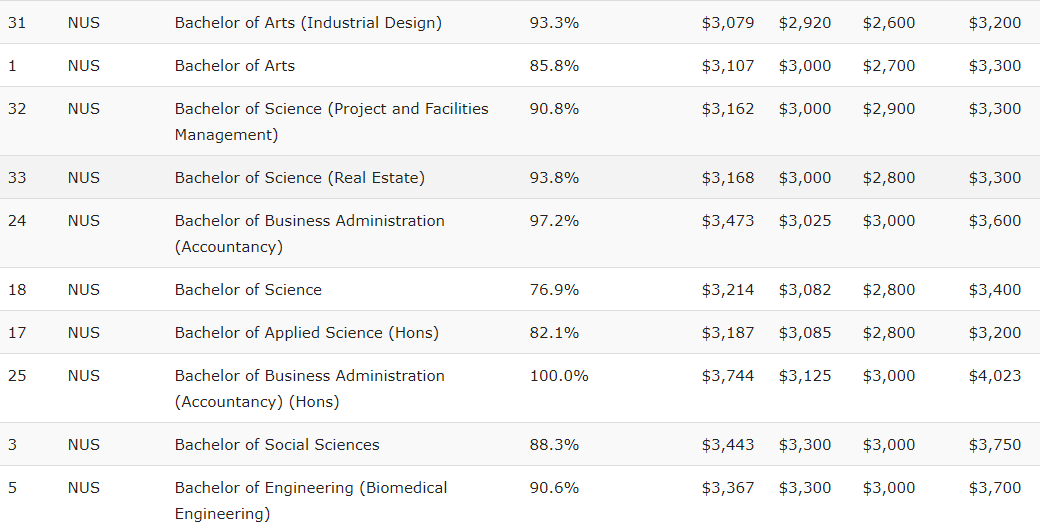
You can easily find a website and dig out statistics on starting salaries and employment rates of a degree program.

To stay politically correct, I have listed the worst NUS degrees you can apply for after your A level exams, omitting the truly abysmal numbers coming out from SIT. The third column from the right contains the median monthly income figures and the percentages are employment figures after 6 months of graduation.

In many cases, people do really major in minor things.

Enjoy !

Tuesday, May 15, 2018

The Art of the Good Life #23 : The "Good Death" Fallacy


Short post because I'm not feeling good ( sprained my back ) and it's been a long night.

The "Good Death" Fallacy is a mistake we make because we not give any weight to a duration of an event.

Consider Anna who was single, unmarried and had no children. She had good friends and enjoyed going on long holidays. At age 30, she suddenly died in a car accident.

Now consider Beth who was also single, unmarried and had no children. She had good friends and enjoyed going on long holidays. The last five years of her life was not as good as her first 30 years. At age 35, she suddenly died in a car accident.

When asked to determine who lived a better life, most surveyed participants said that Anna had a better life even though Beth lived 5 years longer.

Our mind is prone to over emphasize the peak in each event and how each event ended.

The duration does not matter so much.


Sunday, May 13, 2018

How hypergamy and rise of involuntary celibates affect our personal finances.


The recently Toronto attacks by a single man on women illustrates the danger of involuntary celibates to our modern society. If you have been following this blog, I write about about the rise of the useless caste - Video gamer males who do not participate in the labour and marriage markets. Involuntary celibates are a different archetype. Incels are angry men who are upset that they are being ignored by women or "Staceys" who prefer dating what incels label as jerks.

One of the root causes of involuntary celibacy among males is demographic policy. China is now ticking time-bomb because their rural areas are full of men who cannot find a spouse  thanks to the ago old practice of aborting female fetuses. A nation of millions of Incels is definitely not a safe place for our daughters.

But there is another reason for the rise of Incels.

Hypergamy is the act of marrying someone of a superior caste. The fact that women are generally hypergamous has been researched and generally supported by social science. The following paper rationalises this phenomenon - because women tend to invest much more heavily in offspring, women will tend towards marrying men with higher human capital and men want women with lower human capital because of men's desire to have legitimate children.

( My personal experiences being exposed to family law also seems to give me the impression that men with lower human capital marrying women with higher human capital will result in marriages of poorer quality. )

The effect of hypergamy on personal finances is largely ignored by investment gurus but it is far reaching and can impact your investments.

Face with a dearth of eligible women, men in China work punishing hours to own an apartment to attract a spouse pushing up real estate prices. Interestingly, many people still remains single. Chinese women who are highly-educated  and successful get dissed by society as sheng nu. At the other end of the spectrum, lowly educated rural men sometimes have to resort to kidnapping or sharing spouses.

Imagine our 4G leadership making a decision to re-introduce immigration to deal with our low fertility rate. The Chinese, being so used to high real estate prices, will definitely push up real estate prices in Singapore. This will occur without a corresponding increase in rentals creating price compression in local real estate markets. Wait... i think it's already happening today.

At a personal level, this means that I now see myself as a "corrupting influence" when I hang out with LLB interns.

To me, when a fresh male Law graduate starts a new career, the high starting salaries and career potential allows them some leeway to play a waiting game in the game of marriage. Their human capital is an appreciating asset and hypergamy guarantees that the harder they work on their cases, the more attractive they are as husband material. It's like playing blackjack and only committing the heavy bets when there are more 10s and Aces left in the shoe.

For the female Law graduate, the marriage game is much harder. The university is the last place where they will be surrounded by eligible men who are intellectually compatible with them. One bad move and they will miss out on the marriage markets.

I think this also answers my previous posts as to why we can't make RGS girls marry ITE guys.