Can't do a really long post as my kid's viral infection has finally spread to me.
I really would not want to leave readers with the feeling that everything is bleak for IT PMs.
The solution to all of life's obstacles is to "Science the shit out of this problem !"
In the book Smarter Faster Better by Charles Duhigg shared about research done on superstar project managers has the following to say which is not taught in the PMP program at all :
a) Superstar project managers limit the number of projects they do.
Superstar project managers tend to do fewer projects. Around 5 at once.
b) Superstar project managers choose their projects carefully
Rather than go with comfortable projects which they have done before, superstars based their choices on getting more opportunity to meet new people and develop new skills. This explains why they only have capacity for five projects.
c) Superstars join a project at an early stage
A lot of information gets conveyed at an early stage of a project, it's also a way to get more social capital for the project. Furthermore, the fact that projects tend to fail more often at an early stage is not a problem for superstar PMs.
d) Superstars are constantly trying to develop mental models.
This fourth skill is quite interesting as I suspect its the same skill which makes great investors. Superstar PMs are constantly trying to explain a phenomenon by creating narratives as to what has happened. These narratives are dynamic and changes with the flow of the project.
I can imagine a strong fundamental analyst as someone who can turn balance sheet numbers into a story and spin a bullish tale and adjust accordingly as the market situation changes.
Anyway, that's all I have for this weekend.
Sunday, October 30, 2016


Thursday, October 27, 2016
Death of the IT Project Manager
I was one of the early adopters of the Project Management Professional qualification and held it for nine years from 2003 to 2012. I was reading about the PMETs who are losing their jobs and wanted to understand why there is such a wide gap between the skills desired by the markets and the skills which middle-aged PMETs like me have.
I also read a really badly written book called the Neo-Generalist by Kenneth Mikelsen, one of the worse books ever written in support of a generalist career which paints the picture of a polymath as someone who is a trickster, hipster, and has few practical skills. The book was a horrible experience but it gave some insights into how the modern economy is changing.
For a start, lets look at the typical engineering/IT career path for Generation Xers.
In your 20s, you start out with a Bachelor's in Engineering and is highly specialised in one discipline. It easily lands you a solid job with an above average pay because you can do what you are paid to do. But your knowledge is "I" shaped, it is narrowly focused in one discipline.
In your 30s, you branch into project management. Some guys get MBAs but project management is the only way to maintain a high salary glide-path in your 30s. At this stage, with a certain amount of maturity, your knowledge becomes "T" shaped because you have to develop some organisational and business skills which are fairly broad and general in nature.
At this stage, a lot of people don't realise that becoming a PM has a hidden cost.
The broadening of skill sets comes at a sacrifice on technical skill sets, so it become rusty after a while. The introduction of cloud computing was a hint as to what was to come. And paradigm shifts like functional programming, DevOps and data analytics represent a knowledge hurdle which a technology professional needs to overcome but companies will generally not invest in their workers in Singapore.
So in your 40s, your knowledge is "T" shaped with a broader horizontal line but shorter vertical line and the next paradigm shift eventually kills your career. The older generation of IT Project Managers can talk about servers, routers and switches, but we have since moved into the cloud and are running projects to analyse datasets owned by the company.
The bulk of us in our 40s ask ourselves why are we jobless in spite of having an engineering degree and MBA. Can't really blame the industry as I've attended talks on Blockchains where the Senior staff of some local firms are plugging security solutions which are over a decade old for a technology which isn't even centralised and controlled by one party.
It gets even more exciting if you hit your 50s. If you survive, you will be just those director level staff with no real technical skills whose only job is to keep costs low and retrench staff. At this stage, your knowledge flatlines into a "-". I do not have kind words for senior IT staff as they are quite obstructive and do not add any value to the business. A skill-set is to repeated cut costs through outsourcing and hollowing out of the IT department until they do not even have a team to manage anymore. This explains why Gen-X has some real beef against the Boomers. What skills do Boomers have that Gen-X don't which entitles them to a salary of $250k -$350k. Worse, they are the ones with the hiring and firing power. And don't get me started on how the Boomers benefitted the most from the asset inflation throughout the 90s which Gen-X did no fully get to subscribe to.
It gets even more exciting if you hit your 50s. If you survive, you will be just those director level staff with no real technical skills whose only job is to keep costs low and retrench staff. At this stage, your knowledge flatlines into a "-". I do not have kind words for senior IT staff as they are quite obstructive and do not add any value to the business. A skill-set is to repeated cut costs through outsourcing and hollowing out of the IT department until they do not even have a team to manage anymore. This explains why Gen-X has some real beef against the Boomers. What skills do Boomers have that Gen-X don't which entitles them to a salary of $250k -$350k. Worse, they are the ones with the hiring and firing power. And don't get me started on how the Boomers benefitted the most from the asset inflation throughout the 90s which Gen-X did no fully get to subscribe to.
An IT professionals only recourse now is to become "π" shaped. Project managers in their 40s have to literally kill their careers to function as a technical specialist again in a radically different field so that they can continue to be taken seriously. Data Analytics requires a statistics foundation which very few 40-something year old IT professionals can handle. Alternatively, an IT PM may have to take a qualification in a vertical like a "HR qualification" to remain relevant.
But for the bulk of 40-something year olds, the key question is whether you can accumulate enough wealth to survive a long winter.
The IT industry with government policies on immigration has basically allowed many engineers to climb a ladder in their 20s but in their 40s they find these ladders got taken away by a combination of policy and technological change.
They suddenly have no valuable skills and no capability to develop new ones which are in high demand in Singapore today.
I expect that the same will happen to the elite Computer Science graduate today.
Hope they can resist the lure of project management career track for as long as they can.
Monday, October 24, 2016
Life-hacks for the money-conscious.
We had to send our kids to the hospital due to both getting high fever over the weekend. Things have only settled down today, so the weekend post has been slightly delayed.
Here are three life-hacks for the money conscious.
a) Roti Banjir Arbitrage

I read about a variant method to eat roti prata the other day, so I tried ordering two roti kosongs and then poured the curry all over it. I then bought two soft boiled eggs from the drinks seller and place it over my new creation. The result is light years better than any egg prata in Singapore.
However, the creation costs about $3.20 instead of the $3.00 cost of egg prata. So it would seem more expensive.
Fortunately, my wife reminded me that folks normally order soft-boiled eggs as a breakfast set meal so it may be actually cheaper if I ordered kopi, kaya toast and soft-boiled eggs along with my roti kosong instead.
b) Hacking Sheng Siong payment kiosks

One problem I've been facing is that I have always been collecting the spare change that I have accumulated over the day in a bowl in my living room but I was not very conscientious in spending these coins I have accumulated in the past. POSB coin deposits systems actually levy a fee when you use them which does not give anyone an incentive to deposit their coins in their bank account.
For the past few days, I have been putting coins in this pouch I bought from Action City at City Square Malaysia. Every time I visit Sheng Siong, I would take this pouch with me and make sure that I pay for my groceries at the self-service kiosks which allows me to deposit my coins as payment.
The Sheng Siong machine is so amazing, I can scoop a handful of coins, drop it into the machine and the machine will count the coins precisely and will even provide me change in notes if I had paid excessively in coins. The machine was even able to spit out Malaysian coins which I have mixed in by accident.
This way I can systematically reduce my coin hoard which has reached hundreds of dollars over a years of accumulation and I now try to shop at Sheng Siong as much as possible.
It's no wonder that the Sheng Siong stock price has rocketed over the months.
c) Designer style from Little India

The last hack is simply my latest designer bag purchase which resembles a Balenciaga bag:

Ok, it's not an exact match.
But I paid $3.50 from a pasar malam stall in Little India.
The difference in prices, I am farming back into the stock markets which is currently at the lowest PE value compared to all major markets worldwide.
Things are going to get worse before they better, so its best to be economise before shit really hits the fan.
Here are three life-hacks for the money conscious.
a) Roti Banjir Arbitrage

I read about a variant method to eat roti prata the other day, so I tried ordering two roti kosongs and then poured the curry all over it. I then bought two soft boiled eggs from the drinks seller and place it over my new creation. The result is light years better than any egg prata in Singapore.
However, the creation costs about $3.20 instead of the $3.00 cost of egg prata. So it would seem more expensive.
Fortunately, my wife reminded me that folks normally order soft-boiled eggs as a breakfast set meal so it may be actually cheaper if I ordered kopi, kaya toast and soft-boiled eggs along with my roti kosong instead.
b) Hacking Sheng Siong payment kiosks

One problem I've been facing is that I have always been collecting the spare change that I have accumulated over the day in a bowl in my living room but I was not very conscientious in spending these coins I have accumulated in the past. POSB coin deposits systems actually levy a fee when you use them which does not give anyone an incentive to deposit their coins in their bank account.
For the past few days, I have been putting coins in this pouch I bought from Action City at City Square Malaysia. Every time I visit Sheng Siong, I would take this pouch with me and make sure that I pay for my groceries at the self-service kiosks which allows me to deposit my coins as payment.
The Sheng Siong machine is so amazing, I can scoop a handful of coins, drop it into the machine and the machine will count the coins precisely and will even provide me change in notes if I had paid excessively in coins. The machine was even able to spit out Malaysian coins which I have mixed in by accident.
This way I can systematically reduce my coin hoard which has reached hundreds of dollars over a years of accumulation and I now try to shop at Sheng Siong as much as possible.
It's no wonder that the Sheng Siong stock price has rocketed over the months.
c) Designer style from Little India
The last hack is simply my latest designer bag purchase which resembles a Balenciaga bag:
Ok, it's not an exact match.
But I paid $3.50 from a pasar malam stall in Little India.
The difference in prices, I am farming back into the stock markets which is currently at the lowest PE value compared to all major markets worldwide.
Things are going to get worse before they better, so its best to be economise before shit really hits the fan.
Wednesday, October 19, 2016
Beyond Sex in Confined Spaces.

I am late to the game to write about the comments made by Josephine Teo that you do not need a lot of space to have sex. While I think she has probably been quoted out of context, it's refreshing to have politicians being so direct on this topic. Josephine Teo herself is a mother of three making her eminently qualified to discuss this topic.
It's not like our TFR can get any worse so it is an area which we can be more candid about.
Beyond sex in confined spaces, it might be useful to look at social science research on the spending patterns of US families to determine whether Singaporeans are indeed stressed out by the economics of starting families.
Let's look at information on "The Magnitude of Scale Economy in Households Size" table found in the book The Five Life Decisions by R T Michael.
Suppose you are single and live alone, we will normalise your expenditure per unit time as 1x.
A married couple will typically spend 1.62x.
A family of three will spend 2.16x
A family of four will spend 2.64x
A family of five will spend 3.09x
In Western societies, the case for marriage is relatively strong. You can expect a married couple to economise and save about 20% more by division of labor, splitting of rental payments and specialisation. Even better is the possibility of having incomes uncorrelated with each other to survive an economic downturn. As such, the case to start a family is strong as it create a unit which becomes more optimal and efficient as time goes by.
The problem arises when we look at Singapore families.
Most singles already live with their parents in a family of four, so instead of a discount when starting a family, a single person can expect spending about 33% more when he splits off from his parents and starts a new household.
Marriages are, thus, very long term investments where it takes decades to create an efficient economic unit.
Here are some possible conclusions from this data :
a) You really need to learn how to practice sex in confined spaces.
I lived with my parents only when my daughter was three years old. It just made more sense to have more members in a household. Life was much better when I did not have a mortgage and our joint families only paid for one broadband account. If there is a possibility of harmonious existence ( which is rare and this makes my wife even more awesome ), then the first few years of building up a war chest towards your first mortgage makes sense.
But as Chan Chun Sing is not sex police, I am not a sex blogger.
More advice will have to come from some other website ( like Xhamster ).
b) Only conscientious people should ever get married.
Once sociological data confirms that marriage requires such long term planning, it rules out all the flakes and "in the moment" people. People who have problems sticking to plan, showing up on time and seeing themselves as spontaneous unique snowflakes needs to get out of the marriage game or end up at Family Court.
Now the good news is that some folks become more reliable as they get older.
But there's a bigger problem...
c) There is a shelf life for both men and women.
It's no use knowing that men do not have a real biological clock.
From a purely cold and calculated economic point of view, you need children for a family unit to achieve economic efficiency so the best time to settle down is earlier rather than later. While there is a biological clock for women and I will not belabor the point here, but as it turns out men have a socio-economic clock as well as they need to be economically vigorous to have the resources to afford and raise children and create productive family units.
I think this reality is truly what gives Josephine Teo nightmares - once men find starting families no longer economic in spite of being biologically viable and that they can't go through the increase or hump in family expenses at the first stage of marriage, they will just stay in Tinder and be fuck-boys forever.
Of course, reader might take offence at such a cold calculated way of looking at formation of families.
If you want a romantic blog that justifies your touchy-feeliess, go read Tree of Sexuality.
Tree of Prosperity is for cold, calculating people.
Friday, October 14, 2016
Personal thoughts on Phillip SGX APAC Dividend Leaders REIT ETF
The folks at Phillip Capital Management invited financial bloggers to a session where they introduced us to this ETF which just ended its offering period yesterday to quite a red-hot reception from investors. Many other bloggers are talking about this ETF, so I will just say a few words about this new product.
Let's start with the negatives :
a) Dividend yield of 4.5-5% does not make my heart sing.
The fund is not really attractive for high yield investors in a market where a REIT like Fraser Hospitality Trust can give more than 8% when bought directly from SGX. However, management has asserted that it is reasonable to expect about 5% growth in dividends over time, which makes this REIT more attractive to investors who are not so much looking at dividend yields but dividends growth.
b) Expense ratio of 0.65%is on the high side for an ETF.
The fund expects an expense ratio of 0.65% which is more than double that of the STI ETF. But the management is not completely passive because the manager needs to react to the occasional rights issues which come about by every now and they promised that they will subscribe to issues which would be advantageous for the investor.
Management has assured us that expense ratios of ETFs can drop as the size gets larger and operations become more efficient. My skeptical nature believes that expense ratios will drop when there is more competition in the markets from other REIT ETFs.
c) 60% allocation to the Australian market introduces some country risk.
As the fund is fundamentally indexed via net dividends declared, the REITs with the largest dividend payouts tend to be clustered in Australia. This makes the fund less diverse and introduces more AUD forex risk. Personally, it's not so much of a big deal because most of my REITs are local so I would benefit from more diversification if I introduce this into my portfolio.
d) At least for the Singapore REITS component in the ETF, you lose the tax benefits from investing directly in them.
This revelation actually makes me angry, but my anger is not directed at the ETF manager. Basically when you buy a local REIT, you are not taxed at a personal level. If the REIT declares 90% income as dividends, it is not taxed at the corporate level as well. When you buy a basket of local REITs through an ETF, it attracts corporate taxation of 17% at the fund level which really sucks for the folks who need more diversification.
However, the asset allocation to Singapore is not particularly high, so it may not be such a big concern.
Now we've gone through the negatives. At least from my point of view, the ETF launch is a net positive for Singapore. Fund managers cannot sustain themselves through active investing funds because the costs is too damn high. This REIT ETF is one of the first ETFs that bring fundamental indexation and Smart beta to Singapore markets which is great because it allows a new kind of tactical asset allocator to emerge amongst retail investors.
I can definitely see who would be best suited to this product :
a) You are into the Permanent Portfolio investment strategy.
You can now build an Equity, Bond, REIT and Commodities portfolio using a combination of the STI ETF, Asian Bond ETF, this REIT ETF and Lyxor Commodities ETF to create a portfolio to weather any possible economic situation.
I think this REIT plays best to investors who like this strategy.
b) You already have a fairly decent local REIT portfolio and want to reach overseas.
If a person already has a fairly sizeable local REIT portfolio, this product gives you some amount of diversification towards international REITS. And you only need to hold one counter to start diversifying your holdings to Australia and Hong Kong.
c) You want to arbitrage the ETF against its constituent counters.
Right now I am not sure whether this would work. A REIT ETF might be valued at an amount lower than the underlying net assets value. Phillip says that the NAV would be published on their website soon enough so there is a distinct possibility of buying $1 worth of REITS with 99 cents, but I'm not sure whether Phillips will also play the role of a market maker in the markets to prevent arbitrage from taking place.
d) You keep pestering financial bloggers which is the best REIT to buy
This ETF certainly provides a better answer from me in the past which is "Buy as many small positions for all the REIT counters in SGX. This will eliminate the need to micromanage your investments."
If you are too lazy to read up on the prospects of individual REIT counters, paying an expense ratio of 0.6% for a nice 5% yield is reasonable price to pay because you can spend your time on more profitable pursuits.
Anyway, I will be putting my money where my mouth is and will buy at least one small lot at least to keep this ETF in my radar.
[ This REIT is the first of a new kind of Smart Beta ETF which I wrote about months age here ]
Let's start with the negatives :
a) Dividend yield of 4.5-5% does not make my heart sing.
The fund is not really attractive for high yield investors in a market where a REIT like Fraser Hospitality Trust can give more than 8% when bought directly from SGX. However, management has asserted that it is reasonable to expect about 5% growth in dividends over time, which makes this REIT more attractive to investors who are not so much looking at dividend yields but dividends growth.
b) Expense ratio of 0.65%is on the high side for an ETF.
The fund expects an expense ratio of 0.65% which is more than double that of the STI ETF. But the management is not completely passive because the manager needs to react to the occasional rights issues which come about by every now and they promised that they will subscribe to issues which would be advantageous for the investor.
Management has assured us that expense ratios of ETFs can drop as the size gets larger and operations become more efficient. My skeptical nature believes that expense ratios will drop when there is more competition in the markets from other REIT ETFs.
c) 60% allocation to the Australian market introduces some country risk.
As the fund is fundamentally indexed via net dividends declared, the REITs with the largest dividend payouts tend to be clustered in Australia. This makes the fund less diverse and introduces more AUD forex risk. Personally, it's not so much of a big deal because most of my REITs are local so I would benefit from more diversification if I introduce this into my portfolio.
d) At least for the Singapore REITS component in the ETF, you lose the tax benefits from investing directly in them.
This revelation actually makes me angry, but my anger is not directed at the ETF manager. Basically when you buy a local REIT, you are not taxed at a personal level. If the REIT declares 90% income as dividends, it is not taxed at the corporate level as well. When you buy a basket of local REITs through an ETF, it attracts corporate taxation of 17% at the fund level which really sucks for the folks who need more diversification.
However, the asset allocation to Singapore is not particularly high, so it may not be such a big concern.
Now we've gone through the negatives. At least from my point of view, the ETF launch is a net positive for Singapore. Fund managers cannot sustain themselves through active investing funds because the costs is too damn high. This REIT ETF is one of the first ETFs that bring fundamental indexation and Smart beta to Singapore markets which is great because it allows a new kind of tactical asset allocator to emerge amongst retail investors.
I can definitely see who would be best suited to this product :
a) You are into the Permanent Portfolio investment strategy.
You can now build an Equity, Bond, REIT and Commodities portfolio using a combination of the STI ETF, Asian Bond ETF, this REIT ETF and Lyxor Commodities ETF to create a portfolio to weather any possible economic situation.
I think this REIT plays best to investors who like this strategy.
b) You already have a fairly decent local REIT portfolio and want to reach overseas.
If a person already has a fairly sizeable local REIT portfolio, this product gives you some amount of diversification towards international REITS. And you only need to hold one counter to start diversifying your holdings to Australia and Hong Kong.
c) You want to arbitrage the ETF against its constituent counters.
Right now I am not sure whether this would work. A REIT ETF might be valued at an amount lower than the underlying net assets value. Phillip says that the NAV would be published on their website soon enough so there is a distinct possibility of buying $1 worth of REITS with 99 cents, but I'm not sure whether Phillips will also play the role of a market maker in the markets to prevent arbitrage from taking place.
d) You keep pestering financial bloggers which is the best REIT to buy
This ETF certainly provides a better answer from me in the past which is "Buy as many small positions for all the REIT counters in SGX. This will eliminate the need to micromanage your investments."
If you are too lazy to read up on the prospects of individual REIT counters, paying an expense ratio of 0.6% for a nice 5% yield is reasonable price to pay because you can spend your time on more profitable pursuits.
Anyway, I will be putting my money where my mouth is and will buy at least one small lot at least to keep this ETF in my radar.
[ This REIT is the first of a new kind of Smart Beta ETF which I wrote about months age here ]
Tuesday, October 11, 2016
A perfect storm for REIT investors.

Another point which was keyed off the meeting we had with some fans is the idea of the perfect storm for REITs.
Just to summarise REITs are the perfect instrument for the investor who is gunning for financial independence.
REITs are Collective Investment Schemes so come under moderate scrutiny by the Singapore Government. Issuing REITs require a high level of compliance to prospectus requirements. Investors then get rewarded with be able to diversify their holdings among multiple pieces of property. REITs are also held by back with a gearing limit of 45% and a 25% on development property. The most important feature is that REITs must pay out 90% of their income to retain their benefits.
A combination of these investor friendly restrictions and tax benefits has resulted in a huge growth in the REITs market and many investors who are financially independent today count REITs as a mainstay in their dividend portfolio.
But what can go wrong ?
A perfect storm for REITs investors looks like this :
a) Rising interest rates
One fear is Janet Yellen after achieving a level of comfort in jobs growth in the US, decides to raise interest rates. This will create ripples on SIBOR which would affect interest payments for the highly geared REITs investments.
In this scenario, investors should expect getting less dividends on their investments.
b) Lower rents due to oversupply.
The second fear is oversupply. This is likely to be felt in industrials before the end of the year. I imagine retail property to be hit badly over the next two years because of changes in consumption patterns. Singaporeans have always been buying online for their goods and now I always make it a point to search Carousell if I really want something badly.
In this scenario, tenants are willing to pay less for shop or factory space, hurting investors further.
c) Removal/reduction of tax benefits.
Currently, if REITS pay out at least 90% of the income they receive, they will not be taxed at the corporate level. This was done to promote the asset class and promote the Singapore markets. Since its inception, the government has been slowly scaling back some benefits for REITs. In 2015, REITs no longer have stamp duty concession.
The next time the government will review this tax concession will be in 2020. It's too early to guess whether this will taken away but investors should be aware that these concessions can be taken away once the rationale for them ceases to exist.
Not only will investors be entitled to less dividends, REITs no longer need to provide a 90% payout to obtain tax breaks.
If (a),(b) and (c) occur at the same time, we will have a perfect storm for REITs investors and I expect the damage to be quite significant for most of our portfolios.
The only defence against this is to promote diversification and limit REITs to smaller part of your portfolio.
The problem is that high-yielding equities are quite rare in Singapore markets and you will need to lower your expected yield to around 5% to have a decent non-REIT equity portfolio.
Saturday, October 08, 2016
My Cinderella Story.

One interesting notion I learnt from the AAR of our talk is idea of a Cinderella Story.
Here is an example of a Cinderella story of fictional finance guru Ah Huat :
" Born to a single mum, Ah Huat grew up in a one room flat. Partially blind from a birth defect, Ah Huat joined successive gangs, first extorting money from cardboard aunties, and then dealing with lifestyle drugs after dropping out of primary school. Ah Huat's life changed when he was thrown in jail. Upon his release, he dabbled in multiple businesses but was cheated by someone and became a bankrupt at age 22.
At this time, Ah Huat decided to turn his life around. Ah Huat discovered (Forex / No money down property techniques / Internet Marketing / Insurance sales ) and has been making $10M every year from age 24.
Today Professor Ah Huat, age 32, now holds 3 Phds from different countries, has a great and loving family, and lives in a GCB.
Now, you too can become like Ah Huat if you have pay $6,000 for a money making seminar !"
People like Cinderella stories when they are told by investment gurus.
I always thought that one of our biggest weaknesses (and strength) as a coalition of financial bloggers is our lack of a Cinderella story.
For our sessions, we wanted to persuade the audience that value and dividends investing is a strategic move that is best undertaken from a position of strength. You must have a steady job and has to take on a lower standard of living. There are no short cuts in life.
We don't have any of the following stories to share which would be familiar to you if you attended a lot of finance sales-driven talks :
a) We don't brag about dropping out of school.
I suspect that we are all quite academically inclined and we were well above average in Maths. After having had deeper conversations with 15WW, I realised that he may be a superior investor because he somehow managed to internalise the Kelly Criterion, which is an intuitive tendency to up the bets when the odds gives him the largest edge.
b) We don't have very heroic tales about being abused or retrenched at work.
I made some career mistakes in the past which explains why I went into Law School immediately after being able to replace my income with my dividends, but they were never catastrophic.
None of us were ever retrenched. As a consequence, we never felt any need to stick it to Man.
The Man was actually quite nice to us with REIT tax holidays, hawker centres, etc....
c) We were never bankrupt.
Personally, I don't understand why folks dig the bankruptcy story. When someone becomes insolvent it is often at the expense of their creditors who are the folks who made a sacrifice to lend them money in the first place.
My starting position will always be that bankrupts are untrustworthy folks. Unless it is medically or circumstantially driven, it hints a lack conscientiousness in money management skills and an inability to plan for the future.
While I think we need to be more forgiving of bankrupts so that we can achieve a risk-taking culture, it's an entirely different thing to celebrate it altogether.
d) Our personal family circumstances are fairly average when we were growing up.
We never joined a gang as youths. Never really took drugs. Our parents never beat us. We did not come from single-parent families. Or parents were never compulsive gamblers.
Our circumstances are quite average and the same as our audience.
e) Generally we never under-performed in most of the stuff we did.
I did repeatedly fail my CL2 exams and IPPT but it was never fatal to my academic and working life. I also missed out on some scholarships in my youth which still upset me today. If you googled my name, I was in Singapore's first International Informatics Olympiad training squad in NUS but I was too young and foolish to cherish this opportunity and was dropped out of my Olympiad squad. This is one of the biggest regrets in my entire life. I think my life would be completely different had I qualified.
Hardly a heroic story because I was never in ITE. I also never got less than 180 for my PSLE T-score. No teacher ever told me that I would amount to nothing (except my Chinese teacher who spent more time vomiting blood from reading my essay submissions) .
So no Cinderella story there too....
But plot twist !
Kyith shocked me when he told me that I actually told the audience a Cinderella story during the session...
I was replying to a question how to deal with an economic downturn.
I related a story about my time in Singapore Mercantile Exchange where we were insulated from the Great Recession of 2009. My portfolio was down and I had easily had an entry-level BMW worth of paper losses. Most investors were going through a tough period in their life.
From 2008 to 2010, I invested every single cent of my earned income into the financial markets and lived only my dividends scraps. I had the confidence to do that because I read a research paper on how long recessions typically last, which is around 18 months on average and I was already a year into the recession when I read the paper. In those days, Cambridge REITs was yielding 12% and a portfolio of REITs can deliver 10%+ yields.
You can guess the rest of the story. Without the Great Recession of 2009, I doubt I would be where I am today.
Ok, it's still hardly a Cinderella story.
But it's the closest one I know of so far.
Friday, October 07, 2016
Session with Financial Bloggers : After Action Review

Today's session was a blast. For a maiden effort, it was a good attempt. After all, we did sell out within 24 hours. Our event's unique selling proposition was that it had ample substance, and we do not use this session as an attempt to get more sales from the audience.
With this event, what you see is what you get.
Content-wise, I was especially surprised at what Brian bought to the table in today's session - it really changed the way I looked at REITs. This idea alone makes the session worth the price tag we charge for. As we only saw each other's slides and did not rehearse our presentation together, some of the content was also very refreshing to me.
I am pretty sure each of us had a different take on what happened just now, but I want to be candid about our performance today because we are definitely trying to sustain our momentum with these blogger meet-up sessions in the near future.
Here are some areas of improvement we discussed on after the session ended. This should give fans an assurance that our event would be even better.
a) I thought the readers of financial blogs were a very punctual bunch, we should have catered for some snacks and allocated the first 30 minutes to fellowship so that we can break the ice with the audience before we start.
b) On hindsight, our panel was a little too long and too formal. We prepared too many questions and one thing we will change is that we will be more spontaneous in future events and not prepare too much and just answer the questions to the best of our ability. We do have the capabilities and knowledge to handle the Q&A but we should not have scared each other by designing hypothetical questions for each other. Perhaps the session should be half an hour shorter.
c) In the future, if we can anticipate a common question in the audience, we should address this in our presentation slides with written notes and diagrams. Answering a complicated finance question without powerpoint to supplement our answers will cause the audience to lose their train of thought.
d) Finally, as you can tell from the picture, the lawyer look does not go well with a fun and engaging finance talk so expect me to ditch my 'armor' in future sessions as well. I was also told that I handled one Q&A with insufficient pathos, details which I may turn into a longer blog posting in the future as it concerns the lost of human capital in a recessionary economy.
So whether you are a paid customer, a reader of this blog or someone who missed our event, do share with us what kind of event that you'd like to attend in the future and actually be willing to pay money for.
Sunday, October 02, 2016
Life Lessons from understanding why bestsellers sell.
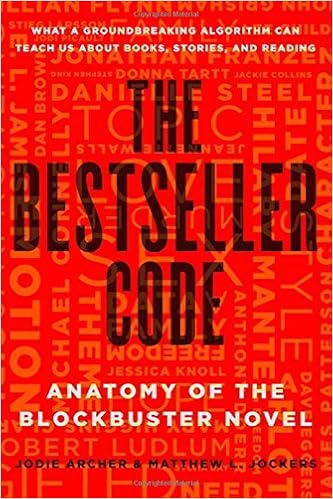
When I first read the premise of The Bestseller Code by Jodie Archer and Matthew Jockers, I placed a pre-order immediately. It is something too interesting to miss given my grander ambitions.
Apparently computer scientists, through the use of Natural Language Processing (NLP) techniques which have made so much headway to programmatically de-construct a fictional bestseller, it is possible to use AI to score a piece of fiction for earning potential. Already publishers may be front-running manuscripts by passing it through an algorithm and giving only the writers with the most potential advances to reach best-seller status.
More importantly, what computer scientists can now figure out whether culture runs on principles more similar to the laws of physics.
The conclusion from this book is stunning and creates a whole new world of possibilities.
Right now, I can imagine what algorithms can already do when processing investment news. It is definitely possible to read a piece of journalistic writing and determine whether it is bullish or bearish for a piece of stock and then trigger a buy or sell call. This may be the only credible strategy when we trade crypto-currencies. At the more exotic end, I can even imagine that an AI might even be able to read a judgement from a lower court and determine whether an appeal will succeed.
I am just going to talk about two aspects of bestselling fiction which I found particularly interesting from this book which may be useful to readers like myself who are investors rather than readers of fiction :
a) Best-sellers are emotional roller coaster rides
The premise is actually very simple for a computer scientist. Simply scan the text and find sections which consists of more positive words like "love" and separate them from more negative words like "hate". Create a graph which goes up when a section is positive and goes down when a section is negative. You will create a graph which charts the emotional terrain of a piece of fictional work.
It is found that bestsellers are almost always emotional roller coaster rides with multiple highs and lows.
b) Protagonists in a bestseller must always have a high degree of agency in their lives
The second aspect of a best-seller work is that the protagonists must always have agency - lead characters must always be in control of their destiny and must do things to interact with the events and people around them. Books where the person is just a casual observer or someone who is helpless against the events around them tend to score poorer with the AI.
One way an algorithm can do this is to consider the use of verbs in bestsellers compared to those that do not sell well. For some strange reason, associating with verbs "need" and "want" always leads to bigger sales and the verb "wish".
To me this is a very teachable moment about personal development and self-help. People in general are just not excited by folks who seem to want to "wish" their personal situations to change. People who think and observe don't seem to score well with readers who want to read about folks who need or want something and so proceed to take steps to achieve their destiny.
Deep learning and AI techniques are fast invading the field of humanities which is good news for computer scientists who can find new domains to solve really tough problems which in the past would require personal judgement. Imagine the amount of work-load savings a literary agent can achieve if he can trim his pile of manuscripts by 70% but running it thorough an algorithm first. ( I think even the folks who built the algorithm admits that human judgement cannot be outsourced away at the last mile )
Imagine a piece of software that can run through an appellate brief and give an opinion as to whether there is a chance of winning a case.
This is the potential of NLP !
Friday, September 30, 2016
Legal issues which are of concern to financial bloggers.
Some financial bloggers know that one of my personal aims is to become the financial blogger that other financial bloggers read. As such, I am always trying to establish myself as a thought leader in personal finance but it also forces me to sacrifice some relevance to ordinary readers.
I have an exam in Financial Regulations after my mid-term break and have made it a point to write this article for other financial bloggers as we always have some legal concerns when it comes to the articles which we write.
As I am but a humble law student, please do not take this as legal advice. Just appreciate this as an essay on how I intend to manage my own personal risks when putting up articles on this blog.
A problem when it comes to financial blogging is that if someone makes a complaint to MAS that we are providing financial advise without a license, we face the risk of being fined or given a jail term.
a) What constitutes financial advise ?
Schedule Two of the Financial Advisor's Act (FAA) has the following definition on what financial advise is. As you can observe later below, some blog articles can constitute research analysis concerning an investment product like a stock. Even promoting an ETF investment strategy can run the risk of being accused of attempting to market a collective investment scheme.
If you are considered by MAS to be providing a financial advisory service, you will need to obtain a license from MAS and be subject to even more stringent regulations ( which would not be the subject to this article today).
You can find the relevant snippet from Schedule Two of the FAA here :
I have an exam in Financial Regulations after my mid-term break and have made it a point to write this article for other financial bloggers as we always have some legal concerns when it comes to the articles which we write.
As I am but a humble law student, please do not take this as legal advice. Just appreciate this as an essay on how I intend to manage my own personal risks when putting up articles on this blog.
A problem when it comes to financial blogging is that if someone makes a complaint to MAS that we are providing financial advise without a license, we face the risk of being fined or given a jail term.
a) What constitutes financial advise ?
Schedule Two of the Financial Advisor's Act (FAA) has the following definition on what financial advise is. As you can observe later below, some blog articles can constitute research analysis concerning an investment product like a stock. Even promoting an ETF investment strategy can run the risk of being accused of attempting to market a collective investment scheme.
If you are considered by MAS to be providing a financial advisory service, you will need to obtain a license from MAS and be subject to even more stringent regulations ( which would not be the subject to this article today).
You can find the relevant snippet from Schedule Two of the FAA here :
TYPES OF FINANCIAL ADVISORY SERVICE
1. Advising others, either directly or through publications or writings, and whether in electronic, print or other form, concerning any investment product, other than —
(a)
in the manner set out in paragraph 2; or
(b)
advising on corporate finance within the meaning of the Securities and Futures Act (Cap. 289).
2. Advising others by issuing or promulgating research analyses or research reports, whether in electronic, print or other form, concerning any investment product.
3. Marketing of any collective investment scheme.
4. Arranging of any contract of insurance in respect of life policies, other than a contract of reinsurance.
b) So how do bloggers get their exemption from the requirement of getting a license ?
MAS obviously does not really want to spend their time going after bloggers, so an exemption occurs under the first schedule of the SFA. Section 4 under Schedule 1 of the FAA relieves financial bloggers from the need to obtain a license :
Blogging is generally available to the public in Singapore. Our articles are issued only on our blogs and various aggregators, and we get no commissions from our readers and the advice given by blogs is incidental to the operation of our blog.
So in essence, if you are a financial blogger, you are safe.
4. Any person who owns, operates or provides an information service through an electronic, or a broadcasting or telecommunications medium, where —
(a)
the service is generally available to the public in Singapore;
(b)
any advice given, or analysis or report issued or promulgated, is given, issued or promulgated only through that service;
(c)
that person receives no commission or other consideration, apart from any fee received from subscription to the service, for giving the advice, or for issuing or promulgating the analysis or report; and
(d)
the advice is given, or the analysis or report is issued or promulgated, solely as incidental to that person’s ownership, operation or provision of that service.
Blogging is generally available to the public in Singapore. Our articles are issued only on our blogs and various aggregators, and we get no commissions from our readers and the advice given by blogs is incidental to the operation of our blog.
So in essence, if you are a financial blogger, you are safe.
c) Some risks are heightened when we get into the public and speak to people.
One issue which was repeatedly bugging me is next week's talk when participants do pay good money to engage with us.
Due to the lack of common law precedents, I can only offer a very amateurish take on cases where bloggers get paid for a public appearance to mingle with fans.
One possibility is that the exemption remains valid because the blogger does not get commissions from any sales of securities from the talk. But I am not comfortable with this notion because being paid a speaking fee may be considered "other consideration" as stated in s4(c) FAA.
The safest course of action is to treat all public appearance as voiding the exemption for financial bloggers.
This means that we need to be extra careful once we start speaking for a fee.
d) Financial bloggers need to be careful when interacting with the public for a fee.
Some things we have done :
- In this case, it may be safer to make sure that every power point slide does not mention specific securities so that it cannot be interpreted as an inducement to get the public to buy something. I have censored some screenshots from Bloomberg to avoid creating the impression that the stocks in the screen-shot are buy recommendations.
- Another possibility is to couch our answers in a way which cannot be misunderstood as any form of financial advice but instead as what we would do for our own portfolios given our own personal situations.
- The safest way to share with readers is to share broad strategic ideas that add value to the participant without making a buy/sell recommendation for any specific stock counter.
Anyway, that's all I have for now given how much I studied our local laws.
The only way for me to know more and become more useful to other bloggers is that I somehow get into real legal practice and take on actual cases.
Please so not mistake this as legal advise.
Always consult a real lawyer.
Wednesday, September 28, 2016
Talk by financial bloggers got sold out in less than 24 hours !
As our friendly neighbourhood troll, SMOL has rightfully pointed out, I did not do a really great job promoting my fellow bloggers Kyith and Brian who were giving this talk on 6th October 2016.
I was actually meaning to meet up with them yesterday to have a discussion on the talk and then drum up support for the talk today in a separate article.
How was I to know that we got SOLD OUT IN LESS THAN 24 hours ?
So I have no talk to promote today.
For the folks who were disappointed that they are unable to get tickets, we are definitely planning a similar session soon once we get our numbers and logistical planning right, we are doing this the first time as a team and really want to make this a successful enterprise.
So yesterday Kyith, Brian and myself met up to discuss this upcoming talk. one of our key concerns was to make sure that participants get their value for money. We expect you guys to want this session to be more fruitful than the $19 that you paid for.
As a law student, I have other worries, I was mugging up on the Financial Advisors Act and walked through some legal risks we might be getting ourselves into so its important to maintain that we are not making a recommendation on any financial products. We are just sharing on how we manage our own finances.
More interesting, we were brainstorming tactics on tackling more difficult questions from the crowd.
I thought I'd just share a tough question we came up with which stumped ourselves :
If you have a choice between creating a bond ladder or investing in the Asian Bond ETF, which would you choose and why ?
We did eventually come up with an answer amongst ourselves but I think we should get participants to send questions to us via email.
If you wish to have a question addressed on 6th October, do email me at waichung.ng@gmail.com.
Things can a lot easier and objective if I can refer to a Bloomberg terminal before I can provide an answer.
I was actually meaning to meet up with them yesterday to have a discussion on the talk and then drum up support for the talk today in a separate article.
How was I to know that we got SOLD OUT IN LESS THAN 24 hours ?
So I have no talk to promote today.
For the folks who were disappointed that they are unable to get tickets, we are definitely planning a similar session soon once we get our numbers and logistical planning right, we are doing this the first time as a team and really want to make this a successful enterprise.
So yesterday Kyith, Brian and myself met up to discuss this upcoming talk. one of our key concerns was to make sure that participants get their value for money. We expect you guys to want this session to be more fruitful than the $19 that you paid for.
As a law student, I have other worries, I was mugging up on the Financial Advisors Act and walked through some legal risks we might be getting ourselves into so its important to maintain that we are not making a recommendation on any financial products. We are just sharing on how we manage our own finances.
More interesting, we were brainstorming tactics on tackling more difficult questions from the crowd.
I thought I'd just share a tough question we came up with which stumped ourselves :
If you have a choice between creating a bond ladder or investing in the Asian Bond ETF, which would you choose and why ?
We did eventually come up with an answer amongst ourselves but I think we should get participants to send questions to us via email.
If you wish to have a question addressed on 6th October, do email me at waichung.ng@gmail.com.
Things can a lot easier and objective if I can refer to a Bloomberg terminal before I can provide an answer.
Tuesday, September 27, 2016
Talk Event - Building Cash Flow from Stocks
From a professional perspective, I will be making a fairly substantial leap in about a week's time. In the past, I have been giving free talks to members of the public on money matters.
This time round, the talk which I will be giving will be a paid talk but at a reasonable $19.

Myself and a few other prominent bloggers are part of a collective called BigScribe. We think that we will be more effective in promoting ourselves when we band together and pool our resources because some of us can do research, others are really good at speaking and marketing.
As this is the first time I will be speaking behind a pay-wall, so we are going to try to make it as valuable to you as reasonably possible but as it is our maiden effort, this talk will still be geared towards beginners.
I will first conduct a short presentation on on how all of us bloggers agree on how to build up cash flow from stocks, after which I will talk about how I filter the stock market for counters for sustainable dividend yields.
After which the panel segment will begin proper as we have already anticipated some of the questions you guys would have. The other bloggers will participate in this panel and answer these questions to the best of their ability.
This time round, the talk which I will be giving will be a paid talk but at a reasonable $19.

Myself and a few other prominent bloggers are part of a collective called BigScribe. We think that we will be more effective in promoting ourselves when we band together and pool our resources because some of us can do research, others are really good at speaking and marketing.
As this is the first time I will be speaking behind a pay-wall, so we are going to try to make it as valuable to you as reasonably possible but as it is our maiden effort, this talk will still be geared towards beginners.
I will first conduct a short presentation on on how all of us bloggers agree on how to build up cash flow from stocks, after which I will talk about how I filter the stock market for counters for sustainable dividend yields.
After which the panel segment will begin proper as we have already anticipated some of the questions you guys would have. The other bloggers will participate in this panel and answer these questions to the best of their ability.
Saturday, September 24, 2016
On Oscar Wilde, cynics, price and value.

Today's piece is going to be little philosophical.
Let's start with Oscar Wilde's definition of a cynic which is "A man who knows the price of everything and the value of nothing."
I thought this is exactly the kind of nasty remark most disgruntled Singaporeans would heap on a value investor so I thought it might be a good time to think deeper about this statement. It is highly probable that a person who thrives on economic analysis would see everything in economic terms.
After all, once you have a hammer in your hands, everything looks like a nail.
I'm going to propose a philosophical framework for us investment types not to fall into the trap of valuing everything via economic means. The inspiration for this idea is from the book The Five Life Decisions by Robert T Michael which is yet another excellent read which details a longitudinal study on Millenials and the consequences of the many life decisions they made. This also ties into my exhortation a few essays ago that we should study Gen X like an anthropologist and decide whether the YOLO philosophy makes sense for you.
My framework is as follows :
We need to understand that some things in life are means to an end as opposed to other things which are ends in itself. There is also a hybrid class of things which are both means and ends.
Here are my proposed examples :
a) An education is largely a means to some end.
The study confirmed that even in the US, for the batch born in 1980, a higher education results in higher wage differentials, with someone with an advanced degree earning twice as that of a someone with a high school diploma. More damning news for the folks who want to emulate Bill Gates the Harvard dropout, the gap widens dramatically as the Millenials grow older.
An education also determines the people you associate with, who you marry, your lifespan, and the odds of your children also receiving a high education.
It is a key decision you have to make in your life. But education does not really stand on its own, it is merely a means to end. As such, economic analysis is useful in this regard. What courses to take should account for employment opportunities and median salaries.
b) A spouse is both a means and an end.
If you perform economic analysis on whether to marry, there is ample evidence to go ahead and get hitched in ROM. While it is not accurate to say that two can live on the price of one, according to the survey, two can indeed live on the price of 1.62. ( In fact 5 can live on the price of 3, but polygamy is not longer allowed in modern societies ! )
Marriage allows two people to complement each other and specialise in something to keep the household running, but marriage also takes time to work out and generate enough savings for both husband and wife so the overwhelming advice from the survey is to marry only if you have a long term orientation. Another words, if your significant other is a "here and now" kind of crazy personality, the best advice is to dump the person ASAP and find someone more stable.
But we don't generally do economic analysis on our spouses because you cannot really put a price tag on the intimacy and joys of being with someone else. Otherwise, SDU would have been much more successful in that case we Singaporeans are such a kiasu people.
c) Children are better treated as an end in itself.
Unless you are really perverse, children should not be the means to anything. They are really expensive to raise in the US which can cost $1,000 per month from ages 0-2. While it's way cheaper in Singapore thanks to government subsidies, parents suffer from bad job performance and lose a lot of personal freedom once they have kids. So right now, no economic analysis can justify having children in modern society.
But once you shift your focus to children as an end in itself, then very possibly you can enjoy the process of raising kids.
This is the key to avoid becoming a cynic.
Children should be treated as ends rather than means. We become financially independent to raise our kids. But it's not wise nor realistic to raise kids thinking that they can make us financially independent although some very successful parents may be able to that.
But it does not end at just kids.
Sports, artistic and cultural endeavours are better off evaluated as an end point objective rather than some sort of means to an end.
Which comes back to my previous point on Vladimir Nabokov. Cultural capital should based on its own merit, and not to be benchmarked against other forms of capital. Otherwise, there will be no art and beauty in society at all.
Of course, this framework cannot deal adequately with all issues we face in this modern age.
If a person wishes to study for a qualification in Fine Arts, he is paying good money to eventually join an economy which places little value on their qualification. He needs to be clear that Fine Arts is an end and should not expect to be remunerated ( unless he is very talented ) as perhaps a surgeon should in modern society.
The most pragmatic way of dealing with this problem is to simply be born with rich parents.
Wednesday, September 21, 2016
What do high income people know ?

Self-help in this age of complicated data analytics means that the advice we can get on how to conduct our lives can become very specific and very useful. This is light years ahead of the good old days where we are stuck with Dale Carnegie, Stephen Covey and, worse, Napoleon Hill if we actually try to read to improve ourselves.
William Poundstone's Head in the Clouds, can be a very disturbing read but I now view it as a compulsory read if one aspires to be a thought leader in personal finance. William's experiment is ground breaking because he invented a questionnaire which asks a series of questions on general knowledge and then he maps out the answers to a person's earned income. In many cases, he adjusted his statistical results to remove the effects of age and educational level.
What we have is a guide to what a person knows against his annual income.
I am just going to share three findings which really made me think.
a) Knowing about personal finance increases wealth and income but not dramatically.
Knowing about personal finance such as effects of compounding interest would ideally be the biggest predictor of income and wealth, but it had only a moderate effect. The income gap between a person who knows compound interest and basic personal finance is only $20,000.
b) General knowledge and in particular basic knowledge on sports has the greatest effect on income and wealth.
The biggest income gap is worth over $50,000 of annual income is general knowledge and basic knowledge on sports. The folks who can point to Kazakhstan on the map have a huge income differential against someone who could not do so. That is somehow intuitive.
What is not intuitive is that knowledge on sports also results in a dramatic difference. But the questions on sports were simple ones which well-informed persons would know such as the number of players in a soccer team.
But don't start cancelling your Economist subscription for the New Paper yet ! When Poundstone created a sports quiz for die hard fans, the income difference vanishes. I struggle with understanding result and harbour grave doubts that this will replicate in Singapore.
c) Cultural knowledge does not result in any income difference
The most hilarious result is that cultural knowledge does not result in any income advantage at all. If you know that Vladimir Nabokov is the author of the book Lolita, it does not enrich you financially in any way ! This is a mind-blowing finding which nay have repercussions on how the US would see their cultural education in the future.
The only current explanation is that the folks who have a mastery of cultural trivia tends to be lower paid than other segments of US society.
d) Open mindedness and curiosity are important traits for wealth creation.
If we are to take our findings in totality, open-mindedness and curiosity are valuable traits for wealth creation. The quiz was designed to be done well by someone who reads beyond his syllabus no matter what his educational qualifications are, which explains why general knowledge creates such a robust income difference even after adjusting for educational qualifications.
Certainly this book has changed my views on the personality traits for wealth creation.
I would place Conscientious and Open-mindedness key in my future works on Learning how to Earn.
Sunday, September 18, 2016
Learning as a fundamental skill in personal finance.

If you look at the news on the glut of law students, one lesson becomes clear : there are no clear career paths with guarantees of comfortable middle class lifestyle. Engineers have always lived in this reality because when times are good, foreigners will be deliberately introduced into the economy to keep salaries and business costs on the low side. The only solution is extreme austerity, career gamesmanship and savvy investing.
Moving forward, I no longer think that my classmates are destined for a good life anymore. For even the select few who can get into the big four law firms, their constitution and resilience will be severely tested. Even with the high incomes, the glut will ensure that the legal industry remains an employer's market for the next 5-10 years. An employer's market based on my personal experience means that you have to accept the working conditions no matter how bad things get. Law students who cannot get a training certificate would have to think of creative ways to have a legal career as a non-lawyer, which can be just as lucrative if played right. Advantage will go to the more creative folks.
This reflects a problem in personal finance, where no one has really bothered to study pre-employment issues in wealth accumulation. Most of us are stuck with the belief that we need high earnings to generate high savings before investment can even take place.
But what enables you to get the high earnings in the first place ? In China, a vocational skills certificate enables the same pay as a graduate degree because skills are in a much higher demand in Chinese society. In Singapore, an NUS graduate can hand-in-heart expect $500 more per month than an SIM graduate.
From this point onwards, a thought leader in personal finance must be focused on Learning as a skill.
Learning is pre-requisite to earning. In knowledge-based economies, the best learners can command the highest salaries. In the book Head in the Clouds by William Poundstone, people who can answer questions on the world history and current affairs were found to have higher salaries. But that's not all, Poundstone adjusted the statistical models to account for education and age and still found that folks who knew more still commanded higher incomes than those who did not. The differences were stark, a graduate who is knowledgeable about world affairs can command almost twice the salary of a similarly aged graduate who was not as knowledgeable. This is in spite of knowledge losing its currency in a world of search engines.
Learning is also a post-requisite to financial independence. Once all your financial goals are met, your curiosity and open-mindedness will probably determine the quality of your life after you dispense with the need to work for someone. Otherwise it's just meaningless existence of sharing food photos and watching cat videos on the Internet.
I am only halfway though the Poundstone book, after which I will read The Five Life Decisions by Robert Michael on how Millenials make key decision on what to study and who to marry.
The aim is to find a way to instill curiosity into someone regardless of his/her academic talent.
I hope to be able to have enough research material to establish Learning as a fundamental personal finance skill.
Thursday, September 15, 2016
[Vote for me #3] Investing your money starts with containing your costs

[ I have submitted a personal finance essay and right now, I am still canvassing for votes here. Voting will only end on 16th September. I will be writing a set of three essays to elaborate on the ideas presented in my essay in the hopes that I can get more hopes and hopefully win something for this competition. This is the third and last essay ]
The last component is investing your money, and I will not go into the territory covered by other bloggers on specifically investing which stock counters, instead I will share general tips which would dramatically improve your investment performance.
a) Investing is about cost control, so you need to get rid of parasites out to suck you dry
If you are focused on investment performance and always trying to guess which sector or industry would outperform the markets, you are already wrong. The performance of global equities over time will always be around 7-8% per annum. For bonds, you might be lucky to get 3-4%.
Face with this reality, the fastest way to outperform is by controlling your costs. If you buy a unit trust or ILP from some financial advisor, you can lose thousands when you hit retirement age because the expense ratios and management fees will cause you to lose 2.5% every year. So your equity returns are more likely to be around 5.5% per year.
The same applies if you invest your own money in the stock market but churn your own account often. The money goes to your stock-broker.
b) Investing is about spreading your risks
Too many investors think that they invest like Warren Buffett. Too many end up investing like Jimmy Buffett. The really good guys who can read financial statements might be able to hold 8-12 stocks and achieve returns of 30% every year, but most of us are average investors.
I think that it is better to assume that you are an average guy.
I hold about 30+ stocks because I really don't want to be affected by the underperformance of one counter. Instead, some of bad performance of my stocks are counteracted by those which outperform, giving me a good night's sleep.
c) ETFs are the best tool to lower costs and spread your risks.
If you agree with my earlier points then an ETF which covers all the stocks like Straits times index is a great way to reduce your costs and spread your risks. For beginners, a simple strategy of holding a stock and bond index is a great way to invest your money without going through the lengths of becoming a stock market expert.
d) If you are stock picker, be principled with your stock picking approach.
If you fancy yourself as a stock picker, then you will need to be principled in your stock picking approach. You can't really wake up one morning and decide that Sheng Siong is a great stock because your wife shops there everyday ( Even though Sheng Siong is actually a great stock to have over the past year ).
I use a Bloomberg terminal which is free for all SMU students. You can use a terminal for free at the central library but fighting the other uncles for a 1 hour slot can be quite annoying.
I employ a selection criteria like "high dividend yields" and "free cash flow > dividends". Every now and then, Bloomberg gives me a list of stocks which meet my criteria, then I try to check out stocks which have yet to own. I will research and then buy the counter if the dividends I accumulate to spread my portfolio further.
Every now and then I try to run a simulation on how my strategy would perform in the markets over the next 10 years.
This is to convince me that the strategy I employ is not a bad joke.
e) I do have money set aside for high-risk investments
As I am a financial blogger, maintaining a degree of thought leadership matters to me, so I dabble in crowdfunding websites and mine cryptocurrencies in a datacenter in Iceland.
These initiatives rarely make me any substantial amount of money but reading up aggressively on these new ideas keeps me updated on technology trends and adds an X factor to my class presentations.
The combined effects of my investment portfolio and high risk initiatives is that I have very little money on me at all times after setting aside family expenses.
How little liquidity I have is often affected by rights issues from my REITs investments.
Wednesday, September 14, 2016
[Vote for me #2] Saving money and resisting the lure of a YOLO lifestyle.
[ I have submitted a personal finance essay and right now, I am still canvassing for votes here. Voting will only end on 16th September. I will be writing a set of three essays to elaborate on the ideas presented in my essay in the hopes that I can get more hopes and hopefully win something for this competition. This is the second essay ]
The second aspect of personal finance I would like to talk about today is the idea of saving money. Saving money lacks the complexity of finding ways to earn more money because it is largely something which is within a person's control. The financial blogosphere is replete with ideas on how to save your money and I shall not repeat them here in this article.
Some bloggers have become successful by tracking their meticulous expenses either using a new-fangled app or an old fashioned note-book. Others blogs have great advice on cutting personal expenses but it all revolves around the concept of downgrading - finding a cheaper alternative to a goods purchase. And it can all be very effective. Downgrading from Starbucks coffee to Kopitiam Kopi-O kosong can save $5-$10 a day.
There are some hard truths that we bloggers have to personally confront when we talk about saving money :
a) Only conscientious people can save more.
The bulk of folks who benefit from savings advice are the folks who are already conscientious which covers the bulk of the readership of this blog. The question arises as to how to deal with unconscientious readers or folks who are likely to benefit the most from saving more money. Beyond getting a loved one to actually force them into an automated savings programs, most of us do not have a workable solution to this problem.
Sometimes it takes a huge personal setback to get a person to wake up their ideas and change their lifestyle.
For my generation, it may be too late.
b) People are fascinated with the YOLO philosophy
The lives of a financial blogger is, frankly, only inspiring to other financial bloggers.
We seldom put up exciting pictures of us posing next to a perfect sunset or eating exotic seafood or a mountain of roast beef. Even though I kinda like my current lifestyle, pictures of mountains of legal textbooks can be depressing to a large segment of the population.
I think cracking the savings puzzle is to find a way to defuse the YOLO philosophy. The idea that you only live once and you should enjoy your life while you can is very attractive compared to a philosophy of always delaying gratification.
My only advice is to get the younger folks to stop observing other younger folks and start observing the 40-something year olds like me. Study the folks in my generation like an anthropologist. Take notes and learn from the mistakes made by my generation. Because it is only in your 40s when the corporate world deems you too expensive for your obsolete skills.
When you study Gen-X :
The second aspect of personal finance I would like to talk about today is the idea of saving money. Saving money lacks the complexity of finding ways to earn more money because it is largely something which is within a person's control. The financial blogosphere is replete with ideas on how to save your money and I shall not repeat them here in this article.
Some bloggers have become successful by tracking their meticulous expenses either using a new-fangled app or an old fashioned note-book. Others blogs have great advice on cutting personal expenses but it all revolves around the concept of downgrading - finding a cheaper alternative to a goods purchase. And it can all be very effective. Downgrading from Starbucks coffee to Kopitiam Kopi-O kosong can save $5-$10 a day.
There are some hard truths that we bloggers have to personally confront when we talk about saving money :
a) Only conscientious people can save more.
The bulk of folks who benefit from savings advice are the folks who are already conscientious which covers the bulk of the readership of this blog. The question arises as to how to deal with unconscientious readers or folks who are likely to benefit the most from saving more money. Beyond getting a loved one to actually force them into an automated savings programs, most of us do not have a workable solution to this problem.
Sometimes it takes a huge personal setback to get a person to wake up their ideas and change their lifestyle.
For my generation, it may be too late.
b) People are fascinated with the YOLO philosophy
The lives of a financial blogger is, frankly, only inspiring to other financial bloggers.
We seldom put up exciting pictures of us posing next to a perfect sunset or eating exotic seafood or a mountain of roast beef. Even though I kinda like my current lifestyle, pictures of mountains of legal textbooks can be depressing to a large segment of the population.
I think cracking the savings puzzle is to find a way to defuse the YOLO philosophy. The idea that you only live once and you should enjoy your life while you can is very attractive compared to a philosophy of always delaying gratification.
My only advice is to get the younger folks to stop observing other younger folks and start observing the 40-something year olds like me. Study the folks in my generation like an anthropologist. Take notes and learn from the mistakes made by my generation. Because it is only in your 40s when the corporate world deems you too expensive for your obsolete skills.
When you study Gen-X :
- Who were the cool dudes and the attractive fly boys who always lead interesting lives that is full of variety ?
- Who is always "happening" and can be found in Zouk on Mambo Wednesdays ?
- Do these subjects have jobs today ?
- Are they slaving for their mortgages and become middle-aged uncles who are constantly being pushed around by other life priorities ?
- Are they struggling to support their kids and their parents ?
Ask them about the time when they were in 20s.
Get them to regale you with their tales of derring-do from their younger days of "Chionging" their watering holes.
Ask them about Fire Disco, China Black and Devil's Bar.
Ask them about BigO magazine, The Mighty Lemon Drops, Lizard's Convention
Ask them about Nirvana and the grunge movement.
Ask them about slacking at Newton hawker centre or the Esplanade.
For some, there are very fond memories.
For other's, they are the glory days which will never be repeated amidst the modern pressures of being the sandwiched generation.
In my generation, there will be winners and there will losers. Sometimes, winners can turn into losers. Other times, losers bloom into winners.
Study them carefully, then make a decision on how precious your YOLO philosophy is.
Tuesday, September 13, 2016
[Vote for Me #1] Earning your money and Career Management
[ I have submitted a personal finance essay and right now, I am still canvassing for votes here. Voting will only end on 16th September. I will be writing a set of three essays to elaborate on the ideas presented in my essay in the hopes that I can get more hopes and hopefully win something for this competition. ]
Figuring out how to earn your money is most critical component of personal finance and very possibly something which even the best financial advisors would be unqualified to advice on. If you can manage your career and earnings well enough, more than half the battle for Financial Independence can be won. In Singapore, this is compounded even further by our low tax regime which allows most Singapore workers to retain as much money as they can from their labour.
Unfortunately, career management is the hardest and most complex component in personal finance because it taps on your ability to learn, adapt and play company politics. Your financial advisor will also not have a clue on how you should plan for finances for the occasional 1 or 2 years when you will be searching for a new job in your 40s.
Here are some points to note when considering your career :
a) You will always be better off with better educational qualifications
Companies determine your pay scale by looking at your educational qualifications.
A local graduate draws on average $3,300 as starting pay and has a fairly good increment to look forward to. A local private university graduate draws $2,700 but pays more to get that degree. A fresh polytechnic graduate draws $2,100 but gets to start work at a younger age.
A lot of people cannot accept this fundamental truth.
They keep reminding themselves that Bill Gates dropped out from Harvard.
They should sell fishballs.
b) Extroverts always have an edge in their careers
There is a lot of "hope literature" which tells you that academics may not matter in some jobs, but if you look at success stories beyond academic qualifications, it always boils down to a job with an unlimited upside in sales. This gives the extrovert salesman a huge advantage over the introvert herbivore.
If you are great in sales, it is possibly the easiest job in the world but if you suck at it, life can be a living nightmare.
The situation is changing for introverts who can crunch a lot of numbers and write fantastic code, but the transformation of our economy is currently incomplete, if you don't get along with people, a career in sales is not for you.
c) You can get obsolete holding onto a job
I would say that a solid engineering degree has a shelf life of at most 10 years, after which you need to rely on your working experience to remain relevant. Focusing exclusively on the job without thinking about industrial trends is the reason why so many engineers are driving Uber cars today. MNCs are also notorious for keeping their best R&D projects in North America. So Singapore staff will only get to patch and maintain systems.
Because of massive technological disruption, you can suddenly become obsolete overnight and if you work for an SME that cannot afford to retrain you, its time to kiss your earnings goodbye.
d) Heroically working for a startup or SME generally does not pay off
Over 15 years ago, I had a seminar with Ellen Lee who eventually became an MP. I remember arguing in those days that a good graduate will never consider an SME as a place to build his career because MNCs just look better on a person's resume and provide projects on a larger scale to work on. I was openly elitist because I represented my classmates and had to channel that indifference. My NTU counterpart, who was a really stupid guy who on hindsight should not be allowed to represent a great institution like NTU, argued aggressively for SMEs and said that he wants to "Pao Kao Liao". Then he let slipped that he wants to work hard so that he can join an MNC later (maybe he could end up becoming my subordinate later in life).
Now I am at the age where folks of my generation can sit down and compare notes.
Readers can judge as to how well these SME and startup guys fare on average compared to the MNC or government guys. Just don't tell me about the rare cases where someone lucks out and has a multi-million dollar exit in Blk 71, that's an exception and not the norm.
e) So you have to think like a start-up executive, but work for MNC, government agency or a bank
The only solution is to first hitch onto a stable,well-paying job which allows you to save as much money as reasonable possible at an earlier stage of your life so that you can compound your wealth. This means going after all the well-known names in the industry or the government agencies.
But these jobs also have the effect of lulling you into a sense of complacency. So many of us in MNCs in those days hoped to worked for our companies for life. But over the years we got outsourced, retrenched and restructured anyway because MNCs also like to preserve a youthful culture can be very brutal to mid-career executives.
So you have to think very lean like a start-up executive. Keep learning about industrial trends and remain curious about new technologies and how they can potentially turn your comfy MNC life up side down.
But what does this all mean for earning your money ?
Play a tight game, go where the money is and don't be caught up with any ideology which is anti-elitist or political in nature. If you have spare time and energy to create more streams of income like opening a e-portal or writing a book, do it aggressively if it does not violate your HR policy.
Figuring out how to earn your money is most critical component of personal finance and very possibly something which even the best financial advisors would be unqualified to advice on. If you can manage your career and earnings well enough, more than half the battle for Financial Independence can be won. In Singapore, this is compounded even further by our low tax regime which allows most Singapore workers to retain as much money as they can from their labour.
Unfortunately, career management is the hardest and most complex component in personal finance because it taps on your ability to learn, adapt and play company politics. Your financial advisor will also not have a clue on how you should plan for finances for the occasional 1 or 2 years when you will be searching for a new job in your 40s.
Here are some points to note when considering your career :
a) You will always be better off with better educational qualifications
Companies determine your pay scale by looking at your educational qualifications.
A local graduate draws on average $3,300 as starting pay and has a fairly good increment to look forward to. A local private university graduate draws $2,700 but pays more to get that degree. A fresh polytechnic graduate draws $2,100 but gets to start work at a younger age.
A lot of people cannot accept this fundamental truth.
They keep reminding themselves that Bill Gates dropped out from Harvard.
They should sell fishballs.
b) Extroverts always have an edge in their careers
There is a lot of "hope literature" which tells you that academics may not matter in some jobs, but if you look at success stories beyond academic qualifications, it always boils down to a job with an unlimited upside in sales. This gives the extrovert salesman a huge advantage over the introvert herbivore.
If you are great in sales, it is possibly the easiest job in the world but if you suck at it, life can be a living nightmare.
The situation is changing for introverts who can crunch a lot of numbers and write fantastic code, but the transformation of our economy is currently incomplete, if you don't get along with people, a career in sales is not for you.
c) You can get obsolete holding onto a job
I would say that a solid engineering degree has a shelf life of at most 10 years, after which you need to rely on your working experience to remain relevant. Focusing exclusively on the job without thinking about industrial trends is the reason why so many engineers are driving Uber cars today. MNCs are also notorious for keeping their best R&D projects in North America. So Singapore staff will only get to patch and maintain systems.
Because of massive technological disruption, you can suddenly become obsolete overnight and if you work for an SME that cannot afford to retrain you, its time to kiss your earnings goodbye.
d) Heroically working for a startup or SME generally does not pay off
Over 15 years ago, I had a seminar with Ellen Lee who eventually became an MP. I remember arguing in those days that a good graduate will never consider an SME as a place to build his career because MNCs just look better on a person's resume and provide projects on a larger scale to work on. I was openly elitist because I represented my classmates and had to channel that indifference. My NTU counterpart, who was a really stupid guy who on hindsight should not be allowed to represent a great institution like NTU, argued aggressively for SMEs and said that he wants to "Pao Kao Liao". Then he let slipped that he wants to work hard so that he can join an MNC later (maybe he could end up becoming my subordinate later in life).
Now I am at the age where folks of my generation can sit down and compare notes.
Readers can judge as to how well these SME and startup guys fare on average compared to the MNC or government guys. Just don't tell me about the rare cases where someone lucks out and has a multi-million dollar exit in Blk 71, that's an exception and not the norm.
e) So you have to think like a start-up executive, but work for MNC, government agency or a bank
The only solution is to first hitch onto a stable,well-paying job which allows you to save as much money as reasonable possible at an earlier stage of your life so that you can compound your wealth. This means going after all the well-known names in the industry or the government agencies.
But these jobs also have the effect of lulling you into a sense of complacency. So many of us in MNCs in those days hoped to worked for our companies for life. But over the years we got outsourced, retrenched and restructured anyway because MNCs also like to preserve a youthful culture can be very brutal to mid-career executives.
So you have to think very lean like a start-up executive. Keep learning about industrial trends and remain curious about new technologies and how they can potentially turn your comfy MNC life up side down.
But what does this all mean for earning your money ?
Play a tight game, go where the money is and don't be caught up with any ideology which is anti-elitist or political in nature. If you have spare time and energy to create more streams of income like opening a e-portal or writing a book, do it aggressively if it does not violate your HR policy.
Thursday, September 08, 2016
Please vote for my Personal Finance essay !
Even during those intensive days where I was preparing for International Moots, I was able to spend an hour writing a 600 word essay on Personal Finance which can now be found here.
My primary motivation is, of course, to win the competition and enjoy the prestige of winning. But more importantly, the prize is a 2D1N stay at MBS which means that my poor family gets a short holiday away from home which I would not ordinarily spend on even if my money came from my dividends.
Ok, I just want to share the backdrop and motivation of my essay.
I needed to summarise my personal financial philosophy within 600 words.
And regular readers should know this :
My philosophy of personal finance is not a philosophy of fun and laughter. Financial planning more of an engineering problem. More akin to planning a legal defence.
I think that there is a fundamental problem with the way financial planning services are sold in Singapore.
Financial planning is primarily a sales and commissions driven exercise, as such, it is very easy for the Financial Planning Industrial Complex to emotional link financial planning with happiness, fun, variety and relaxation. For example, one major insurance firm hired actresses to jump around like drugged-up-hamsters-surrounded-by-colourful-confetti to create an impression that retirement is time to indulge in your hedonistic fantasies. Another supposed investment guru showed off pictures of his dividend checks, very possibly to hijack the emotions of their client base who will lose control when they see such ostentatious displays of wealth.
The mainstream news is not helpful either, recent articles in Me and My Money already feature the most credible guys in the financial planning industry but no one pointed to the big elephant in the room in all these personal financial plans which is crucial for all Singaporeans facing globalisation and technological disruption today :
Can your client retain his job and income when he reaches his 40s and 50s ? If not, what are your remedies ?
Retirement is not a day of fun at Uncle Ringo's.
The planning required is meticulous and delaying of gratification can be quite depressing to some people.
So I wrote an essay which is somewhat cold. It surgically details the three basic steps to stop that reliance on a pay-check before age 40.
I hope that you can vote for me.
Because in this essay, I will show you how I dealt with that elephant in the room.
My primary motivation is, of course, to win the competition and enjoy the prestige of winning. But more importantly, the prize is a 2D1N stay at MBS which means that my poor family gets a short holiday away from home which I would not ordinarily spend on even if my money came from my dividends.
Ok, I just want to share the backdrop and motivation of my essay.
I needed to summarise my personal financial philosophy within 600 words.
And regular readers should know this :
My philosophy of personal finance is not a philosophy of fun and laughter. Financial planning more of an engineering problem. More akin to planning a legal defence.
I think that there is a fundamental problem with the way financial planning services are sold in Singapore.
Financial planning is primarily a sales and commissions driven exercise, as such, it is very easy for the Financial Planning Industrial Complex to emotional link financial planning with happiness, fun, variety and relaxation. For example, one major insurance firm hired actresses to jump around like drugged-up-hamsters-surrounded-by-colourful-confetti to create an impression that retirement is time to indulge in your hedonistic fantasies. Another supposed investment guru showed off pictures of his dividend checks, very possibly to hijack the emotions of their client base who will lose control when they see such ostentatious displays of wealth.
The mainstream news is not helpful either, recent articles in Me and My Money already feature the most credible guys in the financial planning industry but no one pointed to the big elephant in the room in all these personal financial plans which is crucial for all Singaporeans facing globalisation and technological disruption today :
Can your client retain his job and income when he reaches his 40s and 50s ? If not, what are your remedies ?
Retirement is not a day of fun at Uncle Ringo's.
The planning required is meticulous and delaying of gratification can be quite depressing to some people.
So I wrote an essay which is somewhat cold. It surgically details the three basic steps to stop that reliance on a pay-check before age 40.
I hope that you can vote for me.
Because in this essay, I will show you how I dealt with that elephant in the room.
Subscribe to:
Posts (Atom)