Sunday, January 30, 2022

Do you trust our education system?


This is something I want to write about recently. My wife went to a meeting between parents and teachers and was really shocked at how vicious and unreasonable parents can get when they handle their teachers. 

Two specific events show that things may have gotten too far in favour of parents :

  • An old math teacher was attacked because she wrongly marked her scripts, this is bad but, in her defence, she marks her script until close to midnight. 
  • A Higher Chinese teacher was attacked because her Chinese was too 'cheem'. At least this teacher fought back, if you can't hack Higher Chinese go back to Lower Chinese. Also, because this teacher was PRC, I suspect some amount of xenophobia played into this.
In both cases, this would not have happened in my era.

I'm not going to defend the parents, but I explained that complaints will continue authorities will put a stop to this to protect the sanity of their public servants. 

If more VPs and Principals grow a pair of balls, we will not lose our best teachers to the private sector.

That being said, I do think my generation has reasons to be like this :

a) Complaining works in Singapore

The first reason is that Singapore is probably the rare country where complaining works. Our bureaucracy has a tendency to overcompensate when things go wrong so complaining is highly profitable. 

It's not surprising that Singaporeans grow up thinking that complaining is a great solution. Sadly complaining often fails or backfires in other countries ( like in Malaysia )

b) Some Gen X do not trust their educators

The second reason is that Gen X does not trust their educators. We were taught to be industrial drones while the economy transitioned into an information economy. There are still regrets of rote learning and memorization even though schoolkids do less of that these days.

I have my own tales of woe :
  • In secondary school, I had a Physics teacher who set an MCQ question and got 10 out of 50 answers wrong in a paper she set herself! I went to the library, got an A level text, got another physics teacher as referee and argued my case in the principal's office until the teacher relented. After that incident, there were rumours that the paper was copied from Nanyang Girls and the answer key was taken from her own daughter's answers. I suspect my legal training started then. I traumatised the teacher so badly my class had no physics teacher for 2 months and it was an O level year. Staff who remember the incident still ask after me today.
  • My secondary school refused to start a triple-science class because the principal believed that we were not good enough to become doctors to take a triple science workload. I don't understand why an entire generation of students must suffer to be underestimated this way.
  • Polytechnics sent lecturers to speak to us to tell us half of us will not qualify for university if don't get single-digit O level grades. I asked my RI pals whether they got the same delegation and apparently, they did not.
My own bitterness against my teachers only faded after I arrived in JC, then I was more accustomed to teachers who knew what they were talking about. Sadly that lasted only 2 years.

c) Parents also get slammed by their bosses and customers at work

I think the final reason is that parents are also human and underperform at the workplace so they get picked on as part of their work, so when they see teachers making mistakes, they get to pounce on it.

When I was working with that government agency, my supervisor, the same lady who asked an Indian contractor whether he was participating in the Little India Riots, once bragged to me how she and a bunch of parents nailed an underperforming teacher in NJC. She used to get so stressed at work from her boss who was known as the Invertebrate of the office.  

Most of the unhappiness is just what was being passed around.

I think the Ministry needs to put some brakes on all this abuse of teachers. Some of them are being abused for things done by seniors decades ago. If 500+ lawyers can just walk away from the legal profession, I fail to see why teachers cannot reinvent themselves as tuition teachers to get a semblance of sanity back. 

Let's see whether The Great Resignation will affect the teaching profession next.

If you are a burnt-out teacher, why not google the "FIRE movement" and learn how to rebel the smart way.


Thursday, January 27, 2022

On FIRE, investing and suffering


This is a very good time to talk about suffering because most of our portfolios are down. 

Tech stocks in both China and US are probably experiencing the most pain and this is likely to sustain as interest rates begin to rise and we're starting to see threats of war in Ukraine. REIT investors have also been battered as of late as investors treat them like bonds although I must say that the effects on my portfolio are minimal given that my banking stocks allocation is currently holding up to minimise my damage.

Although I'm losing money every day and feeling some pain, I'm really enjoying this because the cockier Tech investing bros are absolutely getting thrashed, currently licking their wounds, and hiding at the moment. I also expect to relish the idea of commissioned FAs who brought focused tech-based portfolios to their hapless clients trying to explain their strategies to them. This is the moment we see commissioned salesmen begin to talk about long term investing, long term annualised returns, and dollar-cost averaging. 

This brings me to this book The Sweet Spot by Paul Bloom, which talks about the centrality of suffering in our search for meaning. If you enjoyed reading The 50 Shades of Grey and long for the non-fiction equivalent, you should look no further than reading this book that actually has dedicated sections on the pleasures of BDSM.

The key idea of this book is that seeking pleasure is not enough for human beings. Beyond pleasure, human beings want satisfaction and meaning in life. This is why people volunteer to perform acts that may seem uncomfortable at first but contain a long term payoff. Acts include mountain climbing and childbearing. As a dad to two kids, I can never understand why my wife would volunteer to create kid no. 2.
 
But as we think about pain, we should take note that satisfaction only comes from voluntary pain. If you pay a dominatrix to shave your balls, you may obtain pleasure and find it money well spent. But if your client kidnaps you to shave your balls because you asked him to put all his money into a US Tech-focused unit trust, it's probably not even half as fun.

I suspect this book really provides hints on how to succeed in FIRE.

FIRE can be painful but it is really a process that is totally voluntary. 

You have to work hard, forgo enjoying your income, and then study how financial markets work. We cannot expect everyone to really rave about doing this for about 8-12 years of your life. I think for FIRE to work, people need to let it give added meaning to their lives. 

Maybe the process of FIRE leads to a higher net worth compared to your peers so that makes you feel good. FIRE also secures your family's financial future. Maybe for me, FIRE is totally going against the commission financial advisory industry, to show that I can thrive doing the opposite of what financial advisors often say. It is also an active rebellion against corporate life because I am not working to put food on the table and can make moves most employees would not be able to. 

If you examine FIRE through the lens of a search for meaning amidst suffering, then you may conclude that many of us in this community are masochists at heart.


Tuesday, January 25, 2022

[Part 2] Building financial capabilities of vulnerable households


I've finished the book and must say that the most relevant bits are the first and final sections which contain information that is useful to audiences outside the US.

Becoming a financial advisor/coach for the poor is a job that is a lot more complex than advising the wealthy. If the textbook is right, most social workers would not have the sophisticated finance skills to sort out the personal balance sheet of their charges. Folks with a finance background may not understand the ground issues that need to be resolved before they can even review a person's financial institution. At the backdrop we've got a host of legal issues - maybe the person seeking help is an illegal immigrant. Finally, there will always be the probability that the recipient of the aid may not even be grateful for it. 

So helping the poor to build up their financial capability is a multi-disciplinary issue that has just received its first textbook.

I'm just one guy, but strangely reading this book has gathered a strange collection of interested parties who would be happy to assist because they feel really strongly about this. 

This is what I think can be done at the grassroots level :

  • For any impact to be felt, we subject matter experts can't even focus on the poor directly - That remains the job of the social worker.
  • It is possibly easier to assess what a social worker knows about personal finance. So I think I may actually be able to design a 5 question quiz to assess the level of financial proficiency of social workers.
  • With the survey results, we can design a personal finance course for social workers. This can be done by the FIRE community or a pro-bono trainer for free. Maybe a social enterprise or NGO can provide a venue and cater some food.
  • When the caregiver is taken care of, some would be open to assisting to create a variant program for their personal charges. 
  • This second program will be delivered by the social workers with the help of the subject matter experts. It cannot be done by either party alone.
Sadly for me this year, I have my hands full with media appearances and the launch of a new course, but this serves as a guide for future action. If folks want to take this plan and run ahead of me, I'm happy to lend some assistance, but I can't take the lead. 

Some folks suggest visiting a Family Service Center to ask around. 

That may be the first step.


Sunday, January 23, 2022

Letter to Batch 24 of the Early Retirement Masterclass


Dear Students of Batch 24,

It’s been a great honour and privilege to be able to conduct a 5-Day Early Retirement Workshop for you.

It is pretty surreal to conduct the class in the middle of a Technology stock crash in the US. The NASDAQ fell 2.72% on the previous trading day. Cryptocurrencies fell across the board as well. As fears of an interest rate rise begin to infect financial markets, the Singapore stock market is starting to look pretty tame, with banks forming a large part of the STI. 

Course-wise, I’m personally glad that the Early Retirement Masterclass would finally have a coherent set of slides on investing in cryptocurrencies that is tailor-made for conservative investors. It was also rewarding to see the strategies taught to hold up against massive losses in the price of major cryptocurrencies like ETH and BTC. I look forward to your feedback on how to improve my materials further. 

There is never a better time to participate in building a portfolio of Singapore stocks as it has always been priced reasonably. Our batch of students has witnessed a return of traditional value investing factors to guide our stock selection on this batch. We’ve also decided to cycle out our technology stock picks with two small-cap counters that are relatively safe and well-liked by local retail investors.

One point to note is that we’ve made a stock pick for a recent IPO counter that has not acquired enough data to be placed meaningfully in our report generator. Please refer to our FB community discussion to get information on this counter.

Lastly, I hope that Batch 24 will participate actively in the FB group. In March 2022, we should be meeting up for an online webinar. At the time of writing, I have yet to determine the subject matter of this discussion.

Hope to see you then!

Christopher Ng Wai Chung

Tuesday, January 18, 2022

Putting gaming front and centre in my latest video.

As I'm conducting Batch 24 of the Early Retirement Masterclass this week, you have to wait a week before some content reappears on this blog.  

But I have a special treat for you today :


For this video, my objective is to pay homage to my gaming roots. 


I made a special point to highlight to iFast that I really want to talk about the Alpha Black Lotus card which last traded for $500,000+ at an ebay auction. Considering this is a trading card I used to play within the 1990s, it has the potential to make TSLA stock look like a money market instrument.

Hopefully this can humanise retirement planning and it gives gamers something to shout about.

We will resume regular articles this weekend as by then I should have finished the book on helping vulnerable families by then.


Saturday, January 15, 2022

[Part 1] Building financial capabilities of vulnerable households


I found an interesting textbook for social workers in Kinokuniya a week ago and decided to buy it because it discusses issues that have bugged me for more than a decade. 

When I just published my first book, I attracted my first bunch of critics. They challenged me to see whether a non-degree worker can also be made to retire early on a salary below $2,000 in today's dollars. 

Faced with such a question, I retreated immediately because my salary was actually quite good when made my first $100,000 ages ago. Also, I enjoyed living like an ascetic. The idea then was that most of Singapore cannot be helped. Even if some kind of magic formula were to exist, most citizens would lack the IQ or conscientiousness to implement a multi-decade plan for retirement. Government understand this well which is why they have CPF - it's a system to save Singaporeans from themselves.  

I'm not the kind of guy who retreats from fight, so the incident stung me for many years. 

Even if Financial Capability and Asset Building in Vulnerable Households is unable to address that challenge, it's worth plunking down $100 to read a book that highlights the difficulties of vulnerable families so that we can at least understand what obstacles stand in their way. To further this end, I made the immense personal sacrifice to stop reading the Economist to focus on finishing this textbook book. 

I'm halfway through and find this a pleasurable read. Way more pleasurable than certain sections of The Economist. 

Before I begin, I'd just like to point out that if you are that unfortunate social worker who reads my blog, the book will be useless to you because it is totally US-centric, I had to wade through information on 529 college plans and welfare schemes available to Native Americans. I also baulked at how shameless US textbooks are at giving suggestions on how to lobby and protest against unfair regulations. The book is written by the political left. And we don't need that kind of shit here in Singapore. 

On the other hand, the book may be useful for some local bodies to develop a framework to help vulnerable families, the key is to wade through all the chapters and find the equivalent social programs to document for Singapore. Whoever succeeds in doing this, is a saint, it may make commissioned financial advisors matter less in society, and I'm happy to volunteer my personal time to help. 

Here are some things I have learnt from 50% of the book:

  • It's hubristic to jump in to look at the expenses of the vulnerable immediately. If someone looks for a social worker, they have a specific problem they need to be solved. Solve it first before getting into processes to clean up a person's finances. Eg. An abused wife may need a PPO before addressing the lack of a bank account as all her money is shared. 
  • Banks can be very oppressive with deposit account charges and ATM fees. Social workers need to be armed with alternatives or find ways to top up to avoid service charges. Sadly, if you have a savings account that is less than $500 with DBS, you will have to pay $2 a month. But $500 is kinda manageable.  
  • Because vulnerable families often work for the gig economy, one area that needs to be looked at are earnings volatility. A poorer family can expect 25+% drop in monthly income every few months from illness or other events. So social workers in the US are always finding ways to get their charges to find more sources of income. 
  • A three-month emergency income kitty is ridiculously hard to achieve for vulnerable families and suggesting this can make you lose credibility. $200-$300 standing by for sudden visits to the doctor or malfunctioning appliances is a simpler and quicker win. I would say $500 to minimise service charges from DBS is a good confidence target.
  • Eventually, a social worker needs to build a map of the family finances. Prioritise the income statement first because there may be some bleeding to stop. Constructing a balance sheet can only come later once they are ready to build better financial capabilities. I don't even know how many can even reach the balance sheet stage.
To go through the volume, I have also wasted a lot of time figuring out how to game withholding taxes and massaging a person's credit report. I really think that the US is really not helping their citizens with a complicated system that makes our CPF policies look like a colouring book.   

In part 2 of my review, I may propose what this means for Singaporeans and what we can do for vulnerable families here.

Tuesday, January 11, 2022

On The Status Game in Singapore


One possible reason why I turned to the FIRE movement was that I was never the star employee of the department. I do ok at work and get decent ratings, but someone else will always take pole position. FIRE was a way of creating something which I am good at. While my increments were lower than top-rated colleagues in my 20s, it would be quite hard to beat my income if you account for salary, overtime pay and dividend payouts. 

One powerful way of reframing anything in Singapore is to see it as status games. In the book The Status Game, Will Storr discusses and illustrates with examples how jockeying for status is something really fundamental that human beings really do. If you think about it, the field of financial advice is basically taking folks with minimum A-level qualifications and bestowing upon them high-status labels like MDRT, COT or TOT and then convincing them that their wonderful advice is as valuable as that given out by doctors when, in essence, they are commissioned sales people. 

This book is one of my better reads this week and I think it is time to look at the kind of status games we have in Singapore because the first step is identifying the kind of status game we are really playing.

a) Games of Dominance

These are status games people play in the past and largely evolved from the games where physically dominant males coerce others to do what they want. Games of Dominance can arise from violence and threats of physical harm. Expect games of dominance in the Mafia, but I found a game of dominance in NUS Engineering School - a classmate who was a specialist in the Commando Battalion told me that punching someone up is often a great method of resolving disputes in his unit. According to him, a fight is often the best way for men to respect you. 

I always found this guy unsettling and I'm glad he was not my sergeant. 

b) Games of Virtue

If you cannot physically overcome someone, maybe you can position yourself as being holier. A Game of Virtue is all about attaining a higher rank based on morality. Obvious examples are hierarchies within a religious organization. In Singapore, games of virtue are often played on social media when an angry self-righteous mob cancels someone. 

2021 was a great year for the cancel crowd as folks like Kenny Leck of Books Actually and Sylvia was targeted by angry Singaporeans. 

c) Games of Success

Games of Success is a more modern invention where you can attain a higher status based on personal achievements. Climbing the corporate ladder is a game of success. If you think about it, labelling someone BBFA is basically a humiliating appellation to lower the status of an EDMW denizen to imply that they are not successful in their lives - which is why they are fat, undesirable and hide behind their keyboards all day. You will find that in every society there is some kind of incel or hikikomori who are folks, often male, who is at the bottom of the Games of Success - incels may fight and actually kill women, but hikikomori usually takes flight.

Personally, one of the best insights from the book is that a person cannot avoid playing The Status Game. 

But he might be playing a different game from you. 

In the FIRE movement, we play the game commonly as a Game of Success where we measure our dividends and calculate what it takes to attain a lifestyle without utilising our monthly paychecks. However, there are groups of folks who play FIRE as a Game of Virtue, where they attack capitalism and promote a more freegan lifestyle that is more environmentally friendly. 

You may be wealthier than the dumpster diver, but he's holier than you. 

If we cannot avoid playing some kind of Status Game then everyone benefits if we have access to more diverse games in society. Maybe I can't qualify to take H3 subjects in JC, but I am charismatic enough to lead the Student Council. If society insists on academic excellence, then there is little room to manoeuvre and no one, especially single males, will willingly accept a low status in the environment they are in - some will migrate, and others will turn to violence. 

At a personal level, to protect our mental health, we should also cultivate multiple interests to play multiple status games simultaneously. Young lawyers quit in droves because it is simply not feasible or logical to play that one status game where lawyers race towards becoming an equity partner.  

So the book does have a self-help dimension - Maybe there is a status game or some subculture out there that we can do well in so that we can bolster our self-esteem and not have to be tortured by the idea of being at the bottom of the shit heap.

When I hit 50, I will qualify for Golden Age Talentime! 

Maybe they'll accept a heavy metal entry.


Sunday, January 09, 2022

Two wacky ideas to think about


On New Year's Eve I had a privilege of being invited to a CPF interest party. To entertain my host and fellow guests, I shared two wacky ideas with them. I just wanted to see how receptive folks are to them. 

I was fortunate as there were many younger professionals attending the reception so it's a good way to look observe their reactions as well.

So here it goes :

a) NTUC should mint its own cryptocurrency

I did spend 11 months with the IT Department in NTUC-ARU. Amazingly my host worked with SLF who holds the purse-strings behind NTUC initiatives. 

My first idea is that it is time to launch a cryptocurrency and the best body to do this is NTUC-ARU. The idea is that with the wealthy cornering fiat in Singapore and almost all rental properties, a new form of utility token that can be exchanged when low-income Singaporeans perform services to help each other can create a new hierarchy of wealth ownership in Singapore. Of course the question is whether MAS will provide oversight over this project. The group says that for this to work, this Ucoin will need to replace the Linkpoints system. 

After I got home, I now feel that my idea is actually too unambitious. UCoin should not even be a utility token. 

UCoin should be a stablecoin based on the seigniorage model. There should be a USGD that is pegged to the SGD and a reserve currency UCoin that fluctuates to enable NTUC social enterprises to plug into the infrastructure to create a decentralised Union Cooperative. Union members can yield farm on USGD to get passive income just like a co-op.

The biggest issue is that Unions will become a second central bank in Singapore, but if its a question of regulation the massive resources of NTUC will probably find compliance much easier than, say the gang behind Anchor protocol.  

b) Someone should try to sell Polytechnic insurance

Since we're already into crazy ideas. I thought that Polytechnic insurance should totally be a thing. I was telling everyone about this horrible article about kiasu parents threatening to withdraw support because their son chose the Polytechnic track and it actually force the Polytechnic to offer financial support for this student.

Regardless of how abhorrent this idea is, anxious parents may want to perform risk transfer in the event their kid enters a Polytechnic. 

From a solely mathematic perspective, an actuarial scientist can calculate the difference in human capital accumulation for the Polytechnic versus JC cohort. We do know of two facts about how a polytechnic education would affect the balance of one person's human capital:

  • 80% of JC students qualify for local university as opposed to 20% of polytechnic students.
  • A Local University graduate earns 50% more than a private university graduate while paying much lower fees.  
The question is: If some insurtech company launches Polytechnic insurance, would kiasu parents buy it?

There are some analogues in the insurance world. Tan Kin Lian is probably more proficient in how insurance products are being built, but I can think of how to model Polytechnic risk. 

One model treats polytechnic education (mathematically - I'm not being unPC here) as a critical illness and pays off a lump sum to parents who need to prepare to send children to Australia after the child enters Poly. Another can model a disability payout and pay a monthly fee to offset school expenses until the child's salary exceeds $3,600 or enters a local university. To prevent adverse selection, the actuarial scientist can use PSLE scores to determine premiums and may even insist on a "bribe" that parents will pay their kids if they qualify for a JC program. The idea is that in each risk pool, parents with kids in JC programs will "compensate" parents with kids in Polytechnic programs. 

( Some blockchain enthusiasts will also note that with government data exposed in oracles, a smart contract can govern the payouts. )

The resistance of this idea is that MOE will get upset at anyone who sells this insurance as there is a strong policy objective to equalise outcomes for Poly and JC education. But this is not a fair objection because if Poly and JC outcomes are indeed equalised and parents have no hang-ups, then the value of polytechnic insurance premiums will be zero anyway. The business will fail. 

As such, this is a powerful signal that can be monitored to view how unequal our society is.

Like every polite crowd, I think one of my ideas has received much more support than the other. 

I leave the reader to guess which one is more popular.  


Tuesday, January 04, 2022

Nothing can save you if you lack conscientiousness !


Two previews ago, I got a pretty smart attendee who wanted to know whether my investment courses are good for students who lack the ability to deal with detail, and may not be able to focus in class. Each signup earns me almost $1,000, but because my investment portfolio depends on how good my students are, I told him that my course is unsuitable for such a person because this person is not conscientious. 

Investment courses require attention to detail, some mathematical aptitude, and is, thus,  a function of two things - IQ and conscientiousness. You need to combine your smarts with the ability to delay gratification to enjoy the fruits of your investments.

Investment course trainers are never worried about students who lack conscientiousness because conscientious people will self-select to study investing.  

Anyway, I've been sort of obsessed with the idea of conscientiousness for quite a while because I strongly believe that anyone who can crack the problem of conscientiousness would be able to become a millionaire many times over. In fact, I think a lot of gurus who claim that kids can be taught grit, perseverance, and the ability to delay gratification, are already making millions of dollars without really channelling academic theories that are peer-reviewed and proven to work across different contexts. 

To really get a grasp of all these attempts at hacking the human mind, you can read Jesse Singal's book entitled The Quick Fix that highlights the crisis faced by psychology academics because a lot of studies published by famous academics are not getting replicated and verified by others. Power posing by Amy Cuddy is a particularly infamous study that a local guru has championed but now getting debunked, ruining the dreams of folks who want to fake it until they make it in the corporate world.

Another academic Angela Duckworth, the academic who discovered the academic definition of grit, is also currently under fire, but that's really not her fault. Grit, which is composed of a person's ability to persist despite hardship and maintain their consistency of personal interests, was initially found to play a large role in personal success, now has been discovered to lag IQ by a factor of over 10 in determining academic success. 

Sadly the idea has taken a life of its own in mainstream media and hardworking academics have tried to play grit down as it is too similar to conscientiousness. 

Right now, millions of dollars await anyone who can crack the code of conscientiousness and design an intervention that exists as a magical elixir to make your kids grittier. 

This is exactly what I did today back in NUS. 

I signed up my son Durendal to study under the NUS Psychology department  Unbeknownst to the academics, this study is consequential for my kids, as it will determine whether they can handle their legacies while I am still alive. 

If you are a parent with kids this age, why not volunteer for this study? 

I'm super proud of my alma mater for working so hard to crack the conscientiousness puzzle.

But I get dibs on starting a business on this!


Saturday, January 01, 2022

Happy New Year ! Cautiously optimistic about 2022

It's the first day of 2022 and I've already gotten my share of silly adventures. Last night, I gathered with a few financial influencers to attend my first "CPF Interest Party" where we celebrate the crediting of interest into our CPF. Throughout the evening until countdown, the CPF website was down for maintenance so I was only able to check this morning.

I did not start the New Year on a particularly good note. We left the party at around 1am, I tried to take the MRT home but it terminated after 1 stop so I got stuck at Botanical Gardens. Then I took a rest at Macdonalds Serene Centre to get a drink, then call for a grab car but there were no cars available at 2am in Serene Centre on Grab or Gojek. 

Initially, I thought I could read a magazine until 530am and then take public transport home. 

I finished the latest Economist at 3am and then realised that I have nothing left to do, then I realised that I had to take a leak but there were no toilets at Serene Centre that are open at that time. Staff said that access passes are only for themselves. Half groggy, I walked over to Adam Road Hawker Centre to relieve myself. 

After that, I realised that I might be too old for this shit, and I might fall sick if I waited for sunrise to get some sleep. So I walked along Bukit Timah Road, walk across Hwa Chong Institution and kept a lookout any passing cab. I thought if no cab showed up, I'd be able to get a teh halia at Beauty World. By then my phone has lost all its juice.

In the end, I found a cab at 4am. I hiked a fair distance by then. 

I got home and fell asleep at 5am.  

Hopefully, the financial markets will be less bungling for me in 2022. 

1) The biggest jackass move this year was putting 37% of all my revenues into my CPF voluntary contribution. That made 2021 quite difficult to handle as my training fees had to feed into portfolios built by my student. Any amount left had to go to the $15,300 Supplementary Retirement Scheme contribution. 2021 felt surreal because there were moments, I felt I was farming my dividends from REITs into my CPF account.

2) The combined moves paid off today when the interest was credited into the CPF account. But I will do things differently in 2022. A friend suggested that I put it in stable coin yields farming and earn an interest rate on my holdings until 2022 December before extracting it for tax management purposes. This sound like a decent idea. 

3) Business revenue for 2021 has been down more than 50%. The pandemic has made the investment training business more competitive as barriers of entry dropped once everyone got online. I don't see things improving in 2022, but I hope I get to launch a new product to sustain my current lifestyle. The thought of failure has loomed large in my mind and I have been making enquiries to smaller law firms since I have cleared all my weekday normal office hours. I like my life, don't need the money but I have enough self-awareness to know that I may do something destructive if I stop exchanging time for money.  

4) While the revenue has been down, as a sole proprietor, I made more milestones than if I were in the Employee quadrant. I worked with iFast to launch my introducer service and someone stumbled into a regular segment on iFast TV.  I'm producing a lot more videos than before. 

5) A more detailed writeup will be made on the Dr Wealth Blog on portfolio results. Student portfolios did 13.52% this year compared to 12.92% for the STI ETF. I cannot emphasize how hard it is for factor models to beat the index this year as the STI ETF now has 7 REITs and is fairly formidable as an opponent. Do note that we do take less risk with a beta of 0.8. Factor models also missed out on restructuring efforts as laggard Temasek counters caught up. My students have now beaten the STI ETF three years in a row. 

6) Of course 13.52% returns are not too shabby if you consider the fact that I leverage all my student portfolios for myself. 

7) Thanks to the pandemic, we could not travel, so we did not spend a lot of money. I spent $15,000 on home improvement at the end of the year. 

8) My mum's angioplasty was financially the riskiest event we faced, but we took 3 months of dividends to offset the costs. This is a serious privilege that has been built up by my dad for the past half-century.

Still, 2022 is starting on a fairly good note. 

I think 2021 was kind to me although I took steps to make it tougher to shore up for the future. At least all that work in 2021 was supposed to lower my tax bill so, due to a drop in revenues, I expect lower expenses this year. I've got a solid plan moving forward to survive in my business.  

Let's see what this new year can bring for us.


Thursday, December 30, 2021

Will Zoomers even bother to wake up in the morning to go to work?


Preparing to launch a new cryptocurrency programme targeted at conservative folks in my generation has raised some questions that probably can't be answered right now even with all the information we have. 

What you can be shown above is a simple experiment I'm doing with my spare cash. Beyond the usual yield farming strategies, I've also used some kopi money ($3,000+) to farm into really dubious projects - just for the lolz. 

As you can see, some projects under the Nexus Protocol can yield over 100%+ a year. 

BTW, I don't recommend this to readers because I started losing money immediately after pulling this stunt - it's still a big question mark as to whether the yields farm can cover the losses over the next few months. I also could not, for the life of me, understand the white paper of this project.  

The rest of my yielding farming strategies using stablecoins, however, are doing fine and I was able to build a fairly steady portfolio that yields about 14% a year. And while I actually do not think this is sustainable over the long term, if stable strategies above 14% can be shown to work in the cryptocurrency world, it raises some issues for policymakers and philosophers to think about.

Imagine a world where you can yield 14%-20% without experiencing market risk. No matter what you do, be it internal marketing campaigns or launching of new products in a company, your opportunity cost would be making 14%-20% in the cryptocurrency world. Suppose you are an IT manager that wants to pitch some service management software to be deployed to make your department more efficient. Your CFO may argue that in order to justify your project you need a hurdle rate IRR of 20%,  because, otherwise, it's better to convert the funds into crypto to yield farm instead.

This will also have ramifications in your personal life - why do you want to take a risk to start a business when a stablecoin can be farmed at 20%? Also, anyone working and saving up $120,000 can generate $2000 a month at 20% yield year. Why would anyone with $120,000 liquid cash wake up to answer to the boss at work? 

Of course, in real life, no one will really believe that 20% yield are sustainable, there may be some kind of de-pegging in the horizon, farming yields may drop, or inflation will surge. 

But I think this will not stop some Zoomers from giving this high-yielding for of FIRE a try. This shuld be a thing that should bother employers because we are in the midst of a Great Resignation. 

For folks my generation, there's nothing stopping us from getting some $200-$300 Amazon goods from yield farming strategies every month, if we get depegged, we should just move on in life.  We may enjoy better odds than playing 4D or Toto.

Anyway, all my crypto is bought using dividends from my equity portfolio. 


Monday, December 27, 2021

How trying to be Financially Independent can leave you Forever Alone


One useful mental model to have for readers of the blog is the OCEAN personality model, where we can describe a person's personality by 5 axes. This is the Rolls Royce of personality models and psychologists are able to map each factor into an actual biological brain function:

  • O - Openness to New Experiences measures how much you prefer novelty over the familiar
  • C - Conscientiousness measures how neat, orderly and dependable you are.
  • E - Extroversion measures how outgoing and sociable you are.
  • A - Agreeableness measures how trusting you are and how much you get along with others.
  • N - Neuroticism measures how vulnerable you are when faced with emotional disturbances.

Once you are armed with the OCEAN personality model, you can begin to enjoy reading articles on psychology and a friend forwarded me this gem on an article that explains why some folks are single (link)

Single folks fall into two categories :

a) BBFA - Bui Bui Forever Alone

The first category is the much-celebrated personality that you can find in Hardwarezone's EDMW forums. While it is used to describe the kind of keyboard warriors who hide behind their anonymity, I think the real insight is that these folks are highly introverted. 

A large part of the single population is like this because they are highly introverted and find crowds and interacting with other people quite draining. And this is what feedback I receive from folks who go SDN gatherings and tinder dates. Some dates are really unpleasant because the other party is too quiet. 

The reason I find a link between trying for Financial Independence (FI) and being Forever Alone (FA) is that the FI movement has strong participation from Introverts with Reddit surveys claiming a majority of FIRErs being INTJ.  

Does this explain why some objectively rich folks remain single? I think there's a valid reason to tie FI and FA together if this were the case. Nevertheless, the article suggests that singlehood is not a permanent affair and folks do eventually find someone.

It's not difficult to detect an introvert. Invite them to a party and watch it slowly drain them of personal energy. Then, if they are not hot enough for you, you can send them back and possibly never date them again.

b) KKKFA - Kah Kwee Kwee Forever Alone

But that's not the most important insight. Apparently, BBFA only covers a portion of singles. 

It was found that a high openness to new experiences is also a precursor to singlehood, which is why I coined a new KKKFA moniker. I am very excited about this insight because I always felt that I had a higher openness to new experiences compared to peers my age. 

The logic is extremely sound. Folks who like variety in their lives find it hard to settle down with one person, which explains why Wang Lee Hom wanted to avoid marriage in the first place. 

I actually believe that some men remain single because they are attracted to women with high openness to new experiences and they can't overcome the singlehood hurdle. I told some of my friends that in targetting some attractive women,  they are actually not competing against other men - they are competing against singlehood which comes with travel and fewer personal obligations.  

One way of figuring out whether you are doomed to waste your time on someone with high openness to new experiences is to examine the books, music and artefacts in their homes. Folks with a high O-score have a varied taste in music and books. You are highly likely to find World Music CDs, books from around the world with an eclectic mix of genres and artefacts from different continents.

It would be interesting for single readers to ask themselves whether they are BBFA or KKKFA. 

For the rest, you should acquaint yourself with this model because I'll be doing some heavy research on personality types and investment performance for the Dr Wealth blog pretty soon.

Saturday, December 25, 2021

Merry Christmas, Happy New Year and Happy Holidays !


I'm 47 years old this year and I just reviewed what I wrote on Christmas Day last year. I think for most of us, 2021 is a big disappointment, my revenues dropped like a ton of bricks which is sort of expected, but so far investment gains largely negated the loss of sales. What is frustrating is that despite vaccines, travel has not resumed, and I can't really bring my mum to visit relatives in Malaysia this year.

I don't have a lot of wishes this year. I should be launching a new programme in 2022 and then it's basically hoping for the best that we recover from the pandemic and travel resumes. I'm cautiously optimistic that once Paxlovid gets deployed in Singapore, we will see the end of the pandemic as hospitalization rates drop by 88%. The truth of the matter is that I have a lot hinged on the COVID-19 pill and Singapore's recovery, investments inclusive. 

iFast has also released the Christmas episode of My 2 Cents. You can access the link here :


This is the most depressing episode I made. The background story is that I had contact with a COVID-19 patient, so even though I tested negative for ART, the policy was that I can't be physically present in the shoot. iFast staff was pretty fast-acting and we held an emergency meeting to somehow allow me to be present without actually being present. 

The result is that... I cannot have my cake and eat it too. 

I'm getting into a period of my life where I need to play up caution. I'm also a Tiger and starting February 1st, I will be entering a period of Fan Tai Shui where a lot of challenges will be thrown at me. Even right now, my business has to survive because I have, more or less, internalised the idea that I can't sit still and just ride into the sunset after FIRE. 


Thursday, December 23, 2021

The Leisure article - Happy Holidays !

I'm two days away from my birthday, so it's time to slow down and talk about hobbies and interests. I have not been doing very much this holiday season even though I see a lot of folks going on staycations and travels via VTL. Also, my family has decided to stay put. 

Personally, I'm betting that things will get much better once the Pfizer pill gets deployed in Singapore. We basically have a way of not overtaxing our medical facilities and the opening will accelerate faster by then. Even now, we're seeing better numbers every day although Omicron may start to hit us hard in January 2022. 

I only have two things to share with the readers as we come to a close this year.

a) Session Zero - A D&D-themed theatre production

Generally speaking, I will not support the local Arts scene because I don't want my money to flow to woke people, but I really have to make an exception when a local production channels my favourite hobby Dungeons & Dragons. My fear is that the reception falls flat and someone loses money - then no one will support productions with D&D references in the future. 

For my first attempt to watch a play, I made sure that my party had the skills to navigate the scene, so I was accompanied by not one but two English Literature teachers, and it really helped me with appreciating the experience. The best bits I picked up is the team behind the production and how the professor thinks when improving the script. I was obviously more interested in whether the play can break even financially and the teachers explained to me that selling out is often not enough and rents still need to be paid. We estimated one full house session to bring in about 20 x $35 or $700 and rental of the premises may be several hundred a day. And there are many mouths to feed.

Still, I don't need an expert to tell me that the acting was way better than Mediacorp and the two actors did a fantastic job. Sadly the fairly brutal and real story of a disintegrating marriage was somewhat wasted on someone like me who prefer stories set in the MCU replete with pop culture references. The script really does hit really close to home and as a D&D fanboy, I felt it hit the number of requisite RPG references. 

Maybe it's just me, but 75% of the fun is talking about the event after the fact in the ice-cream parlour. It would have made a nice dating event and I was somewhat dismayed at the lack of, in woke-speak, (cis-het) couples attending the event. I'm trying my hand currently at match-making some of my friends and I must say that plays and theatre is a good choice of venue.   

Now I know that Gen-Z is gently castrating themselves our population is doomed!

b) Hikes with random friends


While I remain quite ambivalent about the Arts, I genuinely enjoyed the hikes I had for the past few weeks. It started out with ex-colleagues inviting me to meet up at 745am to climb Bukit Timah hill. It was really tiring at first, but it led to better sleep at night. 

I took some pictures of my hikes and, eventually, some friends who were on leave started to ask whether I am free to hike with them. I think the guy who FIREs is like a friend of last resort. These hikes were so random but I managed to get an invite every week now. I started with 12k steps and now I'm doing about 25k without really feeling tired. My last hike did not last too long, but I was able to swim the day after and there seems to be no need for a recovery period the next day. 

The challenge for me now is to assemble a team to walk the entire Rail Corridor from Hillview to Tanjong Pagar. Currently, I can only do half on one go. But this is not such a big deal with folks inviting me to their hikes and I let them determine the route.

I will just focus on making the dialogue as interesting as possible. 

In two days time, I'm going to be 47. There will come a time when my fluid intelligence drops, I lose my open-mindedness to new experiences, and I will become a cranky old man. I think the struggle is to continue to be relevant and fun. Fortunately, exposure to law school where I get to work with folks half my age has helped. 

Here's the thing that is interesting: For now, all the folks who invited me to walk with them are younger than me, some more than a decade younger. 

Maybe I'm using them to stay young, but hanging with Gen X really does not appeal to me ever since I graduated from SMU. Even though I cracked the finance puzzle, I'm not really interested in mortgage payments, cars to buy, Manchester United, or the real estate market. With younger folks, I can talk about cryptocurrency, robo-advisors, Wang Lee Hom's sex life, Fei Yuqing rumoured sado-masochism, crafting potions on Skyrim and Roblox. 

I might be interested in talking to Gen X about my kids, but that may actually offend my peers because I fully intend to experiment with creating trust-fund kids and my latest crazy idea is called Polytechnic Insurance. I think I'm the opposite of a good parent my peers aspire to be. 

To find out more, you need to stay tuned to future articles. 


Monday, December 20, 2021

[iFast TV] Unconventional Financial Tips You Don't Hear About Everyday


The second part of my video under My Two Cents is out, you can follow this link to access it :

https://www.ifasttv.com/videos/list/ajvruFqE/-unconventional-financial-tips-you-don%E2%80%99t-hear-everyday

I let the video speak for itself. I'm particularly proud of Kopi Tilok arbitrage.

As we had to brainstorm more unconventional ideas compared to how much we actually deploy, not all of my ideas made the cut, so I will list out the rejected ideas on this blog :

a) Don't believe in asset decumulation

In financial planning circles, a lot of care is taken to consider decumulation which is the process an older person begins to spend down his asset class before he dies. To dividends investors with a portfolio of decent size above $3M who also have children, this is totally optional.


It is entirely possible to limit spending to investment income and pass along capital to your children after you pass away. Wealthy people do not believe in decumulation anyway as spending all that capital may even inflict harm on your well-being.


How many bowls of sharks fin can a person eat anyway?


This idea was not included in the video probably because most viewers are unaware of what decumulation even is.


b) Don't believe in consumption smoothing


Another idea in financial planning circles is that ideally, a person should smoothen his consumption over time. This means being liable for some debt to increase their spending when they are younger and have lower pay and to be able to save more when they receive a higher salary when they are older.


This is always puzzling to me as the key is to be able to save more and work harder when younger to generate compound interest and then build up your savings to live on investments as early as they can. It is not understood why consumption is so important in life as we’re likely trying to buy something to impress someone we don’t even like.


This idea was not included in the video probably because most viewers are unaware of what consumption smoothing is. In advanced societies where fee advice is the norm, consumers are taught this term from financial advisors.


In Singapore, commissioned FAs are too busy taking Instagram photos with their European cars and selling ILPs.


Friday, December 17, 2021

#1 : Ray Dalio's latest book is simply... WOW !


Some books are so mind-blowing and powerful that they should quickly be elevated to the level of an investment classic. Ray Dalio's Principles for Dealing with the Changing World Order is so important, that maybe it should be taught in our secondary school history classes. 

This book is important because of an investor's need to cut through the proliferation of books on intellectual masturbation written by academics and political scientists. We know that Ray Dalio has a lot of skin in the game because if he misreads the prospects of the countries he invests in, a lot of his money can be lost.  He also has this wonderful talent of turning really subjective measures like Character/Civility/Determination of a country into a quantitative scoring system. Doing this may give a political science professor a brain aneurysm, but it lends a certain amount of credibility to this analysis. The final reason why you should read this is that he's probably the only western author that is even-handed about China. He has long ties with the Chinese leadership and you will find his writing much less critical than, say, the run of the mill articles on The Economist. 

The part that should be taught in local history classes is that Ray's idea is that there are six phases of a dynastic cycle that repeats itself over and over again. Armed with this model, history students can attempt to figure out which phase a society is in, and they can also predict what is likely to happen next. 

This is light years better than a regurgitation of facts and dates. 

I can summarise the six stages are as follows :

Stage 1 - After a period of chaos, a new order begins and a new leadership consolidates their power. Eg. Singapore on its day of Independence from Malaysia

Stage 2 - The society begins to figure out how to do resource allocation and government bureaucracies are built and refined. Eg. Singapore in the 1970s.

Stage 3 - The society experiences a golden age of peace and prosperity. Eg. Singapore from 1980s till today. 

Stage 4 - The society experiences great excesses in spending and debt and income inequality rises. Singapore has not reached this stage, but the US definitely is at the tail end of this with large debt and income inequality. China may be already in Stage 4. Singapore is ramping up property taxes right now and raising ABSD in a bid to delay entering stage 4. 

Stage 5 - Society experiences bad financial conditions and intense conflict. The US is expected to head to this stage next. It takes one bad recession/event for folks to realise that the wealthy are protected from a lot of disasters compared to the poor. This can trigger class warfare. Polarisation between the political left and right has already started.

Stage 6 - Society collapses from civil war and revolution. This was what happened when the Chinese Communists took over and when the Bolsheviks in Russia toppled their monarchy.   

I think right now, societies do not have a way to extend Stage 3 because some kind of wealth taxes may need to be enacted at the global level to prevent the flight of capital out of any individual country to improve the social mobility of blue-collar workers and the working classes all across the world.

Like a bottle of good wine, this book really pairs well with Marko Papic's book on Geopolitical Alpha. You can read my article on that excellent book by following this link :


Anyway, I am not done with this classic piece of work, I will discuss other aspects of this book in future blog articles.


Saturday, December 11, 2021

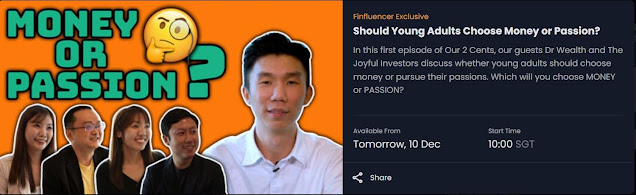
[iFast TV] Should Young Adults Choose Money or Passion?


For the past few weeks, I have been collaborating with iFast TV on this series called My 2 Cents. You can watch the video by following this link

Some readers will be wondering about some details of my collaboration with iFast. I'm happy to share that I actually did everything without financial remuneration as I have the means of monetising these eyeballs through my course offerings. The upside is that there is a stronger degree of control and I get exposure to what media broadcast is like. Naturally, I ended up having a great deal of respect for actors and the logistics required to create even a short video like this. 

A lot of discussions I have of late is about choosing between Money or Passion which is actually a false dichotomy - you can choose both. But the reason why this remains a hot topic is that a lot of young people feel trapped in jobs that they pay and actually switching to job that they love would result in a serious pay cut.

In this video, I made two pertinent points that should be useful to the reader :

a) Understanding Job B matters

As a society we're too obsessed with Job A, a high-paying we take to pay the bills, and advance in society, that we often dislike, and can't wait to get out of. This can be a job as a Legal Senior associate while counting the days to a junior partnership. 

But equally important is the idea of Job B -  a job we enjoy, we can sustain but may not pay as well. 

My rationale is for everyone to know what is their Job B so that they can decide how long they can sustain Job A before they give it up for a better life. This knowledge is valuable because Job B with some passive income can be the equivalent of Job A. 

So my stand is to meditate on what Job B is and how much it pays, I tell lawyers that for them it's generally becoming a GP tutor in a private tuition agency. 

b) Three S's in picking professions. 

If you want to survive this new world where tech obsolesces becomes a way of life, you need to be guided by the three S's. A job has to be Surprising - no SOP can contain instructions on how you do your task because it can be automated. The job should be Scarce, not everyone can do the job. One litmus test is to see whether there is a licensing regime to perform the task or there is a guild to protect the interest of these professional groups. Finally, the job should be Social - a strong element of personal interaction should exist because it is harder to outsource actual human connections.

I will summarise my points in later videos, but I hope you will watch them to find out what my colleagues have to say about the matter as well 


Tuesday, December 07, 2021

Early Retirement Masterclass Community Event Q42021 - ERM goes Crypto !

We will be conducting a community event for my Early Retirement Masterclass alumni on 16th December 2021 7.30pm. 

In this event, I will be describing my nascent efforts to invest in cryptocurrency in a manner that is more consistent for ERM alumni. My students have already been invited to send me some questions so the slides will address them over the next few days.

Members of the public are invited to attend this event. At the moment, I'm not positioning myself as an expert, I see myself as more like a fellow explorer so expect the material to be somewhat basic for now.  

The main question I want to answer is the question of :

"Whether Skeptics and Conservative investors have room in their portfolios for cryptocurrencies?".

Items of discussion include :

  • Some cryptocurrency basics.
  • Why conservative investors should take a closer look at stable-coins.
  • How a beginning crypto investor's environment and tools can look like.
  • Two interesting ideas investment ideas for Early Retirement.
  • A quick tour of the Metaverse and what's trending in this space.
In my investigation, I have discovered more questions than easy answers so members of the public will be encouraged to participate in some online surveys, this ensures that everyone will be able to leave with something useful at the end of the session.


I will conduct the usual portfolio updates for the student-built portfolios at the end of the presentation.

Please register by following this link: 

https://us02web.zoom.us/webinar/register/3616388661643/WN_frQJE5rMT2yeGZXiEIDYIQ

Saturday, December 04, 2021

Using a Finance Blog to hone your critical thinking skills


The Life-Changing Science of Detecting Bullshit by John Petrocelli is a gem of a book that really does not hesitate to name names and one of the big joys of reading this book is to look at how much bullshit Americans have to live with. Some big names along with concrete examples of their bullshitting include Dr. Mehmet Oz and Deepak Chopra. Naturally, the situation in Singapore is not much better and I find that, after banks can link up CDP to create a 360-degree view of your personal finances, folks like my mum are starting to get more calls inquiring about her investments.    

One useful way of benefitting from this book is to use the appendix of the book that has a comprehensive list of fallacies and try to identify them on finance blog articles to sharpen your own thinking. 

So what I'm going to do is to simply take the latest Money Maverick article and then run through the list of logical fallacies to see where can find some areas where a reader can improve his ability to think critically. Money Maverick was a controversial blog owned by Financial Advisor Luke Ho, but it has since changed hands.

You can go through this exercise yourself by using this link.  

See if you agree with my analysis.

a) Anecdotal Fallacy

An anecdotal fallacy occurs when someone uses anecdotal evidence or vivid examples in his reasoning.

You can find this performance table in this article : 

The thing is that we will see a lot of these results demonstrations on the web, but because Seth can only show off his own portfolio, this is just one data point and does not reflect all of a FA's customers. As it seems to cover just Seth's performance to me, this may well be anecdotal.  

Similarly, we need to be very careful when FAs display the results of their customers. We should not settle if they only get to cherry-pick their top performers. 

b) Hot Hand Fallacy

This is a fallacy where we believe that good things will occur directly following favorable/desirable outcomes. 

From that same snippet, you can find a fairly good return of 36.74%. The Sharpe ratio is off the charts are over 3, but the record only covers one year of performance. To understand what a Sharpe ratio of 3 means, it is actually very sensational, a quant who gets about 0.8 over 10 years is a fairly good investor. This is clearly a one-year hot-hand and the question is whether a Sharpe ratio of 3 can be maintained over time. 

In the investing universe, a one-year record is hardly something to crow about especially when China and US Tech stocks have well but not having a good time lately. 

The problem with asking for a longer track record is that we won't even know who the real owner of the Money Maverick blog is going to be in one or two years' time.

c) False analogy 

When you employ a false analogy, you are using perceived similarities to infer additional similarities that have yet to be observed.

The third fallacy is kinda hard to find given that, frankly, the quality of this article is really poor and the author rambles as he goes on. You need to suffer through the article after which you can scroll down to the section on "Penny-wise, Pound Foolish will not work"

Seth first talks about running his business and why it's not wise to skimp on rewarding good employees. He then tries to take a logical leap to say that, similarly, it is dumb to spend hours looking for the best-fixed deposit for just an extra $75.

If you put on your thinking hat for the moment, you will realize that employee retention and savings deposits are not the same things.

Employees have varying levels of productivity and putting in more rewards can pay off immediately if you consider the cost of employee retention and how difficult it is to get good help in a business. It is also expensive to figure out who a good employee is - you've probably paid sunk costs to do that. You are rewarding them to minimize waste as well. So this kind of good money should be spent.  

A good fixed deposit pays out a higher amount and is an objective measure. There is no reason to take a more expensive option when a cheaper one exists. Also, savings accumulate and compound over time and the final outcome can be quite consequential. How can putting more time to find a better product be considered pound-foolish? 

Readers need to be careful. 

This argument is common in the finance industry that is struggling with high expense ratios and is now faced with cheaper options like robo-advisors and ETFs. The logical defence is to just say that folks trying to cut costs are penny-wise pound foolish. 

In summary, the Singapore financial blogosphere is a great place to practice your critical thinking skills and there are quite a number of blogs that facilitate this kind of practice. Of course, I have only used the book on one sample blog, you are free to even use these tools on any piece of writing including my own. 

I'm not infallible and we can probably learn a thing or two from the exercise.