Wednesday, June 21, 2023

When will we admit that Singapore Millenials are doing very well?


I've not been active because I'm super busy with my new product launch. The next round is where I will actually conduct one sample lesson for my ERM alumni on Saturday without a dry run just to see the kind of feedback I will get on the lesson. 

But one question weighs heavily on my mind since my last article. A very sharp reader pointed out that I can be wrong about Malaysian property not just because Malaysia straightens itself out - I can also be wrong when Singapore reverts to the mean. What are the conditions for Singapore to revert to the mean, other words become as unexceptional as our ASEAN neighbours?

This is something worth looking at. 

I'm going to digress before trying to answer this question. I attempted to do through some of Mr Loo's 1M65 videos to see what he's talking about, but without completing some of his very lengthy productions, I can only say that even if he's right about many Singaporeans being asset rich-cash poor, Malaysian property may not be the right answer. 

And I speak from experience. 

I lived in landed property almost all my life (I'm not proud of it), and my dad's Malaysian property paid my way through my first degree. Even though this was a very successful investment by Malaysian standards, the price and rentals were stagnant for the past 30 years and my dad should have extracted the capital and placed it in REITs / DBS instead. 

But don't ask me, ask the guys who got hammered by CLOB. 

Ask the folks who paid for Forest City which was backed by the Sultan of Johor.

JB is littered with the corpses of crypto-like investment ideas pitched at Singaporeans - Danga Bay, Best World Shopping Centre, etc...

I have great respect for the work of 1M65, but as he places that dollop of wonderful Nasi Lemak that he claims to be better than Selera Rasa in Adam Road which deeply affected me and made me hungry, but I invite him to predict the next election results of the six Malaysia states coming up next. 

Beyond political stability, top universities, and the usual things our Government likes to brag about, there are some features that can be quite unique to Singapore that if lost, could mean our destruction.

  • MAS's unique method of using the $NEER to control exchange rates has given us lower inflation compared to other OECD countries. This was the brainchild of Goh Keng Swee.
  • As pointed out by Leslie Yee in BT, Singapore is small but can produce more residential housing per unit of time because we don't have too much red tape to repurpose land from one use to another. We just invoke the laws on land acquisition. Places like NZ has so much land but actually lack decent housing.    
  • The Economist credits our success during the Pandemic because we are kinda utilitarian and amoral and only Miami was able to beat us in performance. In other words, fuck your feelings. This is the Singapore I love. 

Amazing, this blog threw up some answers to the question. Link:

 http://treeofprosperity.blogspot.com/2021/09/does-singapore-feel-cheap.html

Reversion to the mean can take place if Singapore feels expensive to foreigners and we end up in a current account deficit. There are two conditions for this to happen.

In this case, the whining Millenials are right. We are objectively expensive. But we've been on a current surplus so far, so I'm not duly concerned about reversion to the mean.

As you read the literature on various social sciences coming out from the States, Singaporean Millenials have all the advantages of a better education compared to those in the US, but none of the disadvantages like crippling study loans, or fentanyl abuse. Houses are not cheap in Singapore, but some Millenials are already sitting on property that has already been appreciated.

So why Millenials on social media cannot admit that they are doing fine?

  • The first reason is that the benefits almost all accrue to local degree holders, with private degree holders quite distant away.
  • The second reason is the envy arising from social media. You know you're not supposed to enjoy Naomi Neo's Instagram by gawking at her sports car or house. If you get envious of that, you're doing it wrong!

I'll tell you what I'm concerned about. 

PM-elect Lawrence Wong believes that the solution to our problems is to broadly flatten the incomes between the top and the bottom - to reduce inequality. Just remember that talented local grads can easily find jobs in places like HK and UK which is also rolling out the red carpet for foreigners. We need to do this without triggering a budget deficit and a flight of human capital. Inequality is bad in theory, but if solving it means $15 for a plate of char kway teow or $500 for someone to fix your pipes, we may have an insurrection on our hands. 

Then we will revert to the mean. 

Of course, at the end of the day, the devil is in the details. I shall leave it to the high CEP panjandrums to decide how to meet policy objectives.





Sunday, June 11, 2023

Some thoughts on whether it is wise to buy Malaysian property and retire in JB


For the past 4 days, I've been in JB to meet distant relatives who are on a business trip from China. Fortunately, a secondary school classmate was kind enough to bring me around JB for breakfast and share with me his latest property move which is to buy a piece of landed property unit at Eco Botanic Gardens.


Eco Botanic Gardens is primarily owned by Malaysians who work in Singapore and Singaporeans who want to live in Malaysia. The pricing is well above $1.5M MYR, so Singaporeans are legally entitled to own these properties. 

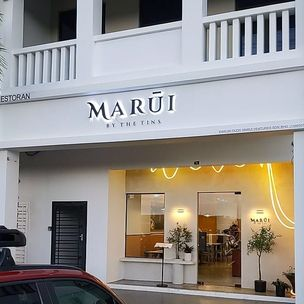
Of course, my classmate wants to promote his estate and suggests that I either rent/buy a unit in Malaysia there  The idea is that we can all retire in style, given that our conversations are not tainted by modern professional comparisons and tend to be more like banter between secondary school pals. On top of that, Eco Botanic Gardens looks posh with a fairly nice gentrified row of shophouses with fusion restaurants such as Marui.


My pal means well, but I am in the process of getting legal rights to all my mum's properties in JB with the eventual aim to sell them at a reasonable price. So logically, I'm doing the opposite of what my friends suggest. I'm doubling down on Singapore. I'm penning my thoughts here not to demonstrate my impeccable logic, which will have its share of supporters,  but to chronicle my thoughts on how I'm likely to be wrong. 

For some background. My property in Malaysia is currently stuck at a current yield of about 6.1% and rents have not increased for the past 30 years! Even worse, real estate agents actually believe that the rent I'm charging is relatively high for the area. I'm hesitant to sell because converting it to a portfolio of high-quality S-REITs may just give me a yield of about 5.3% but it will have the advantage of dispensing with currency risk. 

In my view there are just too many considerations to living a blissful life in Malaysia:

a) At the personal level you need to change yourself to adapt to a different environment.

First off, I'm a public transport guy from Singapore. I need to pick up a refresher to drive if I move to JB. Then I need to develop a rugged DIY kind of attitude to living in Malaysia and become some kind of handyman. These are great skills to develop for anyone, but it's not exactly what I want to build given that I'm more interested in AI, quantum computing and investing. 

Also, Singaporeans need an attitude adjustment as there are no Town Councils to complain to. 

b) We need to imagine the state of the property after 10 years to determine whether this is really the beautiful life we will be getting

The reason why Singapore is so good at what we do is that we are excellent at maintaining and sustaining things. Over the years, Singaporeans have been seduced by many real estate development projects, but often they result in becoming ghost towns like Forest City. Even if your property does ok over the years, a layer of algae will eventually grow around it. Entropy is a very powerful force in JB.

So we cannot just look at one development and see just how beautiful it is, we need to imagine what it will look like in 10 years. There is a real probability that your development will become a ghost town. I remember going to the sales office for Forest City and there were horse carriages to bring potential buyers around. I was even told that this development has the personal oversight of the Sultan. 

But look what Mahathir did to it?

Anything can happen.

c) You just need one mugging incident to change your mind about the place

If half your family is Malaysian like mine, then you will know that crime levels are not like in Singapore. There are of course terrible incidents and stories of crime and I was advised never to pump petrol or withdraw money at night in JB. But muggings are real - someone hit my late father-in-law on the head when he was doing morning exercise in Kulai.

In such cases, the solution in JB is always to wall up the estate and hire security. But in my head, the question is always who is going to keep you safe from security?

Security cannot come fully from just guards and cameras. It has to come from legal systems, procedures and swift execution of justice. Good luck with that.

d) What needs to happen for me to be wrong?

This point is more important because Singapore wants to see real change before we are happy to part our strong currency for Malaysian land. At this point in time, if you read financial planning journals from Malaysia, you will hardly be impressed with what you read. Right now a Singapore journalist (I  dunno what drugs he is on) is openly writing about comparing CPF Life being better than buying investment property. In Malaysia, they are debating whether to draw out their EPF for personal expenses. You can imagine how these two societies will evolve over time. 

As expectations are not high in Malaysia, I hope to see the RTS gets built as a baseline to consider that I might have misjudged the country. After that, the current government must survive its term in power. Beyond this one term, if the Anwar government can win an election without needing to form a coalition with UMNO, then I can consider my judgement to be incorrect, but this will only improve the probability of profiting from our investments.

What is the probability of this happening? This is something we can debate about and monitor. 

If they let Najib out of jail, this is a big negative and we gotta adjust the probability downwards, If Mahathir dies, then it's a great positive and we can adjust it in the opposite direction.

Whatever it is, I don't think it's within a Singaporean's power to come up with reasons for how things are going to work. We've been losing money on projects in JB since we've existed as a country. My relatives remember the days 1 SGD = 0.90 MYR. 

If anything, Malaysia needs to prove that it's an investable place. They need to respect the ownership of private property, ease up on currency controls, and stop penalising folks who just want to come to your country to spend money.

Finally, if you can FIRE in Singapore, it's the best scenario because you've succeeded in retiring in one of the most expensive places in the world. If anything, your assets and physical body are safe. Retiring in a place like JB makes more sense if you are somewhere in the twilight zone of retirement planning. 

Still, nothing beats coming in occasionally to JB to enjoy the power of the SGD. 

Tuesday, June 06, 2023

Bridging the mating gap between men and women


I would not ordinarily read Motherhood on Ice by Marcia Inhorn, as I have bigger fish to fry like picking up quantum programming or maybe signing up for a ChatGPT prompt engineering course but I've already written a number of articles on this blog on egg-freezing and the book came under strong recommendation from my sociologist buddy.

For a married guy who is not vested in technology, but actually has two ex-eggs running around the house, the book is too much information for a dude to process. Not only do I need to be introduced to egg-freezing technology, I have to read sob stories from very successful professional women, who lay much of their dating woes on men. Ultimately, egg freezing is not so much about single female professionals, but it is also about the fathers, ex-husbands and boyfriends who often have to pay for the procedure. However, I did come off a bit more positive about approving this technology broadly here, but it would not fulfil the wishes of many professional women in Singapore because the problem is that men have better things to do, and, thanks to dating apps, younger women to date. Egg freezing is, therefore, more akin to insurance, something that gives professional women some peace of mind. It will not arrest the decline of our fertility rate.

If egg freezing is going to be more like insurance, then we can expect the medical industry to sell it as a form of female empowerment or a passport to focus on a woman's career. This is while some branches of feminism are actually against egg freezing, and in the sample, almost no one froze their eggs for career reasons.

The big elephant in the room, according to anthropologists is the mating gap. The pool of eligible, educated and egalitarian men is very rare and, channelling the other book I read Generations, adults are taking a long time to get their shit together. 

This leaves two groups of people on the shelves - professional women and low-status men. 

So every society has an imperative to change the way humans mate and get professional women to marry and form families with blue-collar men. 

In this case, anthropologists are warming up to the idea of mix-collar marriages. Now we have Phds lamenting the idea that if RGS marries an ITE guy, she is labelled as "settling". 

This is something as a blogger I'm really proud of as I have been blogging about this issue for years.

Some kind of agency needs to be launched, in fact, a whole of government effort, should be launched to address this mating gap. My projection is that we have to admit men into more degree programs, failing which, we need to make viable better non-degree tradesmen paths for men. Maybe even cut NS down to 1.5 years and pay NS men's Army regular salaries. 

My money is on Singapore succeeding in this effort after a few GST rises.

I think the bigger challenge is getting white-collar women to accept blue-collar men as life partners.

The idea of a dating agency that caters to professional women and blue-collar men has been mooted by anthropologists, but when I broached the idea with friends, both men and women are disgusted by the idea as we are an Asian after all and female hypergamy / male hypogamy is still largely the norm. Even guys who, on the surface, fantasise about the great life as a househusband, they get upset when I say what if their daughters support their husbands financially. One reply from a guy is that if his daughter does this, it would mean his failure as a father. This sums up most men in Singapore, they actually want some degree of financial independence, but get angry when their daughters provide for it some another guy. 

I think this mixed-collar dating agency catering to professional women - working-class men is currently the best idea there is. It may take a generation for a mindset change to come about, but we need a catalyst to generate some positive stories about these marriages. It may take a few high-CEP scholars to succeed in coming up with a first attempt. 

How do we sell this to blue-collar men? Off the top of my head, I would sell it this way - they just need to show up for a buffet spread where some mysterious women might try to engage in conversation with them. This sounds so good, even professional men want to do this ( but they are not invited )

I leave it to fine brains who read this blog to brainstorm ideas on how to sell this to professional women. 

This is too hard for me, let me get back to my Quantum computing texts.


Tuesday, May 30, 2023

New Preview Launch : All-Weather Portfolio Masterclass

Conventional wisdom probably does not support the idea of launching a new course in such a bleak economic backdrop, but I owe it to myself to grow professionally and all that coding on Python needs to be channelled into something that benefits everyone. 


So tomorrow will be the inaugural preview for my new course entitled All-Weather Portfolio Masterclass.

This is a program where I show students how to run and operate their own robo-advisors and construct well-diversified ETF portfolios that will generally do well in all different market conditions. 


I will be sharing a little bit on :

  • My views on the macroeconomy.
  • How a great investing strategy is like a good marriage and why poor profitable strategies can turn beginners off.
  • A brief summary of four uncorrelated strategies that can be built using computer code and how you can have not just one, but four robo-advisors running on your system with no coding knowledge required.
  • How we intend to teach this program, pricing details and timings.
Like all my previews, this new preview is a free mini-course that will add value to your lives even if you don't sign up with me. We've been quite good at this freemium model for a number of years.

I guess the fun part is that I am still quite raw so my presentation will not be as polished as m ERM product. 

You can sign up by following this link :

Tuesday, May 23, 2023

Actually Gen X is more cursed than Millenials.


MissFITFI has just launched our latest collaboration on differences in Generations. You can listen by following the link here

A couple of days after doing the podcast, Jean Twenge wrote possibly the most comprehensive book on the differences between entitled Generations, and this has caused me to do a double take on the material I shared and in some cases, I cannot be more wrong. I hope that more objective readers will use this article as a guide to the podcast and if actually work in education or HR, this book is mandatory reading.

The first thing I'd like to point out is that there's an easy way to analyse all generations all at once. Generations are shaped first and foremost by technological changes that impact them. Secondly, every subsequent generation is becoming more individualistic and communitarian. Finally, adulthood for every generation is delayed further as adolescence gets stretched as it takes longer to train a person to be productive in the economy.

With this framework in mind, a few things I said in the podcast is wrong.

a) Actually Millenials are doing quite ok financially

As a highly educated cohort, Millenials actually earn well compared to Gen X by pure virtue of educational levels. The problem arises if you are an American millennial who is saddled with educational loans, for these folks their net worth is 11% lower than Gen X at the same age. The good news for Singaporean millennials is that they are not struggling to pay their educational loans, so I might venture to say that the gap in net worth may not be as bad as reported in the books. 

Gen X's biggest advantage here is that they get to buy homes when homes were well cheaper, but this cannot compare to the prices Boomers get. 

b) Millenials whine a lot because of social media 

If Millenials are doing better than Gen X or Boomers, then why are they such whiners? The answer is social media. As Millenials live in the age of Facebook and Instagram, they get hit by images of people having beautiful holidays and ridiculously picturesque lifestyles so it's harder to avoid envy. 

The fact that most folks don't share the harsh reality of life creates the impression that one's life can be better. I'm still waiting for Naomi Neo to share her household bills with us so that we will know what's required to live that kind of life.

Being bombarded by images of success (many inauthentic) create a generation with weaker mental health. 

c) Millenials do mature later and take a longer time to reach life milestones

We will definitely notice that Millenials become adults much later than Gen X. This is because it takes a longer time to train them to contribute to the economy. Take, for instance, reaching the CPF FRS. I was able to hit this target before I was 30 because the target was about $80k. Then compound interest took care of everything else. I don't think it's even remotely fair to expect a millennial to do the same.

Millennials will marry later and retire later than Gen X. I suspect over time, the sheer educational training MIllenials get will have them generate more wealth than earlier generations. 

d) If Millenials are cursed, it is because they are more individualistic than Gen X

We should expect Millenials to be more individualistic than Gen X. We should also expect the gender-fluid Gen Z to be even more so.

While it means being any gender or ay belief system, it also means the ultimate decay of religiosity and with it, avenues for building social relationships. I predict Singaporeans becoming less religious and community centres in their current form would become a waste of tax payer's money.

More millennials will die single, more will be lonely, and more corpses found next to gaming consoles.

Still, I can't argue that Millenials are cursed because Gen Z will be even worse!

All this being said, there are some harsh realities that Millenials face that Gen X does not. For one thing, most of the economic benefits for Millenials accrue to degree holders, specifically those with local degrees. Private degree holders face quite a big gap with their local degree counterparts. For Gen X, degree holders are a smaller part of the population so even if such a gap exists, it will grate on us this much.

Furthermore, as a younger generation, they could not participate in Singapore's miraculous growth into a wealthy city-state. Older generations will always seem like they are sitting pretty on the best real estate.

Still, as Gen X, we should also take a good look at our own generation. We are the CECA generation. One prominent IT professor called the technical professionals the Garbage in Garbage Out generation. We weathered the dot-com crash, the great financial crisis, and the pandemic. As our numbers are quite small compared to Boomers and Gen Y ( in the US ), we will find that businesses, pop culture and political groups will tend to ignore Gen X as we don't make the numbers.


Saturday, May 20, 2023

Letter to Batch 30 of the Early Retirement Masterclass


Dear Students of Batch 30,

It’s been a great honour and privilege to conduct a 3-Day Early Retirement Workshop for you.

The 30th batch of the Early Retirement Masterclass faces a challenging financial market. China’s recovery from COVID-19 has stalled, and the US faces gridlock as Republicans and Democrats begin a political dance to raise the debt ceiling. Singapore’s GDP growth enters negative territory as inflation remains stubbornly entrenched in the 5% territory.

There’s much to fear in this market.

Consequently, we conducted the smallest class in the history of the program. The cosy atmosphere and skilful student body still allowed us to build a 17-stock portfolio despite each student doing independent research without a teammate. The portfolio we will track will also halve its size as I try to fit the 17 stocks into a tight budget of $10,000. A high yield of 6.5% helps.

But there is hope.

The equity risk premium we track is over 6%, and we have proof that students who conduct bargain hunting will be rewarded in the future. We are also seeing substantial discounts in the REIT space.

Whoever farms the most money into the markets over the next two years will reap the rewards in oversized returns when the market recovers.

The Early Retirement class will stubbornly cling to its survival. To ensure decent class sizes, we will conduct Batch 31 in October 2023 as I make way for an entirely new course in August.

Lastly, I hope Batch 30 will participate actively in the FB group. On 24 June 2023, we will meet face to face in our ERM Networking Session!

Hope to see you then!

Christopher Ng Wai Chung

Thursday, May 18, 2023

Personal Update


It's time for another personal update since I am in the middle of graduating from ERM's 30th batch of students and want to leave the heavier stuff for next week.

a) Left the Government Healthcare orbit

I've finally decided that the best option to manage my health would be to pay more and transition into private healthcare. I've since learnt that there have been many lapses in my diabetic and hyperactive thyroid management. According to records, the government system stopped monitoring my thyroid levels about 9 years ago and mixed two diabetic medications that would not ordinarily be administered together by the private sector. Consultations have also been draggy with long waits thanks to a really horrible IT system roll-out in TTSH. 

While I still respect government healthcare for being cheap and affordable, I no longer have the energy to read up and micromanage my own ailment to constantly be on the watch for lapses. At the end of the day, I'm not a medical professional and can't keep second-guessing whoever is providing medical care for me.

There are serious consequences when I make this decision because to maintain a low cost of management, I will have to spend more time getting medication from "cheaper sources". This means spending more time on bus 950. Government pharmacy dispensaries do not entertain prescriptions from the private sector. 

b) With my thyroid problems under control, I need to finish my story on regular employment

It felt weird to start legal practice feeling tired even at 9am in the morning after fighting normal traffic. I also did not do well canvassing files for my business. This will remain one of the most monumental and humiliating failures in my career, but at least I know that my energy levels were out of whack not because of middle age, but because I was ill.

But now with my thyroid hormones under control, I can take a long walk in the mornings, go for a swim in the afternoons, and then have enough energy to attend SME conferences.

While I'm going to look after my health moving forward, I should continue to pursue a full-time gig if the opportunity shows up. I was discussing with the FI telegram group that I am not like them. INTJs can just find more exotic interests and leave a trail of hobbies in their wake after financial independence. If an ENTJ like me is not working on getting more Money or more Power, we will languish. I still have an interview going on since early this year and see this as a good opportunity to finally push my CPF-SA to ERS levels. The bear market is also making it very lucrative to hold multiple gigs to stocks at a ridiculous discount.

Maybe 2023 is the year I succeed in doing well in multiple gigs.

c) ERM and the new All-Weathering Investment course is going to proceed

Even though I may entertain the idea of returning to regular employment, I am going to put in a lot of effort to launch my new course which will take place in August. We are aggressively going to push forward the new preview by the end of May. There are so many questions I want to answer about my new course as some folks are asking whether I am trying to become the next Ray Dalio. 

To make way for so many priorities, ERM Batch 31 will be delayed slightly to October for us to see whether my new ETF-based program has any legs to move. An investment course centred on computer code will be the first of its kind here. 

d) Markets will get worse before they get better

If you get a gig wearing a maid outfit but need to regularly get slapped by your mistress for $27k a month, this is the right time to do it. 

Market equity risk premiums are exceeding high and may even hit 2020 pandemic levels if China remains sluggish. This can generate a one-year discount window to just keep buying equities until recovery can be seen. The probability of Singaporeans entering a technical recession is no longer low. 

There is also the US debt ceiling wreaking havoc on Singapore portfolios right now. 

A safe factor to invest in would be to focus on value.

e) Reading and hobbies

I hope to be sharing more books I am reading as I've recently been reading fairly decent books. I have a podcast coming up talking about generational differences, but I felt it was really bantering without informed research, when the podcast arrives, I will be putting up an article to supplement it here. 

As for gaming, I no longer see myself as an active participant, but a distant observer. I will still go to games bazaars this June and will read RPG rule books as a hobby. As I enjoy training people, all my residual effort will be put into my jobs instead. In particular,  I am obsessed with all the latest playtesting documents of the D&D ruleset.

I still buy abstract board games to play with my kids.

All in all, 2023 has not been going my way, but now at least I have a handle on my health problems and can make headway to restore part of my revenues. The struggle will still go on and if I play my cards well, I can be rewarded when the economy recovers. 

f) Friends

There are times when I wish I had more friends to have a coffee with. I have regular friends but they are busy, so my newfound energy needs to be directed somewhere and I still put a huge premium on good conversation.

As I have emphasised before, Early Retirement is a networked good. It's only useful if more people around you are Early Retired. Waiting for your friends to retire is like watching the paint dry. 

But what I realise is that my students form an extended acquaintance network. Beginning next week, I will begin to promote a gathering of ERM Alumni quite aggressively, just to see how my students are doing in this nasty bear market. 

Monday, May 08, 2023

The Joy of Unsafe Rates of Withdrawals


There is a lot of talk about safe rates of withdrawal. I would venture to opine that discussions on the safe rates of withdrawal in this blogosphere are enough for more than a lifetime!

I think the problem with this train of discussion is that we don't spend enough time discussing the opposite of a safe rate of withdrawal and taking a leaf off Charlie Munger's page, I wish to invert this topic so that we can glean some insights on retirement planning.

Today I want to talk about why I prefer unsafe withdrawal rates and why most readers should agree with me more than anyone asserting a safe option.

Specifically, an unsafe withdrawal rate applies to an intermediate investor who builds a decent dividends portfolio and spends about the current yield annually. In today's market, if you successfully replace your expenses with dividends, you may withdraw about 6-6.5% of your portfolio, which would be mathematically unsustainable based on long-drawn studies by academics and my Monte Carlo simulations.

Here are the reasons why I prefer rates of withdrawal to be unsafe:

a) You need to be unsafe first before you can be safe.

One way of looking at the problem of creating a sustainable retirement is that, unless you are an inheritor like me, you won't leap from being a new entrant into the working world to having a sustainable pension. If you need $2,000 a month, with a safe rate of 3%, you need $800,000. If you live on 6.5%, you only need about $370,000. 

So regardless of what happens, you will reach the unsafe stage before you can even be safe. Consequently, you are more likely to reach the unsafe range than the safe range.   

b) Easier to convince someone to be financially independent than to be retired safely

If I propose a target of $370,000 instead of $800,000, I would have a lot of traction because it's not just about freedom from an earned income. It's actually solving a bigger problem in the Singaporean workplace. If you attend my preview, I'm not just selling dividends higher than personal expenses. 

I'm selling freedom away from a toxic work environment. 

This can get many millennials and Gen Z to sit up and listen.

I've gotten feedback from my students and readers of the blog that $300,000 is a lovely spot for them.

c) People need to anchor themselves to success

During sports day, my 7-year-old son won a medal even though his team was last in a running competition. Even though his team came last, my son bragged about his award, would wear it all day, and even wore it to his piano lessons. 

In my earlier article on my existential crisis, it's essential to have significant achievements to fall back on when you hit a mid-life crisis - medals in life matter. Generating enough investment income to cover monthly expenses is one possible anchor to your personality. It is a formidable achievement and is consequential to your life.

Most investors should not be bothered to double their portfolio targets mentally to hit a safe withdrawal rate. You work on getting there unsafely first, and $370,000 is definitely achievable for local PMETs.

So you live on your dividends first, then you find a way to secure your retirement plan.

d) So what if you are really unsafe

The weakness of promoting a dividends approach is that not everyone will continue to build up their wealth after reaching 6.5%. 

Having observed some people, I don't think it's anything that should be pinned on their "dividends mindset". They just hate working for other people. Another weakness is that addiction to current yields can lead to concentrated portfolios, which means diversification across different dividend sources do matter.

By this time, my Monte Carlo simulator can pull ETF data from Yahoo Finance and simulate what happens if you run down a SPY/AGG portfolio using high rates of withdrawals. This table lists how long the portfolio will last for the worst 5% simulations. 

This means we can sort of estimate how long your money will last if you decide to throw caution to the wind.


So for a 60/40 portfolio with a withdrawal rate of 6.5% and average inflation at 3%, we are looking at 14-15 years of fun living. 

But humanity is resilient.

People don't lie on the bed and draw down their portfolios to 0. 

People can cut back on expenses, draw from CPF Life, or join the gig economy. They can downgrade their homes.

Finally, does it mean we avoid attaining a safe withdrawal rate once dividends are high enough? 

It depends on your personality. 

As an ENTJ, my withdrawal rate is around 3%, but I still want a day job to supplement my trainer fees and hit ERS CPF-Life. Because I can't sit still and want to contribute to society. I've got training revenues and Graves Disease, and I'm still interviewing!

Most other personality types will run the risk of quitting if they hit 6.5%. Singapore's corporate culture is toxic. If someone wants to live on their dividends and see their portfolios go to hell in 15 years, maybe we should examine the kinds of workplaces they function in.

IMHO, only the INTJ strategists who dominate the finance telegram group ( and every ERM intake ), will precisely quit when they reach the target rate. This is about 2% of the male population and 1.5% of the female population.

Finally, if I had not done some unsafe acts in the past,  I would not be a proud dad of two kids today. 

One just won a medal.


Wednesday, May 03, 2023

Money is Sexual Energy !


A week ago, I was invited to have a friendly banter with young podcasters. The colourful parts of the discussion did not go into the podcast, because I don't want to get censored, but came when I got everyone coffee later. As there is no need for self-censorship anymore, everyone's guard was down.

One of the coordinators was a young man who just got out of a relationship, he's at this stage where he does not really give a damn anymore and wants to focus on his work. Being an older guy, I began to congratulate him - I told him that in making the decision to move on in a relationship and focus on himself, he has put himself in a position of great power - he can now sublimate his sexual energies on.. well... whatever he gives a damn about. 

Maybe it's my accidental choice of words, but folks found this hilarious, so perhaps I want to talk about the idea of sublimation. Sublimation is basically directing your energy into doing something creative. It is a solution to resolve the existential crisis we face. I did an article on this before. 

You can follow this link to learn more about mid-life crisis and sublimation.

Recently, there's been very deep discussions on the use of first principles, but there is insufficient discussion on what these first principles are. For dividend investors, compounding is often the first principle quoted. For the ETF asset allocation folks, the first principle is diversification as a free lunch.

Podcasters who worked with me for a while have noticed that I have this habit of always relating money and finance to mate acquisition from the male perspective. So I think the first principles to me are not finance related. In fact, my first principle is this:

Money is Sexual Energy

When a guy is looking for a mate, he has a certain amount of energy at his disposal and can invest it to make himself more attractive to women. If a woman, in most online dating surveys, unanimously reveals their preferences for educational qualifications and income, then this sexual energy will be invested in the accumulation of economic resources. This is not right or wrong, this has evolutionary origins. 

Civilisation will not exist if women are not choosy.

I find two very useful applications of this theory :

The first phenomenon is when crypto was at its peak, bros were bragging about their crypto trades during Tinder dates. Even when the risk that they can be engaging in a Ponzi scheme is high, crypto was a good way to signal economic resourcefulness, often this is the only way to show it if the crypto bro did not have a local degree. If you understand that crypto schemes reinforce the mate-worthiness of a segment of the male population, then you will conclude that crypto will never be destroyed and folks will come up with more insane schemes in the near future. Only coordinated worldwide regulation can kill crypto.

The second phenomenon is the large number of single financial influencers who attained FIRE. When I first appeared in the Sunday Times, I attracted a lot of hateful posts on EDMW and many critics said that I was able to FIRE because I was a single guy. I think that's not a sufficiently nuanced criticism because many single guys never attain FIRE ( Instead, many Gen X single guys go Fire disco ). 

It takes the ability to make a decision to channel the sexual energy somewhere else ( in my case, dividends ) to meet the FIRE objective. 

Once you understand that money is sexual energy as a guy, then there are some self-help ideas for you.

a) Giving up on relationships is a power move

As a guy, you need to realise that your bargaining power increases with time. In your 20s, you might be just a small engineer in a server room. This same engineer can become a landlord in his 40s. 

We guys are like Pokemon, we evolve into a higher form! Of course, we have different evolutionary paths.

Where your bargaining power is weak, you have the option of just giving up - becoming a Sigma male. A dude who does not give a damn and just wants to focus on your work and hobbies.

This frees up a lot of sexual energy for you to pick up investing, climb the corporate ladder, start a side hustle, and of course, attend investment courses. 

Do this when the women are the most emotionally demanding. 

b) Financial independence is the first step to returning to the dating game

Now, if you are pursuing a dividends strategy, you can start to replace your bachelor expenses at a withdrawal rate of about 6.5%. That's way more unsafe than what a retiree can accept. But you are not a retiree, you are a single dude happily living on your dividends.

At this stage, the FIRE movement can become a crutch. Because dividends are so seductive, you will keep trying to reduce your SWR and ignore the dating pool of eligible women. When you don't need your salary, you would be able to project your confidence as a mature and worldly man,

So take the plunge and start dating casually. Further advances in the financial front can come later. Most of the younger guys and the unsavvy ones your age cannot match up to your sexual power!

c) Continue the accumulation of investment income as your family grows

It is not realistic to try to get investment income equivalent to median family expenses when you are single, but with the right spouse, you can do it together as a couple. This stage of wealth accumulation is very important because being married unlocks the BTO option that can supercharge your wealth at a later stage of your life.

I found that journey to allow another person to FI in the family much easier than getting FI as an individual. 

With that, I have thrown my hat into the ring to introduce a new first principle in finance. 

I look forward to defending this idea publicly and rigorously. 

Saturday, April 29, 2023

I Hope Your Heirs Want to Manage Your Dividend Portfolio


If you have been following what's going on in the financial blogosphere, I had the pleasure of rebutting every single point except one that was made in Investment Moats on the Dividend income approach. I strongly suggest that you go read that article if you wish to appreciate this post. 

You can follow this link.

I left the final point for a full-blown blog article because it is a good point that simply cannot be refuted by a well-written Python program or a stream of data downloaded using APIs. 

Points like this are what make personal finance personal. Readers are free to see whether the point resonates with their personal experience.

Logically, the ninth point of the original article does not really make a real point. 

When an investor dies, the beneficiaries of his will get control of their assets and will deploy their assets in any way that they please because it is now their money. As it is now their money, they will find a way to manage it using whatever means that they already have. This can mean putting it with an investment expert, or financial advisor or punting it in the cryptocurrency markets.

The real point Investment Moats is driving at is that a stock-based dividends portfolio has many parts and idiosyncracies, so it is more likely that the heirs will not be able to manage it in its current form.

If we take this as a real point, then I think Kyith successfully touched on one of the fears of a real-life dividends investor. In such a case, I don't even need to talk about my kids, I'm pretty sure my wife and my mum will struggle with this if anything happens to me.

This is what I think a dividends investor reader can do if this point really scares you:

a) Don't Die

The first point is obvious, if you don't die, you don't have this problem. 

But your days being alive need to be put to good use. The moment your kids turn 18, you open a CDP account with them and train them on dividend investing. If they want to shift strategies then they should educate themselves first. For me, as early as any family can get a CDP account, they need to know how dividends work.

( IMHO, Dividends are not the best way to pass things down, I think a residential property is better. But I don't want property ownership to prevent my kids from getting an EC next time they start a family! )

b) CDP is quite good if you know how it works.

Your heirs should know your CDP number and allow themselves to be guided by lawyers on how to transfer the stocks out of your account if you do die. When my dad passed, I moved all his stocks to a joint CDP with my mum. The transfer fee was $10.80 per counter and we had 50+ counters. I remember it was really smooth and the counter staff said I was one of the smoothest clients they had ever seen.

I think this technical detail from probate to CDP stock transfer is very smooth and elegant, but I am open-minded to understanding how funds managed by an FA can be moved in a similar way.

c) Nothing wrong if your dividends counters get sold by your heirs.

Every generation works differently when it comes to managing money. I was the one who shifted my dad from real estate to dividend stocks. My kids will have a different way to look at wealth. 

Just because you like dividends does not mean that it's the best for their generation. 

Similarly, your heirs should be free to sell any property to deal with more immediate lifestyle needs.

My wife should sell the house to educate my kids.

d) If there is anything to pass down, prioritise financial education first

I'm not trying to sway readers to send their heirs to attend my training, but there is definitely room to pursue a financial education in a tertiary institution if they are expecting to inherit wealth. But they need to know that they will eventually inherit wealth.

I was an only child who lived on landed property most of my life, my priority after my first degree was the CFA. My secondary priority was to get as much overtime as I can in my first job so I use my CFA knowledge.

To me, there was a lot I had to manage and I can't just outsource it to an FA. This DIY mindset is what I consider the most challenging value to pass down. My kids need to know that a 1% annual fee is the real thing that will really hurt your safe rate of withdrawal.

Lastly, I like to address the point Investment Moats made about CreateWealth8888. In the financial blogging circles, there are murmurs that Jacob's kids were not fully aware of Jacob's approach to trading. I absolutely do not think that there is anything unusual about this when wealth needs to pass on. If anything, Jacob successfully sent all his kids through a local degree program. 

That is the more important thing. 

It will take some time to figure out Jacob's finances, the final outcome may not be dividends driven.  

But I won't count his kids out. 


Friday, April 21, 2023

Q1 2023 - ERM Community Webinar - 27 April 2023

I know that I'm late with the planning and coordination of the Early Retirement Masterclass webinar, but I've been held up not just by the planning of my new course that is supposed to be out by this year, but my voice, which has been ravaged by a dry mouth caused by a hyperactive thyroid,  has just recovered.

So it is now time to conduct our next ERM Community Webinar which is customised for course participants but totally open to members of the public who want a glimpse of what we actually do.

Date: Thursday, 27 April 2023, 8pm

Registration Link : 

https://us02web.zoom.us/webinar/register/WN__smebPL7RjqXx1p7asw9mQ#/registration

We will be discussing the following topics:

a) How robust is your retirement plan?


Showcasing a new Monte Carlo Retirement Testing tool that will be shared with the community. This will lead to my greater ambitions this year to introduce more Python Jupyter Notebooks into investment training. 

b) Update on the economy and what investors should look out for

I will also be updating everyone on the economy and what I think the community needs to think about over the next 3-6 months.

As usual, I will be showcasing a lot of tools that I have created for my new course launch.

c) Performance Review

ERM portfolio performance review. We look at some of the not-so-good investment decisions we made so that we can improve in the future.

d) The ERM Q2 Community Face to face Meetup

The most important announcement details how to sign up for the ERM Community Q2 Event which is a face-to-face meeting in Raffles Place. This is a sponsored but paid ($20) event for 50 ERM Alumni where refreshments will be provided. 

I will be previewing and conducting a full chapter of my All-Weather Masterclass course, so it will be a substantial learning session, but the real aim is to see how everyone is doing since the pandemic.

So if any alumni members are free, why not come down for a friendly chat on Thursday !

Tuesday, April 18, 2023

Will ChatGPT disrupt the retirement planning space ?

When a pal heard that I'm developing an investment course focused on exploring finance through Python code, he expressed scepticism because he knows a trader who uses ChapGPT to craft basic code to make investment decisions. I did not bother to refute this argument because even with the best code, you still need to make the best trades, and programmers don't make the best investors.

I was unable to verify the argument yesterday until someone on the forums tried to use some keywords to generate some Python code on ChatGPT. His claim is that the code is able to simulate Monte Carlo portfolios and give a percentage of the number of portfolios that make it under an assumed withdrawal rate.

Perhaps this was a great moment for learning for me, I took the code for a test drive and it was horrible.

  • First of all, the cut-and-paste process in Facebook lacked indentation, so I had trouble with the different loops in the program. Nested loops can become consecutive loops if the Python indentment was lost. I lost maybe 15 minutes sorting that out.
  • ChaptGPT programs also produced stub files like a CSV file containing historical returns without really telling you how to find them. The contents of these stub files are very consequential in retirement planning, but ChatGPT does not supply them. I had to inject my own code to download data from Yahoo Finance in real time and generate annual statistics to resolve that issue.
  • The next problem was logic errors in the code even after correcting syntax issues. The code would grow the portfolio using, say, 10 years of returns every year. So every retirement portfolio works in 10,000 different alternate universes because they could be getting 90% returns annually. Worse, the code sees an annual withdrawal rate as a percentage of evolving portfolio value and not as a fixed expense moderated by an inflation rate. Theses are fatal flaws.
  • Finally, after troubleshooting everything, the code would still provide an uneasy number to bring confidence to any investor. I had to add an inflation generator to bring the success probabilities down. 

Ok, now let's look at the positives. ChatGPT wrote a fairly bad program, but it can be corrected to work with better prompt engineering, and about 2-3 man-hours and I'm not even a professional software developer. This can be a huge productivity multiplier for many software engineers. 

But, as it stands,  I don't think someone without a basic understanding of the domain in both finance and IT can petition ChatGPT to come up with something that they can run to make fairly important investment decisions and there should be revenue in my upcoming course.

For now, the software engineering types will have serious concerns about how ChatGPT will change their working landscape. Eventually, some untrained manager with a general degree will pretend that he can issue a prompt to ChatGPT and then he will dump the entire source code to you, claiming that a huge bulk of the work is already done on your behalf. All you need to do is to 'operate' it. 

This is going to be a real problem in the workplace because many MBAs are poets.

Getting to run is already a chore. Troubleshooting the business logic will take more time. Enhancement to make it viable as a product will take even longer. 

This nifty Monte Carlo tool will be refined and given to folks in my ERM Community. Hope this can provide them with a new tool to test the effectiveness of their retirement portfolio.


Using 10 years of data, a 60/40 portfolio has a 34.2% surviving 40 years based on the 4% withdrawal rule.


Sunday, April 16, 2023

The value of being consoled in market downturn


As I've been writing code to turn trading ideas into an advisor that any student can be trained to run, it is now time to review some financial advisory practices. 

For this new course, I've chosen a fairly high bar to beat. 

The 60/40 portfolio is a hard benchmark to beat and, in reality, more clients should be actually put into this portfolio rather than expensive products like ILPs. Bet recently as interest rates have gone up, the 60/40 is not a good place to be. I think at this stage, even the reputable FAs will kick in a process to up the level of hand-holding for the customer who is seeing double-digit percentage losses in otherwise safe bond ETFs.

For those who hand over their wealth to experts, maybe they actually enjoy the hand-holding, I will not fault that. 

But what if you expect more from the industry? 

Well, the truth is beyond hand-holding, the best advisors would rather you stay put. There are strong financial incentives to sit this out. There is a strong belief that the 60/40 portfolio will rebound.

For folk who DIY, there is no one trying to stop your funds from fleeing, so there is the possibility of learning about market edges that can do beyond the 60/40 portfolio. 

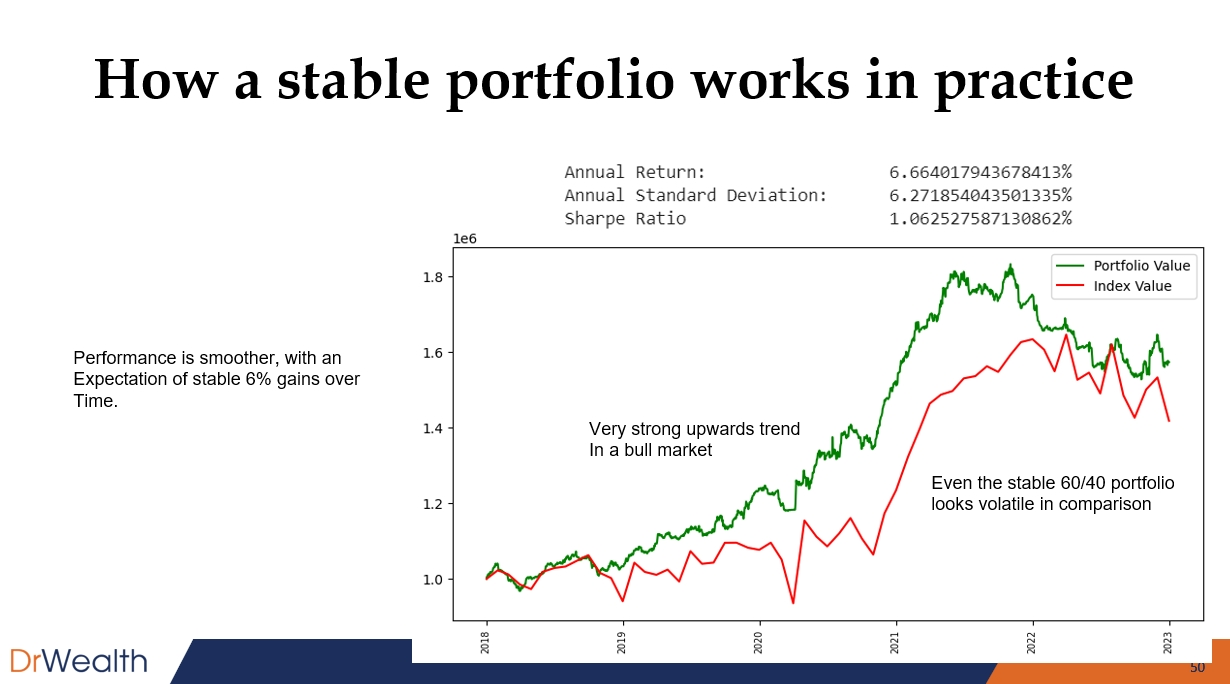
Based on my investigations, traditional portfolios are 60/40 and can produce one unit of return for two units of risk, which is admirable. But armed with a number of market edges, it is possible to do better, maybe 1.5 units of risk to 1 unit of return, or even 1 unit of risk to 1 unit of return. This would generally higher ETF turnover, but these days we have very cheap online brokers to play with. 

Even if you do not achieve these gains, you are in essence earning your own commissions and fees, which is not insubstantial.

I won't spend too much time talking about what sorcery I am working on. I'm still writing out the preview of the sales workshop.

I like to leave you with some final thoughts about financial advice with respect to the value of empathy and consolation. To do that, I subscribed to ChatGPT and got it to write a consoling email to a client who lost money. I added a nice touch on interest rates.

Dear [Client], I'm sorry to hear that your portfolio has experienced losses over the past year. I understand how frustrating this can be, and I want to assure you that I'm here to help you navigate these challenging times. While short-term market fluctuations can be difficult to weather, it's important to remember that investing is a long-term game. Over the long run, markets have historically rebounded from downturns and provided investors with solid returns. While we can't predict exactly when this will happen, I believe that we can remain optimistic about the future. In addition, it's worth noting that high-interest rates are unlikely to last indefinitely in this economic climate. While they can present challenges for investors seeking yield, there are signs that interest rates may begin to decrease in the coming months or years. This could present new opportunities for investors as market conditions shift. In the meantime, please know that I am constantly monitoring your portfolio and making adjustments as needed to ensure that it remains aligned with your goals and risk tolerance. If you have any questions or concerns, please don't hesitate to reach out to me. Thank you for your continued trust in me as your financial advisor. I look forward to working with you to achieve your financial objectives over the long run. Best regards, [Your Name]


Monday, April 10, 2023

Farewell to CreateWealth8888


I've always believed that if I ever achieved REAL retirement, where I no longer have any hustles, I would reinvent myself as a troll on CreateWealth8888's website. He's always had issues with my investment ideas and this was apparent to anyone who knew us both. But he never articulated these ideas in depth so I was never able to rebut him.

The truth is this: He did succeed in irking me quite a big deal, but in his own passive-aggressive way, he never provided an opening that would be making attacking his ideas look good. 

So over the years, I have fantasised about giving him a piece of my mind:
  • He lived in a different generation and should not compare his circumstances to younger bloggers. If anything he needs to be benchmarked against others his own age.
  • His ridiculous fixation with Keppel Corp flies in the face of prudent diversification and would set a bad example for younger folks who can apply his technique to Tesla or even LUNA in the future.
I don't think that if a clash were to really occur, I would be assured of winning the hearts and minds of the public. I might have an edge in logos, but he will hands down win in pathos. I remember speaking in the same panel as him under BIGS and admit that his pull as a speaker was very strong because of his earnestness and emotional appeal. This is one man sharing his investment story totally unbiased by the financial industry. This almost never happens in a financial seminar.

When I visited his wake yesterday, I realised that CW8888 was vindicated by several things which make him a great role model at the end of his life :
  • While it is imprudent to focus on Keppel Corp, it did perform fantastically in the final years of his life. 
  • All his children have managed to earn local degrees and have grown into successful adults.
  • He disengaged from work at 60, was unapologetically so, and enjoyed managing his investments right up till the very end.  
Jacob Ng has departed the world a big winner.

If the cosmos is willing, I will definitely clash with him if we ever meet again.


Friday, April 07, 2023

I may need to plan for Involuntary Retirement


One medical issue I'm grappling with is that I have dry lips, which means I'm not producing enough saliva when speaking. Dry lips make every lecture I present a chore. Beyond one hour of speech, I have difficulties as my throat becomes dry. The use of lozenges like Fishermen’s Friend can backfire as it makes your throat even dryer. 

I do not know whether my dry lips come from Graves' disease or poor blood sugar control, but I can say that I'm already on medication to resolve this problem. The question is when these dry lips can be solved which can take a month.

If I can't resolve this within a month, I must retool how I conduct courses. If I fail to restructure how my class will be conducted, it's game over for me, and I will ironically be involuntarily retired. I won't be able to teach my ERM class anymore. I also can't find a job that relies on my tongue, which I spent decades honing on public speaking platforms. 

I want to discuss some steps I am taking in case the worst scenario happens this year. 

As expected, my finances are the least of my problems, but I have already started planning for having no income since the end of last year. I've expanded my cash reserves to hold one year of expenses and extended it by three months using the dividends earned this month. For me, the problem is not eating into my capital but being unable to grow it for the following year. 

I can return to the D&D gaming circuit, but sadly the hobby is undergoing massive changes as a new edition is launched next year. The bigger problem is my social life. If I no longer work, what kind of hobbies will I need to fill my time as I get my voice back? I'm also not sure whether I am as sociable when socialization comes without any agenda other than having fun. Nevertheless, the demand for DMs is as strong as ever, and so long as I'm willing to run games, I should be fine. 

The final point I want to make, my biggest fear is what kind of books I will read and what frontiers to explore when I no longer earn anything from work. My favourite books are those on office politics, wielding power, and climbing the corporate ladder. As an employee, I used to devour any of the management books I could get my hands on. It gave me a competitive advantage as I could anticipate changes in management work like the Balanced Scorecard. 

You can guess what happened after that - Financial Independence was the best power move in any office environment as you no longer need to suck up to anyone or fight for the best appraisal. 

You may think that I can subsist on finance books. That is actually quite hard. A lot of finance books are not written with the real objective of helping the reader make money. Value investing, when badly written, are tales of investment victory using esoteric knowledge of specific companies that cannot be transferred into another market context. While I prefer quantitative works, they are pages filled with equations and rarely supplemented with source code that allows verification of the authors' assertions on the stock markets. As an investment trainer, I help clients bridge theory and practice. 

Going beyond one finance books is a big challenge because a good book will give your some direction to code a back tester to verify what the author has said. So reading is really just the easiest step in a long journey to understand how markets work. 

If you leave the realm of money but still wish to engage in personal development, all that remains is self-help. These books are touchy-feely, and I've already read most of the ones which are backed by research. 

This leaves me with philosophy and books where the author engages in intellectual masturbation. While I try to read as many philosophy books as the Economist recommends, I think some philosophers need help. Why do you need so much prose when the ideas can be condensed into a paragraph? Maybe I can get ChatGPT to help me with summaries in the future.

I guess if I really want a solution to my problem, I will need to read deeply into the history and biographies of famous people. I've not explored famous people's stories beyond Erwin Rommel and George Patton. 

And of course there is fiction, if only to finish the Game of Throne series if it ever comes out. 


Saturday, April 01, 2023

More medical misadventures


One of the better things I did was to become the resident troll of a BBS called Lothlorien. Basically, it was a gathering place for geeks and outcasts who owned a decent modem. 

Last Friday, we had a small gathering and they straight-up told me that I lost a lot of weight and this could mean that I might have cancer. Fortunately one of the gang is now a doctor and we reduced this to the possibility that my hyperactive thyroid has relapsed. This was really helpful as I have a medical appointment that afternoon to get my problem resolved once and for all. I've had dry lips and lost 4kg of weight and get tired very easily when exercising. 

Unfortunately for me, I was the last patient at the government hospital on a Friday evening and there was no way anyone could administer a blood test and wait for the results to be out. My doctor was apologetic and suggested that I go into A&E which I was highly reluctant about because of the long waits and the possibility of getting something else if I get hospitalised like pneumonia. So sadly, even though I suspected I had a relapse of Graves disease, I can't confirm it and cannot get medication.

It was at that time, I had an epiphany. I told my doctor that it may be time for me to go private and there is not much a public hospital can do for me at this point. My doctor kindly a very long letter to summarise the situation I was in.

The question is how can I get an appointment in the private clinic on such short notice?

I was desperate so I decided to pop in early in the morning without an appointment. The clinic is packed, but if any patient is late, I will get to see the doctor. 

The private clinics are truly very efficient. 

Within 10 mins of reading what my govt doctor wrote, she eliminated the possibility of Diabetic Keto-Acidosis, which was such a huge source of relief. They sent a runner down to draw my blood and I was out of the clinic with my thyroid meds by the afternoon.

Was this really expensive?

I think the $400+ plus consultation and blood test was cheap because it got to the bottom of what I've been experiencing for the past half a year, where I was feeling extremely tired for no reason and felt that I lost my zest in life.

I think what happened so far is really the power of social capital. I'm glad I have a doctor friend who can just help me narrow my problem just before my official consult. My introduction to the private sector was through my ERM student who is an insider in the private hospital system and has spent months asking me to switch to a private clinic.

I'm finally convinced that a significant part of my dividends will end up going to a private doctor. 

If my meds work and I get my smile back, I'll stop contributing to the queues in the public clinics.