Friday, November 04, 2022

Market Deployment #1 : What society are we trying to build?


Two weeks ago, I could finally volunteer at my own secondary school. Blog readers will note that, for one reason or another, I tend to be invited by RI or ACS to speak about the importance of personal finance, but somehow, I never was given a chance to speak at my alma mater.

You cannot call Swiss Cottage Secondary School a bad school, regardless of how negative my personal experience was when I was there from 1987-1990. Swiss Cottage is ranked no. 1 amongst the non-autonomous secondary schools, and entry is extremely competitive with a PSLE cut-off of an AL score of 11 or below. 

My volunteering work was fun and drama-free, but I thought I had one issue to raise, not so much about my secondary school, but what kind of society Singapore is building. 

According to upper management of the school, Swiss Cottage was a leader in educational desegregation. For several years, Swiss Cottage mixed express (AL < 11 ), normal(academic) (AL around 21)  and normal(technical) (AL around 25 ) students within a class. To ensure that nobody gets stigmatised, only the form teacher knows which category a student belongs to. Subject-based banding was imposed so students study with others at their own pace for specific subjects, so a kid can find themselves in a fast-moving Maths class but a slow-moving CL2 class.  

I was fortunate to be able to hobnob with the teachers of my school, and taught me things like always using "positive words". I admitted that to help special needs kids, I told the strongest kids to help the "weak", but professional educators are discouraged from using words the way employed.  I did feel kinda bad after day 1, but when I started on day 2, I was able to just get the fastest kids to help the slowest ones ( to earn a longer recess ) without being too judgmental about them. 

All things considered, I'm proud of my secondary school for trying hard to create the semblance of what Singapore society should look like in the future. Less discrimination and more inclusiveness.

But there are issues with this policy.

Parents are now stigmatising secondary schools for mixing Express and Normal students. In parent chat groups, my wife told me that the perceived value of autonomous schools like Bukit Panjang Government High is no longer sought after because some parents had traumatised children who cannot adapt to having boisterous normal-stream kids in the same class. This is a tad elitist, but I'm sympathetic because there were normal stream kids in my ECA group when I was a teenager, and they love annoying the "mugger-toad" kids like me. In those days, you just shrug it off because it's great training for NS anyway.

If we want to retool the education system to be inclusive, we should not adopt half-measures.

Swiss Cottage clearly has high standards for an Express stream program, but the cost is desegregation. Another school I checked online, Anglican High, has a cut-off of AL12, which is a lower standard but does not offer desegregated classes. As an SAP school, the price to pay for admission is a pass in Higher Chinese.

This is perverse and disturbing. 

Elitist parents can get a safe harbour if they volunteer their children as Chinese elites. Pump enough tuition money into your kids, and they can live in their own "gated communities" free from minorities and normal-stream students. 

I'm not raising the alarm on the really elite schools like Raffles, ACS or Chinese High because good grades are a strict criterion, and they are a small part of the population.

No matter how you improve the system, parents will not change their mindsets overnight. The incoming principal of my secondary school gave me a spiel about choosing a secondary school based on my kid's special interests and talents. I smiled and said that that was not something most parents would believe in. The old boy networks are just too powerful to miss out on in life.

If you want to reform the schools, do it across the spectrum and don't give rich, racist parents a safe harbour.

I've actually done something I might regret later with the funds I got from liquidating my margin accounts. I put most of them into just one DBS stock at the moment. The move is simple and elegant, and I hope to get about 4+% yielding instruments that can benefit from rising interest rates.  

No, I did not diversify between the banks because my objective is to collect dividends in November and slowly liquidate DBS into ultra-high-yielding REITs from December onwards. 

It's arguable whether I'm better off with SSBs or T-bills, but right now, I want a liquid instrument that can bet that markets will underestimate the conviction of the Fed to raise interest rates further beyond 5%.

Also, I can easily stomach the volatility, which is not high anyway because... it is DBS.


Saturday, October 29, 2022

Market Assessment #5 : Old Money vs New Money


As we continue our discussion on status groups, for a financial blog, we should learn to distinguish between Old Money and New Money.

Old Money

Old Money has evolved to come up with a distinctive style that is quite hard to imitate. This is characterised by high levels of financial and cultural capital. The objective of Old Money is not to be noticed by ordinary people, but they want to be recognised by their own kind.

When it comes to fashion, Old Money does not try to be flashy or attract unnecessary attention. Colours are often muted. While I'm no fashion expert, some articles I researched recommend dressing up like you are attending a tennis match. Old Money brands include Ralph Lauren and Chanel - these are brands which have been around for a long time.

From a financial perspective Old Money, while undisputably rich, may have limits when it comes to conspicuous consumption because their wealth is often locked into trust funds. They have many other ways to distinguish themselves, and this can involve their high cultural capital. Old Wealth can spend a lot of time studying art, and it's not really fun for ordinary people to appreciate some complicated movements in classical music. 

Another aesthetic Old Money tends to love is patina. It's one thing to buy a luxury watch worth six digits, but Old Money can inherit a 200-year-old timepiece that has oxidation at the right kind of places. 

New Money

New Money is within reach of professionals in business, finance, law or medicine. For a while, the crypto folks we also part of this group of people.  

We should be more familiar with the conspicuous consumption of New Money. New Money has made their wealth within the same generation, so they can be quite self-conscious of their low cultural capital. 

And this chip on their shoulder is the reason why luxury companies make so much money every year. New Rich have the ability and willingness to spend on supercars, megayachts and Birkin Bags. To compete with other members of New Money, they are even happy to decorate their servants and employees in similar designer gear. 

When it comes to Art, New Money has no time to study the works of an artist like Renoir, but they are happy to plonk millions of dollars on Jeff Koons or an NFT. 

Imitation and counter-signalling

Now let us have a discussion of what this means for us ordinary mortals who are neither old money nor new money.

One way ordinary folks like us interact with Old and New Money is through imitation. 

While we can't adopt all the aspects of the wealthy, we can focus on adopting some parts of the wealthy into our lifestyle. I noticed that a lot of middle-income Singaporeans have a strong interest in luxury watches, and there are plenty of options from $5,000 - $20,000 range like Rolex and IWc. These brands cannot solely operate on the upper ends of the economic strata, so coming up with mid-range options is important for the bottom line. The problem with this is that for these luxury items, anyone with the right amount of credit can own a luxury watch, so I don't understand why there's a prestige in owning a luxury watch.  This is why my personal policy is not to wear one to most engagements, preferring to own stocks in Hour Glass instead.

Another way in which ordinary folks can deal with these status groups is to engage in counter-signalling. For some folks, it is simply impossible to be part of even Old Money or New Money, and imitation can only take you so far. So people form counter-cultures or groups that are directly opposed to Old or New Money. 

One example of counter-cuture is a rebellious group in the 1980s called Centrepoint Kids who are basically Ah Bengs/Ah Lians with a JPOP aesthetic who loved hanging around Far East Plaza and Centrepoint. They love buying cheap jewellery at this place called Lips Enterprises that still exists today. Centrepoint kids are rebelling against the mainstream good boys and girls who study hard and want to live the Singapore Dream.

I'd like to think that the FIRE movement is a counter-culture to Old and New Money. FIRE folks use money to buy their freedom from a toxic workplace and gain more control over their lives. The preferred approach is to be frugal and track their expenses. The most prominent FIRE folks have no identifiable aesthetic - our favourite brands are Decathlon and Uniqlo. We also eat at food courts and kinda proud about taking public transport. 

An understanding of the differences between Old Money, and New Money and the twin responses to them can help many of us in decoding the consumption behaviour of Singaporeans and stand our ground when pursuing our financial independence goals.

This is why when I met another trainer in my industry who told me that he spends $1,000 a month on his pet poodle, I replied with a smile that he probably spends more on his dog than how much I spend on my son. 

On the markets, I noticed that many students are buying T-Bills because they are yielding north of 4%. I made a presentation this morning to ask that some folks reconsider because even DBS is yielding more than T-Bills and can even generate higher dividends over time. Also, there is more flexibility as it is entirely possible that the market bottom can happen within the next 6 months.


Thursday, October 27, 2022

Market Assessment #4 : Why we pursue status ?


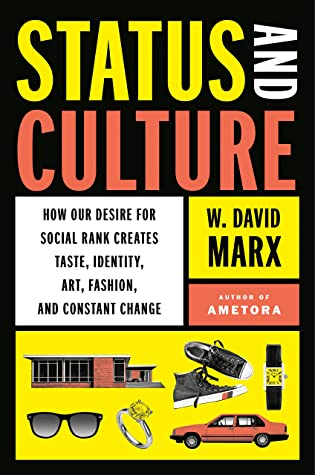
One topic that a lot of personal finance books rarely discuss is status. Why do people seem to be obsessed with their status and why the pursuit of status can actually lead to wealth destruction. As such, a book like Status and Culture by David Marx is a useful addition to a reader's collection because developing an ability to identify status-seeking manoeuvres is the first step to curbing one's own impulses.

There are four important points regarding status :
  • Status is a position within society that denotes respect and perceived importance.
  • Status comes with rights and duties, but having status does accrue benefits.
  • Status has to be bestowed by others.
  • Status is contextual, based on how we are treated at a time and place.
Status matters to me even post-financial freedom. In Singapore, I found out the hard way that you will get abused if you fall into a lower status. I will never forget being shabbily treated when I tried to apply for my wife's Singapore citizenship with ICA, as I was queuing with the folks who are also doing the same for their Vietnamese wives, I was shouted at by boomer auntie counter staff after I said I was an unemployed student. Only after escalation to the woman's manager was I treated better because I revealed I was a law student with SMU (with the requisite non-Singlish orang atas accent).  

So the pursuit of status is really fundamental to being a human being and a higher status does lead to a better quality of life.

When people come together, they form status hierarchies and some fairly universal rules become established. One rule is that a person cannot claim more status than what they deserve. 

The four principles that run in status hierarchies are as follows :
  • Status maximization - we desire high status and fear low status.
  • Status achievement - we can level up and improve our status via our talents, accomplishments, possessions and virtue.
  • Status integrity - we cannot claim more status than what we deserve.
  • Status mobility - we can migrate to a different status hierarchy that values us more.
In my first company Procter & Gamble, employees are subject to a three-grade rating system where getting a grade A is very hard and competitive. As much as tried to get a good rating, I was not able to punch above the higher end of the B grade regardless of how much I invested in my IT skills and certifications. I'm also ranked very low socially among the "management associates" because I don't enjoy small talk during lunch about scuba diving, prefer clowning with operations staff,  and certainly don't see myself as a young and fabulous "yuppie".

So I migrated to a different status hierarchy. 

I used my savings and investments to synthetically build up my wage increments. If I saved 50% of my take-home pay and invested it at 8%, my annual increment will receive a 4% boost the following year from dividends. In a good year, my increment will be higher than someone with a Grade A. Of course, I can't really share this technique with my competition because if a Grade A employee started saving 50%, I'd be toast. 

The funny thing is that after replacing about 60-70% of my expenses with my dividends, I became much more confident about myself, got a lot more vocal and disagreeable, and I actually did get a few A grades after we got sold off to HP. There was no FIRE movement in those days, and I was really trying to build a sub-culture with just myself. But these days I can join a new FIRE movement that values frugality and low-key living instead.

I'm actually really obsessed with this topic of status right now and in the next article, I will talk about the different status markers of Old Money, New Money and FIRE money. So guys who want to hear about Patek Phillip watches and Bugattis may want to read the article I will put up next.

On my observation of the markets, I'm very happy to see a small rebound even after Hong Kong had a crash on Monday. I don't think it is time to move into the markets yet. If on November 2nd, the Fed raises by 75bps, that will be within the realm of market expectations so there should not be a big response. But if the Fed raises by 50bps, there may be a case to start buying a few local counters. 


Monday, October 24, 2022

Market Assessment #3 : Are real estate agents worse than FAs ?


Some parvenu wannabe on social media, incensed at my loathing for FAs, publicly challenged me to air my views about real estate agents, so this article is about my response to this challenge.

I don't have any beef against real estate agents. Yes, they spam my mailbox with letters addressed to "Owner", but I dump all these flyers into the rubbish bin located right in the middle of the PO Box area in my condo. Real estate agents also have to find a way to play up the real estate markets, so in any secondary school reunion, expect real estate agents to work very hard trying to convince you to transact regardless of whether it's a buy or sell transaction. The trick is to simply avoid asking the barber whether you need a haircut and read books on real estate instead. 

If anything, if I do end up doing conveyancing work, I would even end up selling to them!

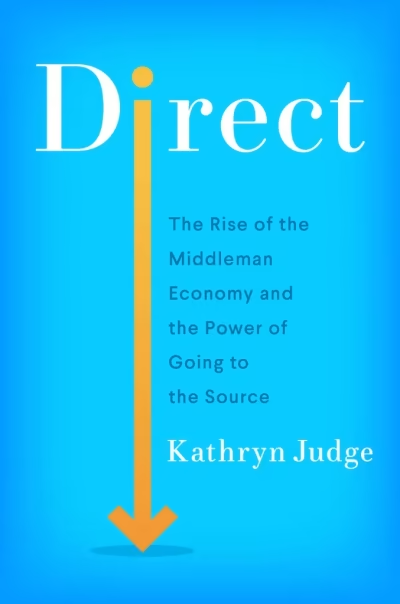
To assist me in writing this article, I wound up reading Direct by Kathryn Judge which discusses the impact of middlemen in our economy and how we can find creative ways to defeat the information asymmetries that exist in our society today. Apparently in the US, real estate agents are likely to be more deplorable than FAs - whoever sells real estate actually pays 5-6% when they sell their property which incentivises wasteful activities like mass mailing.

My real estate friends are actually quite nice to me given they get front-row seats to see what I enjoy saying about financial advisors. But when I am not around, I get wind of very amusing attempts to get some business done. I think in this climate of rising interest rates, real estate agents are seeing a potential drop in sales and they have been trying to talk the markets up. I think it's fine to promote transactions when interest rates are going up, but when you do this to an old friend, you must be seriously trying to insult his intelligence or selfish as hell. 

But who am I to judge? No one has ever actually tried to do this to me.

One important point raised by someone else is useful when comparing real estate agents to FAs. Real estate markets are inefficient as every home is unique and idiosyncratic. This means that if you can find a real estate agent that really understands your needs and financial situation, and you act on their recommendations, you are more likely to profit immensely from your decision if the recommendation was made in good faith. This is opposed to financial advisors who can take a big cut of commissions when they sell a product to you, and there's very little leeway for the product to earn decent risk-adjusted returns net of fees. The best an FA can do for you is to minimise fees, but it takes a true friend to recommend you a "buy term and invest the rest" plan when other products promise much higher commissions. 

You don't have to take my word for it, just observe the folks around you :

  • I have only engaged one real estate agent in my whole life when I bought an EC and I'm sitting on $600,000 in gains today.
  • On the other hand, I see so many folks now in a state of panic when their over-confident FAs placed their funds in China and Technology stocks without any consideration for the underlying volatility. A professional FA is supposed to manage your risk for you, not take bold momentum or trend-following bets with your hard-earned money.  
On local markets, I really cannot imagine the carnage that will occur tomorrow after the unveiling of new leadership in China. Hong Kong stocks tumbled because this does not look like a team that will promote capitalism and business. As Singapore is highly correlated with Hong Kong, I think we should expect more capital losses but I'm hopeful that healthy bargains will be everywhere in mid-November, when I may make my first move after retreating from all leveraged accounts. 

I do hope that I will turn out to be wrong.

Tuesday, October 18, 2022

Market Assessment #2 : Three Singapore Hypocrisies


In my last article, I railed about how academics who have nice sinecures funded by tax-payers can label landlords parasites when, to me, collecting rental payouts can be seen as one attempt to replicate the same kind of financial security academics have. 

Apparently, I'm not done because there are a class of hypocrisies we see in a society where sanctimonious assholes praise or celebrate some acts and condemn other very similar manoeuvres. 

I suspect some acts are condoned because some perpetrators have more social or cultural capital. 

It's like if a poor man likes eating, he's labelled a glutton, but when a rich guy does it, he's a gourmet. 

Here are other hypocrisies I discovered :

a) You can receive advantages from early academic success, but living on investments made earlier in life makes you a rent-seeker

There's always a lot of angst over landlords who bought the property ago and now enjoying positive cash flow after paying off mortgages. If coming from academic scholars, this is highly hypocritical because many of these academics are flying high because of the stellar A-level results they had in the past. While it can be argued that scholars may have gotten high ratings in the public sector, they had a sexier project portfolio mix and a steeper CEP, but landlords also needed to maintain and hold onto their property and resist past the temptation to sell to enjoy the rents they have today. 

We pay property taxes above and beyond income tax, but we don't tax scholars for their sinecures.

b) Enrichment from buying Executive Condos is unjust, but assortative mating, which creates more inequality, is even encouraged.

There have been reports from salty people that folks like me who own executive condominiums are unjustly enriched because we see about $500,000 of capital gains since they bought their units five years ago. I'm happy to say that in this market bear, looking at the value of my EC is one of the few things that gives me joy beyond my CPF-SA account. So some policy adjustments will be made to nerf EC purchases and sales because it exacerbates inequality.

But no one has publicly admitted one of the primary causes of inequality is assortative mating, where people marry spouses who have the same educational qualifications. This gives a ridiculous advantage to their kids, who inherit higher IQs and greater social and economic status than their parents. I think there is a special hell for folks who tolerate assortative mating where doctors marry doctors and summa cum laude marry summa cum laude; some even go as far as to organise matchmaking events for folks with similar qualifications. 

I've publicly challenged policymakers to create situations where folks from Raffles marry someone from ITE. Why can't top software engineers marry ah lians? Why? 

You can code in LISP, but cannot communicate with an Ah Lian?

Next time someone ask me how much my training business contributes to income inequality, I ask them why their spouse is so educated? Why ITE cannot?

c) Inheriting wealth is bad, but inheriting a high IQ and conscientiousness is fine

Society is very upset at folks from the lucky sperm club. 

In many countries, inheritance taxes are quite large, and Singapore has done very well as a wealth hub because we don't have inheritance taxes, but there seems to be increasing rancour from leftist bastards who want to see inheritance taxes come back in Singapore.

This is unfair because we're missing out on the other half of folks from the lucky sperm club, folks who did not necessarily inherit wealth but the high IQs and conscientiousness from their assortatively mated parents. 

You can perform a thought experiment at the street level. 

It's actually accepted practice to pay thousands of dollars to tuition teachers to ramp up kid's grades, but if I save the thousands of dollars and invest it in a lump sum and transfer it to him on graduation, if he fails to enter university, the dividends would give a nice boost to his diploma starting salary in Singapore that may even be superior to graduate starting salaries. I've made public presentations on this matter, and parents always object to my alternative approach. 

At the end of the day, how do we interpret the root cause of these hypocrisies?

I think one useful approach understands that human beings form hierarchies and confer status to each other. Hierarchies themselves can be isolated from each other and are arranged in a hierarchy of their own. If the RI-High-IQ hierarchy is ascendant, they might mess with the ACS-High-Wealth hierarchy and maybe find ways to tax wealth but create privileges for the professional caste. If the opposing faction wins, taxes will be lowered, and more questions on paper generals will arise, and entrepreneurs will be celebrated. 

I don't come from an elite secondary school, I think that at the extremes, Singapore society is a compromise between the powerful RI and ACS factions embedded in elite society. 

Everybody else will have to accept being crushed for being forced into compromises. 

This is why Lawrence Wong is the Prince that was Promised. He comes from a non-elite school. 

Fortunately for us retail investors, the markets crash, affecting elites and peons alike. Had I not fled, portfolios built by my students would be seeing negative returns today.  It's clear from the data that inflation has not come under control in the US, so we should expect raises in early November. China's stubborn adherence to the zero covid policy is also bad news. 

Next month's inflation numbers will hint as to whether we will see s 50bps or 75bps rise in December. 

In the meantime, my war chest remains untouched.


Wednesday, October 12, 2022

Market Assessment #1 : Why Elites hate Landlords


These few days have been interesting, I'm seeing a lot of hate for landlords, with some academics calling landlord parasites etc. Some points may be well argued, so I don't really see a need to rebutt these arguments. Instead I just want to try to understand why elites hate landlords and maybe highlight the hypocrisy of these folks while we're at it.

Not everyone will agree with my worldview about living in Singapore. 

Imagine a wheel with elite schools like RI, ACS and Chinese High. 

As this wheel spins, it crushes the non-elite and neighbourhood schools beneath it as these schools go on to put alumni into positions of power. Some of these powerful folk end up in jobs that are almost sinecures in Singapore, cushy professorships, or senior civil servants on the correct side of the "scholar-farmer" divide. Some even then go on to establish powerful gangs, not unlike the Paypal mafia, to entrench their power in some professional fields. On reddit, I even read about students complaining that their job offers were rescinded because of this "mafia" action although I was not able to verify this. 

If you are nobility ensconced comfortably on the wheel, you have unparalleled access to wealth and power.

Faced with this arrangement in society, what is there left for us farmers to do? 

We desire to break the wheel, but we know this is hard. I hope PM Lawrence Wong will be the Prince that was Promised. He's someone from a neighborhood secondary school who can break this wheel forever, but I am entitled to dream and hope.

So I know a revolution will not make any sense, so I take a different route. I discover that if you buy REITs, the dividends you receive are blind to position on the wheel. 

Dividends do not check your gender, sexual orientation, university grades, the schools you attend or your current estimate potential. 

Dividends pay an equal amount to all shareholders.

Elites hate this.

Over the years, I farmed my meagre farmer paycheck to buy industrial property, land, and when I was in a really bad place in my career after leaving the private sector, I lowered my pay so much, I was able to buy one executive condominium. The capital gains from my home, now has equity nine times my annual salary when I was working for the shithole.

What is there not to love about rising home prices?

After years of studying the financial markets, getting financial certifications, I built a system to invest for dividends, it's not rocket science, but it favors folks who really know how to save money. 

If it is any injustice, I have to admit that I also did inherit money. 

My father started what is today the most successful pet shop franchise in Singapore if not South East Asia, I deployed my father's capital to give my parents comfortable twilight years using rental payouts. While I've yet to directly enjoy the money from my forefathers, I do have a measure of control over it, preferring an ascetic lifestyle so as not to corrupt my kids.

1) The question is this : Am I a parasite ?

If the answer is yes, then elites have a lot to answer for. I never had a sinecure, much less one powered by tax payer's money. I built my own sinecure with dividends payouts, and when it is time to face off a scholar centric work culture, my financial freedom allowed me to say no and enter law school for four years without pay. 

So the Elite can have there sinecure, but landlords can't synthetically build their own ?

2) Does inheriting wealth and land make me a parasite? 

If the answer is this yes, then I suggest as a society we account for items you can inherit beyond what written in your will. Intelligent people inherit a high IQ and possibly high conscientiousness. In law school, I might be able to read 8-12 cases a day, I have classmates that can do 20-30. I cannot accept that this has nothing to do with inherited genes. We are products of both nature and nurture.  

As the Strategic Retreat phase is over, we will now hunker down to observe the markets to find a good timing to get our war-chest back into the markets.
  • On 13th October, US will be releasing inflation figures, I suspect while inflation is down, it would not be enough for the Fed to stop raising rates.
  • On 14th October, MAS will release their actions on the $NEER. AS inflation will not be tamed sufficiently, it's not unreasonable to bet that MAS will steepen and recenter the $NEER
  • This should lead to 75 bps increase in interest on 2nd November.
  • Markets will see a bottom yet.
The economist has some really bad news for policy wonks. To push inflation down to close to 2%, unemployment in the US may need to reach 7%+. 

The US is still creating new jobs today.

Maybe this is the time to think about Communist revolutions and what will happen if there is peasant uprising in Singapore.

For sure, if an uprising occurs, capitalists, landlord and rent-seekers will be murdered or have their wealth confiscated. 

But history says that intellectuals will not have easy time as well. 

Can ask Xi Jinping's dad if you want the details. 

Sunday, October 09, 2022

Strategic Retreat #3 : How I assess your man bun


The week has become more relaxed as I attempt to “study” for my next blood test by eating more strictly and going for more hikes. A pal wanted to do some networking with folks who understand a little bit more about Malaysian property, so I called in a few favours to get some Malaysians to show up to explain how to pick up cheap properties in JB and KL. I don’t think any opportunity can beat Singapore property, but Malaysian property can be a good lifestyle decision post-FIRE. 

The my pal asked me a question the next day.

He asked me what I think of his man bun.

I didn’t even know he has a man bun, much less act as an authority on it. For the past 30 years, I gave only one instruction to the barber which is “medium slope”, and even right up today, I have no idea what other kinds of slope instructions there are that can be given to barbers. I did try other styles like Armani, but like ILPs, Armanis are just a shit excuse for the barber to charge more and even I do look like Jacky Cheung, I can’t sing as well and it’s even rumoured that I might actually be better with money management.

I have no comment on man buns, I can only suggest that he ask the ladies what they think about it. ( Update : The aunties are not a huge fan, but lions do not care about the opinion of sheep. )

I think what’s more important is the passive income that comes with man bun. There was Chinese poem that says that as high as a mountain can be, you need the presence of an angel to bring it great esteem. Deep oceans are mediocre unless it’s graced by the presence of a Dragon. 

I think that this idea can be reapplied to man buns. My pal has a decent stream of passive income since the last time we met, which explains why the sudden desire for Malaysian women and landed property, I think that’s the clincher. 

Of course, he can’t sell his man buns for money more than I can shave my pubes to get more dividends every month.

I’ve concluded my strategic retreat. 

My objective is to secure enough cash for 2023 and maximise my tax deductibles. I have completed the following actions :

  • Set aside enough family expenses inclusive of mortgage payments until December 2023 in a separate bucket.
  • Place $15,300 into my SRS account, to reduce my assessable income
  • Set aside enough CPF voluntary contributions to ensure that I pay zero income taxes in 2023. 

The CPF move is particularly important as a contribution for a 48 year old will yield about 3.22% as it is spread between three accounts, tax benefits will bring it up further. More importantly, it should be noted that the CPF-SA is very much superior to a SSB purchase, as you get some creditor protection and interest rates can even be increased in the future as it is tied to yields of 10-year government bonds.

Finally, none of the proceeds are invested yet. I’m adopting a wait and see stance as I expect things to still get worse with better US jobs numbers. If on 13 Oct, we still don’t see a significant drop in inflation, we’ll likely see more money flee the equity markets. 

Be careful when read news on Yahoo Finance, a lot of fund management types are harbouring fantasies of the Fed easing their monetary tightening when the Fed is just getting started. In similar vein, you need to shut off your Real Estate agent pals who still think that this is a great time to buy more property.


Thursday, October 06, 2022

Strategic Retreat #2 : Details on deleveraging from margin brokers


I was meaning to update this blog a while ago, but I think I better wait for all my funds to arrive in my bank account before I piss off my margin brokers any further. 

But before I do this, an update on my health. I saw a specialist and it is likely that my situation is not deadly or urgent, so I tried to get blood test in two weeks just to see whether my numbers improve, if they do, I may skip the scans and go back to the public medical system. The downside is that I need to test whether lifestyle changes can actually improve my numbers. I've been hiking quite aggressively for the past few days and refrained from eating dairy products and red meat. 

Ok, deleveraging totally from my margin accounts and moving them into my bank account took a while and is not as orderly as I expected. I'm sharing my notes here in case some readers employ the same platforms as I do.

I will begin with my more pleasant experience with Interactive Brokers :
  • Selling from Interactive brokers is easy, but it's safer to use the Close button rather than the Sell button because it's harder to make a mistake on selling quantity. I'm dealing with over 30+ counters per broker.
  • Note that you cannot use the "Sell Everything" feature in the platform for SG stocks. 
  • Transferring from platform to bank account was fast and I transferred on Monday and received my funds on Tuesday evening.
  • The system will say that sometimes a rep will call me up to confirm my fund's transfer if the amounts are large. This did not happen. 
  • After the transfer, I have about $1,000+ left worth of fractional lots so IB is prompting me with threats of margin calls and liquidation, which can be daunting if the money has yet to arrive in your bank account.  
My more unpleasant experience was with Maybank Kim Eng :
  • I sold my stocks on the mobile app and my sale was incomplete. The reason was that the mobile app did not display the number of stocks I own correctly. The rep told me that stocks gained from corporate actions in the past are not reflected in the mobile app at all.
  • This means that I need to go through two rounds of selling. My second round was sold via the mobile app and I referred to a screenshot of my desktop app that reflected all the stocks I actually owned. 
  • Why such a convoluted method of selling? Simple, the desktop app is extremely slow during market operating hours and sometimes may hang. The mobile app responds quickly.
  • This has the unpleasant effect of allowing my broker to earn more commissions even though it is already unhealthy compared to the alternative. 
  • The money came a day later than IB, I received it yesterday evening.
All things considered, I don't want to be too harsh to Maybank Kim Eng because at least they have a responsive team and were able to use human contact to soften the edges of their drastically inferior technology so they may be better for folks desiring a human touch. I used to have a margin account with DBS Vickers and no one was there to even answer my call during the March 2020 crash, and I closed the account after my retreat. 

Also, IB margin financing rates are now over 5% for SG stocks while MBKE is 3.8%. 

Finally, I've decided to maintain both my accounts and prepare for my releverage sometime in the future. 

But which system will I employ as my primary margin broker is anyone's guess at the moment. IB's rates are high, but I think it might be determined by an algorithm so it may come down faster in the future. 


Saturday, October 01, 2022

Strategic Retreat #1 : Personal Update


I've been receiving a lot of well-wishers over my health condition so I thought I'd share an update. My medical checkup yesterday ruled out the possibility of pancreatitis, which can be good news or bad news. Good news is that I'm less likely to be suddenly hospitalized over the next few days, the bad news is that we have no idea why my Lipase numbers shot up so much over such a short time. 

Googling my condition is a bad idea because it can be a gall bladder problem or even pancreatic cancer. 

At this stage, there's nothing much the system can do for me as even I tried my best, my next appointment is a month's time, so I pulled some strings to get a private gastroenterologist to look at me next Monday. I'm not impressed with public healthcare right now because the government hospitals just rolled out this white elephant called the Epic system and every consult now is basically waiting for the doctor to waste time with data entry. So as it stands, I need to use the private sector can help me rule out the more adverse root causes, but I'll be paying through my nose because of the bodily scans and I need to manage the conflict of interest with a private doctor. 

At this point of time, I can only say that I'm really grateful for dividend payouts over the years as I'm not on any insurance panel. 

Which brings me to the issue of our strategic retreat from the markets.

I really don't enjoy being right about deleveraging but markets have attempted several rallies unsuccessfully over the past few days and we're not even getting one solid rebound at the moment. 

Fortunately, I have the luxury of time and can carefully plan how to counter attack when the fear is at the highest peak. 

There are several ways to go about the attempt, one involves high yielding REITs which have been beaten senseless by retreating investors, another involves banks. 

A couple of strategies seem credible right now - using dollar cost averaging to go in over the next year. Another is gaming the CPF and SRS system to maximize tax deductibility. A general approach will probably be explained in a free video, but detailed steps will be incorporated into my training program in November.  

We'll see how things go next week.  


Wednesday, September 28, 2022

Time for a Strategic Retreat


I had a health scare this week. 

After a routine blood test, doctors found that my Lipase level was elevated at 200+. This can be signs of pancreatitis which can be quite painful and requires an IV drip and hospitalisation if symptoms crop up later. Naturally, I carried on googling the symptoms and worse scenarios can occur. I will be doing another blood test tomorrow and already have an appointment with a different specialist.

With medical problems, and an attempt to pivot to part-time legal practice, I have little cognitive bandwidth to entertain a margin call if it happens in the market, so when markets dipped by over 1% on Monday, I told the ERM Community that I'll be getting out of all leveraged positions built by my students, and then I ran a webinar last night to justify my decisions and answer questions in my community. 

The essence is that it's impossible to fight the Fed. 

Repeated 75bps increases to the interest rate will not be remedied even if landlords raise the rent so my fear is that REITs will behave practically like bonds over the short term. If my community were to remain leveraged until 13 October when the US publishes the inflation report, an adverse report will push Singapore stocks lower, even though we are quite insulated and riding on the COVID recovery. 

With yesterday's action, I'm happy to say that we're out with some diminished profits and it's not so much a panicked rout. This is contrasted with my actions on March 2020 where I stubbornly held on until we began suffering losses. It also puts us in a position to leverage again when markets face a recovery, which can be as late as Q3 2023.

In my case, I did not stop at just selling enough to deleverage my portfolio. I sold everything into cash and will be consolidating my holdings over the next few weeks. I will be just 10% cash, but will enjoy my immunity to margin calls. If my calculated gamble that markets will continue to drop, I should be able to do some bottom fishing into the year-end. 

While I do entertain the possibility that I might be wrong to run, this is a whole new era that is similar to the 1970s when Paul Volcker was Fed Chief. To battle inflation, the hawks pushed interest rates all the way to 17+% and triggered a recession in 1981. None of my quantitative models predicts what will happen even if we pick a conservative portfolio of banks, and high-yielding REITs. 

Suppose my factors models outperform the average by 3%, and markets dip by 30%, my community will still be hammered by 40%+ losses on their margin account. I can't have my student's blood on my hands, so my leverage is now about x0.9.

Now we are in a very strong position to watch what happens to the markets here.  

I would caution making any false move until mid-October to see whether inflation can really be tamed. 

Some experts even say that November will see another 75bp rise. 

At this point in time, I will continue to invest funds into student portfolios in my unleveraged CDP account. But this will look more like dollar cost averaging moving forward. 

This is not the time to play hero. 

I hope history will vindicate this move of mine.

[ I put an Advanced Squad Leader graphic because US squads actually have very low morale for a victorious Army. As it turns out they take cover very frequently, but they recover very quickly as well. German forces on the other hand are quite brave but once they rout, it's hard to recover. ]


Friday, September 23, 2022

ERM Community Event Q32022 - Running your own Robo-advisor


Pretty sure by now, folks who regularly attend evening investment webinars are sick and tired of discussions on inflation and the latest series of interest rate increases by the Fed. So when I was thinking about the next Early Retirement Masterclass community event, I wanted a seminar that has some link to the current macroeconomic situation, but it's really about something else. 

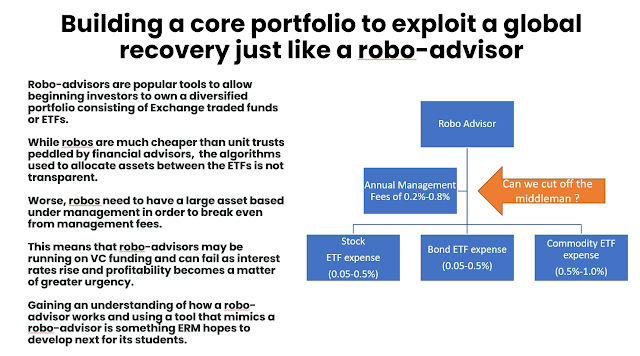
For quite a while, I did not comment on robo-advisors because I see them as a "lesser evil" compared to getting a commissioned-based financial advisor, but over time, the lack of transparency over how these algorithms work on the back-end eventually began to grate on me. Worst, there are robos that just could not beat a naive strategy of buying, for example, every REITs in equal shares. 

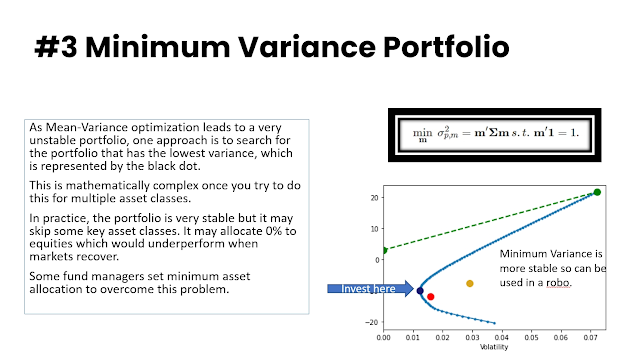
So I thought I would discuss robo-advisors with my community. We will not discuss specific product offerings in the market, but we will look into various approaches to allocating assets among different ETFs. I will round up a discussion with three theoretical frameworks for algorithmic asset allocation, and I will round up with a software demo of a Jupyter Notebook I wrote combining code snippets from different authors around the world that, when combined together, can be used as robo-advisor for ERM alumni and students. 


We will be looking at numbers for traditional asset classes and crypto. 

Date: 27 September 2022 7.30pm

Format: Webinar 

Programme :

·        ERM – Running your own Robo-advisor – 30 min

  • Core portfolios with ETFs.
  • Different algorithmic approaches to asset allocation.

·        ERM/CCI – Demo a Robo-advisor in Python Jupyter – 15 min

  • Demo on a beta tool that will be deployed to all ERM students in the future.
  • Demo will cover main asset classes ETFs and major cryptocurrencies.

·        ERM Portfolio Update

Registration link : 

https://us02web.zoom.us/webinar/register/3816560529405/WN_HlQhcGioQk24E9lDmImPaw

This seminar is open to everyone but is pegged at the standard of someone who has already attended my programme. There will be no recording for the session but a video will be shared on my Youtube channel soon after the event. 

Beta Jupyter notebooks will only be made available within the ERM Community.

Tuesday, September 20, 2022

The Three House Investment Plan


There are some investment ideas that really enable some really out-of-the-box thinking in this book. My favourite idea is the Three-House Investment Plan.

When a geo-arbitrager settles in a foreign land, one useful rule of thumb is to ensure that rental payments are about a third of total expenses. So logically, after living in a new country for a while, you may wish to make a rent or buy decision in your adopted country. 

If you actually like your new country and have made a decision to buy one home, why not buy three houses instead? 

You live in your first home, so that takes care of the rent. Your two other homes can be rented to others at one-third of their expenses, so if you charge a fair rent, your own personal expenses can be met by rental payments from two houses. 

Of course, the author does not take the pain of coming up with one actual example of employing this in a real country. There are tax laws to contend with and a subsequent home beyond the first may require a different set of calculations. This clearly rules out doing this stunt in Singapore thanks to low yields and ABSD.

But the author sets useful boundary conditions - where rental yields are 2% or below, just stick to renting, as houses will be too costly. This option should only be seriously considered where rental yields exceed 4%. 

In my classes, my students can easily build tax-free portfolios that yield 5%, so Singaporeans can opt to keep their assets at home while renting in a foreign land. There is no pressure to actually buy three homes, but home ownership in a fast-growing economy can reap high capital gains in the right jurisdiction. You also have an advantage as real estate markets are highly inefficient and your area may be popular with other ex-pats. 

Readers who managed to pull this stunt in Vietnam, Bali or Malaysia can share their personal experiences in the comments section below. 


Saturday, September 17, 2022

Letter to Batch 27 of the Early Retirement Masterclass


Dear Students of Batch 27,

It’s been a great honour and privilege to conduct a 5-Day Early Retirement Workshop for you.

We’re getting into deeper bearish territory as the Fed is about to raise rates by another 75 basis points. This will dampen demand and make it harder for growth strategies to flourish. Correspondingly, every factor model built by this class has shifted to favour a value-based strategy. We are slowly changing from a course that invests in high dividend and low beta stocks. Now we buy cheap stocks with decent momentum.

One consequence of a shift to value is that the factor models will start to highlight stocks that are unpopular with investors, so the rejection rate this round was much higher. Another anomaly is that, for the first time, the factor models did not flag a single bank or REIT in the final STI portfolio which may need getting used to. DBS was added as a bonus stock since banks do benefit from higher Net Interest Margins as interest rates go north.

The second consequence is that for the REITs segment, I’ve added the large STI REITs into to REITs universe for backtesting and this ended up favouring the very same 7 REITs in the STI. Choosing REITs with strong sponsors, while reducing volatility has resulted in lower yields for the final portfolio.

Students have commented that the dividend yield of this batch is on the low end at about 5.4%. For students who wish to have higher yields, they are welcome to research US Office REITs like Keppel Pacific Oak REIT, Prime REIT or United Hampshire REIT and make a discretionary investment on their own. I‘m not adding them into the batch 27 portfolio as I have a large allotment in my family fund.

The important takeaway is that the model portfolios built by ERM do not bind student decisions in any way and they are free to invest as they wish. The model portfolio exists as a tool to track the investment performance of all ERM students and bind the instructor into investing his training fees into choices made by the students. Poor investment decisions on the student's part are meant to affect the instructor first. This is the unique selling proposition of the course - I have skin in the game.

Lastly, I hope that Batch 27 will participate actively in the FB group. Sometime in Q3 2022, we should be meeting up for an online community webinar.

Hope to see you then!


Christopher Ng Wai Chung

Wednesday, September 14, 2022

Who is the Seven Dollar Millionaire ?


To maintain thought leadership, I can't stick to just the advanced finance books, I have to read the basic guides as well, and often I get some enlightening reads that change the way I look at my own personal finances. 

Happy Ever After is the brainchild of Michael Gilmore who goes by the moniker Seven Dollar Millionaire. Every local finance influencer who has not heard of him should be ashamed of themselves as I was when I discovered that this foreigner came all the way over to Singapore to teach personal finance to migrant workers here! It's a brilliant rationale, the migrant workers are the lowliest paid workers in a nation that probably have one of the highest standards of living in the world. This alone should make a trainer like myself feel a little inadequate and uneasy.    

I'm going to do a review in two parts, for now, I'm going to just explain two simple ideas from the book. If you want more, I suggest you buy the book from Amazon Kindle. If you have influence over Kino, I think this book should be on every shelf in a local bookstore. If anything, more volunteers to teach migrant workers is not a bad idea. 

a) Your target portfolio size is 25 x Annual Expenses

The first idea is probably quite familiar to most readers and it is to imply use (25 x Annual Expenses) to determine the size of a portfolio to gain financial independence. It's simple and elegant. If you want to reach your target faster either save more or spend much less.  

b) How investing $7 at 7% makes you a millionaire in 50 years 

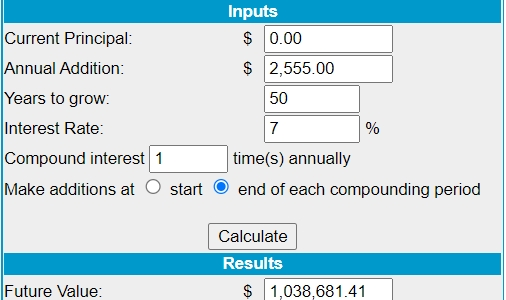
The second idea, while less practical, has great elegance. If you can save just $7 a day, compounded at 7%, easily achievable with a 50:50 Global Stock: Global Bond ETF, you will have a million dollars in 50 years. 

I've attached the evidence here:


The main point of the idea is that becoming a millionaire is not hard if you compound your investments over time, the question is perhaps how much is $1M worth in 50 years' time, and whether you can retain your good health when you finally get it. For a guy who starts work at age 25, he would have to funnel his CPF Life into his portfolio from age 65 to 75 to get this right.

I'm in the middle of conducting a class. I hope on Friday I can talk about the more counter-intuitive ideas from this book. 

If you can, try to support the author and the book, he's already done a lot for migrant workers here while most of us hadn't.


Sunday, September 11, 2022

On developing new personal hobbies


I'm not posting something too hardcore this weekend as I've just returned from Kulai JB where I spent a fun weekend with my in-laws for Mooncake Festival. 

Instead, I want to just share with readers what's been happening on the personal front. Mirroring some of the changes in my career, I'm also making some drastic changes to my personal hobbies.

I've been playing Dungeons and Dragons for about 38 years, the game has its ups and downs. With the 5th Edition rules, the game has peaked in terms of elegance and playability, but of late, with more adoption by mainstream players, the game has also become more political. Extremely woke elements have entrenched themselves in D&D culture and it has become a lot more intolerant to campaign elements which were welcomed in the past by my generation of gamers. Recently, the game designers created a new race of monkey men that were supposed to be a slave race to an evil wizard. The player base decided to become offended because it reminded them of real-world slavery and game designers had to retcon the origins of the race. 

I don't think game designers can do a good job and tiptoe around fragile players at the same time. The whole point of fantasy is that there is some kind of evil to defeat. I suspect if we push this to the logical conclusion, we will end up with mediocre campaign settings that will be politically correct but bland. I don't Game of Thrones would be so popular if every scene was censored by a woke fanbase.

So I continue to just buy D&D books online but I've almost given up on actual gameplay. My job as a parent is to get my kids involved in RPGs because it's still a healthy and educational hobby, but I think it's time to move on.

But as one door closes and another opens. By some stroke of luck, I bought some old-school hex and counter wargames and got in touch with the guy who actually taught me D&D 30 years ago, and he's looking for folks to play this seriously arcane wargame called Advanced Squad Leader (ASL).


ASL cannot be considered a game. It is a ridiculously complicated simulation of squad-to-squad warfare in WWII.  

You control a few sections of men and have missions to take a few building objectives. Everything is resolved by a pair of dice and it takes maybe an hour of real-time gameplay to simulate a few seconds of WWII combat. 

Like in real life, moving in open space to enemy fire is lethal. Not throwing smoke before advancing is lethal. Not trying to take a stone building with at least 3x the headcount of the defender will see you routed. There are tables for different types of ordnance and armour. The psychological makeup of US and German forces are totally different and matter in the game. The tutorial for the game is 133 pages long and recommends actual study like a university module. Rules are more complicated than our Penal Code. Worse, understanding the rules mean nothing as figuring out how to tie your strategic intent into successful mission objectives. 

ASL also cannot be politically correct. Sometimes, one of the players actually controls the Nazis. The other player often controls the Rusian Communists. I hope this keeps the woke snowflakes from even trying. 

Even right now, I don't understand why anyone would play a game that is more painful than building a diversified portfolio in real life, but I'm happy to meet a few like-minded souls, all guys in their 30s-50s who have the game at home, and did not have a gaming buddy for decades. So all of us are learning the game for the first time in our lives. 

After two sessions, I can finally appreciate ASL as a metaphor for life.

We don't have an operating manual for real life or finance, and we can learn the fundamentals for decades before someone comes along and explain FIRE to you which provides the over-arching strategic intent of investing. And many folks who understand FIRE may not know how to invest to make FI a reality. It takes decades to get your finances to work and have it provide a positive impact on your life. Like ASL, finance also requires a knowledge of odds and statistics, but things often go wrong in practice. 

With my increasingly heavy involvement in ASL, I'm also changing the way I look at the games I play. 

For me, games should be hard. Hard games sharpen the mind. It also attracts a bunch of hardcore geeks and weirdos that I really missed in my RPG sessions in the 1980s. In the 1980s, AD&D players were almost hunted by the local churches. I kinda miss being persecuted actually, it shaped my life as a troll.  

If you spend more time thinking deeply about tactics, you will adopt the same habit with your life and your investments.

I'm not sure how many readers will appreciate this post, but I think I'm going to dedicate my hobbies to the Big 3 hardest games with a fanatical fanbase around the world.

  • Advanced Dungeons and Dragons ( 1st Ed ) - Just declare a grapple and see your DM's face
  • Advanced Squad Leader
  • Star Fleet Battles

I've not started Star Fleet Battles yet but my gang will join me after we master the use of Armour in ASL. They've already started sending me the game tutorials. 


Wednesday, September 07, 2022

BaliFIRE and Geo-arbitrage - The case of Jean Voronkova


RGS girls see themselves as "daughters of a better age". 

Sadly, we live in the Age of Incels, where anonymous trolls seem to be extremely salty of her in various chat rooms. Jean has now joined the ranks of Female financial influencers who somehow, rubbed many single men the wrong way. You can read about her here (link).

Criticisms of her are largely unjustified. I find it quite unfair the incels picked on elite school status and concluded that she had a lot of privilege. Others were fixated on her childless status, only to admit that their own male FIRE role models are also single and childless. 

I don't think  Jean Voronkova is privileged personally, wealthy families will not be so fixated on their daughter's professional status. My bet is that she's firmly middle class.

With so much hypocrisy around this case, I think Jean deserves a more balanced analysis of her approach to FIRE, so this is what I intend to do with this article. 

a) How Jean earned her money

The first point of analysis will always be the way someone who succeeded was to earn her money. There seems to be some jealousy of the fact that she's a lawyer. Her salary was $120,000 after six years so my guess is that she's some kind of senior associate-level lawyer. While the pay is high, the hours are brutally long, and most importantly, we have to accept that logically Jean would not have saved that much given only 6 years of work. Folks who worked longer with lower pay may have more due to the effects of compounding. 

The second phase of her life is not bereft of income, Jean started multiple businesses which I doubt were roaring successes because, in the end, her passive income was around $2,000 USD from various properties she has. 

If we look at the complete picture, FIREing in Singapore would be hard for the Voronkova couple even at this point in time, which leads us to the second point of the analysis, which is about saving money.

While I am not Jean, I thought exhausted senior associates should try in-house legal counsel work first for more pay and less work before jumping to any conclusions about the profession. But that's just me.

b) How Jean saved her money

It is this second point that is the most instructive for readers. Too little credit was given to Jean for the fact that she is GEP by the incels from social media. It takes a high intelligence to understand that a situation is unsustainable and an even higher one to adapt to a new country to solve a problem. 

Jean is outstanding she shopped in multiple jurisdictions like a good lawyer should. 

Getting out of SG is smart because you leave that toxic workplace where divorce lady lawyers battle with Chanel bags. In class reunions, you also would have to put yourself in groups where other lady lawyers start to talk, and compare lives and spouses.  If she is a classic INTJ FIRE seeker, she would actually really hate doing this. ( NB: We cannot conclude her MBTI with such scant data )

Geo-arbitrage in Bali is smart, but ERM students know Kuala Lumpur is even smarter these days as digital nomads have started to really ramp up the prices in Bali, but Jean obviously puts a lot of emphasis on lifestyle and Bali really looks good. According to research from my students which I do every course, you need about $1,500 SGD per month to lead an ex-pat lifestyle in Bali. 

But Jean is smart, she shopped for a future home and has spent time in Vietnam and Bali, so this is something we can all learn from. 

c) How Jean Invests

This section is one that had me the most stumped. We have very little data on how Jean derives her passive income. 

Overseas property generating $2,600 SGD would barely support the couple as a family unit even without kids, so I suspect they are running thin. Bali is also a favourite place for digital nomads so I expect inflation to be increasingly an issue. With this amount of information, it seems that Jean's version of FIRE is threadbare, so the content creation on Youtube may be the start of a new business initiative. 

Personally, I think the forex risk and inflation should justify maybe adding a home into the rental mix but I admit that rents can increase in tandem with inflation. This is an area of risk I would not like to get myself into.   

Is there a way for the couple to load up some REITs in SG and wire dividends to their expenses account? I think it's worth exploring that move. 

All in all, I'm glad young folks are coming out of the woodwork with their version of FIRE. Hopefully, the older folks will have their back when they come under FIRE from Incels. 

I'm definitely biased towards Jean as she is almost an inverted version of myself.

She pursued Law to become Financially Independent.
I pursued Financial Independence to do Law. 


Sunday, September 04, 2022

Overemployment as a method to achieve your FIRE ambitions


I lost an interesting bet lately. 

The structure of the bet I made was this : 

Which will be gone first, s377a of the Penal Code or SAP education? 

I offered the bet to some regulars in finance forums and one guy decided to bet on s377a being gone first, so I naturally took the other side of the bet. The forfeit was a meal. 

I was not anticipating the bet going to be resolved within a decade so when s377a was repealed, I made good for my loss and since "losing with grace" is an important value to me, to make it more fun, I decided to give a meal to everybody who witnessed the bet taking place. 

It's always nice to occasionally give a meal to young people because they are often well-informed on things that we might not noticed and one of the major things I learned from the event is the concept of overemployment. 

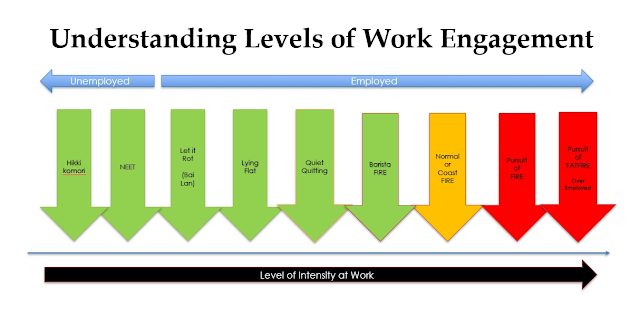
Overemployment is an important concept because it is the opposite of lying flat, quiet quitting, letting things rot, and all the reactionary movements to the toxic workplaces in the world. 

The concept is simple, for folks who work from home, it is possible to sign up for two jobs at the same time and do both competently. This works better if the work consists of processing IT tickets and choosing a different time-zone. From an employment contract perspective, it's possible contract breach but some folks tell me that the secret is not to get caught doing it. 

As an ENTJ, I'm very attracted to the idea of overemployment because it would allow a smart, young IT professional to rapidly reach FIRE and possibly FATFIRE within a decade because not only are you earning more, you have less time to spend away your money. By the time you FIRE, you would be so young, downgrading to work on one job would already seem like a holiday. 

This allows some folks to get into a situation where they can have money-time-energy all at once at a fairly young age. 

With overemployment, I have managed to arrange all the reactionary movements, the pursuit of FIRE and overemployment into a single framework where you can pick and choose which part of the continuum you wish to park yourself at. 

At a personal level, I want to implement some form of ethical overemployment into my life, I will be seeing whether I can sell my time to a law-firm during normal working hours and still run my training business with my current hours. My variant does not provide me with a base salary though, I prefer a larger share of hourly billings so that I can control my exposure to work to do justice for future students.

I think what is interesting is how folks with more than one formal job can contribute to CPF. I want to know once and for all whether the $37,740 limit can be busted by taking on more jobs. There are folks claiming it can and some saying that it can't. And whether tax deductibility applies if it does bust the limits.    

Overemployment cannot become too common in Singapore. If this happens, employers will force workers to return to the office and returning just 2 days out of a week can make balancing two jobs a much bigger hassle. But in the case of some folks in software, getting 50% of an ace is often better than team of goons.