Saturday, August 27, 2022

On Wild Problems


As I run a programme that is highly dependent on number crunching by computers, I'm fully aware that there are a class of problems that simply cannot be analysed by data and statistical models. 

In Russ Robert's Wild Problems the vivid example is the question of whether we should get married or have children. Especially when it comes to having children, if everyone were to boil the decision-making down to cost-benefit analysis, no one will have kids in Singapore. And yet, even a child-hating misanthrope like me would love my kids so much, that I'd gladly disadvantage myself financially so that they can have a good life. 

This means that there are definitely mental models beyond quantitive ones that are required to resolve that class of hard problems that lives throw at you.

One solution to the children's problem is to understand that looking at the kind of cost-benefit analysis is based on the fallacy of narrow utilitarianism. If you find some money in a wallet and there was no one there to witness you finding the wallet, you may really hate to surrender the wallet to the police because it's full of cash that can be used to pay for your children's expenses. But you return it anyway because keeping the money changes the notion of your identity. You can't live with yourself if you keep the money. Folks who return the wallet ultimately prefer to make decisions on personal principles and not that of narrow utilitarianism. 

I think something has to be said about choosing to remain single. There are almost zero disadvantages to not having children, you will end up having more money and time. If you feel bad, you can even volunteer your time to charity. But to remain childless is essentially not propagating your genes, and you won't be able to find out what your kids will ever be like while growing up. I don't think this ultimately bothers some of my single friends, but I think it does bother me a little. 

For me, I'm dealing with a tough question in my own life.

As my training business is struggling with sales and I've just obtained my CFA charter, I've started talking with pals in law firms to see whether I can get part-time hourly paid consultant gigs with them since an entry-level lawyer is kinda expensive and I should really address the issue of going through law school without even trying out legal work beyond my training contract. 

So yesterday, I had the privilege to meet very possibly the richest and most successful customer I will ever get as a trainer, and he totally shot the idea down. He does not think that starting out as a rookie lawyer will do me any good as a middle-aged guy and there are better ways to scale a business. And he was very kind enough to suggest a few ideas which I liked a lot and may pursue with some folks.

As he's been around, I have to accept that this is valid feedback. Me going back to the law firm has always sounded ridiculous, but so was entering law school at age 39, and saving 100% of my take-home pay since I was 32 years old. 

But once again, this is a cost-benefit analysis. If we take it too far, as a financially independent guy with a five-digit dividend monthly income, nothing I do can compensate me for the time I waste on the job, so I cannot just apply one quantitative mental model to this problem of what I want to do with my life next. Also, I'm not quitting my job as a trainer, my condition is that the law firm needs to let me carry on teaching my Early Retirement Masterclass.

So what kind of personal principle can justify starting as a part-time associate in a law firm while balancing my time with a training business?

After a day of deep thinking, I think my central principle is "When you set out to do something, you must complete the task. "
  • My stint as a trainer finally got me my CFA - nineteen years after I passed the Level 3 exams. It required 3 years of full-time work as a training professional. 
  • In law school, I always found some of my classmates ridiculous, I had classmates who dropped out in the final year after paying all the school fees. 
  • I used to get exasperated at friends who can only talk about publishing a book but never complete a proper manuscript, it was the main reason why I set out to write three books on personal finance as an IT engineer. 
  • Even if the last 2 seasons of Game of Thrones sucked balls, I watched it anyway.
Now, I admit that I did not enjoy my practice training, I was mildly depressed when I asked Dr Wealth for help. Thanks to my partners, I created a business line called ERM that exceeded a million dollars in revenue. But this time, I get to choose my level of engagement in a firm and who my colleagues are going to be - I'm starting without a base income. If I fail, I have multiple fallback positions and no one in my family will starve as a consequence of my decisions. 

The fundamental principle is that I should try three years of actual legal practice because I am a completist and not doing would have serious consequences on my self-esteem.


Tuesday, August 23, 2022

FIRE is a good servant but bad master.

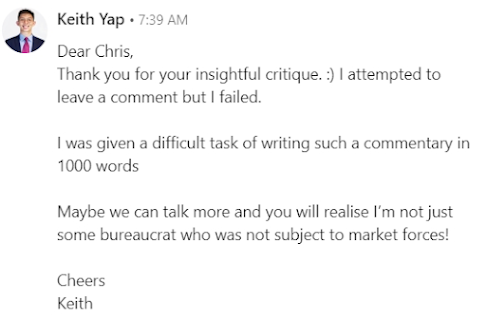
I had the good fortune to received a message on Linkedin from Keith Yap. 

He wrote this, and I'm posting it here because somehow he could not comment on my blog :


His comment was very intriguing, I initially thought that there was possibility that he was tasked to write about FIRE from his bosses based on this message, so I offered to defend FIRE publicly against his supervisor which seemed to be someone from Enterprise SG. Many FIRE aspirants are conservative PAP voters and continue to pay taxes post financial independence, so there is no need to fear that FIRE metastasize into some kind of Tang Ping movement.  

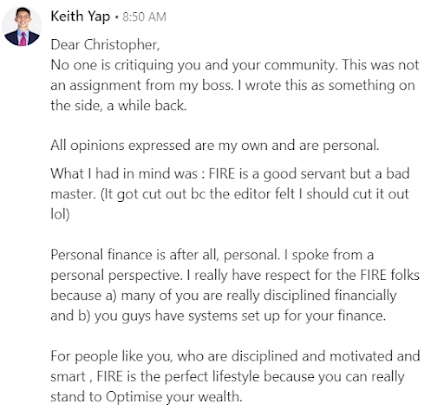
Thankfully, after a short exchange, Keith clarified that he wrote the article based on his own personal capacity.

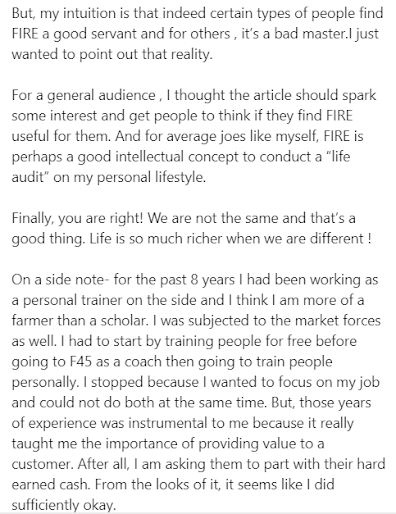
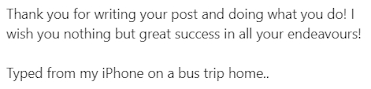
I think his reply was even-handed and fairly neutral so it's safe to be shared on this blog :


I really like the admission that "FIRE is a good servant but a bad master" was cut out during editing. I don't necessarily agree with this, but IMHO,  it would have been a better title for his article. 

Anyway if FIRE does become a bad master, then quit the FIRE movement and do something else with your life. 


Wednesday, August 17, 2022

Does FIRE subvert conventional ideas of work and finances ? WTF !


I don't know whether to laugh or to cry, his guy called Keith Yap, who seems to work in the Government, referenced my CNA article, and then proceeded to make some inaccurate statements about the FIRE movement and millennials ( and I'm not even a millennial ! ). 

You can read the article yourself by following this link

I'm generally quite sympathetic to folks who try to FIRE, because inevitably they will accumulate $100,000 before their 30s then get slammed in social media for sharing it. There is no evidence that Keith Yap is on the road to FIRE, but his main thesis is that FIRE will subvert conventional ideas of work and finances and I fail to see how its possible to agree with this. Furthermore, I think a much higher standard of proof is required to link millennial's dissatisfaction with the workplace status quo with the rise of FIRE.

My first point is that anyone who is attempting FIRE will know how much more engaged you will need to be at work to stand a chance of accumulating (25 x annual expenses) before age 40. This is generally not a game for the average millennial who hates his boss, but someone who enjoys his current work, figured out it may not be sustainable, so wants to volunteer for as much overtime as possible. 

My second point is Keith Yap seems a tad defensive when he finds some FIRE zealots seems to baulk when it comes to discretionary expenses, so he constructs these false dichotomies in his article. You either can save money on pumpkin spiced lattes, or catch up with old friends, Keith conveniently forgets that I can catch up with old friends over a cup of kopi-o kosong. Keith asserts that if you save and skip out on an extravagant wedding, you will lose a chance to gather everyone together, forgetting that I can get everyone together with a buffet instead of a banquet. 

Worse, after setting up a series of false dichotomies, Keith had the temerity to invoke Aristotle's golden mean - which leads me to question whether he is trolling the discerning reader ?

My third point is that folks with an affinity to FIRE are my INTJ pals who probably just belong to 1-3% of the human population but over-represented in FIRE forums and my ERM class. If you actually bother to have friends who are INTJ, you will find that their lives are actually quite interesting. INTJs have very diverse hobbies and often no relation to their jobs. INTJs do not really march to conventional lives and work, so cannot be actively trying to subvert work but to seek a wholly independent approach on lifestyle design. If anything I find INTJs quite fun and hedonistic - they don't eat expensive food, but they are really obsessed with the best hawker fare and can be counted on to find out the best eats. 

Finally, as it is pointed by a lot of successful entrepreneurs and CEO-types, mostly ENTJs who attain FATFire, the skills and talent which made FIRE possible often leads to financial independence but not early retirement or retreat from the workforce. Folks like me still want to find ways to contribute to society and will continue to seek employment, but on our own terms. This is why a paradox will occur if Early Retirement Masterclass is taught by a sometime who is fully retired.

Finally, I think Keith Yap really needs to look at himself and his biases before talking about FIRE folks. 

I visited his profile and find that his work may be government related, in some blog articles, he talks about his scholarship application process. I had a short, miserable stint in a statutory board and I know this - If your income has very bond-like characteristics like government work, and you're on the right side of the scholar-farmer divide, there will ultimately be a disconnect of your salary scale from actual market forces. This is the magic of high current estimated potential and having KPIs widely disconnected from commercial reality.

This inoculation from market forces accords you a more carefree expenses profile which most Singaporeans cannot afford. So maybe you can have that pumpkin spiced latte, that extravagant wedding, that monthly trip to backpack in Europe. You willingness to spend matches your ability to earn. Regardless of market cycles. 

Your equivalent in the private sector or private enterprise may not have that privilege even if he gets the same pay because he knows that in the business world - it's feast or famine. As such, my willingness to spend is only a fraction of my ability to earn. In such a case, having a high investment income is just a desire to have the same privileges of a government scholar.

So some commentators might be scholars and can get high falutin about FIRE. 

I am a statistic, even if I FIRE.

We are not the same.


Monday, August 15, 2022

On Singapore's elusive third gear lifestyle


Every National Day, I want to talk about emigration. But this year it seems that many influencers and bloggers have started to beat me to the punch. Kelvin Learns Investing probably made many Singaporeans proud when he talked about why he will not retire in Malaysia (link). A week ago, there was this wonderful article about a Singaporean who settled down in Chile (link).

I'm trying to put something together to talk about quitting until I saw this article about a Japanese restaurant called Tenya that has raised salaries by 10% and instituted a four day week to solve their manpower crunch. ( link )

I think Tenya is onto something.

I called this the Singapore "Third Gear" problem. For folks who remember cars with a manual transmission, drivers would start at 1st gear and, as the vehicle moved faster, gradually shifted until 5th gear, when the car is reaching its fastest speed. When I was very close to becoming Financially independent, I realized that there was a problem in Singapore - Singapore workers can only be unemployed (first gear) or work crazy hours (fifth gear). 

There is no middle-ground or third gear in Singapore. 

No lifestyle design where you can work a little and live a little pushing many Singaporeans to emigrate somewhere else. 

The first gear would be folks who do not have real jobs. These can be stay at home mums, folks living on government welfare by attending courses organized by the government during the pandemic, husbands who have successful wives calling themselves "business consultants", folks who inherit money, or anyone claiming to be a life-coach.   

Fifth gear would be a majority of Singapore workers. Folks who are committed 9-5 on weekdays on jobs which provide a career path, decent pay, but very little leeway for work-life balance. If you belong to the professional or executive path, bosses expect you to be available 24-7. To be fair fifth gear in Singapore is probably a decent place to be because of low taxes and you really get to keep what you kill, but it is soul draining and some countries like Dubai pay even better for fifth gear work.  

When I was teetering at the brink of financial independence, I was concerned about shifting down to first gear, this is even though I was not just financially independent on my own but I'm also a bit of an inheritor. 

First gear may be irreversible, after a while, no sane HR professional would want to have a look at your resume. Worse, I can't seem to take first-gear folks seriously, they seem so out of touch with reality. For an ENTJ, it's better to lose my financial independence than to stop mattering in society. 

And there's no respect. We're a nation of snobs.

So I stuck to fifth gear for 7 years after living on my investment income. But eventually you end up working for toxic environments as you rise through the ranks of management, where your skills matter less than your political maneuvering. Fortunately, I was able to let fifth gear go at age 39, long after investment payouts exceeded work take home pay.

But I can't find the third gear. 

I delayed for 4 years to go back to school to contemplate my life and maintain an air of respectability.

Eventually, I found some semblance to the third gear after rejecting the legal industry.

In this life, I can free most of the time unless I am conducting a class, then all the work and attendance is non-negotiable given how much preparation my colleagues need to get a class for me. This third gear is very volatile and my sales can be very unpredictable and only those with a fairly high investment cash flow can sustain it for this long. 

I suspect most third gear folks, if you can find them, are not conventionally employed in Singapore. Like me, they either report taxes as a sole proprietor or under the  LLP structure. 

( The guys who own a Pte Ltd actually work kinda hard and may even work on 6th gear until their business becomes profitable. ) 

The good news is that things are changing. 

I think with the pandemic and tighter curbs to foreign labor, SMEs may finally be pushed to really start thinking about what the modern Singapore worker wants. Building a fifth gear job with no chances of advancement would mean that very few locals would want to work for SMEs. But upping the pay a little and then downgrading to a 4-day workweek is a good start and these jobs may meet the aspiration of the Singapore worker. 

Not everyone is a an ENTJ. Many are INFPs who can't count, are lazy, and have an affinity for making bad life decisions..

At the very least, you can live the New Zealand and Aussie lifestyle in a low tax regime. Also you don't have to resort to career in sales to do this. How many balloons need to be forcibly taken away from children for angry parents to seek a statutory amendment to outlaw FAs here?

From a FIRE perspective, thanks to Tenya, Barista FIRE becomes a lot easier to attain in Singapore, where a fifth gear job can get you about $1,000 a month in investment income after 5-8 years, then you downshift to third gear lifestyle on a four day week in the F&B or retail industry.

At the end of the day, liberals like Tommy Koh can talk about Singaporeans being snobbish and the government can talk about a new social compact. 

Just pressure SMEs to unlock a four day work week and make a third-gear lifestyle achievable, fewer folks would emigrate to Australia and New Zealand design a lifestyle there. 


Friday, August 12, 2022

The best is yet to be - My adventures at ACS Independent


It is good that investment trainers to do some pro-bono by visiting secondary schools and presenting to students. If you're lucky, some students will get the message and you'll get to shape some lives, but it is also good for the trainer because you get practice to see whether you ideas can find traction in young minds. It is always challenging when the audience did not pay for your time or may not have the inclination to listen to lecture.

So I was delighted when the Entrepreneurship society of ACS Independent invite me to speak to their students for an hour and spent the afternoon in their campus premises. This is actually he first time I'm presenting in school premises as my slides have only been deployed in RI over Zoom for the past 3 years.

The talk was fine, but I felt that the material, honed over two years at RI, could not fully resonate with ACSI audience but I was mostly able to maintain the attention of these teenagers when I spoke of my personal story - about how outsourcing work can lead to suicides in the workplace and the scholar-farmer divide in the government sector is alienating to those labelled farmers. But I think I won the crowd eventually when I spoke about how the effects of compounding wealth over the years is literally the reason why "the best is yet to be". 

Why do I know it works? Because I love triggering RI students about how compounding of wealth is embedded in their rival's school motto, and relying just on brains and not capital is a loser's game. 

[ In such situations, I see myself as a cross between Magneto and Professor Snape. ]

Anyway, I was actually disappointed that kids have moved on their personal interests. I tried sharing my own personal interests on one slide but no one perked up. I think that's fair, you can't really tell young people about Pink Floyd or David Bowie ( but my son loves Rick Astley ). I also suspect my slides, being keyed to League of Legends, may not actually be played by teens today.


Naturally, I broke the news of speaking in ACSI after the fact, then my FB was flooded by extremely negative people who claim that ACSI does not need any help in financial management and some already come from billionaire families. One joker even said that ACS is so wealthy that my audience were probably all paid body doubles. 

Maybe it's cool to demonize the wealth of ACS twenty years ago, but I find the kids in my class very ordinary. 

The most intelligent question I was asked yesterday was whether I felt it was fair for policy makers to give 2.5%/4% for CPF when invested returns far exceed that amount. I was not very inclined to catalyse the birth of the next Chee Soon Juan, so I told him that while returns are low, the risk or standard deviation is zero, so CPF is actually a very attractive savings instrument.  Furthermore, Singaporeans actually rushed to contribute to CPF during the pandemic so I am not inclined to disagree with current returns are puny.

Anyway, for the blog reader, what is the moral of the story ?

Harsh truth - ACSI has a very dedicated team of teachers who supported their CCA by inviting an investment trainer into campus.  RI even has a dedicated segment for students who aspire to be future investment bankers. In every case, when I worked with our elite schools, no one burdened me with humiliating checks over my course materials and attempts at censorship. 

Fact is people pay thousands of dollars to hear me speak.   

The saddest story is that I took so much pains to volunteer to teach personal finance in my own secondary school and so far I've not managed to gain any ground over this as communications get dropped and people just wander off to take on other projects.

So in the future if ACSI and RI groomed more billionaires or generates the greatest number of jobs for Singaporeans, don't be salty, ask yourselves how much red tape the neighbourhood schools are saddled with before demonize others for their prosperity.


Wednesday, August 10, 2022

Keep discretionary expenses to things that suit your personality


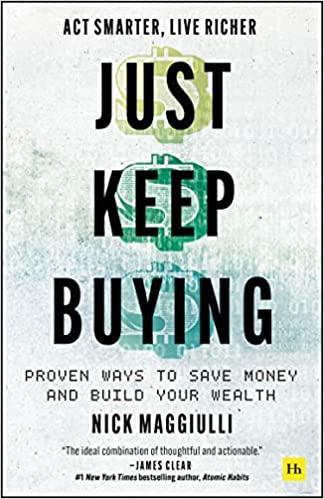
Nick Maggiulli's Just Keep Buying was highly recommended by friends and some readers of this blog and I enjoyed the book immensely. While the book does not change my approach towards personal finance, it had a great financial perspective. Imagine a mathematics textbook that had the same answers to every standard problem but had such a novel working that it's worth a read.

I'm going to share only point which is gold on selecting the right kind of expenses. Nick Maggiulli really got me when he said that he's not really satisfied with the idea that we should simply buy experiences instead of physical goods. Advice like this cannot possibly apply to the entire population and it is more likely to be biased towards extroverts and ignore the 30% of the population that are introverts who may prefer sleeping in bed than travelling to another country. So he proposes that we splurge on things that is consistent with our own personality makeup.

That's basically all there is from the book. 

But the quest for thought leadership cannot stop at just a raw reading of a non-fictional work. The book has a wonderful reference to a paper by Matz, Gladstone and Stillwell from the University of Cambridge entitled Money buys happiness when spending fits our personality.  

This paper is the true treasure from the book.

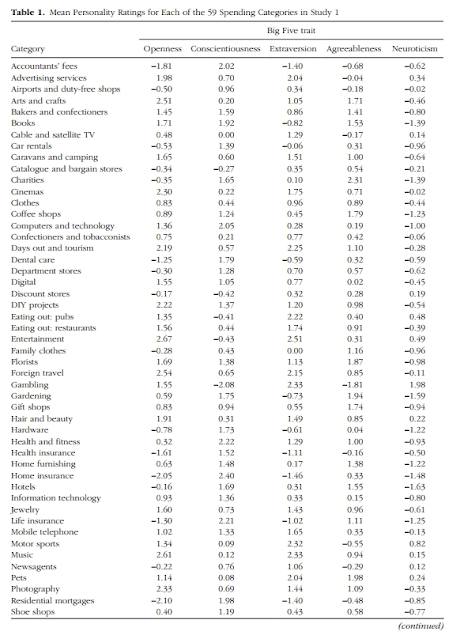
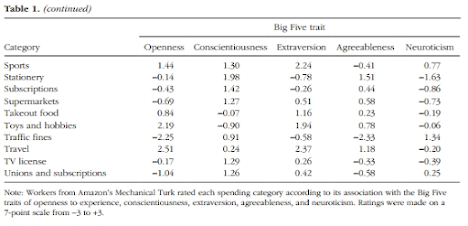
Researchers actually paid Amazon Mechanical Turk to imagine what kind of person would buy something, allowing a Big5 personality profile to be mapped to a consumer good. Then researchers found out that folks who buy goods mapped to their personality type had higher levels of personal satisfaction. 

I shall reproduce the mapping here : 


So basically, if you know your personality, you can use this table to guide you on what consumer products would give you the highest personal satisfaction. Buy enough to make yourself happy, then you can invest the rest. So extraverts should be happy attending a music concert with friends. Introverts are happy getting a bonsai plant. So unless the book you are giving is 50 Shades of Grey, expect your extroverted pal to keep it in his KIV list for decades, you might be better off signing him up with a club for swingers.

For me, my toys and hobbies come from my openness to new experiences and now I know that given that I'm not a very agreeable person, doing charity does not really hit the right spot for me, but I can contribute to society by making more videos and speaking to secondary schools since I am an extrovert. 

But try not to read too much into this table - it seems that neurotics should engage in gambling to be happy, and disagreeble assholes have an affinity with traffic fines. 

Maybe if you have two purchases of equal price and you want to make a comparison, buy something that is more consistent with your personality.


Monday, August 08, 2022

Thinking and lifestyle design using real options and annuities


This post came about because of MissFITFI's podcast with the owner of Saturday Kids. You can listen to the podcast here.

I want to focus on one important idea mentioned in the podcast which is the idea of placing little bets in life that have a small probability of success but can pay off in a large way. This idea can be broadened quite significantly on this blog.

Consider the term life insurance. This is basically a put option on your human capital. If you die, the insurance pays off a fraction of the loss of your human capital to your family. If you outlive the insurance, it expires worthless. 

There is a class of life strategies that exploit a myriad of real options that behave like term life insurance. Advanced education qualification is a call option on your human capital. If there is a strong market demand for people with such advanced degrees, you can enjoy a higher salary or a boost in your human capital. If your advanced degree is in something that society does not value, it can remain dormant or "out of the money" until there is a shift in industry trends. Options gain value when the underlying security goes up in value or even when the situation is very unpredictable or volatility is very high. 

If you are a fan of Nicholas Taleb's Antifragility, living an anti-fragile life is all about embedding real options in your life. 

Now we consider the opposite of term life insurance, the annuity. An annuity hedges against longevity risk. If you live too long, the annuity pays a monthly stipend every month until you die. 

If we consider term life insurance and annuity as a spectrum, then our lifestyle design based on real options is incomplete. While we need to make many tiny bets to get ahead in life, we need systems that pay out a predictable amount every regular time interval, at least to survive. The importance of having a steady job, some royalty payments, and dividends which are uncorrelated to market cycles are vital to survival in modern society. 

Lifestyle design is all about having both real options and regular cash flows to suit your personal needs. 

One way of approaching lifestyle design with this insight can be as follows:

a) You need to know your absolute base essential lifestyle and find ways to match this using earned and passive income. When doing this, you need to think like a landlord. Ideally, if you need to work harder to do this using passive income, do it as the payoff of getting time freedom is extremely high if you can meet this threshold.

b) Once basic needs are covered by earned or passive income, you can start to think about tiny bets that pay off in a big way. This way you can think like a VC. You can earn a qualification that will be valuable in the future, or put in some capital into a startup. In this example, it is better to do position sizing and make uncorrelated bets so that one big win would cover all your losses elsewhere.

c) Income-generating assets and real options should be interchangeable. Maybe some dividends are used to signup with a new Skillsfuture course or advanced degree. Once the advanced degree gets you a higher salary, you can farm extra proceeds into a bigger dividends portfolio. Balancing the two is an art and you can decide how to allocate your capital based on your own capabilities and personal situation.

Some readers will note that in a discussion that straddles between real options and cash flows, where do capital gains that are analogous to growth stocks stand in this spectrum? Stocks belong at the centre of this continuum. Some stocks pay a dividend and it has an option to grow if their valuation goes up. 

( For the absolutely pedantic, stocks are also a written put option, it can drop in value when the underlying business loses money )


Saturday, August 06, 2022

Why you will fail at Value Investing - part 3


Having established that the company has a high business and management quality. The final step is to determine whether the price is cheap enough to justify a market entry. 

It is this process that I find the hardest to execute.

The author does initially seem to employ a simple metric to determine whether the entry is worthwhile. He starts with the earnings yield numbers which is 1 divided by the PE ratio of the company.

But it is the next step that resembles sorcery more than science. 

As tech companies invest in a lot of R&D, it is entirely possible that earnings after deduction for R&D will be low, so the analyst would have to moderate the earning yields. So the company may have an earnings yield of just 2%, but a smaller company in the same space may have less R&D and were able to conduct their business comfortably at an earnings yield of 10%, the earning yield, now relabelled as earnings power may be adjusted closer to 10% to reflect the market reality. 

The details do go a little deeper when you read the book, but I think it would be very hard for actual retail investors to be able to do this confidently without, once again, tricking themselves into falling in love with the company.  

The idea is that if you can find an earnings power of 5%, you can comfortably add the stock to your portfolio.

Ok, so I'm done with my review, how can we treat the book as a whole?

I'm actually not militantly against this latest version of value investing. While there is a subjective component in each step of the analysis, an investor who applies this consistently as a whole against one specific industry may be able to find some success using this framework. But the question for folks like me is whether superior returns when it does occur, come with higher volatility. Furthermore, can these superior strategies beat momentum-based trends following stock picks in an economic expansion which is where tech-stock picking is at its strongest?

Finally, I'd like to say that I won't review a book if I don't really see some value in it. But perhaps a better value investing toolbox can be a wider literature review of books in this space, which is exactly what you will find on my blog over the next few weeks.   


Wednesday, August 03, 2022

Why you will fail at Value Investing - part 2


If you think that Part 1 of this series makes Value Investing look impossible for retail investors, part 2 would be even worse, we will be looking at Management Quality in this installation.

Management Quality in this book is divided into two parts :

a) Does Management think and act like owners?

In this section, an investor needs to read management's minds. Somehow, you need to find out whether management acts for themselves or their shareholders. There are of course some hints at how to do so, one possibility is to see whether management owns the company shares and will benefit when the share price goes up. Another is to see whether there are any incentives to skew their behavior, like stock options. 

Notwithstanding, you need to be able to tell whether the manager is working for the shareholder or for himself, even though this may not be mutually exclusive. 

b) Do executives understand what drives business value?

This is even harder, as some retail investors may not understand what drives business value, but it is at this point where the book really starts paying for itself. The author likes company bosses this really sharp question, which is more important? (a)  growth in sales/profits or (b) return on capital ?

The correct answer is (b), because, with enough capital, you can generate any amounts of growth to your sales or profit. But high return on capital may evince a sustainable competitive advantage.

The best managers are, therefore, those which are most adept at managing capital. This means that speculative R&D projects with little pay-off need to be traded off for projects which can potentially bring value to the company.

Bringing this central idea to the local markets, I'm afraid that I am only aware of one local boss that meets the bill - Andy Luong of UMS, but this is after the fact. I have earned so much from his stock splits and generous dividend payouts, of course I have a great impression of him. I don't have clout to now enough bosses to know who else hits the bill. UMS is hardly a perfect value stock as it is bogged down by having just one major customer.

I also like Mohd Salleh of Second Chance but that's because of his candour and his public admission that, like me, he loves dividends, I would not say that I've made much from my Second Chance holdings.

[ All this being said, I noticed that Lim Chung Chun CEO of iFast seems to have the same psychological make-up as my business partners who I count as allies closer than friends. I also derive income from iFast these days. The question is whether is he an efficient capital allocator? Or I'm just biased because I make money from them? ] 

While it certainly sounds that management quality is a powerful determinant of investment success and may actually justify paying for active management skills, management itself can be subject to change. Some bosses grow old, fall sick, and make mistakes in secession planning, other's become obsolete and allocate capital as if things are 20 years ago. 

Worse, I've seen so many proponents of management quality generate such bad returns because it takes so much effort to understand management well, these analysts may become fixated with a stock due to the sheer effort put into analysis. If you see some "F" in their MBTI, I notice that emotions can hijack their portfolio decisions quite readily for folks who claim that they are great analysts. 

Companies are companies, you should be ready to move your capital out if your investment thesis is no longer valid. 

Companies are not your girlfriend, but MBTI folks with a "TJ" (folks who read this blog) would be happy to dump a girlfriend if a better person comes around. 

Is value investing a construct to create the illusion for "feelings" people to have credibility in the investing world?

God knows.


Saturday, July 30, 2022

Letter to Batch 26 of the Early Retirement Masterclass


Dear Students of Batch 26,

It’s been a great honour and privilege to conduct a 5-Day Early Retirement Workshop for you.

Batch 26 is one of the luckiest batches to graduate from the ERM programme, just a tad less lucky compared to Batch 12, which managed to buy right at the market bottom of the pandemic crisis. Batch 12 bought the stocks in March 2020 and constructed a dividend portfolio that generated 7% per year. At the time of writing, they still managed an XIRR of 16% when the rest of ERM was plugging along with an XIRR of just 4%.

This can be considered the wrong time to invest for many people. The US had just completed two consecutive quarters of negative GDP growth. China is bogged down by the demon of its own design, otherwise known as the Zero COVID policy. Russia is still trying to invade Ukraine. The Fed has declared a crusade against inflation, leading to rising interest rates worldwide. And now, the Hungry Ghost month has just started.

But it is always the darkest before the dawn. ERM remains resolute that there is no better time to invest than now. The equity risk premium we track has been going up three batches in a row. A downturn worldwide has always been suitable for low beta, high dividend portfolios that our programme has been known for.

This is also the batch where a lot of calculated risk-taking took place, with Dasin Retail Trust being chosen after Group 3 did a detailed investigation on the odds of being able to enjoy the 16% current yield that it offers. The team was cognisant that the business could fail but was persuaded when they saw some recent purchases by Aqua Wealth holdings from the SGX announcements. Alumni should feel free to omit the purchase of this counter if they are uncomfortable with the risks involved.

Lastly, I hope that Batch 26 will participate actively in the FB group. Sometime in Q3 2022, we should be meeting up for an online community webinar.

Hope to see you then!


Christopher Ng Wai Chung

Friday, July 29, 2022

Why you will fail at Value Investing - part 1


Over the next few weeks, I will be reviewing the latest literature on Value Investing. I've decided to do a three-part series on this blog before I summarise it into something more useful on the Dr Wealth blog. The first book I will be reviewing is Where the Money Is by Adam Seesel and I see this as a valiant attempt to update the principles of value investing in the digital era. 

The biggest conclusion I get from reading this book is that most of us would likely fail at value investing. 

If you look at the training provided by my peers in the training industry, a lot of younger trainers claim to be some kind of acolyte of Waren Buffett, but even Warren Buffett has evolved over the years. He started as a disciple of Benjamin Graham and adopted a deep value philosophy based on liquidation value, combining it with board control. Then Buffett pivoted under the influence of Charlie Munger and began to buy companies with powerful mindshare on TV. The latest incarnation of value investing subjectively imputes earning yields of digital companies by peer review. 

If I adopt this alleged form of value investing,  then value investing is effectively meaningless.  It becomes ambulatory with the times - it can be anything you want it to be. So long as investment performance is good. 

Nevertheless, I think there is great value in doing a thorough literature review and seeing what scraps can actually be used in Singapore. 

There are three parts to doing value investing for the digital age, I will discuss business quality. 

In the author's view, business quality is high if (1) the company has a low market share in a market that is very large and growing rapidly. (2) The company has a sustainable competitive advantage.

The moment we look at this definition of business quality, we will see logistical difficulties in finding such businesses. It is tough to generate a screen for low market share in a growing market. A retail investor would literally have to read the newspaper and find a company by pure luck. And weekly periodicals in Singapore put a very neutral spin on articles featuring local companies. No journalist would deliberately put in the article numbers on market share and the rate of growth of the industry at large - you need to find the exact article by chance.

Also, what are the odds of a Singapore company being able to compete globally? In many of these cases, authors of value investing companies will invoke Peter Lynch - buy what you know or follow your wife around when she goes shopping. 

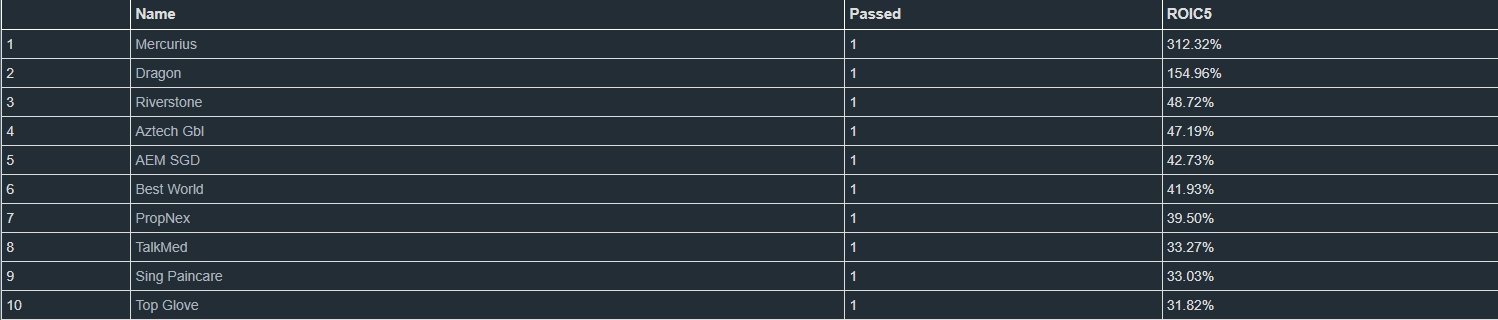
The idea of sustainable competitive advantage is slightly more useful because we can isolate a factor in screening. Companies with a high ROIC are generally seen to have large moats. Now let's see the highest 5-year average ROIC companies in SGX.

[ Note that most value investing acolytes prefer to subjectively evaluate the moat of a company. I hated that ever since someone else in an investment panel argues that Old Chang Kee had great investment moats when any Mak Cik from Batam can come over and start selling sardine epok at MRT exits. If you still prefer this form of subjective evaluation then you should revise Porter's 5 forces model and steer clear of eating too many curry puffs. ]


So as a budding value investor, you will start with this list of 10 companies, and you want to go through each of them one by one to see (1) what is their size relative to their target market (2) whether their market is in fact growing. 

As in all cases, it helps if you are a full-time investor. You may also want a Bloomberg terminal.

This is just round (1) Business quality.


Sunday, July 24, 2022

Why buy the whole cow when you only need the milk ?


The idea of why a person would want to buy a whole cow when he only needs to drink some milk is quite an ancient one. My dad always had a bunch of friends, which I did not respect very much, they said this very often to my dad and me when we hung out over weekends. The idea is mostly applied to their views on marriage. And my dad’s single pals were asking why bother getting married when they could visit prostitutes. Now I want to point out that I had a fairly liberal upbringing, my parents would visit lounges over weekends and I take along as a secondary school and JC kid, so I was familiar with the smoke, alcohol and prostitution way before NS.

I thought it would be fun to revisit this idea in the financial realm. If you adopt the mindset of my dad’s single pals, then the same argument can be made for making a living in Singapore.

It does not take a lot to survive as a bachelor in Singapore. The ballpark is not too far from LKYSPP’s 55-year old imaginary single who needs $1,768 a month. While this is not high living, it enables a basic standard of living with some amounts of entertainment thrown into the mix. 

Now, it does not take a lot to earn $1,800 a month. You can earn his amount doing food delivery. Recently, you can even earn $3,500 washing dishes. You might be able to wash dishes part time to earn that bare minimum of $1,800 to sustain your lifestyle. You can play Diablo Immortal the rest of the time and still have some money leftover to visit prostitutes.

Now my father’s single friends are probably the very kind of people who will scoff at the FIRE movement. If you want to FIRE, then you need to aim well above the median income of $4,500 and save more than 50% of your take home pay. You will need about $530,400 at the safe rate of return of 4% to credible generate about $1,768 a month. They would then find the idea of earning $530,400 within a decade even more ridiculous, with folks paying me good money to raise the probability of success of doing that. 

So the same mental model applies in finance. Why buy the whole cow ( raise $530,400 ) when you only need some milk ( $1,768 a month ).

If you follow this train of thought, you’d come back to that story of the MBA who tried to advise a fishermen. The idea was go through one full circle of levelling up, starting a business, scaling, so that the fisherman can relax like what he used to do in his youth. 

Whats hidden in the story is that the fisherman can probably fish for a living over the short term, but he has to contend with illness and old age over the long term, so saving up and scaling up a business is just another way to sustain his lifestyle, and possibly grow a family in the meantime. It’s also ridiculous if the fisherman is single and contend with other fishermen for mates, so he has to struggle to signal his economic resourcefulness to women as well. 

But I think there’s no better no way to understand the consequences of choosing this philosophy of life. 

And I should explain why my philosophy is the opposite - to own as many cows as legally possible. If things work out, folks will be paying good money to buy my milk. 

My dad’s friend, did remain single his whole life, he partied hard with prostitutes and drank lots of beer. At an older age, he got lonely, and eventually settled down with an old prostitute in a HDB. The old prostitute had some kids from an earlier dalliance, but he provided some financial assistance for them as they grew up. 

He did buy an old cow in the end, the calves were not even his but he had to raise them too.   


Friday, July 22, 2022

Is Singapore too "tense" for our own good ?


For reasons which can only be explained if you know me well enough, I seldom have a meal with my secondary school classmates. It's just the way it is if you are a banana and your school is very Chinese helicopter. But when I do, I always learn something.

Prior to the latest event, my classmates asked me why his dad could support a family on one income but he can't and whether it is feasible to emigrate to Australia. 

This time around, my classmate, who is a very senior Malaysian R&D engineer, said that Singapore is very tense and he'd rather live in JB and commute to Singapore than living here in Woodlands. Initially, I thought this was an economic argument because SGD goes a long way in JB. 

But it is not, the main draw is that he can be with his family in JB over weekends.

So I was puzzled because what's the difference if you spent a weekend with family in JB versus SG beyond the obvious economic advantages?

I did not unpack the argument. His reasoning was that Singapore is just a "tense" place.

Just today I found out the hard way what my classmate meant.

I was bringing my son back from school and this bastard rode a bicycle at warp speed towards a crowd of K2 children. I did the best thing I could and interposed myself between my son and him, forcing him to slow down, then he cussed me in Hokkien, and rode away. Upon reflection, there was nothing I can do because my son rode a tiny scooter and I would hypocritical to tell a bicyclist off in front of my kid, so I just kept silent.

In my head, there were two scenarios, if my son was hit and I go berserk on him, I will die. He's got a hard luck Kranji Turf Club face and looked fit in his forties and I'm a diabetic sedentary worker who might have sarcopenia. If somehow I survive and hit him with a lawsuit, I'll probably be able to do better than engaging in melee combat, but I probably can't recoup my costs, so I won't win either way. 

But the outcome is optimal, I keep quiet and go about my own way, and bicyclists will continue to plague the pavements around the primary school.

You can interpret the meaning of the word 'tense' from the rudeness of the encounter. That's one way of seeing it. 

In KL, the infrastructure is so bad, bicyclists will have to contend with potholes rather than schoolchildren. Traffic infrastructure is so bad that courtesy actually helps a lot if you need to cross the road. Same in some US states - if everyone can carry a gun, being extra polite is a survival skill. 

I think the deeper problem is the internal calculus I am so used to going through as I go by the day-to-day business in Singapore. I can :
  • Physically fight, but that never achieves any objective and getting caught on camera will ruin me.
  • Call the police, if there's clearly a Penal Code violation, but my experience is that police may reject the case. 
  • Go to court where you can find recourse in Civil Litigation. But you need to be rich and the amounts at stake substantial. 
  • Complain to MP. A favourite manoeuvre. 
  • Somehow pay the problem to go away, but the other party wins.
I apply the same mental model in many tense situations. If a fight breaks out, should it be done with words, a video, my fists or a writ?

A society can be thought of as "tense" if everyone is constantly evaluating their options this way. 

Apparently, things can be as ferocious in one local social media platform for traders and investors. I heard of this story/myth/ rumour from friends. All unsubstantiated, so I will keep the parties anonymous.

Apparently, some seasoned investor takes it very personally if he plugs a buy call for particular company stock and someone actively brags about trying to short it. One altercation got so bad, the police got involved because someone's profile even got uploaded to a gay dating website. 

For me, whoever shorts a stock I really like is a True Friend, at least others can buy it at a cheaper price.

No, I will not name that platform with salty traders. 

I will also never go there.


Friday, July 15, 2022

Why you need to have your own Marshmallow Test


When the Stanford Marshmallow Test was conducted in the 1970s, psychologists concluded that kids who can exert enough self-control to resist eating a marshmallow move on to have greater life satisfaction and success. This rocked the world of self-help when the ability to delay gratification was then touted as a powerful predictor of personal success.

But in 2020, psychologists attempted to replicate the experiment with a more diverse and larger sample size, they found that the effects were very much more muted, with children with a higher SES background being able to resist the marshmallow much better. 

Heck even when my son was sent to NUS to measure his ability to resist temptation, he coped well beyond what other kids could handle because I would buy him an ice-cream quite often when I brought him home from school so a Mars bars is not very much to him. Perhaps the modern test should be 10 mins on an iPad, with an extra 30 mins if the kids can do nothing for an hour. I think my kids will fail the test if it's designed this way.

Validity of the test aside, business and executives should design their own version of the Marshmallow test to see whether the folks they work with have the capability to delay gratification. Not everyone is designed to be able to commit to long term projects to make money. 

I noticed a particular pattern among the younger people I get exposed to. 

The folks who condone quick-fix marketing messages that hijack the emotions of other people also have a heightened fascination with get rick quick schemes. They might be useful to other business people, but these are not the kind of folks who can support a product or project that builds wealth steadily. When I work with folks like this, my brand almost always takes a hit.

So how do we design a Marshmallow test for our personal use? 

The first cut is always educational qualifications. Sadly, Singapore is so hierarchical and obsessed with paper qualifications, a degree from a local university requires a lot of careful planning and execution. This will be followed by the field of study - the harder the field is, the more conscientious and intelligence the candidate will be.

But what if you're just stuck with candidates with the same qualifications? 

Then you need to design something from your own industry. Maybe in software engineering, you might wish to see the developer's comments in their software code to see whether they are intelligible, whether Programming Patterns are adhered to and variables don't get recycled.

For me, I will just show or write about the latest REIT current dividends. 

If you are an investor for a while, REIT dividends are fairly high right now and some of the heavily beaten down REITs like EC WORLD can be bought at bargain prices.     


More of the folks who get excited about the table above tend to become my better clients. As yields are at a historical high around 8%, it's still mathematically impossible to get rich quickly by waiting for REIT dividends to arrive. Folks who are interested in this are generally willing to pay the price and delay gratification for financial independence. 

Now to complete the test, we need the opposite of REITs dividend yields. 


The above table shows the real-time yields of Apollo Vaults, a platform to do liquidity pool mining on the collapsed Terra Classic blockchain. The yields fluctuate by the day and are largely boosted by exploiting mathematical differences between APR and APY.  More importantly, vaults compound in USTC, which is a stablecoin that has already collapsed in May 2022. So while you can compound your USTC at 1,600%, USTC can collapsed by 60-70% over a day's trade.  

( I love channeling part of my REIT dividends into the Terra Classic Blockchain. )

Invariably, Apollo Vaults will attract a different kind of investor. These are the same folks who can really comfortable discuss options, drop-shipping, building a business empire with information products, direct selling and SEO. They may not be the students that I'd like to have but are grist for the mill for the dudes that show up in a Youtube ad. 

( Yup, even my crypto course is too serious for them ) 

This is what I've discovered over time, as I flash the different mathematical properties of the two asset classes I teach, I excite a different demographic. The same goes for different blog articles. 

The really sad thing was that I had an even more powerful Marshmallow Test when I was growing up :


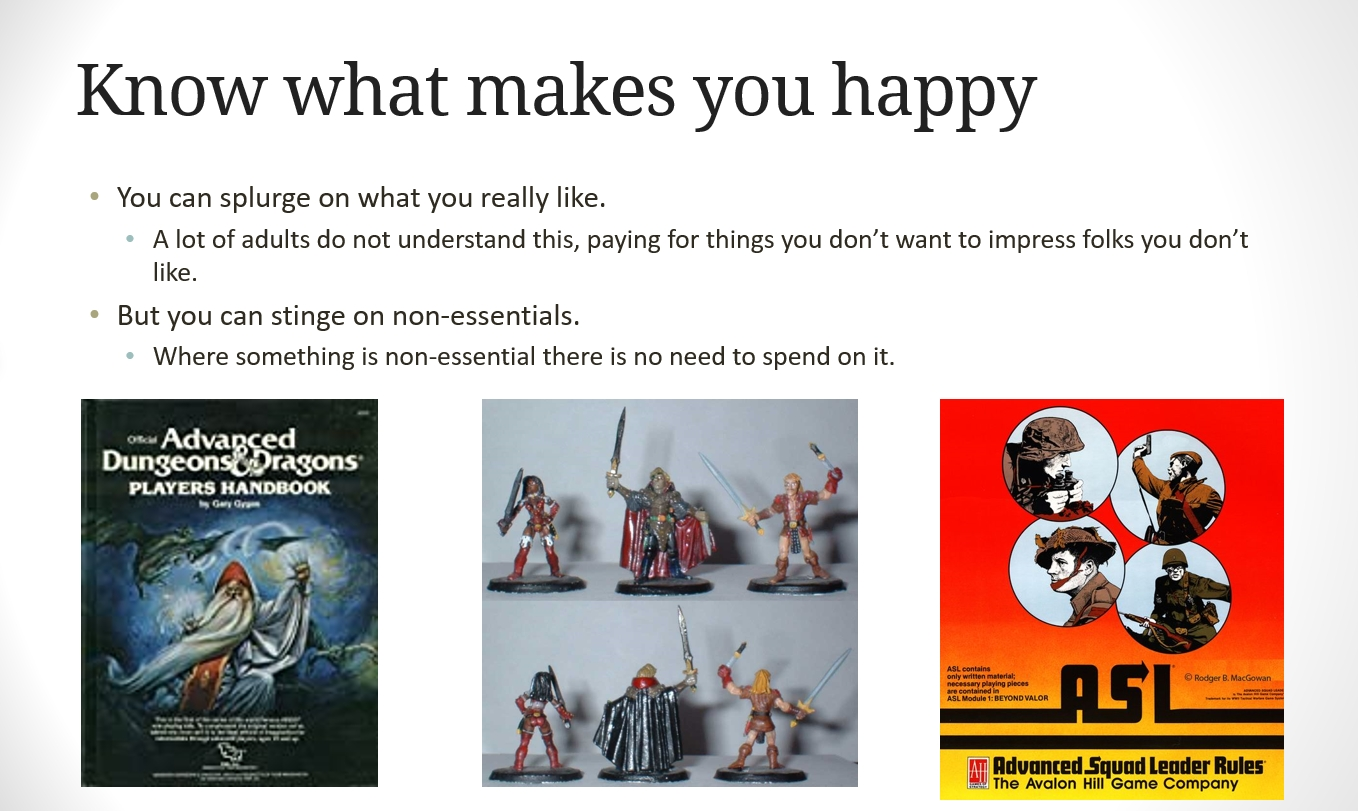
I stared playing D&D at the age of 10. What's a fricking plate of marshmallows compared to a handbook that introduces the bell curve to primary school students using 3 six-sided dice? 

The 1st Edition AD&D was so dense and difficult as a ruleset, it's impossible to play without at least processing 100+ pages of text. Worse, in the 1980s, no one plays D&D in a consistent manner.  

Too bad the latest edition of D&D has become so simplified that it's now a staple of mainstream entertainment and playing D&D has lost it exclusivity.  

Pfft, you can even catch Vecna on Netflix. 


Monday, July 11, 2022

Million dollar idea : How to Develop Conscientiousness


The question of how to develop and increase conscientiousness is a million-dollar question that parents and various arms of the government want to be answered. It is no surprise that this is one of those questions that I've kept at the back of my head because one way to summarise my life is all about witnessing folks who are less talented and intelligent than I move on to thrash me in all areas of my life.

How big is such a question?
  • Ritalin, a drug that deals with ADHD, rakes in millions every year. Some folks without ADHD take the drug to help them concentrate in class and do coding. 
  • Angela Duckworth earned millions in defence contracts to teach grit and resilience to US Air Force.
  • Teen camps that can turn students around probably generate many times more revenue than investment training courses.  
I don't think the question of developing conscientiousness can be fully answered because a lot of interventions may not result in permanent change. I am only 10 percentiles above the median in conscientiousness, and only became more conscientious after I got older.

If there are few ways to make someone more conscientiousness, borderline conscientious folks like me have to rely on changing the way I work to be more effective. So while I can never be as punctilious as some of my ISTJ colleagues at work, I can develop a system to be as effective as these very OCD people.

These systems to virtually raise conscientiousness comes in many forms :
  • Getting things done or GTD is a popular productivity system. ( Which I just can't follow, sadly )
  • Marie Kondo's KonMari system is an organizational principle for physical objects.
  • Lawyers use a simple system called IRAC to improve their legal writing. 
  • Even entering all your stock picks in Stocks Cafe is a system. ( Vital one, in fact! )
The beauty of Building a Second Brain is that it jazzes up note-taking. Knowledge workers often have to capture notes from different media from images to paragraphs of text to .wav files. The author teaches a simple system called PARA to organise your notes :
  • Projects - Ongoing projects. For me the courses I conduct are projects.
  • Areas - Areas of interest. For me, it is Investments, Health, Parenting, Lifestyle Design and Comedy.
  • Resources - Material related to specific Subjects. I split mine into areas like Engineering, Finance, Psychology, Philosophy, and Law
  • Archives - Completed Projects that are no longer being run.
I think I can sense an improvement in my quality of life after I've installed Microsoft OneNote on all my devices and I can now capture interesting snippets of information without really caring what format they come in. Not only do I have something to relate to my training material, but it's also easier to help my body of knowledge evolve. When organizing my notes, I can suddenly recall that one area of study can solve a problem in another.

Of course, my low conscientiousness does affect how much I can integrate this into my life. I can install note-taking software and build a taxonomy of notes. I still can't build an over-arching productivity system out of this note-taking tool because it feels as uncompromising as GTD. 

But hey, it's managed to change my life in a small way. 

I think the final lesson about developing conscientiousness is that baseline conscientiousness is often required before life can flourish. Blog readers will forward my posts if I regale them with stories of that guy who promised to make out 100 prostitutes in a year, but productivity posts like this will see a much more lukewarm response.  

Worse, nothing much can be done for folks who don't read blogs at all. 


Sunday, July 10, 2022

What great questions are you working on?


Financial independence and running a freelancing business has narrowed the field that I read. In those days when I worked for other people, I read books on running businesses and office politics, it feels quite good that I can free up some of the mindshare to read more deeply into quantitative finance and technology. 

Building a Second Brain  by Tiago Forte is a fairly nice read with interesting ramifications for knowledge workers. I enjoyed this book and will be putting in several articles to blog on it. 

I think one surprising point of personal improvement is to simple ask ourselves, what are the big questions we are grappling right now ? In this world where folks are narcissistically trying to increase personal pleasure and reduce personal pain, refocusing on the big questions about life can bring more focus into what the modern knowledge worker is trying to do. I think this is particularly relevant in an era where younger Millenials / Gen Z are trying to focus on mental health / doing fuck'all / lying flat, when older Millenials / Gen X are too busy sipping champagne, spending their money on expensive holidays, and accusing some other generation of being lazy and self-entitled. 

Seems like in all cases, Millenials seems to be root of their own problems.

In this book, the author recommends that all knowledge workers prepare about a dozen questions that they'd like answered. This is almost like the GP papers that A level students will have to do except the answers may take a lifetime to answer. A dozen questions is too much,  but I think having 2-3 questions is more reasonable. While the author does not have a system to qualify these questions, I think it's worth applying the ikigai framework as a test to see whether it is worth solving - we should be asking ourselves whether answering the questions is profitable, desirable, something you enjoy working on, and something you can credibly solve one day. 

Once you have these great questions embedded in year head, you will automatically employ a cross-disciplinary approach looking at it. Solving good questions often require mental models and skills from multiple disciplines. 

It's fairly obvious what question I was fixated with in my 20s and 30s. 

My question was simply what does it take to become financially independent such that I can decouple my survival from my need to work the corporate world. When I asked myself this in my mid-20s, the IT industry was reeling from the first dot-com crash and the beginning of the outsourcing revolution which eventually took the life of an European colleague of mine.

Everything I did, from earning multiple degrees, building a dividend portfolio, downgrading from economic rice to vegetarian beehoon, dabbling in Stoic philosophy, reading 2-3 books a week, was channeled to answer this one question. And even after solving it for myself, even as I can systematize my solution to teach other PMET, I can't seem to show low income Singaporeans how to solve this problem. 

I think a good question or problem will probably not be solvable over a lifetime, so I'm not beating myself up over this, I just keep improving my knowledge over time. 

There are other questions that animate me and would motivate make me expend sufficient effort to solve it if the opportunity arises :
  • What will it take for Singapore society to do  away with commissioned salespersons in the financial advisory industry?
  • How can we increase the conscientiousness of ourselves and our children?
In my second part of the review of this book, I will talk about the multi-million dollar question of how to infuse conscientiousness into someone. 

In the meantime, feel free to share the big questions you are currently looking at. 


Tuesday, July 05, 2022

On Stand-Up Comedy


Last week, just before July this month, when I'll be conducting not one class but two, I decided to do a bit of exploration beyond just finance and gaming. So I paid $50 to attend a stand-up comedy event by Rachman Blake who is still performing at Blue Jaz at the moment.

It's good to get out every now and then to do things out of the blue. Anthony Robbins called this a 'breaking the pattern' and it was money well spent. I had a good laugh but I also managed to get exposure to what a world-class performance is like.  

What I particularly like about the performance is that the comedian took great pains to understand what living in Singapore is like and shared some really sharp observations about us.

I won't spoil all his jokes which centre on his sex life and dating in general but one of my favourite anecdotes is about Singaporeans who love talking about interest rates while on a date. And this was a great observation because if I were in the dating scene, I'd definitely talk about Fed action this coming end-July and its possible impact on interest rates and home loans. I think talking about interest rates exceeding 4% for fixed-rate loans is probably more exciting (and painful) than talking about anal. Worse if your loan is tied to SIBOR/SORA.

While I doubt ENTJs make great comedians, I'm beginning to see that exposure to comedy is not just relaxing and fun, but also good for my business, because the injection of some comedic elements can make my material more engaging. Some clients go for my programmes because of my competence, but I think I can increase my reach if I can improve my warmth. 

I'm not coming from unfamiliar territory as I did try some improv in the past but I did not follow up after one session. Feedback from classmates was that my jokes are too 'atas' and require some knowledge of current affairs. Also almost 4 decades of TRPGs should help. 

So I'm going to do this the slow steady way, I'm going to sign up for comedy courses in Udemy which should set me back less than $200, then I will slowly attend a couple of stand-up comedy acts. This July, I will attend my first Powerpoint karaoke session.  

If I find some avenue where I try my luck with an open mic setting, I'll go to unleash a few quips about FAs and hope I don't get beaten up by insurance salesmen. 

If you have a cruel anecdote or gag about FAs and don't mind me stealing and repurposing your material, feel free to write to me with your contribution. 


Sunday, July 03, 2022

Feedback on Education and Lifelong Learning


If I do get to participate in the Forward Singapore feedback sessions, I'm going to talk about two issues:

a) Changing the grading system in local universities

There's been a big change jumping from NUS Engineering school in 1995 to SMU Law School in 2014.

The most immediate change is the increase in levels of anxiety which I was not really prepared for even though I'm kinda used to the academic environment. I don't come from a generation that really gives a damn about mental health but I witnessed a nervous breakdown in class and an exam score hacking from another classmate. The system is really unhealthy and students don't get to work on their personalities and interests because final grades are so consequential. ( eg. Baker and McKenzie will only interview anyone with SMU GPA > 3.7 )

It's extra grating because SMU likes to put happy faces on the walls while you are getting to the lecture theatres. The fucking dancers on campus don't help because they are actually not from SMU. 

One problem is that universities see themselves as being in the service of industries and GPAs function as some kind of shortcut that HR managers love. 

I propose a simpler three-grade system for local degrees.  For every subject, either you pass, fail or get a distinction. A distinction means you score in the top 5% of your cohort. Scoring and weights for the final degree classification should be confidential and students should also just get three grades Fail, Pass and Distinction. 

The system still celebrates excellence and some top employers can still use the distinction grade as selection criteria, but students still get a chance to shape their resumes with more internships, CCAs or hobbies. 

Let's not spoil the HR managers and let them try to learn more about an interviewee rather than to fixate on just one aggregate score. 

Graduates are not wagyu beef.

b) Claw-back of Skillfutures payouts

During the pandemic, it is possible to sign up for courses that pay $1,200-$1,500 per month for six months. This is a lifesaver during the pandemic but we're not getting numbers on re-employment after training is over. I do know that folks who do not get a job after 6 months exist in Singapore, some are highly educated, which makes this convenient money grab at the expense of taxpayers.

When I learnt about this loophole, I was so angry I actually took steps to actively rebel against the taxman last year.  ( But it's totally legal, I used my dividends and fees to generate $50k+ of tax deductibles by maxing out my SRS, CPF and Medisave contributions. ) I ended up cutting my nose to spite my face and lowered my standard of living so that I don't have to pay a single cent of income tax this year.

I'm probably going to do this again this year even though we are out of lockdowns. The price I pay is that I don't get fancy travel, but at least I get the satisfaction that my money is not used to subsidise these deadbeats. ( Having more money in CPF-SA is not too bad as well. )

I want future schemes to include a claw-back provision. If a job is not found six months after training, then maybe a clawback amount of $2,000 should be imposed to provide an incentive for the bum to at least try to get employed. I am aware that the government is now more careful in selecting candidates for these incentives but I think clawbacks should plainly be outcome-driven. 

As I do invest in my student portfolios, the government may even want to claw back money from training firms as well, but this can be smaller at maybe 5% of revenue for each student who does not get a job within 6 months. This way the schools have an incentive to actively filter potential students.

I'm sure other citizens will have different peeves and I respect them for it. 

But do let me know whether you agree with my approach.