I am writing this article in Raffles City Food Court after a second day of lectures for the Part B Bar preparation exams. Two uncles sitting next to me are talking to each other about MLM and bragging about their recent trading successes via cryptocurrency trades. The conversation is quite fascinating but I have a blog article to write.
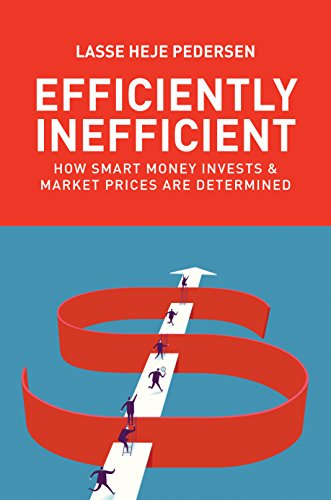
The book Efficiently Inefficient by Lasse Heje Pedersen was written as a textbook for folks who want an introduction into various hedge fund strategies. I thought the concepts may be be useful for retail investors who want to craft a more sophisticated investment strategy. After all, you guys are aware that I have since the last book, built a margin account which I intend to expand over the next two weeks. By August this year, about 4% of my total portfolio value would be leveraged by 200%.
We will start with a relatively simple concept of market efficiency.
The idea that markets are efficient is the idea that our stockmarket reflects all market information. Market prices always reflect fundamental value and readjust when breaking news occur. If markets are efficient, then active investing is pointless and your should just minimise your costs and just buy ETFs for your portfolio.
The converse of market efficiency is that the market prices do not reflect fundamental value and it is possible for active investors to succeed. Human beings make mistakes and it is possible for the investing crowd to become overexuberant or overly pessimistic.
The idea of markets being efficiently inefficient is a new one which tries to be a halfway house between market efficiency and market inefficiently. Markets are inefficient enough just to compensate money managers for their costs and fees but efficient enough to make it hard for a new market manager to enter the market.
If you adopt this belief, then market managers will typically perform well enough to be rewarded for the liquidity they provide to the markets but will find it challenging to perform beyond what they charge an investor in terms of trading costs and management expenses.
Some active managers will be able to exploit market anomalies over the short term but they will need to keep searching for new ideas to remain relevant to their clients.
I would this hypothesis to be correct. The only way to keep ahead of the markets is to keep reading and finding new ways to invest your money.
It does not make sense for anyone to be permanently financially independent without performing a porfolio review every now and then readjusting their investments to adapting to changing circumstances.
Wednesday, July 19, 2017


Saturday, July 15, 2017
Equity Management ( Last Episode ) : Time to move on and how to think about GLP.
I'm closing this segment in favour of something more reader-friendly next week based on more interesting hedge fund strategies.
I thought perhaps I'd like to show how the stuff I wrote on this column would be applied to the latest news on GLP.
Based on what can figure out on the news, GLP is being bought out at $3.38 and dividends declared in May will not reduce it's value which means that potentially whoever owns GLP will get to exit at $3.44 by latest April 2018. Looking at the current price, GLP is also trading at $3.29 which provides a nice 15 cent profit even for investors who decide to buy after the news has been declared.
Here are a few points :
I thought perhaps I'd like to show how the stuff I wrote on this column would be applied to the latest news on GLP.
Based on what can figure out on the news, GLP is being bought out at $3.38 and dividends declared in May will not reduce it's value which means that potentially whoever owns GLP will get to exit at $3.44 by latest April 2018. Looking at the current price, GLP is also trading at $3.29 which provides a nice 15 cent profit even for investors who decide to buy after the news has been declared.
Here are a few points :
- Basic maths says that buying and holding GLP until next April will return around 4.55% or around 6.825% annualised. A lot of friends and bloggers have been sounding the alarm on such an arbitrage opportunity.
- At this stage it is very easy to fall into a trap of equating this deal as a short term bond issue which gives 4.55% in 8 months. A 4.55% corporate bond is relatively stable but a buyout largely depends on whether the buyout will succeed. Serious losses can result in the buyout does not take place.
- At this stage, we can give benefit of the doubt to the folks who see this as a bond-like investment because the underlying mechanism is what we folks in law school know as a s210 Scheme of Arrangement which is welcomed by initiated by internal management. ( But a s210 can be shot down by the courts in a myriad of ways which will not be the subject of this article. )
- So will you invest your money to earn an annualised 6.825% ? Depending on your level of risk aversion, some folks might. For me, I have much more attractive counters yielding 8-10% on my radar.
What is more interesting is when you apply leverage and try to mirror what some professional hedge fund managers do.
If you look at Maybank's lending rates for GLP, they consider this a Tier 1 stock so they only charge 2.88% for margin. Suppose you leverage at 300%, You can expect to earn over 6.825 * 3 - 2.88 * 2 or 14.715% annualised over 8 months.
14.715% is a decent return, but take note that if the buyout fails, you may be looking at perhaps 20% drop which would cost you 60% of your capital. There is no such thing as a free lunch.
This is something that I don't have the guts to do, but thinking about risk and return in this manner may provide more interesting insights that you can't find elsewhere.
( I am not vested in GLP )
Anyway, beginning next week, we will trying to go through the following book :
Tuesday, July 11, 2017
JD Aftermath #7 : Future of the legal industry

Today marks the end of my journey with SMU where I travelled back to campus for Commencement 2017. I wanted to save one last salvo before I begin preparations for the bar exams next week.
Today's highlight was Minister Shanmugam's speech. I would like to share some personal thoughts on what was presented to us today.
I felt that Minister Shanmugam's tone was generally positive. However, I can't help but feel that lawyers are going to be in for some really tough times unless they belong to the category that do bespoke work for big clients.
a) Elephant in the Room : No one knows how the legal landscape is going to be disrupted.
I interviewed with SMU as someone who has just left the data.gov team in IDA. At that time, I just completed my Coursera specialization on Data Analytics with R. I spent my time during the interview talking about legal analytics and ultimately how judgments can be predicted with the right deep learning algorithms. During my final year, some judgments from the European Court of Human Rights can already be predicted with 80% accuracy by just scanning the submissions.
In today's Commencement, what was not said was more important than what was said. Ho Kwon Ping's opening address briefly mentioned Fintech but nothing more was said about legal-tech.
IMHO, the Big Elephant in the room is that SMU does not have a module that teaches lawyers how to address the latest developments in computer science and give law students a sample of the skill-set required to master them. We are still not creating lawyers with the ability to speak to engineers and other technology professionals.
NUS, in contrast, offers this module to its students.
( If SMU wants to start, it should make Richard Susskind a compulsory read. Just sayin.... )
b) Inevitably, many of us will leave for greener pastures.
Minister Shanmugam puts up a series of very interesting slides which talk about how easy it is for other countries to take our lunch. In particular, Singapore is always under the threat of losing its position as an air hub. We also do not have a particularly efficient people-to-lawyer ratio compared to countries like South Korea (I felt that the Minister should not have withheld that ratios for the US but that's just me). If we want to succeed, we have to do more with less and a subtle message I received is that companies would not be satisfied with paying so much for non-bespoke legal advice. This is convincing to me because I spent over a decade in IT outsourcing.
I might be better off using the ITSM discipline to control a cadre of Indian lawyers to generate the low level research for more experienced partners before the passing the work to the client. I can even implement follow-the-sun where a document can be handed over to an Indian Call center and work complete before breakfast the following day.
If the legal landscape is going IT's way, then lawyers may be wiser to try to leverage on this outsourcing trend or at least find a bluer ocean to swim in.
c) Two great places to get into are Arbitration and Insolvency.
I felt a certain pang of regret when the Minister showed his info-graphic for Arbitration which was showing rampant growth.
Over a decade ago, fresh after my CFA I almost wanted to pick up a graduate diploma in Arbitration but was stunned when I was turned down for the inaugural batch of the course. Even in SMU, I pursued modules which taught me more about business so that I can be a better investor so I no longer had enough credit to study the arbitration module.
I was luckier because I spent a lot of time on Insolvency which was a tough subject. Initially I wanted to get into an area of the law where I get a leading indicator of whether the economy is coming to an inflection point. So I hope to get some real work on Insolvency in a later phase of my career.
Perhaps the most positive aspect of the talk is when the Minister sharing about growing areas of practice that rookies can get into.
What's next ?
Well what is next for me is that I will begin Part B next week.
I will withhold judgment until I meet the hordes of overseas graduates who are coming back to compete for a pie that growing smaller and smaller over time.
On the whole, I believe that SMU has prepared me well.
Heck, NUS Engineering and Finance school has prepared me well for this.
Bring it on !
Sunday, July 09, 2017
Why Singaporeans will not matter in the future.

I thought I'd spend Sunday writing about some of the key conclusions from the book Homo Deus by Yuval Harari within our local context. This is a very interesting read which I strongly recommend to all readers. In fact, you might be better off skipping Sapiens and going into Homo Deus straight because it talks about the future instead of the past.
a) Politically Singaporeans do not matter
If you look at the Oxley Road matter, one takeaway is that ordinary Singaporeans do not really matter in this unfolding drama, the support for our constituencies will not collapse overnight whether we preserve or demolish 38 Oxley Road. Ditto for the Elected Presidency.
The more interesting insight I gained from reading Homo Deus is the philosophical question of whether PAP is a political party or an algorithm. I find the algorithm argument convincing because the PAP is one of the most successful and consistent political parties in the world. Imagine the PAP as some sort of computer process or daemon with the Constitution and associated Statutes as some kind of database.
The PAP algorithm under the hood may work like this : Keep unemployment low within 5%, keep economic growth reasonable at 2-3%, manage constituencies to cover all basic and security needs. If all these conditions are being met, no opposition party can gain enough foothold to block a Constitutional amendment which further allows PAP to tweak the Constitution to continue to meeting these hard economic guidelines further entrenching their power.
Unlike the ministers that direct the PAP, the PAP is a highly intelligent algorithm without the requisite consciousness that knows Singaporeans better than Singaporeans themselves. Where Singaporeans can make a difference is only during rare cases like in 2011, when they gave an entire GRC to the Worker's party which triggers a flag for the PAP to make bigger changes to its social policies. But any intelligent programmer will know that code can be written to adjust to external sensor. This external sensor being an election poll.
b) Militarily Singaporeans do not matter
This is a much easier argument to extend because the nature of war itself is changing. A fat, overweight soldier can be a butcher in the battlefield because he can command a squad of attack robots. The consciousness of a solder is no longer an asset in a world where command and control can be simplified suing highly-refined AIs.
This will be a province of a few select Elite Singapore battle scholars.
c) Economically Singaporeans do not matter.
The ordinary Singaporean will have about 20-30 years head-start but will will become irrelevant much faster than his counterpart from another country because we are embracing a Smart Nation with a much bigger sense of urgency.
Look no further than the emergence of a robo-advisor, a low cost financial planner that would not push products down your throat or create a conflict of interest. The technology will not just render an army of financial professionals unemployed, it will create a better environment for millenials to invest their money. In the future, a robo-advisor might even be able to replicate active fund manager capabilities. I see this happening within 10 years.
As more technologies begin to disrupt the services, the population will split into a caste of "useless" citizens and a "super-elite" core that will control and direct an army of artificial intelligences to keep the economy humming.
I actually believe that the creation of the "useless' caste has already started.
I had a conversation with a bunch of friends the other day where 80% of the subject matter is about events in the virtual world such as : What games to play. How to power level your Necromancer and what we bought in the latest Steam Sale.
A world in which Singaporeans do not matter may be welcomed by many Singaporeans
What I painted on this blog is very dystopian but I also believe that it would be welcomed by many Singaporeans who finally get the rest they desire. There will be no Marxist nightmare because the proletarian are too busy killing Diablo to overpower the bourgeois elite.
The ordinary "useless" class will withdraw from the marriage and breeding market ending years of heartache and frustration (Already happening based on the latest survey). They can plug into a virtual world where you can have a sense of achievement and even lead meaningful lives. (Unless you power-level and depend on someone else to give you free xp, which is akin to living on your inheritance). A world where non-degree males have problems finding employment, a government algorithm only needs to provide enough basic universal income to sustain a lifetime of plugging in playing games for an entire lifetime or watching Netflix videos.
The population will likely drop and the Singapore will be ruled by an enhanced and very small caste of High Programmers/Policy makers.
Your future Ikigai will be to reach 1000 paragon points.
What can you do?
This is not a question that I will need to answer as I have already retired once. But this is a serious challenge for my children.
The first answer for everyone is to simple embrace the future. For this to take place, some form of Universal basic income for internet bandwidth and food needs to be provided for the population. Efficiencies may make this a very small burden even for 5% of the population that pays taxes.
The next best answer is to attempt to join the super-elite. This is not going to be easy as the skills in the future would be advanced degrees in both biology and computer science. But perhaps 5-10% of the population will make the cut.
My answer is for folks within our generation to amass enough wealth to support just one or two generation ahead of ours. Investing in companies that will bring in this new age will maintain prosperity for our children who may or may not qualify to be super-elite.
If they fail, the family line will end with them but they will have comfortable lives. If they succeed, they will work very hard to keep the nation advancing into the future and may be able to continue going one perhaps a few generation more.
Saturday, July 08, 2017
Equity Management #19 : Dividends strategy versus Deep Value Investing.
During my preparations for the talks at the end of the month ( which is rapidly selling out ! ), I would go to Lee Kong Chian Library and take down some interesting observations on the market from the Bloomberg terminals.
Today's observation goes beyond the scope of my presentation in July so it's better to share this on my blog for intermediate investors. It will also give attendees and idea of what my presentation would be like at the end of the month.
An important question investors are curious to know is whether deep value strategies outperform a well-crafted dividends strategy. I have always maintained in my talks that a dividend strategy is, in many cases, inferior to the deep value strategy.
( Information on my dividends strategy will be shared on my talk itself but let's look at simple deep value strategy I back-tested on Bloomberg.)
Suppose we take the bottom 20% P/E ratios from a set of local SGX stocks. And then within this set, we find the bottom 20% P/B ratio. We will end up with a list of deep value stocks that belongs to the province of deep value investors.
Backtested 10 years and annually rebalanced, the performance is abysmal :Returns are 3.07% and the portfolio is highly volatile with a semivariance of 23.40%.
Investing in the STI ETF would have gotten better results.
As I could not believe my eyes, I then tried to observe the stocks selected by this approach. The market returned mostly Chinese companies.
So the next step would be to limit the scope of this strategy to locally domiciled companies.
The improvement is very dramatic - Once you filter out the Chinese companies, the returns become 52.46% annually ! The semivariance becomes higher at 34.69%.
This is superior to any dividends strategy I will be presenting end of this month and possibly superior to any performance of active managers covering the Singapore market !
Some preliminary suggestions for investors :
a) If you go for deep value, filter out the China stocks in SGX.
b) While your returns will improve, your risks will also be magnified.
c) The backtest does not account for the lack of liquidity of good deep value stock counters. So you might even be able to buy the stocks suggested by the screen becuase no one is selling them.
d) While it's tempting to leverage such counters, brokers are unlikely to give you decent lending rates for deep value stocks.
e) Unlike dividend stocks, deep value counters may not occasionally give you a reward you for holding counters over time.
f) No release of dopamine in your brain when you get rewarded with dividends. ( Which is what got me hooked more than a decade ago ! Dividends are the opiate for the investing masses ! )
Today's observation goes beyond the scope of my presentation in July so it's better to share this on my blog for intermediate investors. It will also give attendees and idea of what my presentation would be like at the end of the month.
An important question investors are curious to know is whether deep value strategies outperform a well-crafted dividends strategy. I have always maintained in my talks that a dividend strategy is, in many cases, inferior to the deep value strategy.
( Information on my dividends strategy will be shared on my talk itself but let's look at simple deep value strategy I back-tested on Bloomberg.)
Suppose we take the bottom 20% P/E ratios from a set of local SGX stocks. And then within this set, we find the bottom 20% P/B ratio. We will end up with a list of deep value stocks that belongs to the province of deep value investors.
Backtested 10 years and annually rebalanced, the performance is abysmal :Returns are 3.07% and the portfolio is highly volatile with a semivariance of 23.40%.
Investing in the STI ETF would have gotten better results.
As I could not believe my eyes, I then tried to observe the stocks selected by this approach. The market returned mostly Chinese companies.
So the next step would be to limit the scope of this strategy to locally domiciled companies.
The improvement is very dramatic - Once you filter out the Chinese companies, the returns become 52.46% annually ! The semivariance becomes higher at 34.69%.
This is superior to any dividends strategy I will be presenting end of this month and possibly superior to any performance of active managers covering the Singapore market !
Some preliminary suggestions for investors :
a) If you go for deep value, filter out the China stocks in SGX.
b) While your returns will improve, your risks will also be magnified.
c) The backtest does not account for the lack of liquidity of good deep value stock counters. So you might even be able to buy the stocks suggested by the screen becuase no one is selling them.
d) While it's tempting to leverage such counters, brokers are unlikely to give you decent lending rates for deep value stocks.
e) Unlike dividend stocks, deep value counters may not occasionally give you a reward you for holding counters over time.
f) No release of dopamine in your brain when you get rewarded with dividends. ( Which is what got me hooked more than a decade ago ! Dividends are the opiate for the investing masses ! )
Wednesday, July 05, 2017
Personal Update : The Road to Commencement and Part B.
Just another personal update as I have just returned from my short holiday which has been spent mostly queuing for Universal Studio rides.
The next few weeks is going to be rough :
a) Signing up for a 2-day shorthand course
Fans of my blog know that when it comes to lifelong learning, I tend to go all-out and take a skills mismatch quite personally. One of the problems I faced during my internship is the taking of Court Attendance notes during Pre-Trial Conferences. My fingers were too slow when taking the notes down and the quality of my work was generally quite poor. ( These are verbatim notes, not the summaries which I can comfortably handle in the past. )
So yesterday, I shortlisted a shorthand approach called the Pitman approach which is efficient but has a high learning curve and will begin lessons this Friday. I am rushing this through so that I can unleash this new Talent Tree/Feat when I begin my lectures for Part B.
I will let everyone know whether I can claim my Skillsfuture credit for this class.
b) Cryptocurrency classes on Coursera
Just one day before Commencement, a Coursera class on Blockchains would be opening up next Monday. I am now considering whether I should attend this course. The question is whether I should pay for the course to do the capstone project.
This is somewhat risky since Part B has a distinction grade and a senior lawyer half-jokingly told me that I should not try to merely try to just pass my bar exams. ( Gimme a break I SMU is brutal enough ! )
If you do wanna sign up for the course and want a study buddy, do let me know.
c) My next talk "50 Shades of Dividends Investing"
This talk is shaping up well and all my content has been incorporated into my slides so I can share my overview here. Generally speaking, expect a highly quantitatively driven talk. I don't make bald assertions without backing it up with a back-test from a Bloomberg terminal. You can sign up for this mega-event here.
Some of my findings should be counter-intuitive and controversial enough even for intermediate investors but there is definitely two useful investment strategies which I will share in my talk.
The Overview look like this :
•The
Corporate workplace as a Brutal Master
•Fifty
Shades Darker
–Earning
–Saving
–Investing
your way to freedom
•Investing
specifics :
–The
flaws of the STI ETF strategy.
–How
dividends can assist you.
–Importance
of REITs in a dividends strategy.
–Two
cool approaches to dividends investing.
•Question
of leverage
•Fifty
Shades Freed
–Attaining
Financial Independence
Monday, July 03, 2017
Oxley Road Saga : Lee Kuan Yew as an intersubjective phenomenon.
I did not follow closely what was said in Parliament today. The reason is because Singaporean should not be distracted by what is essentially an internal family dispute. However, the dispute is interesting because it raises a very interesting philosophical problem which goes beyond the agendas of Team Preserve and Team Demolish. After some consideration, I think that I now belong to the Team Preserve faction but it is a lot more interesting to look to at the issue from Team Demolish's point of view.
If this issue is merely a family dispute, then 30% of Singaporeans belonging to the anti-PAP would possibly spend a lot more time eating popcorn than throwing their lot for Team Demolish. Why would the folks who hate the PAP want to fulfill the wishes of LKY so much?
Personally, the answer lies in the concept of an intersubjective phenomenon narrated in the books by Yuval Harari. To get under the hood and understand why the factions are split, we have to see the difference between Lee Kuan Yew as a man and Lee Kuan Yew as an intersubjective phenomenon.
As a man, Lee Kuan Yew is mortal. He has his failings as a human being.
As I am a dad myself, I know that my kids will run away from me when I release a nice wet fart when I was out on staycation with them for the past two days. I can imagine what PM Lee's personal relationship with his dad is like. Lee Kuan Yew is a demigod to most of us but, very likely, he farts just like me. To all of us, LKY was Singapore's first PM. But to PM Lee and his brother, his dad farts like most other dads. Hence the idea that there is nothing "magical" about Oxley Road.
In this case, PM Lee cannot be more wrong about how magical Oxley Road is. I agree with PM Lee that Singaporeans do not currently need 38 Oxley Road and will not make political decisions based on the preservation of one historical monument.
But belief is powerful. And people need a symbol in times of crisis and instability.
A belief in an intersubjective phenomenon like Christianity can launch a crusade to take back Jerusalem in the middle ages and result in the destruction of millions of lives. Bitcoin and Ethereum are also intersubjective phenomenons which made quite a few people rich over the past few months.
Thus, I think that Lee Kuan Yew as an ideal is millions of times more powerful than Lee Kuan Yew as a mortal, and 38 Oxley Road is the physical manifestation of Lee Kuan Yew as an ideal. While it can be argued that Singapore itself is such a symbol, 38 Oxley Road can at least be identified while you are within the country.
Why do we need ideals ? The reason we need ideals is that science and economics is not enough to galvanise millions of people into one nation. To do really big, astronomical things, we need an ideology.
Not everything can be explained or proven by science or social science.
Take for instance the statement by Lee Kuan Yew that "Poetry is a luxury that we cannot afford". Economists cannot prove that, if we emphasise English Literature and Poetry as a nation, it would definitely bring ruin to our island economy. The statement is, thus, an ideological one which positions the study of poems as being "unethical" and antithetical to a practical Confucianist society like ours. The truth is that a lot of things in life which make societies work require a conflation of morality and facts. The political process determines which facts/morality wins.
Keeping 38 Oxley Road preserves a part of Lee Kuan Yew as an ideology. Depending on where you fall on the political spectrum, you might want to preserve it if in the future you see a faction which may try to resurrect Republican and right wings values based on some of the things Lee Kuan Yew did. A rising political left in the far future might wish to emphasise the other side of Lee Kuan Yew who fought hard for labour unions. This may happen hundreds of years down the road and independent of the wishes of the Lee family or the PAP.
(Would Chairman Mao be happy to have his face printed on every dollar note in China ?)
The faction that wants to see 38 Oxley Road destroyed probably believe whole-heartedly that any ideology brought forth by Lee Kuan Yew as a concept is repugnant to their sensitivities. As such, my personal bet is that the literati forms the vanguard of the Team Demolish faction.
Like it or not, Lee Kuan Yew is now an intersubjective phenomenon, which is why our government will need to perform some sort of calculus before deciding to preserve or demolish 38 Oxley Road.
IMHO, it's already out of the Lee family's hands.
This is not an easy task, because there are many ways to wield and weaponise an ideology.
If this issue is merely a family dispute, then 30% of Singaporeans belonging to the anti-PAP would possibly spend a lot more time eating popcorn than throwing their lot for Team Demolish. Why would the folks who hate the PAP want to fulfill the wishes of LKY so much?
Personally, the answer lies in the concept of an intersubjective phenomenon narrated in the books by Yuval Harari. To get under the hood and understand why the factions are split, we have to see the difference between Lee Kuan Yew as a man and Lee Kuan Yew as an intersubjective phenomenon.
As a man, Lee Kuan Yew is mortal. He has his failings as a human being.
As I am a dad myself, I know that my kids will run away from me when I release a nice wet fart when I was out on staycation with them for the past two days. I can imagine what PM Lee's personal relationship with his dad is like. Lee Kuan Yew is a demigod to most of us but, very likely, he farts just like me. To all of us, LKY was Singapore's first PM. But to PM Lee and his brother, his dad farts like most other dads. Hence the idea that there is nothing "magical" about Oxley Road.
In this case, PM Lee cannot be more wrong about how magical Oxley Road is. I agree with PM Lee that Singaporeans do not currently need 38 Oxley Road and will not make political decisions based on the preservation of one historical monument.
But belief is powerful. And people need a symbol in times of crisis and instability.
A belief in an intersubjective phenomenon like Christianity can launch a crusade to take back Jerusalem in the middle ages and result in the destruction of millions of lives. Bitcoin and Ethereum are also intersubjective phenomenons which made quite a few people rich over the past few months.
Thus, I think that Lee Kuan Yew as an ideal is millions of times more powerful than Lee Kuan Yew as a mortal, and 38 Oxley Road is the physical manifestation of Lee Kuan Yew as an ideal. While it can be argued that Singapore itself is such a symbol, 38 Oxley Road can at least be identified while you are within the country.
Why do we need ideals ? The reason we need ideals is that science and economics is not enough to galvanise millions of people into one nation. To do really big, astronomical things, we need an ideology.
Not everything can be explained or proven by science or social science.
Take for instance the statement by Lee Kuan Yew that "Poetry is a luxury that we cannot afford". Economists cannot prove that, if we emphasise English Literature and Poetry as a nation, it would definitely bring ruin to our island economy. The statement is, thus, an ideological one which positions the study of poems as being "unethical" and antithetical to a practical Confucianist society like ours. The truth is that a lot of things in life which make societies work require a conflation of morality and facts. The political process determines which facts/morality wins.
Keeping 38 Oxley Road preserves a part of Lee Kuan Yew as an ideology. Depending on where you fall on the political spectrum, you might want to preserve it if in the future you see a faction which may try to resurrect Republican and right wings values based on some of the things Lee Kuan Yew did. A rising political left in the far future might wish to emphasise the other side of Lee Kuan Yew who fought hard for labour unions. This may happen hundreds of years down the road and independent of the wishes of the Lee family or the PAP.
(Would Chairman Mao be happy to have his face printed on every dollar note in China ?)
The faction that wants to see 38 Oxley Road destroyed probably believe whole-heartedly that any ideology brought forth by Lee Kuan Yew as a concept is repugnant to their sensitivities. As such, my personal bet is that the literati forms the vanguard of the Team Demolish faction.
Like it or not, Lee Kuan Yew is now an intersubjective phenomenon, which is why our government will need to perform some sort of calculus before deciding to preserve or demolish 38 Oxley Road.
IMHO, it's already out of the Lee family's hands.
This is not an easy task, because there are many ways to wield and weaponise an ideology.
Friday, June 30, 2017
Personal Update : Career transitioning continues.
Ok, as I have just completed another round of internship, it is time to take a break and go for a staycation in Sentosa over the weekend, so there will be no updates until this weekend is over.
a) Career transition into a lawyer is proceeding smoothly so far.
I won a a training contract after two months of gritty, realistic training, my boss admitted that I was thrown somewhat over the deep end and I was treated more like a trainee than an intern.I did my usual share of legal research, assisted in pre-trial conferences, wrote parts of some affidavits, and even used my multidisciplinary skills to produce some spreadsheets and charts to reinforce some of the legal arguments we wanted to use. It was rewarding seeing some of my multi-disciplinary ideas get implemented in a dispute. I'm not too sure if my crazier ideas would have been taken this seriously in a bigger firm.
The only sad thing was that it took 4 months of work before I was able to be offered a contract. The economy for lawyers really sucks right now but I think that things will get better over the next few years.
I believe the 2:1 requirement for foreign grads would have to brought back to ease the glut somehow, let's see if I am right.
b) Was finally conferred my degree by SMU
At the same time, my time in SMU is almost coming to an end and I was conferred my JD this week. I spent the morning getting my gown and certificates and will be attending my third convocation within the next 2 weeks.
My 3 year journey as a Law Student is finally coming to an end !
I will be spending the next 6 months preparing for my Bar Exams. I hope it would be less stressful than Law School.
c) Croesus ! Croesus ! Croesus !
A bona fide dividends yield investor would never miss out on having Croesus in his/her portfolio and I was no exception to this rule. While almost all Croesus investors would be disappointed at losing a wonderful yield counter thanks to the impending offer from Blockrock, most would accept the attractive offer.
I always had an unusually sizeable portion of my portfolio in Croesus and made about 50% returns since the time I started investing around 2013. I guess it's time to move on and I know exactly which part of my portfolio to reinforce with my winnings so that my annual yields would increase after conclusion of the acquisition.
d) Next talk - 50 Shades of Dividends Investing
Once I get back from my short holiday, I will be all hands on deck for the next talk. My slides are quite skeletal at the moment and I need some time with a Bloomberg terminal before I can nail my material down pat.
Getting the numbers is one thing, making the theme consistent with 50 Shades of Grey is of course the biggest challenge for me so far.
e) Readings
A recent survey on what CEOs intend to read this summer show that the book lists are dominated by one name : Yuval Noah Harari. Both his books Sapiens and Homo Deus are similar to each other but I am currently reading the latter after have a great time with the former. ( It was recommended to me by a reader of this blog ! )
The insights are so brilliant, I would possibly need a few articles to ground these ideas into ordinary living in Singapore.
Otherwise, there has been a spate of books which show that the trend is shifting away from blaming inequality on the 1% and more towards the new meritocratic. I expect to comb them all in due time.
Also, we should be getting ready for the return of Game of Thrones.
Catch you guys next week !
a) Career transition into a lawyer is proceeding smoothly so far.
I won a a training contract after two months of gritty, realistic training, my boss admitted that I was thrown somewhat over the deep end and I was treated more like a trainee than an intern.I did my usual share of legal research, assisted in pre-trial conferences, wrote parts of some affidavits, and even used my multidisciplinary skills to produce some spreadsheets and charts to reinforce some of the legal arguments we wanted to use. It was rewarding seeing some of my multi-disciplinary ideas get implemented in a dispute. I'm not too sure if my crazier ideas would have been taken this seriously in a bigger firm.
The only sad thing was that it took 4 months of work before I was able to be offered a contract. The economy for lawyers really sucks right now but I think that things will get better over the next few years.
I believe the 2:1 requirement for foreign grads would have to brought back to ease the glut somehow, let's see if I am right.
b) Was finally conferred my degree by SMU
At the same time, my time in SMU is almost coming to an end and I was conferred my JD this week. I spent the morning getting my gown and certificates and will be attending my third convocation within the next 2 weeks.
My 3 year journey as a Law Student is finally coming to an end !
I will be spending the next 6 months preparing for my Bar Exams. I hope it would be less stressful than Law School.
c) Croesus ! Croesus ! Croesus !
A bona fide dividends yield investor would never miss out on having Croesus in his/her portfolio and I was no exception to this rule. While almost all Croesus investors would be disappointed at losing a wonderful yield counter thanks to the impending offer from Blockrock, most would accept the attractive offer.
I always had an unusually sizeable portion of my portfolio in Croesus and made about 50% returns since the time I started investing around 2013. I guess it's time to move on and I know exactly which part of my portfolio to reinforce with my winnings so that my annual yields would increase after conclusion of the acquisition.
d) Next talk - 50 Shades of Dividends Investing
Once I get back from my short holiday, I will be all hands on deck for the next talk. My slides are quite skeletal at the moment and I need some time with a Bloomberg terminal before I can nail my material down pat.
Getting the numbers is one thing, making the theme consistent with 50 Shades of Grey is of course the biggest challenge for me so far.
e) Readings
A recent survey on what CEOs intend to read this summer show that the book lists are dominated by one name : Yuval Noah Harari. Both his books Sapiens and Homo Deus are similar to each other but I am currently reading the latter after have a great time with the former. ( It was recommended to me by a reader of this blog ! )
The insights are so brilliant, I would possibly need a few articles to ground these ideas into ordinary living in Singapore.
Otherwise, there has been a spate of books which show that the trend is shifting away from blaming inequality on the 1% and more towards the new meritocratic. I expect to comb them all in due time.
Also, we should be getting ready for the return of Game of Thrones.
Catch you guys next week !
Thursday, June 29, 2017
Equity Management #18 : Mysteries of short selling stocks.
Ok, now that I have established a system for margin trading, it is time to move on and consider this other system which I have always been curious about which is short selling.
In the US, short selling is quite interesting as a sale should ideally result in some cash in your hands. You can then deploy this cash into various other long positions.
I've always been curious as to how short selling works but I have no idea how to start. I am somewhat familiar with Contra trading where you sell a stock and then try to buy it back within the next three days but this is more akin to speculation and I can't take up a long-term short position against a stock that is being mis-managed or over-hyped. ( I don't wish to engage in CFDs for now because it's more like getting into a derivatives position. )
The Equity Management textbook mentioned that short positions are very different compared to long positions and are subject to many interesting constraints, some of these constraints are regulatory and others are self-inflicted :
a) You are obviously constrained by a budget which you have set for yourself.
b) Another constraint that is interesting is called Regulation T which applies to equity, convertible bonds and equity mutual funds. Suppose you have $10,000 in your cash account. The sum of long positions and absolute value of short positions cannot exceed $20,000. So if you short $5,000, you can at most create a $15,000 long position. Seems logical but this only applies in the US.
c) Some investor specify a fixed gap between the value of the long positions and the short positions. A 120-20 position has a gap of 100%. A market neutral portfolio has a gap of 0.
d) Some securities are simply hard to borrow and the broker will not even allow you to short those counters.
I would really appreciate it if a reader would point me towards some kind of short selling facility for local stocks.
As of now, the closest thing is my margin account which is basically shorting a 2.88% bond to buy REITs and Business trusts.
In the US, short selling is quite interesting as a sale should ideally result in some cash in your hands. You can then deploy this cash into various other long positions.
I've always been curious as to how short selling works but I have no idea how to start. I am somewhat familiar with Contra trading where you sell a stock and then try to buy it back within the next three days but this is more akin to speculation and I can't take up a long-term short position against a stock that is being mis-managed or over-hyped. ( I don't wish to engage in CFDs for now because it's more like getting into a derivatives position. )
The Equity Management textbook mentioned that short positions are very different compared to long positions and are subject to many interesting constraints, some of these constraints are regulatory and others are self-inflicted :
a) You are obviously constrained by a budget which you have set for yourself.
b) Another constraint that is interesting is called Regulation T which applies to equity, convertible bonds and equity mutual funds. Suppose you have $10,000 in your cash account. The sum of long positions and absolute value of short positions cannot exceed $20,000. So if you short $5,000, you can at most create a $15,000 long position. Seems logical but this only applies in the US.
c) Some investor specify a fixed gap between the value of the long positions and the short positions. A 120-20 position has a gap of 100%. A market neutral portfolio has a gap of 0.
d) Some securities are simply hard to borrow and the broker will not even allow you to short those counters.
I would really appreciate it if a reader would point me towards some kind of short selling facility for local stocks.
As of now, the closest thing is my margin account which is basically shorting a 2.88% bond to buy REITs and Business trusts.
Monday, June 26, 2017
The importance of Cultural Capital when changing careers

This blog has in the past discussed two forms of capital. Financial Capital represents whatever wealth you have in your personal balance sheet and represents what most of us are comfortable with. Human capital is the net present value of our unearned income. We are less familiar with this concept because it corresponds to what professions we have chosen and it can also increase in value with more investment into lifelong learning.
While financial and human capital are two sides of the same coin. Cultural capital comes from a different coin entirely. The idea of cultural capital came from a sociologist called as Pierre Bourdieu. Bourdieu defines cultural capital as one that is derived from skills, tastes, posture, clothing, mannerisms, material belongings and credentials. For example, fans of high-end audio can use their financial capital to get the latest and greatest audio devices from Adelphi plaza, but it take cultural capital to develop an interest and speak convincingly about Classical music and know the difference between Debussy and Bach.
As I'm in the middle of a massive career shift myself, I have on recently started to understand how powerful cultural capital can be and this is often ignored by the readers of this blog who probable spends a lot more time working on their other forms of capital, it may be wise to occasionally try to understand the "feel for the game" as you net worth goes higher. Beyond a particular point, your wealth will not be able to grant you access to certain pockets of power but beyond a certain point, you may find it easier to proceed with Cultural capital.
In modern society, there are many situations where either you get it or you don't. Bourdieu coins this term habitus or "feel for the game". Transitioning from IT to the Law, you notice pretty dramatic changes in the "feel for the game".
Previously in IT, there was a hollowing out of engineering talent to the field of banking and whoever is left normally came from polytechnics and private universities, to have a "feel for the game", you need to practical and problem oriented to earn the respect of operational staff, hence the best IT managers start at the bottom, or at the data centers. At the entry level, you need to be resilient, a little rough on the edge and speak Singlish as it facilitates quick problem solving and intimate working relationships which are built on trust.
This worked at the bottom tier of IT support where problems are solved on a daily basis but can fail at the upper tiers where problems normally involve contract law and some financial mathematics. The "feel of the game" and mannerisms change as you go up the IT ladder.
As you climb up the ladder, you have to start developing some proper IT project management skills which means talking to business people. At the mid-level IT investments must be aligned with business objectives and skill-sets typically become more finance-like with an emphasis on budgetary controls and internal rate of return calculations.
At this stage the "feel of the game" changes. Your mannerism become more formal. Language patterns become based on simple plain English. At the stage some IT Project managers also change their appearance because they start to wear more expensive watches to try to match their business counterparts. At this stage, if you are stuck at the NCC Diploma level, taking project management training only gives you the skills to do the work but not the mannerisms required to get a "feel of the game", which is why project management remains predominantly a game for University degree holders.
( But do not be dismayed, as cultural capital can be earned over time )
As I transition into a legal career, the "feel of the game" changes even further. While SMU has equipped me with the skills of being lawyer, I have to develop new forms of cultural capital to navigate this Brave New World which Law School has not prepared me for.
Hanging around in family court, perhaps I am a little over sensitive when I noticed a subtle war going on between different counsel. The women are trying to outdo each other with their handbags. For the men, perhaps the weapons of war are their watches, which is the only politically correct jewellery that men are allowed to wear.
Even more fascinating is the use of language. I doubt you can taken seriously even if you employ the simple English taught in schools. I observe some occasional Shakespeare thrown in to written documents (But always in a subtle manner). The manner of speech in legal work is elegant and rich with metaphors. It's no accident as lawyers typically from the Arts stream in Junior College and many have Drama and Debating experience.
While most engineers would not even have the time to build up the cultural capital to enter a new industry sector, I was fortunate in that I spent 3 decades of my life playing Dungeons & Dragons which never allowed us to create artificial barriers between the Arts and the Sciences. You need to understand the the statistical properties of a fireball spell but you also need to have a firm grasp of how matriarchal society like the Drow would function in Menzoberranzan to have a great gaming session.
A few weeks ago, a very senior old lawyer used the word "Amanuensis" in an email, it was hilariously intimidating. This would drive most of us, including lawyers, to look it up in a dictionary. I was exposed to the word because Amanuensis in D&D was a Wizard spell to summon a disembodied scribe to copy a scroll or spellbook into another document. So I was able to guess that the word meant some kind of scribe.
Sadly, cultural capital cannot be earned overnight. There is no cryptocurrency which can speculate to up your stash for Bourdieu-coins.
But if you wanna mine for Cultural Capital, playing D&D might help.
Friday, June 23, 2017
Equity Management #17 : More random thoughts on margin investing.
Here's an update.
This week on Wednesday the kind folks of Maybank Kim Eng bought me and two other finance bloggers to lunch to apologise for the margin call made on my account.
( As I was the only guy who got margin called, I accused the other bloggers of getting a free meal out of my misery ! )
The lunch was somewhat hipsterish - we ate octopus at this place called Venue by Sebastian. The highlight of the session if not so much the free food but just how surprisingly insightful the folks of Maybank are.
I always thought that most of the finance folks you meet in the industry are the run of the mill guys who can spout finance after passing a few CMFAS exams. It takes personal effort to read finance literature and even very "smart" guys who claim to be in the know will just talk about about becoming the next Warren Buffett. It was a really enlightening meal.
This article shares some random thoughts about margin investing :
a) Brokerage firms can't promote margin investing as much as they'd like.
I learnt that actually our local regulators are quite wise and proactive in preventing the promoting of margin trading because it induces folks buy stocks that they can't afford. We agreed that this point that this is a good idea because the traditional idea behind margin investing is to buy penny stocks and magnify capital gains.
Only a small minority will use margin trading to magnify yields and minimise trades. It's almost up to us financial bloggers to talk about responsible leverage investing without any inducement from corporate firms.
b) Lifecycle Investing by Ian Ayres and Barry Nalebuff
This was the clincher that convinced me that there are seriously smart folks in Maybank Kim Eng.
Their staff mentioned this book which I read quite a while ago about why, for younger folks, it may be wiser to use some amount of leverage to magnify stock market returns. The book is mathematically rigourous in their approach but it was unable to induce me into action then because I still felt that it was safer to reach financial independence first before even thinking about looking at margins.
I strongly suggest that readers consider reading this book before even getting into margin trading to understand that a more deliberate approach to magnifying gains can be designed to speed up your journey into financial freedom. I'm going to see if there is a way to squeeze this book into my next talk in July.
c) Some preliminary numbers on the risk of default.
I was digging up some of my previous backtest results from the talks I gave last year and found that for most of my dividend screens, whether they are for dividend stocks or REITs, I am looking at a standard deviation of around 12% after a decade long backtest (I use the square root of semivariance). So if you project a return of 9%, a 2-standard deviation event will set you back around -15% and this has a probability of around 2.5% of happening. My backtest for dividend stocks in 2016 had annual returns of 17%.
So this is a strong case for my margin ratio of 200% as I will need a massive drop of 30% to trigger a margin call, this is mathematically expected to occur in less than 1 out of 40 years.
Of course, I just need to beware of the fat tails that I've not been able to mathematically model. Unless you are Nicholas Taleb and have your own prime broker, you are not likely to survive a Black Swan event anyway.
d) Mental accounting and margin trading account.
Investment Moats asked me why don't I just have a unified trading account with a margin facility. I replied that its because I have a mental accounting bias.
In this case, it is justified because Maybank can offer 2.88% interest on 200% leverage so I have to go through the process of opening a new account. I just met an old friend today who claimed that if I go with him on DBS Treasures, I might be able to get financing at merely 1.6% but I can only leverage up to an additional 50%-70%. I guess different providers will come up with a different scheme to attract investors.
At the end of the day, a margin trading account is aspirational and you should not be trying to pay off your basic expenses using leverage. A portfolio that pays the bills should not employ leverage.
For now, I doubt I would recommend that anyone start margin trading without a portfolio backing them up that is ten times the size of the margin account.
Tuesday, June 20, 2017
Investors Exchange 2017 : 50 Shades of Dividends Investing !


I'm really excited to talk about our next event which will feature 7 speakers and last one entire Saturday afternoon on 29 July 2017. This event will be the first time BigScribe would be selling tickets for 250+ seats. You can place your order through this link.
This time round, I'm really excited to be on the same panel as Teh Hooi Ling, who is currently the President of Aware and my super-senior in the NUS Masters of Applied Finance programme. I have to admit that I am the fan boy this time and I have all of Teh Hooi Ling's books.
For this upcoming talk, I probably am the most light-weight among the speakers because I do not come from the finance industry and do not manage money professionally.I will try to balance my talk between two extremes : One one hand, I will talk about financial independence and my personal investing journey but I expect the folks want to show up for the hardcore investing bits so on that aspect I hope not to disappoint the audience.
As of today, I have only started building the outline of my talk and you should expect the same intellectual rigor that I apply to all my presentations.
For the hardcore aspects of my talk. We should be covering the fundamentals of dividends investing, key asset classes that deserve consideration if you are interested in investing for dividends. I will also cover in detail of the more interesting statistical properties of dividend stocks and, depending on what my findings are from my next appointment with a Bloomberg terminal, how you can super-charge a dividends investing portfolio with leverage. ( Because now I know ! )
For the softcore aspect of my talk, I will try to weave a story about how consumption is evolving and how you may be able to achieve your savings goals with much more class than perhaps during my time when I was trying to save for my financial future.
The unifying theme for my entire presentation is, of course, based on 50 Shades of Grey and how to break free from a brutally savage corporate master.
The most light-weight speaker must overcompensate with the most alluring and seductive theme for this upcoming event.
For this upcoming talk, I probably am the most light-weight among the speakers because I do not come from the finance industry and do not manage money professionally.I will try to balance my talk between two extremes : One one hand, I will talk about financial independence and my personal investing journey but I expect the folks want to show up for the hardcore investing bits so on that aspect I hope not to disappoint the audience.
As of today, I have only started building the outline of my talk and you should expect the same intellectual rigor that I apply to all my presentations.
For the hardcore aspects of my talk. We should be covering the fundamentals of dividends investing, key asset classes that deserve consideration if you are interested in investing for dividends. I will also cover in detail of the more interesting statistical properties of dividend stocks and, depending on what my findings are from my next appointment with a Bloomberg terminal, how you can super-charge a dividends investing portfolio with leverage. ( Because now I know ! )
For the softcore aspect of my talk, I will try to weave a story about how consumption is evolving and how you may be able to achieve your savings goals with much more class than perhaps during my time when I was trying to save for my financial future.
The unifying theme for my entire presentation is, of course, based on 50 Shades of Grey and how to break free from a brutally savage corporate master.
The most light-weight speaker must overcompensate with the most alluring and seductive theme for this upcoming event.
Sunday, June 18, 2017
Spending that counts - What we know from the latest surveys on the rich.
I am currently reading The Sum of Small Things : A Theory of the Aspirational Class by Elizabeth Currid-Halkett and it looks like I would have to update some of my thoughts on saving and spending to the latest findings of social science research.
Apparently, it is no longer cool to get into conspicuous consumption. Rich people no longer show off their expensive fashion and toys. Because the middle-class can consistently use credit to purchase the trappings of material wealth, the rich in the US are moving onto other things to maintain their social and cultural distance from the hoi-polloi. This trend has gotten the progressives particularly worried because the rich are no longer spending in a stupid and flashy manner and almost every dollar now is being put to increase income inequality in Western societies.
I will just share three things the aspiration class are spending on these days to maintain their social economic status. If you are observant enough, you will be able to find that financial bloggers also tend to spend very tactically within these three categories :
a) Labor-Intensive expenditure
The first category care utility driven rather than status driven. The new rich prefers to spend on things to give them more time.
The rich has maids to assist them in house-work and childrearing. Some even pay to have people do the gardening for them or to walk their dogs. The aggregate effect of buying time with money means that they have more time to spend either making more money or quality time with their kids. Social scientists are now detecting ( to their dismay ! ) more quality time wealthy individuals are spending with their children.
Even in Singapore, sociologists are detecting that richer families tend to believe in more filial piety.
b) Experience-driven expenditure
The second category are non-utility driven but also non-status driven expenses. Travel comes into this category but I can imagine many kinds of expenditure of this category which does not result in much travel. Some blogger friends have been very public about the staycations they pay for. Even I would be going on a staycation after my internship in early July.
I do not really agree with the author that travel and experiential goods are non-utility driven. Doing charity work in Lhasa may be something nice to put in a resume to distinguish yourself from other candidates. In the age of Instagram, being able to relax next to the beach is no longer something you get to keep to yourself.
But you can't deny that money being spent on experiences is going up over the next few years.
c) Consumption that counts
The third form of consumption which scares the living crap out of liberals is that the rich is starting to buy things that really count. From time spend attending seminars to subscriptions of the New Yorker and The Economist. Wealthy women, already very well read compared to their less-educated peers, are spending more effort breastfeeding their children ensuring that their children gets a huge jump over their peers.
This blog supports category (C) the most because, individually, investments that really count cost very little money but may require years of education and study to exploit fully and will pay dividends over hundreds of years as your children gain a permanent heads up over their peers.
What does this mean for the big picture ?
Rich people will stop acting rich. They will retain ways to signal to each other their social economic status but they will stop inflicting psychic damage to attract the envy of the middle class.
But income inequality and social mobility will suffer even more once the rich learn to invest their time and money properly.
Apparently, it is no longer cool to get into conspicuous consumption. Rich people no longer show off their expensive fashion and toys. Because the middle-class can consistently use credit to purchase the trappings of material wealth, the rich in the US are moving onto other things to maintain their social and cultural distance from the hoi-polloi. This trend has gotten the progressives particularly worried because the rich are no longer spending in a stupid and flashy manner and almost every dollar now is being put to increase income inequality in Western societies.
I will just share three things the aspiration class are spending on these days to maintain their social economic status. If you are observant enough, you will be able to find that financial bloggers also tend to spend very tactically within these three categories :
a) Labor-Intensive expenditure
The first category care utility driven rather than status driven. The new rich prefers to spend on things to give them more time.
The rich has maids to assist them in house-work and childrearing. Some even pay to have people do the gardening for them or to walk their dogs. The aggregate effect of buying time with money means that they have more time to spend either making more money or quality time with their kids. Social scientists are now detecting ( to their dismay ! ) more quality time wealthy individuals are spending with their children.
Even in Singapore, sociologists are detecting that richer families tend to believe in more filial piety.
b) Experience-driven expenditure
The second category are non-utility driven but also non-status driven expenses. Travel comes into this category but I can imagine many kinds of expenditure of this category which does not result in much travel. Some blogger friends have been very public about the staycations they pay for. Even I would be going on a staycation after my internship in early July.
I do not really agree with the author that travel and experiential goods are non-utility driven. Doing charity work in Lhasa may be something nice to put in a resume to distinguish yourself from other candidates. In the age of Instagram, being able to relax next to the beach is no longer something you get to keep to yourself.
But you can't deny that money being spent on experiences is going up over the next few years.
c) Consumption that counts
The third form of consumption which scares the living crap out of liberals is that the rich is starting to buy things that really count. From time spend attending seminars to subscriptions of the New Yorker and The Economist. Wealthy women, already very well read compared to their less-educated peers, are spending more effort breastfeeding their children ensuring that their children gets a huge jump over their peers.
This blog supports category (C) the most because, individually, investments that really count cost very little money but may require years of education and study to exploit fully and will pay dividends over hundreds of years as your children gain a permanent heads up over their peers.
What does this mean for the big picture ?
Rich people will stop acting rich. They will retain ways to signal to each other their social economic status but they will stop inflicting psychic damage to attract the envy of the middle class.
But income inequality and social mobility will suffer even more once the rich learn to invest their time and money properly.
Friday, June 16, 2017
One thing modern workers need to do to stop digging their graves.
This is going to be a short article as I look forward to paying off some sleep debt.
Once of our upcoming talks in August was supposed to be lifelong learning but for very valid reasons, it did not pan out, so we will probably be going ahead with something else later this year.
I've done some preliminary readings on lifelong learning for my own benefit and discovered this insight about lifelong learning which is not shared public about - you need some degree of career mobility to benefit from lifelong learning.
For lifelong learning to really benefit a worker, he needs to be able to effect a change in his/her work environment to exploit his new skills. At the personal level, I was somewhat a negative example of this insight. After getting a Masters in Applied Finance and passing all my CFA exams, my IT career was doing rather well and I never really did make the switch into a finance role. I do not have much regrets because I was able to derive an alternative income by building my own portfolio.
A lot of other workers are not so lucky. If you are over your 40s and struggling to pick up some new qualifications note that the research shows that the odds of you being able to exploit your newfound learning is limited. To test out your new skills, you might have to jump ship but the career mobility of a 40-something worker is somewhat limited so the odds of increasing your income from lifelong learning is also limited. The research paper has recommended that the government make it their role to provide career mobility for middle-aged lifelong learners.
So the modern worker must begin lifelong learning at a younger age and not wait for too long to begin developing cutting edge skills which are suited for tomorrow's corporate environment.
Which leads to another problem - You need to make time to pick up new skills !
Workers of the future may need to look for corporate cultures which release them from work on time so that they can invest in their own human capital by picking up new skills and keeping up with the industry. Otherwise, workers will become sitting ducks while being employed and may even waste too much of their own time developing non-transferable skills that can only be used in one corporate setting. It only takes the next technological change to render them obsolete.
In this aspect, multinationals continue to be attractive relative to SMEs.
Multinationals are also more exclusive and can afford to be selective based on paper qualifications.
At the end of the day, you can't really blame local graduates for only wanting to work for the biggest and most elite international firms.
Its a valid survival strategy.
Once of our upcoming talks in August was supposed to be lifelong learning but for very valid reasons, it did not pan out, so we will probably be going ahead with something else later this year.
I've done some preliminary readings on lifelong learning for my own benefit and discovered this insight about lifelong learning which is not shared public about - you need some degree of career mobility to benefit from lifelong learning.
For lifelong learning to really benefit a worker, he needs to be able to effect a change in his/her work environment to exploit his new skills. At the personal level, I was somewhat a negative example of this insight. After getting a Masters in Applied Finance and passing all my CFA exams, my IT career was doing rather well and I never really did make the switch into a finance role. I do not have much regrets because I was able to derive an alternative income by building my own portfolio.
A lot of other workers are not so lucky. If you are over your 40s and struggling to pick up some new qualifications note that the research shows that the odds of you being able to exploit your newfound learning is limited. To test out your new skills, you might have to jump ship but the career mobility of a 40-something worker is somewhat limited so the odds of increasing your income from lifelong learning is also limited. The research paper has recommended that the government make it their role to provide career mobility for middle-aged lifelong learners.
So the modern worker must begin lifelong learning at a younger age and not wait for too long to begin developing cutting edge skills which are suited for tomorrow's corporate environment.
Which leads to another problem - You need to make time to pick up new skills !
Workers of the future may need to look for corporate cultures which release them from work on time so that they can invest in their own human capital by picking up new skills and keeping up with the industry. Otherwise, workers will become sitting ducks while being employed and may even waste too much of their own time developing non-transferable skills that can only be used in one corporate setting. It only takes the next technological change to render them obsolete.
In this aspect, multinationals continue to be attractive relative to SMEs.
Multinationals are also more exclusive and can afford to be selective based on paper qualifications.
At the end of the day, you can't really blame local graduates for only wanting to work for the biggest and most elite international firms.
Its a valid survival strategy.
Wednesday, June 14, 2017
Equity Management #16 : Troll Portfolio.
Apparently the good folks of Maybank Kim Eng do read my blog and called me up to apologize for the "mistaken" margin call. They also told me that they were not sharing email accounts and my broker did make a mistake and triggered the margin call on Saturday.
I took their word for it because my problem is solved and the system is reflecting my margin numbers correctly. I'm also very forgiving because I am borrowing at only 2.88%, smart readers might wanna hop in after I help these guys even out their operational kinks but the choice is yours.
So let's recap what a margin ratio is :
Margin Ratio = ( Value of shares pledged + Value of shares bought using margin financing ) / ( Amount of financing - Cash collatateral pledged )
In my case, I bought about $20,000 of shares and put in $10,000 of collateral.
Starting Margin ratio = ( $20,000 ) / ( $20,000 - $10,000 ) x 100% = 200%
Suppose I lose 30% of my REIT portfolio a few weeks later and the value of my stocks dip to $14,000.
Margin ratio = ( 14,000 ) / ( $20,000 - $10,000 ) x 100% = 140%
This is the exact amount that triggers a margin call from Maybank and they will write to me to ask for a cash top-up or they will sell off my portfolio.
As such, your margin ratio is somewhat like the number of hit points like in an RPG game. If it dips below 140%, you suffer a margin call which is the equivalent to making a death save in D&D.
Because every quarter my portfolio will generate some dividends into my account, I hope that this would gradually increase my margin ratio over time.
For RPG players, this portfolio behaves like a D&D troll without a maximum hit point cap. Ignore it for a while and it will recover lost hit-points over time. But I guess we'll find out about that aspect of margin trading soon enough as I might face even more operational issues by then.
Sunday, June 11, 2017
It gets worse - I got margin called after one day of trading !
This is so hilarious, I must share what happened to me yesterday for everyone to read.
Yesterday at around 1pm, I received an email from Maybank-Kim Eng telling me that I got a margin call. In that email, I was told that can either pony up $7k or they will sell off $22k of my shares.
I've only traded for a day. With a cash collateral of $10,000, I bought about $22k of REITs and even made $60 on the first day and I received a margin call a day after that ?!?!?
The news almost gave me a heart attack.
At around 3pm yesterday, my broker wrote me back telling me that it was a mistake and nothing needs to be done on my side. Apparently, a colleague was allowed to use the broker's name ( I'm not even sure this is ok from a compliance perspective ! ) to write to me telling me that I got a margin call even though there wasn't one.
You can imagine how disastrous this operational issue is if my broker decided to take a holiday on Monday instead and someone else decided to sell my shares - I might have lost around hundred bucks as the broker sold off my shares. Worse, my margin trading experience would have only last one day and we would never figure out what happens when dividends get declared.
I bet by now, a lot of you might think that I might be better off with another broker but I'll be sticking around at least to document my experience for your benefit. But more importantly I would still hope to achieve 2.88% for my financing costs.
I have no idea what's going to happen on Monday, but I'm tracking every communication with my brokers moving forward just in case I need to say hi to the regulators next week.
Do share a comment or two if you are a Maybank Kim Eng customer.
Yesterday at around 1pm, I received an email from Maybank-Kim Eng telling me that I got a margin call. In that email, I was told that can either pony up $7k or they will sell off $22k of my shares.
I've only traded for a day. With a cash collateral of $10,000, I bought about $22k of REITs and even made $60 on the first day and I received a margin call a day after that ?!?!?
The news almost gave me a heart attack.
At around 3pm yesterday, my broker wrote me back telling me that it was a mistake and nothing needs to be done on my side. Apparently, a colleague was allowed to use the broker's name ( I'm not even sure this is ok from a compliance perspective ! ) to write to me telling me that I got a margin call even though there wasn't one.
You can imagine how disastrous this operational issue is if my broker decided to take a holiday on Monday instead and someone else decided to sell my shares - I might have lost around hundred bucks as the broker sold off my shares. Worse, my margin trading experience would have only last one day and we would never figure out what happens when dividends get declared.
I bet by now, a lot of you might think that I might be better off with another broker but I'll be sticking around at least to document my experience for your benefit. But more importantly I would still hope to achieve 2.88% for my financing costs.
I have no idea what's going to happen on Monday, but I'm tracking every communication with my brokers moving forward just in case I need to say hi to the regulators next week.
Do share a comment or two if you are a Maybank Kim Eng customer.
Saturday, June 10, 2017
Inconspicuous consumption and the theory of platforms.
I felt that a recent article on AEON sums up my approach to life for the past 2 decades.
Today I'd just like to talk about platforms, why they matter in a world of inconspicuous consumption and follow up on margin trading which is causing a small stir on other financial blogs.
a) Platforms matter
The article on inconspicuous consumption discusses new ways by which people signal social economic status. All of these approaches are fairly cheap in terms of money but can be horrendously costly in terms of time. I use a more general term of platforms when thinking about modes of inconspicuous consumption. In IT a platform can mean a class of operating systems like Windows or UNIX, on it's own it does nothing much but with applications it can power the biggest MNCs on planet earth.
Breastfeeding in the modern era is a truly super-expensive platform. The mother needs to be highly educated to understand the benefits of breastfeeding a child for a prolonged period of time ( such as a year ) and the father needs to earn enough to cover the mother to breastfeed her child. It is way cheaper than milk formula but the time costs are super prohibitive. The benefits last a lifetime.
b) The right magazine as a platform
The Economist costs on $13.50 an issue and I buy it every other week. It's not expensive. What's expensive are the years of education required to appreciate and apply what's on the Schumpeter and Free Exchange columns. I only started reading the Economist because legal cases were dry and I needed something to relax when I was a law student. Now after having done some heavy-duty research in real life cases and starting to see repeat patterns in judgments, some Economist articles are starting to look heavy in comparison.
Reading the Economist is super rewarding. It occasionally goes beyond analysis, attempts to predict political results and they are intellectually honest when they fail. And there is the benefit of signalling to other readers of the Economist that you mean business.
Now compare this to Harvard Business Review which costs three times as much with reductionistic articles that make management leadership look like a cake walk.
c) Margin trading as a trading platform
I was alerted by fellow bloggers that a small discussion cropped up at CW8888 over my attempts to pick up margin trading. You can access the link here. As I am more of a student than a master, I prefer to just read the thread and adjust accordingly if my own investment thesis is wrong.
Margin trading is also a platform. You can open an account and not put up a margin position at all. I've demonstrated that getting a trade started can take a full week. We have yet to explore how dividends get credited into the margin and whether there are hidden charges. Even if you do not support my investment thesis, having an account on standby would be useful in another recession where you can leverage yields of up to 15+% to exploit a market recovery.
I've only has one trading day in my margin account. By any standard, I am a beginner. But what I am doing has never been recorded in any book or taught in any seminar. You need to imagine that this is not a small margin account to make coffee money, it is 1% of a fairly substantial core portfolio which can recover the full investment in dividends over 2-3 months, after which another $10,000 gets leveraged by 200% into the margin account system. No hard-earned money goes into this account. The hard-earned money from legal work goes into the core portfolio which is unleveraged.
There is also no exit over the short term from the margin account, dividends are removed after the portfolio hits a critical mass to pay off my mortgage payments so that I can relieve my CPF-OA account of monthly deductions. This will happen much later, but the dividends are fed back into home equity.
The prediction that the market will turn against me in 2018 has been well noted. I backtested a REIT portfolio and it has an approximate standard deviation of about 12-13%. A 30% drop is a two standard deviation event, I project a less than 2.5% chance of that prediction coming true.
( Please correct me if my math is wrong. )
Ok, gotta go for a wedding. Catch you guys tomorrow !
Today I'd just like to talk about platforms, why they matter in a world of inconspicuous consumption and follow up on margin trading which is causing a small stir on other financial blogs.
a) Platforms matter
The article on inconspicuous consumption discusses new ways by which people signal social economic status. All of these approaches are fairly cheap in terms of money but can be horrendously costly in terms of time. I use a more general term of platforms when thinking about modes of inconspicuous consumption. In IT a platform can mean a class of operating systems like Windows or UNIX, on it's own it does nothing much but with applications it can power the biggest MNCs on planet earth.
Breastfeeding in the modern era is a truly super-expensive platform. The mother needs to be highly educated to understand the benefits of breastfeeding a child for a prolonged period of time ( such as a year ) and the father needs to earn enough to cover the mother to breastfeed her child. It is way cheaper than milk formula but the time costs are super prohibitive. The benefits last a lifetime.
b) The right magazine as a platform
The Economist costs on $13.50 an issue and I buy it every other week. It's not expensive. What's expensive are the years of education required to appreciate and apply what's on the Schumpeter and Free Exchange columns. I only started reading the Economist because legal cases were dry and I needed something to relax when I was a law student. Now after having done some heavy-duty research in real life cases and starting to see repeat patterns in judgments, some Economist articles are starting to look heavy in comparison.
Reading the Economist is super rewarding. It occasionally goes beyond analysis, attempts to predict political results and they are intellectually honest when they fail. And there is the benefit of signalling to other readers of the Economist that you mean business.
Now compare this to Harvard Business Review which costs three times as much with reductionistic articles that make management leadership look like a cake walk.
c) Margin trading as a trading platform
I was alerted by fellow bloggers that a small discussion cropped up at CW8888 over my attempts to pick up margin trading. You can access the link here. As I am more of a student than a master, I prefer to just read the thread and adjust accordingly if my own investment thesis is wrong.
Margin trading is also a platform. You can open an account and not put up a margin position at all. I've demonstrated that getting a trade started can take a full week. We have yet to explore how dividends get credited into the margin and whether there are hidden charges. Even if you do not support my investment thesis, having an account on standby would be useful in another recession where you can leverage yields of up to 15+% to exploit a market recovery.
I've only has one trading day in my margin account. By any standard, I am a beginner. But what I am doing has never been recorded in any book or taught in any seminar. You need to imagine that this is not a small margin account to make coffee money, it is 1% of a fairly substantial core portfolio which can recover the full investment in dividends over 2-3 months, after which another $10,000 gets leveraged by 200% into the margin account system. No hard-earned money goes into this account. The hard-earned money from legal work goes into the core portfolio which is unleveraged.
There is also no exit over the short term from the margin account, dividends are removed after the portfolio hits a critical mass to pay off my mortgage payments so that I can relieve my CPF-OA account of monthly deductions. This will happen much later, but the dividends are fed back into home equity.
The prediction that the market will turn against me in 2018 has been well noted. I backtested a REIT portfolio and it has an approximate standard deviation of about 12-13%. A 30% drop is a two standard deviation event, I project a less than 2.5% chance of that prediction coming true.
( Please correct me if my math is wrong. )
Ok, gotta go for a wedding. Catch you guys tomorrow !
Thursday, June 08, 2017
Equity Management #15 : Finally managed to start margin trading today !
Once again, my Equity Management textbook is stuck in my condo but I'm staying at my parent's place tonight so I don't have any advanced equity investing ideas to share with everyone. Right now it seems that everyone has been very excited about the Sanli IPO that made some other financial bloggers very happy today.
I missed out the fun because I saved two quarters of dividend residuals to get my margin account started.
I sure hope that the most challenging part of the process is over.
As there is a decent chance that I would have to start all over again as a rookie in a new industry, I thought perhaps I need a new platform to take on some calculated bets on the stock-market. This time, I am trying to start a small hedge-fund like operation at home.
My first step upon rejoining a new workforce is this :
Build a separate portfolio that yields around $2200 per month at 10-14% yield after leveraging by 100%. This way I would only need a satellite $240,000 portfolio to offset a $500k plus mortgage. My core portfolio can generate around $2k excess savings a month and my new (and very low) paycheck can cover the rest. Because I have access to leverage, I am no longer under much pressure to hunt for yields above 8% which can be very risky. I can now include some 7% yielding REITS which have some amount of growth potential.
So, as of today, my first $10,000 has been committed to this margin portfolio - $230,000 left to go.
Here are the steps I took to get to this stage :
a) First I signed up with Maybank Kim Eng who sponsored my last talk.
b) As the accounts were set-up, I get my ID and pin from them after around 3-5 working days.
c) I figured out how to transfer money from my DBS account into my trading account and do just that.
d) The painful parts come at this stage, the money take days to clear and then lands in my cash account rather than my margin account. I contact the broker to ask him how to move the money into a margin account and act as a collateral. Without doing this, I have 0 limit to my margin trade.
e) It takes a further few days for the money to shift to the margin account. I had to contact the broker today after it has been delayed a couple of times.
f) The broker did something at his backend and I started trading at 4pm today.
g) Right now, I still can't see what's my margin because it will only update tomorrow at 9.30am.
I pushed my money into my account on 31st May 2017 and I made my first trade only on 8th June 2017. I still have some questions in my head :
a) Why can't I have a button to push my cash account into my margin account ?
b) Does the money from the bank always default to the cash account and I will need to call my broker to transfer it ?
( My margin account does have a different number so maybe I have to change the parameters to transfer the money. )
If some folks have gone through this process, please share your experiences and hacks in the comments section.
I will update everyone again next week on how things would have gone.
I missed out the fun because I saved two quarters of dividend residuals to get my margin account started.
I sure hope that the most challenging part of the process is over.
As there is a decent chance that I would have to start all over again as a rookie in a new industry, I thought perhaps I need a new platform to take on some calculated bets on the stock-market. This time, I am trying to start a small hedge-fund like operation at home.
My first step upon rejoining a new workforce is this :
Build a separate portfolio that yields around $2200 per month at 10-14% yield after leveraging by 100%. This way I would only need a satellite $240,000 portfolio to offset a $500k plus mortgage. My core portfolio can generate around $2k excess savings a month and my new (and very low) paycheck can cover the rest. Because I have access to leverage, I am no longer under much pressure to hunt for yields above 8% which can be very risky. I can now include some 7% yielding REITS which have some amount of growth potential.
So, as of today, my first $10,000 has been committed to this margin portfolio - $230,000 left to go.
Here are the steps I took to get to this stage :
a) First I signed up with Maybank Kim Eng who sponsored my last talk.
b) As the accounts were set-up, I get my ID and pin from them after around 3-5 working days.
c) I figured out how to transfer money from my DBS account into my trading account and do just that.
d) The painful parts come at this stage, the money take days to clear and then lands in my cash account rather than my margin account. I contact the broker to ask him how to move the money into a margin account and act as a collateral. Without doing this, I have 0 limit to my margin trade.
e) It takes a further few days for the money to shift to the margin account. I had to contact the broker today after it has been delayed a couple of times.
f) The broker did something at his backend and I started trading at 4pm today.
g) Right now, I still can't see what's my margin because it will only update tomorrow at 9.30am.
I pushed my money into my account on 31st May 2017 and I made my first trade only on 8th June 2017. I still have some questions in my head :
a) Why can't I have a button to push my cash account into my margin account ?
b) Does the money from the bank always default to the cash account and I will need to call my broker to transfer it ?
( My margin account does have a different number so maybe I have to change the parameters to transfer the money. )
If some folks have gone through this process, please share your experiences and hacks in the comments section.
I will update everyone again next week on how things would have gone.
Sunday, June 04, 2017
Some insights from "Rich People Problems"

This is not a book review and I am not going to spoil this story as I think that if a Singaporean wants to read a piece of fiction, he should look no further than "Crazy Rich Asian" trilogy by Kevin Kwan that's going to be made into a movie soon.
Instead, I'm going to put my my very imaginary and non-existent "English Literature hat" and flesh out an interesting feature of Kevin Kwan's writing throughout this novel.
Kevin Kwan name-drops a lot in his works.
Whether you think of Kevin's name dropping of world class brands and designers as a feature or a bug of his work of fiction, his description of the brands worn by characters in the story intensifies when he is describing the antagonists of the story. For example, primary villain and fashion victim Eddie Cheng wears a bespoke Sartoria Ripense suit, Corthay squirrel suede chukkas and A Lange & Sohne Richard Lange "Pour le Merite" watch ( I can't even ).
You can actually tell when the author decides to become a lot more merciful with name-dropping when it comes to describing the protagonists of the story. Nicky Young, when referring to his cousin's wealth, jokingly asked her for a David Bowie CD compilation worth $89.99 from Amazon. Throughout the novel, the good guys brands demonstrated either some understated style or was a beneficiary of something experiential rather than material.
Here is an example of something that many financial bloggers talk about - When a choice presents itself when spending money, always choose an experience rather than a material good. Another words, between a round the world trip and a car, choose the round the world trip. This is the new orthodoxy amongst the new generation of consumers.
Actually, I've been quite bothered by this rule of thumb for quite a while. If you observe the Instagram postings of your millennial friends, how many sunsets or unicorn rainbow shake pictures does it take to drive an average person into depression ? Furthermore, computer games are probably one of the more addictive forms of experiential goods.
In this case, a good piece of fiction might contain novel solutions which have yet to be found in social science journals. As it happens, some of the most precious objects given to the protagonists of the story contain an interesting back story. In this particular story, a pair of earrings given to Rachel Chu hinted at a very interesting story of her grandmother in law during World War II which was pivotal to the resolution of the entire story arc.
So perhaps the material-experiential spending model is incomplete.
Advising folks to spend money on experiences may end up encouraging hours spent on World on Warcraft or cracking the next boss on Dark Souls III. Computer games are a class of experiences which are capable of allowing a person to achieve a state of flow for a modest subscription fee.
I think a better model would be material-experiential-existential. Next time ask yourself :
- What is the meaning of this purchase ?
- Does buying this product or service say anything about your personal identity and what you stand for ?
- Does it give you a meaningful level or achievement or allow you to leave a legacy for others ?
At this point, it is entirely possible that computer games are still a worthy investment because it gives people a level of achievement and meaning that real life simply cannot allow some people to attain.
Once we get to the point where people prefer to find meaning in the virtual rather than the real, we will be in serious trouble.
Friday, June 02, 2017
What can we learn from Male Gaming Hermits ?

This is probably the only local financial blog which talks about the latest phenomenon in the US that may already be a mainstream lifestyle in Singapore.
Young males, especially those without tertiary qualifications, are not just refusing to settle down and have families; they are withdrawing from society, living with their parents and trying to spend as much time playing computer games as possible. The current crop of computer games are highly immersive and addictive. One example is Horizon Zero Dawn with cybernetic dinosaurs and another is the Zelda game on the Nintendo Switch platform.
Academics are working furiously to study this phenomenon. When lowly educated males become unemployed in the US, a large proportion of their time gets re-allocated to playing computer games whereas women would simply devote more time for their families. Labour participation amongst these class of blue-collar males have to recover from the GFC.
More interestingly is that economists now consider gaming to be leisure luxuries. Consider a product like pornography - the more time you spend watching it, the less you want to continue to watch it, so it generates diminishing returns when you exchange your time to watch it. ( Interest wanes typically after ejaculation. )
Games are the opposite of porn. As it turns out, playing games like Skyrim and Horizon Zero Dawn makes you want to play more games. As computer games become more sand-box driven like Skyrim and addictive, virtual reality will be more rewarding than reality. I can imagine the next Opium War being fought over computer games in the next 20-30 years.
The academic writing on this can be found on a Google search but I did not seek permission to cite their writing.
What I did immediately after these series of article is that I stopped PC gaming altogether.
Eric Barker's Barking up the Wrong Tree is so good, I am contemplating doing up a series on it after I am done with Equity investing. We can turn gaming to our advantage by gamifying our real lives.
WNGF is a framework designed by gamification guru Jane McGonigal. I am now trying to incorporate the WNGF framework for my upcoming talks.
- An initiative must be Winnable. At least for the rest of 2017, until I start my training contract, I want to give financial talks in every BIGS event. That's if the directors will continue to lt me do it. I win if I get to give a talk.
- The initiative must be Novel. Each talk I give will be unique, thoroughly researched, and one of it's kind in this commercial space. I have refrained from recycling my slides so far.
- There has to be Goals. I will target every talk that I have been invited to speak for, my goal is a sold out crowd which have so far been met because we are reasonably priced and have small venues. I'm not sure whether we can sell out our next talk because it will be BIG.
- There has to be Feedback. We now have a feedback forms for all our events, I also make it a point to answer questions which we did not fare so well in during Q&A.
So there you have it.
I've practically quit PC gaming and made BIGS my next gaming platform.
Our next talk is in July, marketing will begin later so I hope to catch you then !
Subscribe to:
Posts (Atom)